About this episode
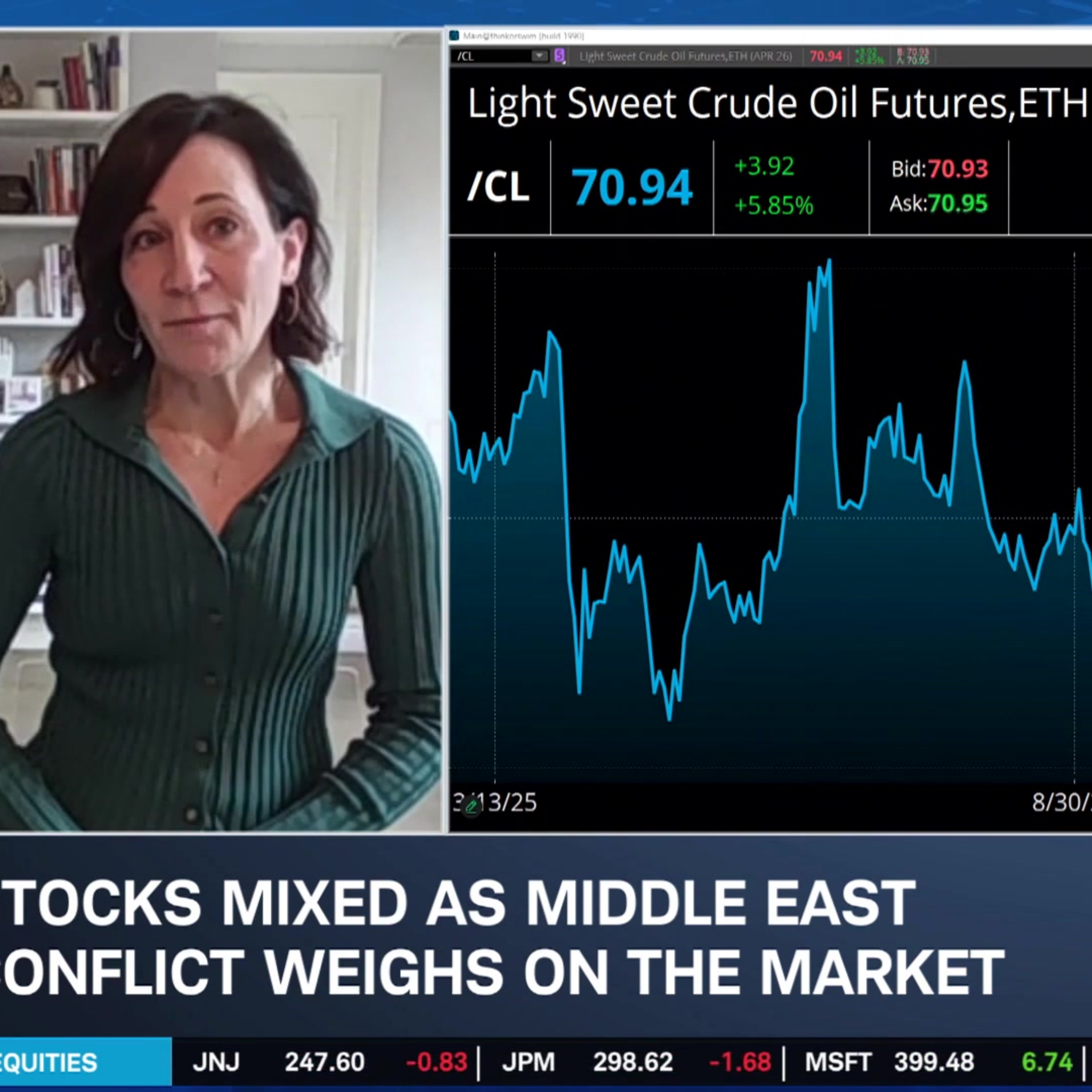
Michelle Brouhard explains what’s at stake for energy markets as Middle East tensions rise. “Right now the movement in the Strait [of Hormuz] is a trickle,” she says, with two ships already sunk as Iran tries to close the Strait. If the campaign lasts several weeks, as Trump has hinted, it could have significant impacts on European and Asian energy supplies. Michelle says this looks like the “Arab Spring” trade, taking a look at oil’s moves during other major disruptions.
======== Schwab Network ========
Empowering every investor and trader, every market day.
Options involve risks and are not suitable for all investors. Before trading, read the Options Disclosure Document. http://bit.ly/2v9tH6D
Subscribe to the Market Minute newsletter - https://schwabnetwork.com/subscribe
Download the iOS app - https://apps.apple.com/us/app/schwab-network/id1460719185
Download the Amazon Fire Tv App - https://www.amazon.com/TD-Ameritrade-Network/dp/B07KRD76C7
Watch on Sling - https://watch.sling.com/1/asset/191928615bd8d47686f94682aefaa007/watch
Watch on Vizio - https://www.vizio.com/en/watchfreeplus-explore
Watch on DistroTV - https://www.distro.tv/live/schwab-network/
Follow us on X – https://twitter.com/schwabnetwork
Follow us on Facebook – https://www.facebook.com/schwabnetwork
Follow us on LinkedIn - https://www.linkedin.com/company/schwab-network/
About Schwab Network - https://schwabnetwork.com/about
Get every episode summarized
Each time Schwab Network publishes, we email you a written briefing from the transcript — the topics, who appeared, and any specific claims, with the ad reads skipped.
Email me new episodesFree for 3 shows. No card needed.
Transcript ready
72 searchable segments. Every word is indexed and playable.
Full transcript
Schwab Network — Energy Crisis Looms if Iran Campaign Drags On. Machine-transcribed; use the interactive transcript above to jump the player to any line.
So, joining us now to break down what's at stake for energy markets and the global economy is Michelle Brohard, Geopolitical Analyst at Helplur. So, thanks so much for being with us, Michelle. Of course, really great time to discuss everything we heard over the weekend. What do you see as right now being the most significant risk from the ongoing situation in the Middle East? The significant risk is that the flows out of the Middle Eastern countries, like Iraq, UAE, Saudi, Kuwait, won't be able to get out of the strait. So, right now the movement in the strait is just a trickle. So, ships are barely going in and out. There was a note that said, the Iraqi, if you have an Iraqi flag, you can move out of the strait. So, most of the ships are backing up inside of the Gulf and not able to go around. We've already had two sunk ships. We've had one that was carrying gasoline and one recently today that was carrying we think bitumen, but we're not entirely sure. We're still double checking that. But the risk is that these
countries won't be able to export their crude. Their storage will fill up and they'll have to start cutting production. There's also, there's already been reports that Iraq's storage is getting near its top and it may have to start cutting production pretty soon. Okay, so for my understanding, this is also like a taking time bomb. Like the longer that we see that this goes on, the worse obviously gets the more impacts I mean global supply chains. And so, what do you see really as like the time frame in which we could be more immune from some of the broad sweeping risks? Or is that even an impossibility? Because I know that again, longer this goes on the worst the situation gets. Yeah, Bill, I think at the first week thought on Saturday, we thought this was going to be a week long campaign. It sounds like from the president's comments, this is going to last a little longer. He said four to five weeks now. Four to five weeks without flows out of the out of the Gulf will be a significant problem. There's no way to replace that much oil and oil products leaving leaving the Gulf. Europe gets almost 40% of their jet fuel from the Middle East
for fineries. That's a lot that's a pro that's going to be a problem for Europe. Asia gets almost 50% of their oil from the Middle Eastern countries. Also, that could seriously constrain some of the Asian countries as well. Okay, and you have mentioned that Iran's options are constrained. What really does retaliation realistically look like, though, if they want to leverage without seeing the mean strategic blowback at a huge scale? Iran is fighting for its life. The regime is fighting and they are backed into a corner. I think for them, all options are on the table. The biggest bang they have is to hit oil infrastructure and to create such a pain point for the global economy to get oil prices to spike. That's how they can get Trump to back off. We already know that the Middle Eastern countries, the neighboring countries around Iran are already trying to work to de-escalate. It sounds like Trump in Israel, though, is going in full force, and they don't have any plans to stop anytime soon. But Iran's options are
the biggest bang that they can get is to really impact energy infrastructure in the region. And oftentimes we do see, I mean, markets sell, I mean, like the spike on some of these geopolitical risks, but we know that that playbook does not guarantee it first and foremost, and also may fail the physical disruption, as you're really mentioning, is so real. And so, what would confirm that we're in this more new regime where, say, like, risk repeating becomes more structural? You know, that's such a great question. I traded commodities for a very long time, and the playbook always was when the bombs fall, that's when you sell. And it has been that way, really, even the political spike that happened in 2013 on the Obama Syria Red Line was a selling. And that was really the first time we started to see these geopolitical risks spikes get sold aggressively when the news would come out. Now, the playbook looks different. It looks a little bit more like the Arab Spring playbook, where we have real barrels that were disrupted. And we're
talking about 2011. We didn't have shale back then. But when barrels got disrupted, you really in Libya, we would have the Red Sea barrels disrupted. So you really had a lot of disrupted oil, which is similar to what we have now. We have actual oil disruptions from the Middle East, where you can't get crude out of the region. Okay. And so, I mean, bottom line here, and I think it's important that you have to sort of divide the way that you, of course, feel against, like, you know, your own personal beliefs, and also just the fact that there's obviously a major human component that's being disrupted in the Middle East, which I do not want to discount at all. But in terms of like the way the markets think about these things, I mean, if you're a policymaker or a risk manager, what do you believe one of the most important hedges or contingency actions that you would take and say the next, do you have several days or next week? Well, I don't know about, as a risk manager, I don't think you can be sure. I don't think you can be sure until you have an idea of how these
barrels are going to make it to the marketplace. I think it would be very hard to sell the spike. When we came into the, when we came into today, today's Monday, yes, when we came into today, the option was very, very long calls, $80 calls, $85 calls. We got up there, you could see a wall of selling. The wall of selling, most likely, where some of those, some of the delta, some of the delta owned the calls getting sold, it was probably a lot of producers. So the US, the US oil producer and the Canadian oil producer hedge their oil prices when we get these spikes. So, there's a wall of selling happening at $80. I don't know if we're going to continue to see that as this continues to progress on as we go along. I think that as a risk manager, you would, you would definitely want to make sure you don't sell into this until you know that the disruption is, is not, is only going to last a couple days. I suspect the disruption will last much longer than we expect. I would say it would probably last two weeks. That's a long time to not have
Middle Eastern oil. No, absolutely. And I think a good, I think, warning, and I think also a good acknowledgement of like the fact that we're still highly uncertain at this point. I could not agree more even from following the news is closely, as I'm sure we both have, but really appreciate your time today, helping us break down. I mean, what's going to be an ongoing situation, of course, in the Middle East, Michelle Brohardt, G-Platta Analyst at Kepler.
More episodes
More from Schwab Network

Stock Market Today: ORCL & ADBE Earnings, AEO Plunges Near 52-Week Low
Schwab Network

Thursday's Final Takeaways: Crude Taps $103 & PPI Hotter than Expected
Schwab Network

Balancing High-Conviction AI With High-Dividend Diversification
Schwab Network

EARNINGS PANEL: ORCL, ADBE
Schwab Network