About this episode
Best Self-improvement Motivation
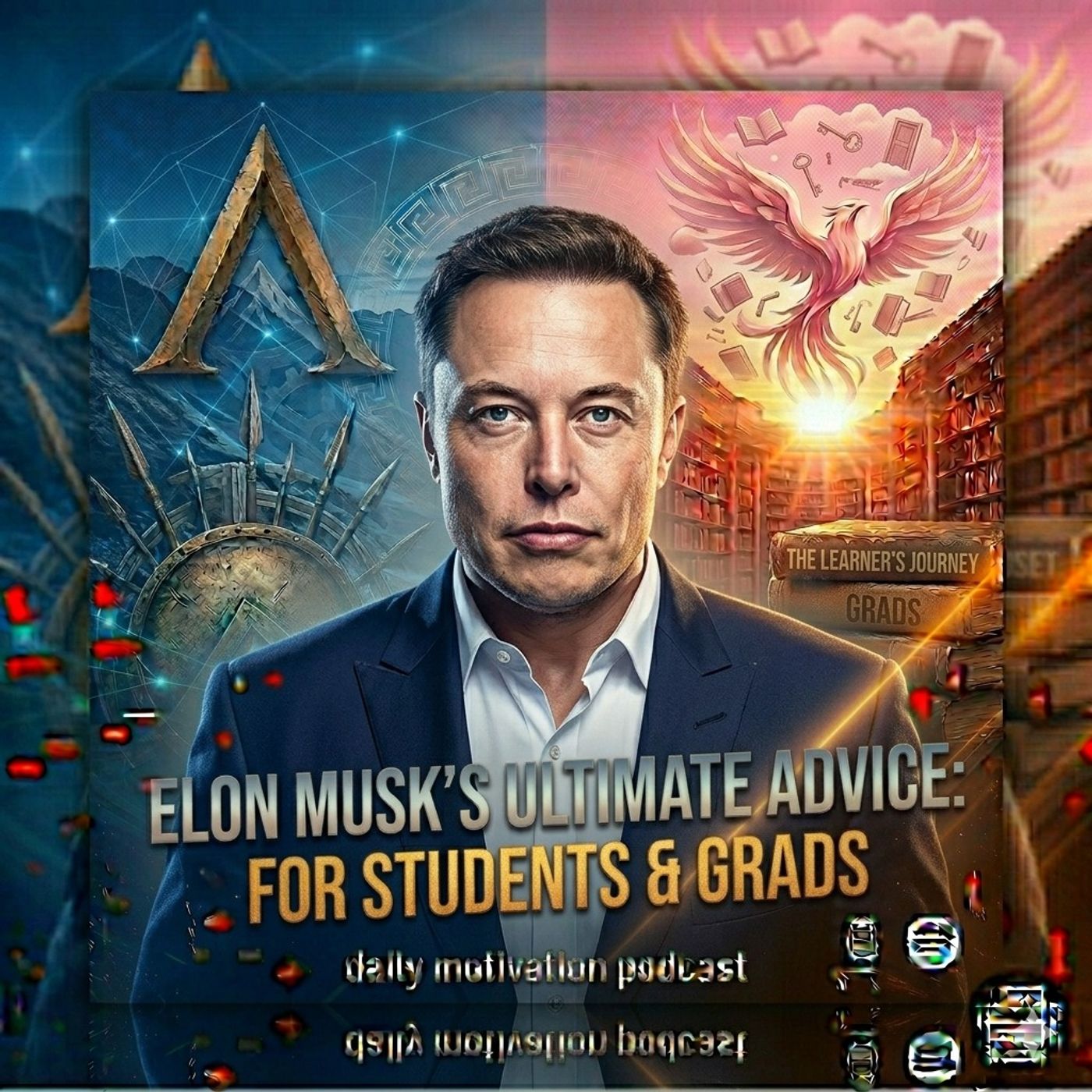
Elon Musk’s Ultimate Advice for Students & Grads
Get inspired by Elon Musk’s powerful advice for students and graduates. Learn how to think big, stay driven, and build a successful future.
We Need Your Love & Support ❤️
Get 3 Audiobooks Free - 👍
👉 How to Boost Your Productivity (audiobooks)
Listen To The Ultimate Life-Changing, Self-Improvement & Self-Development Motivational Audiobooks For Free:
The Subtle Art of Not Giving a F*ck👈
Think Like a Monk by Jay Shetty👈
You Are a Badass by Jen Sincero👈
All The Light We Cannot See by Anthony Doerr👈
How to Win Friends and Influence People by Dale Carnegie👈
Attention Span: Finding Focus for a Fulfilling Life by Gloria Mark👈
A Promised Land by Barack Obama👈
#Motivational_Speech
#motivation #inspirational_quotes #motivationalspeech
👉Best Audiobooks for You - 👍
Hosted by Simplecast, an AdsWizz company. See pcm.adswizz.com for information about our collection and use of personal data for advertising.
Get every episode summarized
Each time Motivational Speeches publishes, we email you a written briefing from the transcript — the topics, who appeared, and any specific claims, with the ad reads skipped.
Email me new episodesFree for 3 shows. No card needed.
Hosts & guests
Transcript ready
143 searchable segments. Every word is indexed and playable.
Full transcript
Motivational Speeches — Elon Musk’s Ultimate Advice for Students & Grads. Machine-transcribed; use the interactive transcript above to jump the player to any line.
You don't need college to learn it, learn stuff. Everything is available basically for free. You can learn anything you want for free. It is not a question of learning. There is a value that colleges have which is like, you know, seeing whether somebody's, it's can somebody work hard at something, including a bunch of sort of annoying homework assignments and still do their homework assignments. And kind of soldier through and get it done. That's like the main value of college. And then also, you know, if you probably want to hang around with a bunch of people your own age for a while, instead of going right into the workforce. So I think colleges are basically for fun and to prove you can do your chores. But they're not for learning. How did the Wharton degree help? I think a business degree teaches you a lot of the terminology.
It introduces you to concepts that you would otherwise, you know, this terminology is something to be said for that. It introduces you to concepts you would otherwise have to learn empirically. I mean, I think you can learn whatever you need to do to start a successful business, either in school or out of school. School, you know, theory should help accelerate that process. And I think it, you know, at oftentimes it does. It can be an efficient learning process. Perhaps more efficient than in empirically learning lessons. But really, I think you, I mean, there are examples of except for those who never graduated high school. And there are those that have PhDs. So I think the important principle is to be dedicated to learning what you need to know, whether that is in school or empirically.
I want to make sure Tesla recruiting does not have anything that says requires university because that's absurd. But there is a requirement of evidence of exceptional ability. Like you just can't, if you try to do something exceptional, they must have evidence of exceptional ability. I don't consider going to college evidence of exceptional ability. In fact, ideally you dropped out of it something. I mean, obviously, you know, like, you know, Gates is a pretty smart guy, he dropped out. He drops pretty smart, he dropped out. You know, Larry Ellison, smart guy, he dropped out. Like, obviously not needed. Did Shakespeare even go to college? Probably not. One of the most common questions I hear young people ask
is, I want to be the next Elon Musk. How do I do that? Obviously, the next Elon Musk will work on very different things than you did. But what have you done or what did you do when you were younger that you think sort of set you up to have a big impact? Well, I think this one I should say that I do not expect to be involved in all these things. Whatever this thing is that you're trying to create, what would be the utility delta compared to the current state of the arts, times how many people it would affect? So that's why I think having something that has a, that has a, makes, makes a big difference, but affects a sort of small, moderate number of people. It's great. As is something that makes even a small difference, but it affects a vast number of people. Somebody is doing something that is useful to the rest of society. I think that's a good thing. Like, it doesn't have to change the world. Like, you know, if you're doing something that has high value to people, and frankly, even if it's something, if it's like just a little game,
or, you know, some improvement in photo sharing or something, if it, if it is a small amount of good for a large number of people, that's, I mean, I think that's fine. Like, stuff doesn't need to be changed the world just to be good. What advice do I have for college graduates interested in getting involved in the spheres you've tapped into? Well, certainly, I don't write you to apply for a job at a sort of city or Tesla or SpaceX. And if not, then, if that doesn't work for whatever reason, I guess apply to jobs at other companies in that arena or try starting a company. Although, I have to say that in the space business, it's quite, it's quite hard to start a company in the space business because it's such a capital-intensive business. So it may be better to do something in solar power.
Or if you're going to do it in cars, do it in as kind of a component supplier of cars, something like that. I studied physics and business because I figured in order to do a lot of these things, you need to know how the universe works and you need to know how the economy works. And you also need to be able to bring a lot of people together to work with you to create something because it's very difficult to do something as individual if it's a significant technology. I originally came out to California to try to figure out how to improve the energy density of electric vehicles basically to try to figure out if there was an advanced capacitor that could serve as an alternative to batteries. And that was in 95. And that's also when the internet started to happen. And I thought, well, I can either pursue this technology
where success may not be one of the possible outcomes, which is always tricky. Or participate in the internet and be part of it. So I decided to drop out. I think also people tend to overweight risk on a personal level. It's one thing if you've got a mortgage to pay and kids to support and that if you do it or deviate from your job, that's how you're going to feed your family and pay the rents. Okay, that's understandable. But let's say you're young and you're just coming out of college or coming out of high school, whatever. What do you risk? You're not going to stop. It's really not in any kind of modern economy. It's so easy to earn enough money just to live somewhere and eat food. Very easy to do. So I don't know what they're afraid of. They're mostly afraid of failure, I think. But people should be less risk of us when there's not much at risk.
Don't just follow the trend. You may have heard me say that it's good to think in terms of the physics approach or first principles, which is rather than reasoning by analogy, you boil things down to the most fundamental truths you can imagine and you reason up from there. And this is a good way to figure out if something really makes sense or if it's just what everybody else is doing. It's hard to think that way. Think that way about everything takes a lot of effort. But if you're trying to do something new, it's the best way to think. And that framework was developed by physicists to figure out counterintuitive things like quantum mechanics. So it's really a powerful method. Now is the time to take risk. You don't have kids as you get older, your obligations increase. And once you have a family, you start taking risks not just for yourself but for your family as well. It gets much harder to do things that might not work out. So now is the time to do that before you have those obligations.
So I would encourage you to take risks now, do something bold. You are regretted. Thank you.
More episodes
More from Motivational Speeches

The Mindset Shift That Will Help You Close More Deals | Dan Lok
Motivational Speeches

The Value of Time: How to Charge What You’re Worth | Dan Lok
Motivational Speeches

The Time I Went on the U-I Talk Show | Dan Lok
Motivational Speeches

The Three Most Powerful Words You Can Use When Selling
Motivational Speeches