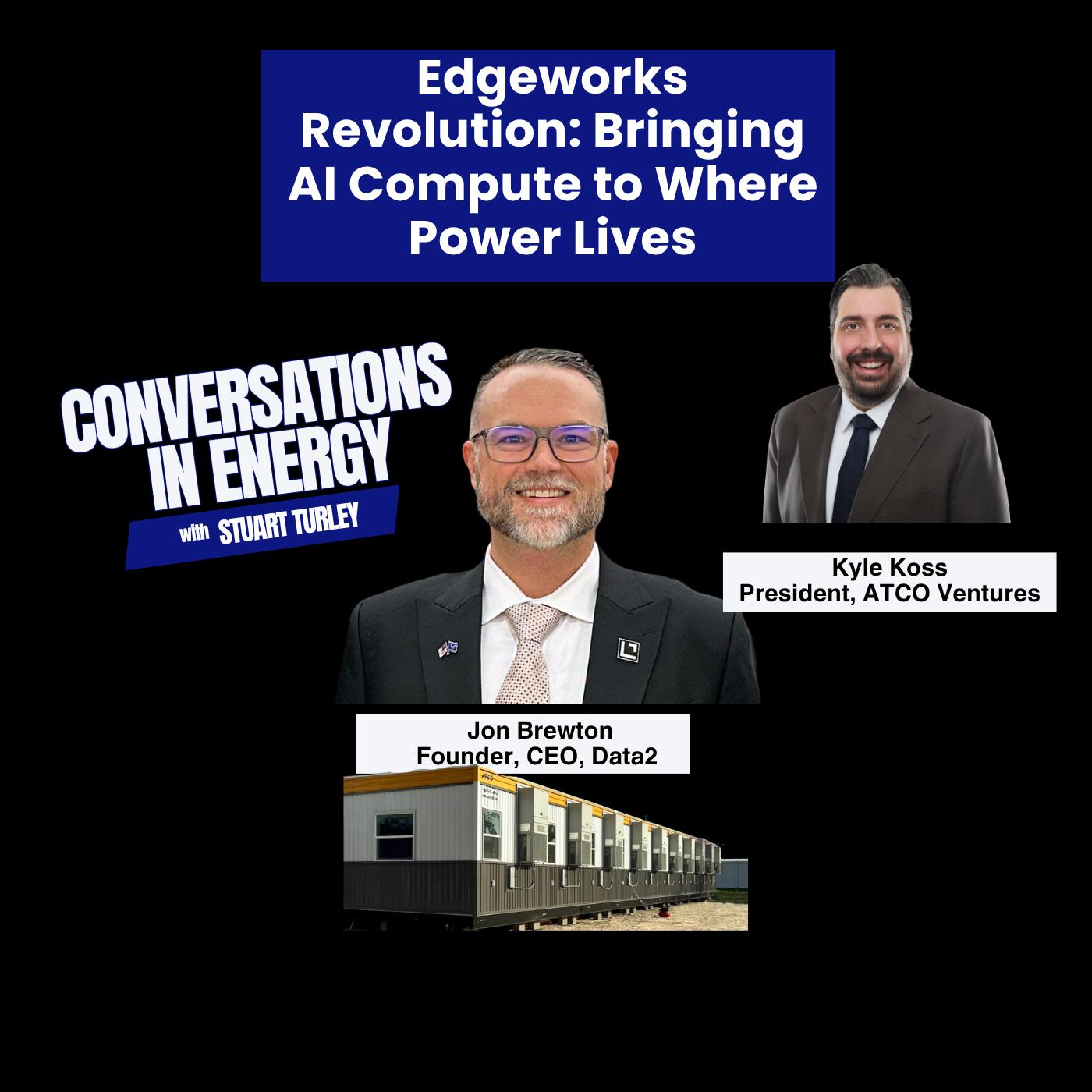
Edgeworks Revolution: Bringing AI Compute to Where Power Lives
About this episode
In this episode of the Energy News Beat Podcast, host Stu Turley sits down with Jon Brewton, CEO and Founder of Data2, and Kyle Koss, President of ATCO Ventures, to explore a critical challenge facing the AI revolution: infrastructure. As artificial intelligence demand skyrockets—with projections suggesting a 5,000% increase in compute requirements over the next five years—traditional mega data centers are hitting a wall.
The solution? ATCO Edgeworks, a groundbreaking modular edge computing platform that brings AI infrastructure closer to power sources rather than centralizing it in massive facilities. This conversation delves into how distributed, modular data centers can democratize AI access for mid-sized companies, solve environmental and community concerns, and create a more resilient computing landscape.
With insights into explainable AI, military applications, and real-world use cases from the energy sector, this episode reveals why the future of AI infrastructure isn't about building bigger—it's about building smarter and closer to home.
Connect with Kyle on his LinkedIn: https://www.linkedin.com/in/kyle-koss-3bbb1927/
Check out ATCO here: https://www.atco.com/en-ca.html
Connect with Jon on his LinkedIn: https://www.linkedin.com/in/jon-brewton-datasquared/
Data 2 website: https://www.data2.ai/
1. Distributed Edge Computing InfrastructureThe core focus is on ATCO Edgeworks, a modular data center solution designed to bring compute closer to power sources rather than centralizing it. This addresses the massive infrastructure bottleneck created by AI demand, which requires enormous capital investments and long lead times (3-5 years) for traditional mega data centers.
2. AI Infrastructure Bottleneck & Power ConstraintsThe guests discuss how AI demand is exploding exponentially, with Goldman Sachs projecting a 5,000% increase in compute demand over the next half decade. The challenge isn't just computing power—it's the massive power requirements, capital commitments, and infrastructure constraints that only a handful of mega-companies can afford.
3. Democratizing AI AccessA key theme is making AI infrastructure accessible to mid-tier companies (the "mom and pop" oil and gas operators) who can't afford billion-dollar data center commitments. Edgeworks enables smaller organizations to deploy AI capabilities without massive upfront capital or 15-20 year power contracts.
4. Environmental & Community Impact (NIMBY Solutions)The discussion addresses concerns about data centers' environmental footprint—water usage, cooling requirements, power grid strain, and community opposition. Modular edge computing reduces these impacts by distributing load across smaller, localized units rather than massive centralized facilities.
5. Data2's Explainable AI & Trust LayerJon Brewton emphasizes the importance of AI validation and explainability. His company Data2 has patented technology that adds a "trust layer" to AI systems, making decisions auditable and trustworthy. They cite a real example where their platform discovered $98 million in hidden fraud risk.
6. Military & Defense ApplicationsThe guests discuss edge compute's critical role in defense—portable, distributed systems that can be deployed in the field, reducing vulnerability from centralized targets and enabling real-time AI decision-making for warfighters.
7. Flexible, Modular Design BenefitsThe Edgeworks solution is built entirely on modular architecture (hardware and software), allowing customers to:
- Scale up or down based on demand
- Use existing power sources (natural gas, solar, flared gas)
- Avoid single points of failure
- Reduce unnecessary data movement
Examples discussed include:
- Oil and gas companies monetizing flared natural gas to power compute
- Bitcoin mining operations pivoting to AI workloads
- Industrial sites leveraging existing infrastructure for edge compute
- Military deployment scenarios
The guests argue this is the right moment for distributed edge computing because: AI demand is rising exponentially, power availability is constrained, and capital requirements for centralized infrastructure are prohibitive. This creates market demand for alternative architectures.
10. Data Sovereignty & SecurityPartnerships with encryption providers (like XQ) ensure quantum-encrypted, zero-trust security—critical for government and military applications, and for protecting sensitive data in distributed environments.
The overarching narrative: Traditional mega data centers are hitting infrastructure limits. Edgeworks offers a paradigm shift by bringing compute to where power exists, enabling broader participation in AI, reducing environmental impact, and creating a more resilient, distributed compute market.
At Energy News Beat, we Make Appendices Great Again.Check out the World's Greatest Podcast Show Notes at EnergyNewsBeat.co or EnergyNewsBeat.com, and the Energy News Beat Substack at: https://theenergynewsbeat.substack.com/
A shout-out to Steve Reese and the Reese Energy Consulting group for sponsoring the Podcast https://reeseenergyconsulting.com/.
Data2 if you have any business systems, can you trust A? Well, they have the patent on validation. . https://data2.zoholandingpage.com/energy
And we have WellDatabase rolling, and we use their tools for the Energy News Beat weekly Rig Reports: https://welldatabase.com/
Also entering Sponsor Rey Trevino, Pecos Operating https://pecos.energy/
Get every episode summarized
Each time Energy News Beat Podcast publishes, we email you a written briefing from the transcript — the topics, who appeared, and any specific claims, with the ad reads skipped.
Email me new episodesFree for 3 shows. No card needed.
Hosts & guests
Transcript ready
589 searchable segments. Every word is indexed and playable.
Full transcript
Energy News Beat Podcast — Edgeworks Revolution: Bringing AI Compute to Where Power Lives. Machine-transcribed; use the interactive transcript above to jump the player to any line.
Hello everybody, welcome to the Energy Newsbeat podcast. My name is to turn really I've got a gigantic episode for you today. If you want to know how are we going to build data centers and we're going to have all the AI we need, I think I got the solution. I've got John Bruton. He's a founder and CEO of Data Squared and he is fresh from his Canadian trip. Where are you sir? Doing great, doing great, looking forward to the combo today. I'll tell you what, this is an absolutely exciting idea. If you can't, I'm one of your biggest cheerleaders out there and I absolutely love the fact you've got the patent on data because there ain't no AI without accountability and you've got the patent on that. That's right. Alright, we also have on the panel today we've got Kyle Koss and we've had a nice chat right before the show and you're the president of Atco Ventures out of Canada and holy smokes.
What an outfit you got. Thank you. Yeah, I'm really looking forward to the discussion today and John's been a great partner with us and so I'm really thinking that we're going to get in some deep good conversation here. Well guys, tell me how the show went in Canada because there's a lot of negative news about Canada right now in the headlines and I want to give a shout out to all my snow Texan friends up in Calgary. I love you guys. I don't care what the press says. I love all my snow Texans. So anyway, how did your Canada show go? I think things went fantastic. I mean, we partnered with Atco and a couple of other technology partners that we have in the Canadian market very specifically with Edgeworks to bring that to that conference and to tell the story about how we can sort of democratize compute and really help people take advantage of explainable, secure, sovereign AI in a really novel and important way. And I think that forum gave us a great opportunity to tell that story both in a tangible way
and an intangible way. We can tell that story but we also had a box on location to show people, to walk people through, to show them demonstrations through to really personalize that experience to what they can expect whenever they're an Edgeworks customer and a customer of data squared. So I think it was fantastic. Are you saying a portable data center? I am. Kyle can tell you a little bit about it. Kyle, what did you think about what we did at the Albert Energy Show? Yeah, I mean, I think I appreciate the shout out to the Texas of the North. Calgary is a wonderful city of Erda's and wonderful province. I think, you know, ultimately what we were able to showcase at the event at the Global Energy Show was, you know, fundamentally the future of how I think data is going to be processed in a safe and secure environment with a more elastified approach so that, you
know, we don't have these kind of single points of failure and that's really what we're driving towards for multiple use case applications with the Edge Edgeworks module. So you're from what we're describing here, the biggest problem that we're seeing is we've got, like, let's take speaking of Texas, Texas just put a pause on their data centers and they have 1800 requests for a data centers in Texas and 20% of those are natural gas. So powering data centers is a real problem. Then we have Nimbis not in my backyard going, I don't want no stinkin, you know, hey, we don't want no badges and we don't want no stinkin data centers in our backyard. And it sounds like you've got pre-made data centers that you can put in smaller locations faster and easier to power, which means a caterpillar engine would get these things going.
Is that a fair assessment? That's exactly right. It is. Kyle, please go ahead and give me a little one. I would say that's exactly right. I mean, we were looking at this landscape stew as being, you know, there's a real conference of power and technology that kind of creates what a data center is. And as a result of that, you've got a big draw on the system. And at Coal, you know, one of our core businesses is utilities. So we understood very early on that these things would take a lot of power and they'd be very difficult to connect and they, you know, they would create, you know, strains on the system and not in my backyard argument is a very fair argument. And they're loud. You know, they can create temperature changes. So all of those things led us to where we're going with this, which is a much lower powered
version that can be multi-nodal and kind of strung together to meet the requirement closer to the consumer, of course, but also it allows the hyperscalers to get up to speed faster and start to process data, you know, without all of these long lead times that we're seeing in the data center environments. I mean, you talk about the transformers, you're looking at, you know, three to five year lead times on some of that equipment. And by the time you get that up and running, your technology cycle has far surpassed your build time. So you might be building yesterday's product or for yesterday's product today. And we're seeing that if you do this in a modular form factor, you can keep up with that pace of change. Yeah. I worry your question. You might have had, I don't want to add something to this because I think it kind of
speaks to the other side of this equation, what cow cover is really, really important, but it's the AI piece of this entire puzzle, just in a general sense is driving the demand in the overall constraints, right? So compute demand is exploding, not because we just generically need more compute. It's very, or sorry, power. We just need more compute and power to satisfy the scale associated to AI workflows being deployed holistically around the nation, right? And we start to look at that. Goldman had a report that came out recently that said tokenization of the overall compute demand could increase by roughly 5,000 percent over the next half decade, which means that our power constraints would increase equally as we start to look at that demand. We're already sort of at capacity. And so AI may be the software that people talk about, but AI at scale is increasingly an infrastructure business. It's a problem created within that context. And so like a lot of companies, the company's capable of building these large AI systems
today increasingly have something that most businesses don't. They have enormous balance sheets. They have access to large quantities of power. They have the ability to assign decades or two decades plus infrastructure commitments. And they just have billions of dollars available for data structure or data center construction. That's really only viable for a certain number of players. And so we started talking about AI as a scaled capacity that actually starts to build competitive nature for everyone. Well, if you don't have access to the compute, then you're kind of left sitting on the sidelines and the ability to really focus on putting power and your capacity from a commute perspective where you need it, when you need it, and what you need it for really speaks to me as a person who works in the AI business. If we're going to democratize AI's real capacity and drive that competitive advantage equally into the market, people need access to things like edge works to do that effectively. And if we don't have access to that, we really reduce the pool of competitive advantage
down to only the people that have the money to do it and spend it. And so that really takes out a large part of the market. And that's the beauty of what I think edge works really brings to the market. It brings competitive balance to the market. And it starts to drive these factors of scale and competitive advantage down to the lowest common denominator. And there's a real beauty in that when we start talking about what we can do with AI. What you're describing is freeing up data centers to go where the power is. That's right. Instead of having to do what Bloomberg last year wrote an article and they had consumers got a 200% increase on their bills because the government data centers had to put in extra feeds. And there's a lot of people that are all grumpy about getting extra lines to there to supply a data center that's already existing. But you all of a sudden have it free by being a data center on the edge can go where the
power is. Change it's a paradigm shift. Yeah, I think it is. Yeah, I think to your points to and to John's point, I'll talk about the AI for a second because that's a huge component of why we have this kind of starvation happening in the compute sector. I mean, because it's where we're at least companies are really require a ton of data processing. And at the end of the day, the democratization of this, the ability for us to create models that aren't, you know, one single point of failure is truly what I think, you know, the future is in terms of, you know, our ability to actually keep up with the pace of change from an AI perspective because it just we, you have to remember to, you know, in Texas, for instance, it's a, it's an isolated grid. It's a balanced grid. And when you're pulling off, you know, even 150 megawatts are putting on 150 megawatts,
that creates imbalances in the system, which can create problems for the consumer. And we don't want, we want to be able to be this sort of player in the game that allows for things to happen, but doesn't have a detrimental effect to the, the ultimate customer of the utilities. This is really cool. And John, when you're sitting back and looking at the customers that were up in Canada, and that who are you talking or who's reaching out to you saying, hey, I, I, I need something going now because the number one problem with AI right now is data centers is you can't afford to wait three years to sit there and look at your balance sheet as a CEO. And I've got an application I'm trying to put in. I'm going, how fast can I get something running to prove to my investors that it works? Is that a fair assessment as well? Yeah, I think so. And I think from an energy industry perspective, like we can really put it into the context of we have these very large players in the energy industry a couple of years to work for
BP, Chevron, X on Shell, you know, the sort of super majors, these very large organizations. And they have a ton of competitive advantage just because of the actual capital that they can deploy within this context. But there are 600 or 1000, called mom and pop, size, oil and gas companies and operators that really operate in sort of the middle of this entire stack, right? And these are people that really operate on the margins and have to sort of operate with competitive advantage to continue to grow and scale their companies. When you talk to these and industry people about AI and how they can apply it, it really comes down to like how can we get access and incredible and really sort of capital sensitive way to compute because we're stuck in this whole situation right now where if we want to compete in this market, well, we have to have a ton of liquidity. We have to have capacity to deploy it. We have to take risk sort of real risk in deploying that capital because that becomes trapped working capital because if we have a five to seven year deployment cycle,
development deployment cycle, well, now we've really taken our liquidity out of the sort of picture and now we can't grow our businesses. So how can we sort of really work within this context so that we can build competitive and manage through these tools, continue to grow our business in a smart way? And that's where I think a lot of the conversation's said. It's what those sort of middle tier companies that are trying to find out how to use AI in a smart way but how to get access to compute in a way that's cost effective, doesn't require them to sort of leverage the entire their future or their business and ultimately create some competitive advantage for them in the short term. I think that's about at the end of the day, really right sizing the capital investment for what you need at that point in time. And so if you can understand what you need in the moment, we can facilitate providing that with Edgeworks in a very smart and cost effective way. We can tie into your existing power assets. We can tie into your standard gas if you have it. We can tie into your solar if you have it. When you start to power these assets, reducing your overall cost profile associated to that.
We're not talking about a $10 billion capital commitment. We're talking about millions of dollars in terms of capital commitment to get access to enterprise grade, scale and compute. So that's right sizing the investment. I think second is really shortening that economic commitment, right? If you start a little look at some of these power demands and some of the data center requirements, these are 15 to 20 year infrastructure requirements. I have people deciding 15 to 20 year contracts. Do you know a mom and pop business that is going to leverage the future of their business on a 15 to 20 year power commitment without great certainty that there's payback at the end of that? There's a handful of companies that can do that. Just a handful. And so I'm going to look past 15 minutes. I'm just now being all the same. I'm good. How could you? Right? And so third is really, I think a point where how do we increase hardware flexibility? There's this whole infrastructure capital commitment associated with a hardware associated with really building AI systems in a smart way.
The thing it really spoke to me about Edgeworks is it's deliberately designed so that that compute layer can come from different sources. The customers can start to provide some access to what they have. We can tie into their existing hyperscaler infrastructure. We can exploit actual infrastructure into the boxes. And we start to create this mesh network effect around how they operate and how we can do that in the most capital effective way. That increases flexibility. And so if we can put the power and the compute close to where the economics makes sense, we can reduce unnecessary data movement. And that brings intelligence and data into the field in the right ways, at the right times and the right places, and really starts to drive the value proposition for people that need it. And so that's really where I think the value proposition comes into the network. Kyle, when you were sitting there as a CEO looking at this thing going, I see a problem and I got a solution. When did that epiphany hit you? You know, I always wanted to try to, I knew what Akhil was good at.
You know, I knew that we're, you know, a very, very capable modular builder. We've got worldwide scale in our manufacturing. And I knew that there was a future that was going to require that modular form factor to be utilized for technology and for data processing. And so, you know, that's kind of how it struck me was, if I knew that I could build a good box, then I knew that, and I was familiar with the power systems. If I had the right technology stack and the right software stack, I could really make a game changing play for, like John said, some of these players that might not have access to, you know, billions of dollars to build out data centers, but also, you know, in a way, you want to avoid these single points of failure, right? Like so, that's a huge thing in these lastified systems.
And that comes in its nature by sort of a multi-noded approach that can be sort of created through modular design. And so, every bit, and I say this a lot, every bit of the exact, wedged solution is built on a modular form factor. It doesn't matter if it's a software stack or if it's hardware stack, everything is built modularly. So, we can really meet the requirement of the customer. And if I can pile on to what John was saying a little bit, it's, we know that AI is changing the world. You know, that's something I think is very apparent stew for all of us. And how do we create and design systems where we can limit or do away with the, you know, the negatives within AI, so the hallucinations and all these things that we,
that kind of are holding us back. And then how do we also, in that technology stack, have that, but then put that closer to the customer so that they can action, you know, those, that new data set for their business appropriately, which will create the competitive advantage that they're looking for, right? So those are a couple of things that I would say, but yeah. We've got about 16 more questions here. And one of the first ones in my NIMBY question that I've got for you is water. In a modular solution, when you sit back in the number one problem with people, and by the way, I think most of the people that are protesting data centers are funded by NGOs. So that's just my personal opinion. I don't think they're actually NIMBYs. I think that they're paid actors out there going, we don't want data centers. And anyway, that's just personal opinion. But I don't think data centers need to go on farmland. I think data centers need to go into areas that aren't going to be using a lot of water.
Are you guys seeing a good cooling solution that reduces the amount of water in your well insulated box? I haven't seen your box yet. And I hope that I get to spend the night in one like I have in my well filled in the past. But I'm just saying, you know, is that anything? Any discussion that your clients are going to have? Because the NIMBYs are going to sit there and go, that's a data center. And here's your nice transportable box, so to speak. And then it's a, where's the water? Yeah. Yeah, look, Kyle, you can definitely answer this question with a lot more precision and detailed, but at super high level. I think the system, if we're talking about democratizing this in a really smart and effective way, has to demonstrate that the power can be reduced, the overall cooling can be reduced, the networking can be reduced, the securities increased and at scale capacity. And the monitoring works and the AI workloads can be facilitated at the edge.
Like holistically, we have to do that. And so that counts on the power side, the cooling side, the overall costing of these solutions. And so I think we have smart answers for all those. But at the end of the day, this is about reducing burdens and increasing capacity at the edge holistically. Sorry, Kyle. No, no, no, no, I think John, you're absolutely right. I think, you know, I would go back to a previous comment, which is these large data centers require a centralization of so many resources. And so, you know, when you're talking about water, when you're talking about electricity, you're talking about cooling. And the reason that they at scale need that much water is because, and of course, like there's closed loop systems for water. So I'm not going to take anything away from, you know, the water cooling infrastructure because I think, you know, there is ways to do it that can be, I mean, we use water in power generation all the time. And we have to cool that water
back down to the ambient temperature of the river or the water system that we're taking it out of for the turbines and make sure that, you know, environmental impact is, you know, nil. So that, you know, because even one degree of water change in temperature, all of these things can affect the ecosystem. So this is not, this is not a problem that we're totally not used to. I think it's a problem that's existed for a long time. And, but the difference is, if you can make this sort of modular in nature, well, you can scale up for the technology and you can scale up for the amount of water usage that you want to use. And in some cases, because it's a smaller form factor, you know, you use traditional AC and HVAC units to cool the, the compute and you don't have to pull water into the system. It's just, you know, so there's a lot of advantages there.
And ultimately, I do think I rest on this thing, which is all of this is coming whether we like it or not. And we need to find ways to do it that, you know, reduces the environmental impact. I'm a huge proponent of reducing environmental impact and making sure that, you know, like I said at the beginning of the conversation, we're not affecting the end customer from a utility perspective. That's just as important because people want to be able to turn their lights on. And I can tell you like in Alberta, if we're having brown oats and black oats in the middle of the winter, due to the fact that we've either overloaded the system or we're growing too much power, you know, that can create a life and death situation for people. And really, we want to steer clear of, you know, having to create those situations by democratizing this and by creating edge-based networks that allow the compute to be closer to where it's needed.
Yeah, I just want to add to that, like there's this whole question around how we're going to build these systems around the infrastructure that we're putting in place and not a conversation around how we can move compute infrastructure towards the power source itself or the source of the activities. And so for decades, we've built power systems around where that industry existed. And AI is going to require us, increasingly require us to think about moving compute towards available power sources so that we can disaggregate that demand and we can do this in a smart and conscientious way. Mega data centers dramatically restrict where infrastructure can be built and because of their power and water requirements being so enormous, the overall toll that it takes on the communities where they sit. If we can take a smaller module infrastructure approach to how we create sustainable, broader, and networked information together, we can start to really lessen that burden holistically. And I think that changes the dynamics of how these people see this as a problem
and more of an upgrade and how we can think about how we can use the utilities infrastructure as it exists today in a smarter and more effective way. I think that changes the overall conversation as far as one of the things that drew me the most to this whenever Kyle and I initially talked about it. It's like, cool. This is not only a need, this is a thing that is a social benefit. It really is something that creates network to benefit across the value chains for both AI and power systems. So that's really unique being able to sort of touch both sides of that equation simultaneously. My house in Abelene is only a couple miles away from Stargate and that is an amazing process seeing that gigantic monstrosity change Abelene Texas. Abelene used to be a sleepy little town and all of a sudden holy smoked Batman and you can't swing a dead cat without running into about 900 people. And it's like, oh man, the traffic is terrible and I looked at the tax assessor on my house and he's going, that's worth about $700,000 more. And I'm like, no, it's not.
So anyway, it's just the tax assessor is going, you got to pay for Stargate now. I'm like, no, I'm not going to put the bill for Stargate, but it is, it makes a gigantic difference. There's 3,000 trailers for the workers there. I'm like, this is nuts. I can see why the NEMBs are not real happy. And when you've got a solution that solves a NEMB's problem, suddenly you ought to like really take a look. You said on your website, you've got Mexico, you've got Canada and John, you're doing fantastic things all over the place. You're all over the place. You've got military contract, you've got government contracts. So where is it you guys are focusing on? Like Kyle, please. Yeah, I mean, I think the main way. So at AQUA, we've got, you know, pretty extensive international experience. And I think, you know, ultimately, Canada and the US are two of the markets that we really want to focus on right now.
You know, I think that there's an inherent need for infrastructure like this. And ultimately, like you said, we're trying to fix a problem that can be adopted by many as being the solution. Right? So it's, you know, we're really trying to take a new stance on how we actually solve this issue. And to John's point, we're trying to bring the compute out to the power source and not the other way around. And so, you know, we're really focusing on those two markets. But I think, you know, the world is a little bit our oyster in terms of being able to, you know, create these systems. And I really hope that, you know, as this grows, all the customers in the world can see that this is something that not only gets them up to scale faster, but it also reduces the cost. And it allows them to really take advantage of this new environment of data processing that we're
in. Like if you again, like just not to the labor of the point, but there's, there's, you know, we're in Alberta in North Dakota, South Dakota, where, you know, Texas, we're flaring natural gas in some cases so that we can, you know, extract the raw materials. And, you know, if we can instead of flare, I mean, you still give the opportunity to flare because that's an emergency, you know, it's a requirement. But if you can take some of that gas and you can turn that into something that's usable for those companies so that they can monetize, you know, the compute and they can make better decisions, that's phenomenal. I also think from a defense, you know, everybody's talking about defense now. And that's a total hot button issue, it doesn't matter where you are. World, but I think you create a large data center, it's unfortunate. You're creating a bit of a target.
Right. And so, oh yeah, you, you, you, you really, in order to defend ourselves properly, I think we also need to start to think about more elastified multi-notal systems that, that can, you know, can survive and doesn't, you know, paint a big target on itself because it's important. You know, the Tesla, hey, you got to love Elon because he has reached, he's changed business. Get your supply lines fixed and you and Etko have been able to do that. John, you're a software engineer extra ordinary. So you got a pretty good supply line on that one. But Tesla announced just recently that they are going to be looking at doing distributed computing, doing renting of your Tesla or shareback of your Tesla. And I'm going, hey, I love the concept. I'm not going to bet against Elon.
But that's about as dumb as it gets as far as my opinion goes because I don't want my Tesla being drained so the city can can use the power. That doesn't make any sense to me. But having distributed GPUs that are available to rent because it helps sell a solution, I'm all in, but I don't want my GPU or my battery being drained by the benefit of the city because the city is going to tax me and then I get to go nowhere. Yeah, this is a very interesting thing, right? I think it speaks to the overall need when we start looking at the economics that are play how fast we can develop this and what it means for our capacity to scale it. Every one of the people that you're, whether it's Jensen Wong, at Envidia, Elon or the heads of Anthropic or Chad Gbt, they all see the same problem. The problem is, regardless of how much money we throw into the system, we're limited by permits, land capacity and the ability to build these data centers in a meaningful and quick and effective way.
And water. And they're trying to find new ways to do it, whether it's putting installations on your home or in your car and this just speaks to the distributed compute narrative associated to how we can de-risk or at least monetize compute in a more effective and a minimal capacity so that we can start to network these assets together so we can create incremental scale. Now that all signs found in good, right? But do you really want your house turned into a data center or your car turned into a data center? I think it's neat and concept, but if you think people are worried about water demands on their land or having a truck run through their land, I think it would be really concerned about having a data center in their house or in their car. And so I struggle to see, I appreciate the idea, but I struggle to see the scale and capacity there because this is really limited to an individual's perspective on being sort of an advocate for something that doesn't uniquely benefit them directly. Right? And so that's a hard, that's a hard sell for me. My 4-150 is got a sell
up loading connection. It says it's going to update the next day. I'm like, I screwed. Yeah. And guess what? It drained the battery and it would not even start. It wouldn't allow me to jump it. It wouldn't do anything after it did an automatic update. Do you think I want a Tesla now after having that done to my brand new Ford? I'm a little bit irritated. No. Yeah. This is like not in my garage. We had that come up with that acronym. Yeah. Yeah. Now there's sort of a beauty to this, right? Because it speaks to the underlying value proposition that Edgeworks is bringing to the market, but it speaks to it in a way that allows us to say, we're trying to do this in a smart way. We're trying to do this in a way that actually generates real value for the people that are going to be using these things at scale and reduce the overall burden of power demands on the system and how that impacts consumers at scale. AI has a software inference, you know, sort of initiative, but underneath it, it's an infrastructure economy. So you can't need a hyper-scale as balance sheet
to meaningfully own your own AI capability. And so the AI bottleneck, and this is really what we're talking about at the end of the day, is like, what this is going to mean and why we're trying to build all this distributed and excess compute is to meet that demand. AI bottleneck isn't chips only. It's power, capital and access, and not every company needs hyper-scale data center capacity. They need the right amount of compute and the right place at the right time. And so Edgeworks isn't really trying to replace the cloud. It's really trying to give businesses another infrastructure choice. And the container itself is a vessel for that. The product is deployable, secure, edge compute infrastructure that creates competitive advantage for the people that use it. Are you looking at the real value? Sorry. I get excited because I've already thought about some new aspects of this. I could see because after watching this weekend, the race Formula 1 racing and the Marines airlifted one of the race cars and brought it in with a cool air, I mean,
that was a cool helicopter. Got the race car. I could see you, Kyle, putting one of your boxes for the military because all of a sudden here is a compute solid solution. You need AI at the front of the battlefield. Yeah. So that's a good point that you just hit that. Yeah, I mean, we're that's certainly a focus in our business. So so that'll be a better battle field deployment of edge compute is extremely important. Right? So, you know, and we want to with the help of John and the AI solutions, there's a whole other thing where you can lower the cognitive lift and you can make better decisions based on data. Lower the cognitive lift, what does that mean? I've got it. I've got a face lift. I'm scheduled for what is it? Lower the cognitive lift. So so if there's operators, warfighters, that people that are defending our our our
nations, we want to be able to make it as easy as possible for them to be able to make decision based on the data they have and they can process at the edge and that's that's a whole new world. And I think, you know, ultimately, yes, you know, we've designed boxes so that they could be loaded into aircraft or, you know, dropped in and and and to stand up compute for those scenarios. That's that's a huge, huge thing. I mean, there's there's lots of there's lots of market noise around those those kind of particular initiatives, but I think, you know, ultimately, again, we always do try to focus on dual use, right? So we, you know, we don't want to just focus on one fixing one problem for one particular use case. We really want to try to fix as many problems as we can for the customers. And ultimately, you know, I'll go
back to the Elon thing. If you're draining your car battery and you can't make it to work, which means you can't, you know, pay for your car, that's going to create a big problem, right? And and we wouldn't it be better to have these scenarios where, you know, the chevrons in the world, the shells of the world, they're they're already in industrial use case sites. They're they're not currently monetizing data. And if we can create, you know, and an advantage where we've got compute, not too many people are living around these massive industrial sites, but, you know, we've got the power there, you know, we've got potentially access to water if we need it. That's really a really prime example of where we should be using modular data and modular data centers to kind of shift the whole scenario so that we don't need to put it, we don't need to pull power from your
Tesla. You know, that's that's a huge thing. And like I said before, I don't want to be an impact to the consumer. I only want to be an enablement. And the way I look at it is that I think also to John's point, we are not replacing the cloud. We are not a competitor. We are an enablement technology that allows for the cloud to be distributed in some cases and and not have, you know, that the same energy draws or the same natural resource draws as it would if it was in a in a in a data center environment. But, you know, it's it's a it's a great thing to be able to say, look, to even to the moment pop, oil and gas, you know, or if you're out of well site that's on your property, well, you know, you're flaring, you guys are flaring this gas, you know, could we put a
one megawatt generator and still allow you to flare the gas, but when you're, you know, when when we can, we'll we'll we'll use the compute. And in that sense, the ramping up and down also creates scalability in a way, right? Because you don't always have to. And then in the larger formats, if you have multiple boxes, well, maybe I can't turn on all 30 boxes that I have today, because I'm doing something else. I've got another power draw, but maybe I'll scale those down. I'll shut 25 of them off and I only use five or maybe I only use 15 today, you know, right? I'm still monetizing and I'm still, you know, creating availability, but I can scale that back and forth. For the for the entrepreneur that is out there, I could see him that is doing Bitcoin mining and can't get it rolling around. And then he wants some of his compute power working on AI bots.
Because the paying for, Ron White is a comedian that's absolutely hilarious and calling things coupons, you know, having to pay for billions of dollars of coupons is something that I did not have on my bingo card. But when you sit back and look at coupons, I could see a unit with several of your GPUs in your data center unit, powering Bitcoin miners and then having that fund other things. That that means flexible. You're not wrong. You're not wrong. I love that. Not wrong about coupons or being flexible. Not wrong about the people. Yeah, you're not wrong about the coupons either, but yes, the flexibility is inherent, right? Part of the design and it really does sort of service any use case within context. It really does create that flexibility. Yeah. And I mean, the tokenization of AI, I mean, it is, it's a bit of a
crazy scenario that we find ourselves in, right? You know, like there's all these stories about, you know, whether it's Uber, whoever, and they burn through all of their AI tokens within, you know, a month, they're supposed to last them a year. And it's, you know, that's, it's crazy. And the end of the day, this is what drives the demand of these sort of things is, and ultimately, it's like, look, we're at the very edge of this. You know, we're still, AI is still very young. We are in the impency of what this industry will eventually be, right? I think AI without validation is absolutely worthless. And I'm sorry, I know a guy that's got the patent on it. And I can help with that. Yeah. Yeah. I mean, AI without validation is worthless, but then AI without power is even more worthless. So which came first, the power or the worthless?
My wife would say probably me, but, you know, no, I look, I, I'm so on board with what you're saying. Like, I mean, why now is a great question? Like, why is it the right time for, for Edgeworks or solutions like Edgeworks? And I just read something in the Wall Street Journal today about a company called the Emerald AI, raising 150 million series A raise. And what they're doing is they're working with sets of data centers to take idle and offline capacity to move it around so that they can utilize that capacity at scale at 100%. And that's just sort of working within that infrastructure environment. That's not building scalable, distributed compute infrastructure that can serve us and multitude of users in a multitude of use cases. And so why now for Edgeworks is AI demand is rising exponentially. Like, we know that we see that everything's leading towards that power availability is becoming or in many instances, already constrained. And capital requirements for centralized infrastructure are absolutely
enormous. And only a few players can really compete in those spaces. And when those three things are happening simultaneously, the market begins looking for new infrastructure and architectural approaches to solve problems. And Edgeworks is the best answer I've seen to that problem. It really is a game changing approach to how we can attack this market and how we can enable the most amount of people with the least amount of impact on customers and consumers. It really is a novel concept. And I'm just proud to be proud of it. A amount of impact with the least amount of on other consumers. That's kind of cool. Yeah. Yeah. Kyle, we're going to go and I'm going to give you both of your last thoughts here and everything else. This is fantastic. After doing 1700 podcasts, that's pretty close to a real number there. I can tell when podcasts are going to do well because they seem like they went two minutes. And this one actually seemed like it was about 1.2 nanoseconds because I got about 9,000 more questions and I'll have to have you back again. But Kyle, where do you see you going with ATCO?
And how do you see this playing out over the next quarter for your stock? You're on the Canadian Stock Exchange. Are you moving to Texas? Because we just got a new Stock Exchange in Texas. We'd love to have you. Well, we've got a structured operation in Dival. So we've got operations in Texas and proud to say that. I think, you know, ultimately for ATCO, we are looking for new technologies, new players like John that can bring something to the table that just doesn't exist today. And I, you know, ultimately with DataSquare, the thing that really drew me to them was the explainability. You know, we talked about explainability and you just said it yourself. It's useless if you can't
explain it. If there isn't any checks and balances, what good does it do for me? So that's, you know, but that's really part of where ATCO is going. It's really trying to, you know, enable the entrepreneur. And it specifically adventures that company that I run were really focused on enabling the entrepreneur and giving them the ability to, you know, play within these environments and create something that is a game-changing technology. And I'm a huge believer in, you know, rising tide lifts all boats. So, you know, I'm a big proponent of win-win business. And I want the consumer to win as well, right? And so, you know, ultimately, and I know it sounds like a kind of a soapboxy thing, but it's, I'm really trying to create solutions that work for the vast majority of people. And they work in the use cases of the customers at the same time so that we can
truly make a dent in what is the future of data as utility and what is the future of data compute and AI and what that impact will have on us. Because guess what? You know, we all have to drive to work and we all have to live and turn our lights on and we want good clean, fresh, drinking water. And, you know, it's ultimately we have to think about these things. And I'm just really appreciative of you having me here to talk about it and giving, you know, me the opportunity to speak on it because I think it's important. I think it's a really, really important thing that we're doing at AtcoEdwrix. And, you know, and it's powered by people like John Bruton and DataSquared. And, you know, I'm really excited about what the future holds for us. Well, that's cool. I'm going to have your website, which is atco.com in there in the show notes and your LinkedIn address. And, John,
I just I treasure every one of our conversations is just I'd I'd love to do a knocking in the back of the head and do a Vulcan mind mountain just kind of pull all your knowledge. I'll leave the personal stuff there, but I'd love to do a spark on you and just get all your knowledge because I really enjoy our conversations. But what are your next thoughts for AI? I know micron is announcing tomorrow and it's going to be a big whether or not by the time this is going to go out, this is going to go out either tomorrow or Saturday. So it'll already be out. And I see either a run for the door as people were sitting there going, yeah, they're going up and then it affects an entire market and it shouldn't, but it will. Yeah. What do you think coming around the corner? Look, a couple of things. You know, I think for me, you know, I sort of hang my hat on this whole explainability thing and what we're seeing in the market right now, especially when we start looking at the news and the overall trends is context arrived under standing for how we're coming
to these answers is a really big part of what the market's moving towards. And it really speaks to what you said earlier. It's what's the real value of AI. Well, if I can't validate what I'm looking at, then the value is nothing. And I think people are coming around to that. And as we work with different people, you know, here's a great example. One of the companies we worked with, this is a great example for them. Imagine discovering 98 million dollars of risk has been sitting in your data in every system that you trusted to find it and missed it. That's really indicative of enterprise AI today. It's more data than ever. There's more models than ever. There's more answers than ever. But nobody can really prove what to trust. That's not real intelligence. That's systemic risk. And so we built review our platform, our patented decision intelligence platform, solved that problem. It's the trust layer that sits above an organization's existing data and IT systems. Finding risk, hidden connections, identifying opportunities buried across those fragmented systems to deliver insights and decisions that are explainable,
auditable, and trusted. And that's not real theoretical, right? One of our customer programs found 98 million dollars in potential fraud and it led to a settlement of plus $39 million out of court to resolve that problem. So that's real value generation. So we're trusted as an organization by major commercial organizations, including ATCO, federal organizations. Today, gendered of AI has taught these machines how to answer questions. We built the AI layer that allows enterprises to act with confidence. And that's the next major layer of the AI stack. That's the market segment we're here to attack and we're here to lead. And so that really kind of leads into what we're doing with Edgeworks. The first generation of this AI infrastructure boom is built by companies making billions of dollars and even hundreds of billion dollar commitments in some instances. That's necessary to sort of grow the industry, hyper scalers, and the infrastructure associated to that. It is important, but it may be the only architecture available to the market. Edgeworks is about creating
another path. We can secure compute infrastructure that can be deployed incrementally to the data closer to the power source, closer to the customer. And if we can do that at scale, we don't just create another data center product. We create a more distributed and resilient and competitive compute market. And for me, that's really, really important. It changes the dynamics of what we can do with the technology that's important to data squared from an AI perspective and how we can really push that down to the people that can use it the most and will benefit the most from it. And so that's really what we're here for. Building trust and systems, using technology and partnerships like Atco to help bring that to the market in a way that it creates the most amount of impact. So that's really what I'm paying attention to, and what I think about every day, and I'm thankful for our partnerships with Atco, our partnerships with XQ message, which helps us from a data and encryption perspective, do real sovereign data security level encryption. And it helps us really deliver on the core mission
that we as a company have, which is to make better and smarter decisions with people and machines. So that's what we're here for. Is the encryption that you're partnering with? I'm sure it's military approved. Oh, yes it is. Zero trust enabled. It is secure. It's quantum encrypted. And it is a true game changer in terms of the total value proposition you can get from encryption. And what it means for the security and the sovereignty of your information. And I'll tell you what, thank you so much for stopping by both of you. And this was a lot of fun. Thank you very much. And look forward to having another discussion and an update again, because I really, even though I stayed in one of your Atco sheds, I really do think I did stay in one. And it was really good. I was so tired at the end of the day after work. And I was like, I was kind of glad to hit that day. In fact, if it was it, it is good enough that the Atco structure could be buried.
And absolutely talk about saving money. I'm going to be buying one and putting it in as a bunker. Yeah, well, that's a funny thing you say. So we're looking at some of those different technologies right now as well. So we're, but that's a good point you make, John. I think XQ deserves a big shout out because they do provide that, you know, the data security layer, which is a really fundamental to things like data sovereignty. And that's probably another conversation for another podcast that it's certainly, you know, a big piece. All right. Sounds great. Thanks, guys. Hey, we'll text you. Cheers. Thanks too.
More episodes
More from Energy News Beat Podcast

National Emergency Securing U.S. Bulk Power Sources and Supply Chains
Energy News Beat Podcast

The Jones Act - Its Impact on DownStream with Colin Grabow, Cato Institute
Energy News Beat Podcast

Energy Addition, Not Transition: Why Politics Is Failing the World
Energy News Beat Podcast

The Everything Shortage: Why Global Supply Chains Are Breaking and What It Means...
Energy News Beat Podcast