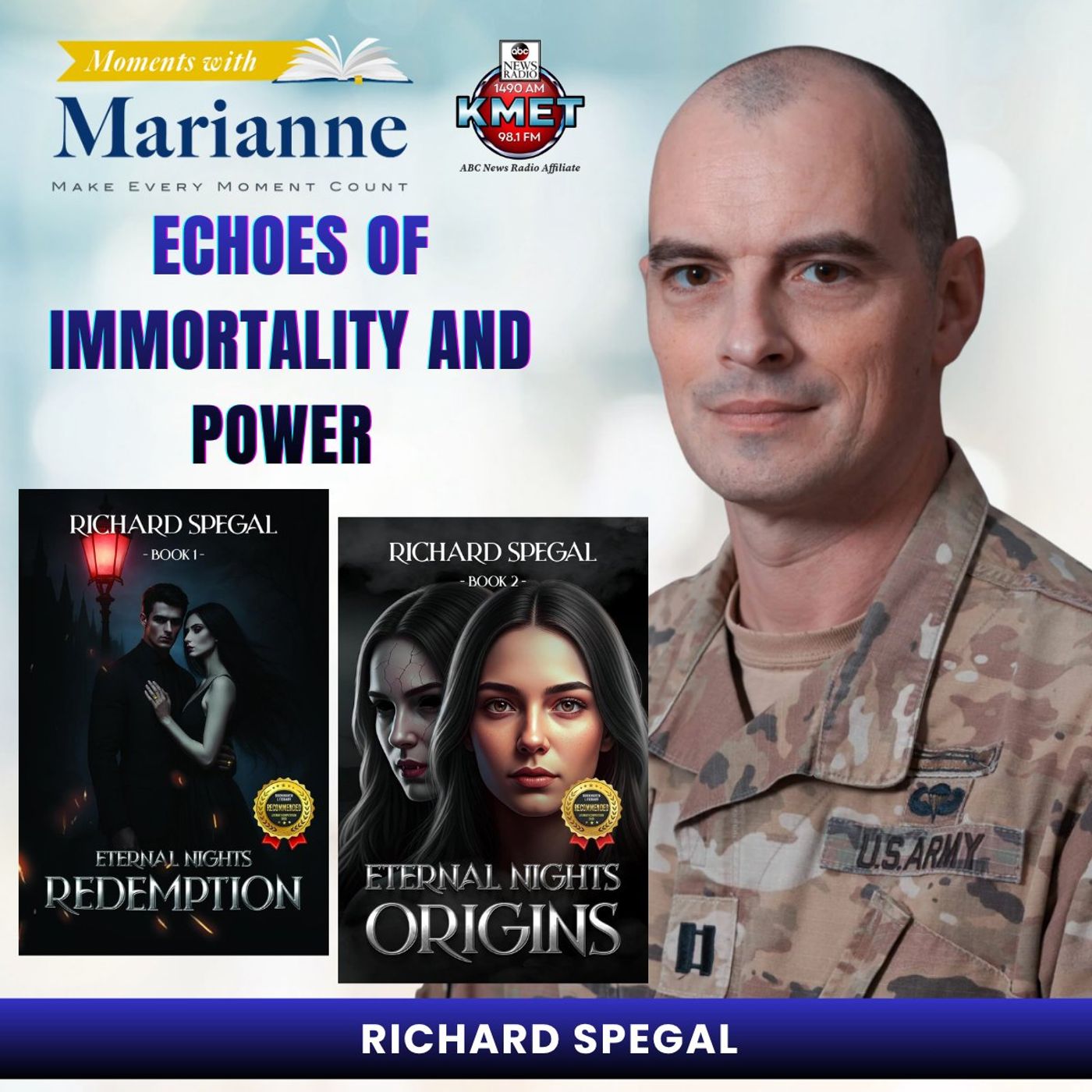
About this episode
Moments with Marianne Radio Show airs in the Southern California area on KMET1490AM & 98.1 FM, an ABC Talk News Radio Affiliate! https://www.kmet1490am.com
Richard Spegal is a storyteller who weaves together magic, mystery, and the darker shades of imagination. His worlds—such as those in Eternal Nights and the Wolves & Ravens trilogy—challenge what we believe, force hard decisions, and explore how much of truth can survive in shadows. Richard serves as an officer in the Pennsylvania National Guard and has a long history with the 82nd Airborne Division. Choosing to build a family, he left active combat service and now balances life with his family, and his writing. https://richardspegal.com
Order Redemption on Amazon: https://a.co/d/029euTzC
Order Origins on Amazon: https://a.co/d/0du6yrKm
To learn more about the show and interview opportunities contact us at: https://www.mariannepestana.com
Get every episode summarized
Each time Moments with Marianne publishes, we email you a written briefing from the transcript — the topics, who appeared, and any specific claims, with the ad reads skipped.
Email me new episodesFree for 3 shows. No card needed.
Hosts & guests
Transcript ready
349 searchable segments. Every word is indexed and playable.
Full transcript
Moments with Marianne — Echoes of Immortality and Power with Richard Spegal. Machine-transcribed; use the interactive transcript above to jump the player to any line.
Welcome to Moments with Marianne. This is your host, Mary Ampestana, and I am so excited to be celebrating 10 years of meaningful conversations with you. As we step into our new primetime hour, it's such an honor to share this exciting new chapter with you. So whether you're starting your day out, headed to work, or listening from wherever you are, this hour is designed to bring you thoughtful dialogue, fresh insight, and inspiring stories, so you can make every moment count. So thank you for being here with me today. And let's dive in. We're here today with special guest, Richard Spiegel, who's here to share with us his two new novels from the Eternal Night series Redemption and Origins. When love, immortality,
and power collides, what happens when becoming the monster is the only way to survive? Well, today's guest is going to dive into his novels that share just that. Richard Spiegel is a storyteller who weaves together, magic mystery, and the darkest shades of imagination. His worlds, such as those in Eternal Night's and The Werewolves and Raven's trilogy, challenge what we believe, force hard decisions and explore how much of the truth can survive in shadows. Richard serves as an officer in the Pennsylvania National Guard and has a long history with the 82nd Airborne Division. So welcome to the show, Richard Spiegel. Thank you for having me. Well, what an honor it is to have you here and to talk about the books you read and my goodness, what a writer you are, I think maybe we should start the actual beginning. Like, what was the first book you wrote and what inspired you to write? There were a lot of things that I wrote in high school
that's when I started writing often on just like short stories and other things, all that kind of stuff kind of got scrapped. And it was later on that I started writing my first novel in the Eternal Night series with vampires because I didn't see anything really out there for adults. And since I couldn't find anything, I decided to just make it. Well, that makes that pretty easy. So when you decided to start writing fantasy and paranormal stories, how did that journey lead you to the books you've published today? Well, in the beginning, it was kind of just like a part-time hobby, yeah, because I had to work a job and things like that and have a family. But then after a little while, I decided to just try to do it. Well, not necessarily full-time, but I knew that I would have a lot of free time when we were on deployments and stuff like that. So that's when I started actually getting the stuff published. And then once I opened that genie, I couldn't put it back in the bottle. So it was nothing but just my head full of just a bunch of crazy fantasy and
fiction worlds that I just couldn't put down on paper fast enough. Okay, so let's dive into your first book that you wrote. I'd love to hear about it. The first book was a redemption. It's the first part of the prequel to the Eternal Night series. Compared to my other books, it's a little bit more, I don't want to say on the normal side, but it doesn't get as graphic as a lot of the other books because a lot of it is more world-building. There's a lot of characters to introduce and a lot of things to set up so that way everything makes sense to the reader. So I've gotten a lot of good feedback about that book, but it doesn't contain a lot of the, let's just say brutality that a lot of the other books do. And so why don't you share a little bit about that story with us without giving away any spoilers? Well, the main idea for the prequel was I had to set everything up because I knew that it was going to turn into like an enormous series. So my main characters, the protagonists are an extremely old married couple who were vampires. They were turned at the
same time. So they're over 900 years old and they're just kind of living their lives, wanting to be left alone. And the first book focuses more on the religious aspect of it because the hardest thing about writing vampires, especially the scope that I'm writing, is despite how many things are out there about vampires, there's almost no effort to describe what they are. They're either written off as demons because they're the bad guys and we don't care because they're the bad guys, so they're just there to kind of get wiped out. There's a couple of things here and there that approach has a virus, but so I had to approach the, I wanted to get the religious aspect out of the way. Like they think they're demons because they grew up in superstitious times. So the main antagonist in the first book is an element of the Catholic Church. So they can challenge that whole demon idea. Get that out of the way in the first book until I was able to flesh out more character development on further books. That is so fascinating, especially looking at it from that perspective.
So you dive into more of their lives as their older? Yes. Because it makes sense, I focus on realism. Like my characters are real people. They think they act, they make decisions like an intelligent person would. And like in the first book, when their ideas get challenged and they decide, you know, wait, maybe we were wrong, maybe we're not demons. The first question, unintelligent person's going to ask is, well, then what are we? And that's a really tough question to answer because I have to make logical arguments for a mythical supernatural immortal being. And I have to find a way to explain that logically, which is what starts happening in the second books, or in the second book. And then the main series is far, far into the future where they're still learning what they are. And it just gets revealed a little bit by little bit in each successive book. Well, so let's talk about your second book origins. Can you share about that?
The biggest difference between origins and redemption is that a lot of that world building's already done. So the books are about the same length, but the main difference is origin focuses around a very, very small number of characters. It's just the couple of protagonists, couple of antagonists, and that's it. It's like five people, except for a little tiny side plot that's sort of off in the background. But there's like only five main people in the entire book. So a lot of interactions are a lot more personal. In that book, there's a lot of graphic brutality and psychological stuff that happens. And the idea is by the end of that book, most of the questions are answered. Like they know what they are. The audience knows what they are at that point. And then it's just, so most of this question gets answered. And then it's just like a small cliffhanger leading into the next, to the main series. I don't want to, I don't want to spoil anything about the book. So I don't want to give away any reveals or anything. I completely understand. Well,
so let's move on to then the next book that you wrote. I believe that's Wolves and Ravens. Yes. Writing science fiction takes a lot of research. So I knew that would take a lot of time. So in the meantime, I decided to write the Wolves and Ravens trilogy, which is a dark fantasy. I didn't expect to have as much fun with it as I did. So I ended up writing all three books in about a year, maybe like a 15 months or something like that. That is a, like I said, it's fantasy. The book focuses on three main races, the wolves, the Ravens, and the normal people. And they're trying to figure out what's wrong with their world. Like there's lots of bad things happening. Nobody can figure it out. Their history doesn't make any sense. So the characters are just stuck in trying to research something that the world as a whole doesn't want researched. Lots of intrigue there. And so then we move on to the next book. Well, the first book in Wolves and Ravens, just like the first book in Eternal Knights,
there's a lot of world building. So, and again, in the second book choice, a lot of that world building and setup is done. So that book, there's a lot more action, a lot more graphic brutality, and things like that. You get introduced to the idea. There's a little bit of it in the first book, but in the second book, you truly get introduced to the idea that while all this stuff is happening on this one world, there's different people watching it and observing it from different celestial realms. So there's more actors on the stage than the people in the book actually realize. And it comes to a head because the main antagonist and his following, the reason the book is so brutal is because they are brutal. Like I don't really deal with kind of like good guys and bad guys. I deal with like pure good and pure evil. So my books are very extreme when it comes to what conflict and stuff like that. Both kind of very black and white with the character building
that you have there. And is that the same with Broken Angel? Broken Angel, it takes place a bit further into the future. At the end of the second book choice, you get the idea that it's over, like the, you know, the good guys won, the battles over, everything's, everybody's happy, but you get the eye, but at the very, very end, you get introduced to that whole thing that I mentioned where the world is being watched. And in Broken Angel is where it really comes to the conclusion when, when the real forces behind everything decide to make their move. It was a very, it was the hardest book I've ever had to write because of how dark it got and a lot of the, a lot of the concepts that I explore because I go deep into the psychological side. So I show like the, the result of mental stress. Other things that I won't even mention, they are intended for an adult audience because of the brutality and stuff like that.
And Broken Angel was difficult to write because of how much of that was affecting celestial characters. And it was complicated to write because there's a million different religions in the world. And I'm trying to write this book without offending any of them, which is a tough thing when you're dealing with like celestial realms and stuff like that so that it was a lot harder than the other books. I was very proud of how it came out though. How you were able to weave all those together. One of the things I found interesting about your books, you've really written about this interconnected worlds that you have. And you described the universe or universes that you created. Can you share a little bit about those? The interconnectivity from eternal nights is mainly how all of the, all of the things that they're dealing with end up becoming, you end up seeing and learning that they're necessary for things to continue happening. It's not as black and white.
There's a lot of gray as like the negative side actually is doing some things that you might consider positive. The positive side is doing a lot of things that you consider negative. The main characters in that series end up not being very nice people, even though they're supposed to be good guys. In wolves and ravens, there's the interconnectivity because you're dealing with like three separate things. I don't mean the three races, but three separate things like the world they're on and then both of the celestial sides. And they start learning that everything is necessary to, it doesn't matter like who thinks they're right and who thinks they're wrong. None of it can actually exist without the other half. And that's one of the most difficult things the main character has to accept throughout the entire trilogy was that the things that she's fighting against have to exist. And if they didn't, everything would fall apart anyway. Sometimes it can be a little bit reflective of real life and how you've positioned these. And it has to be kind of thinking,
your work, it seems to blend magic and mystery and darker emotional themes. What draws you to exploring these elements in your storytelling? Honestly, mainly because nobody else does. There's everything out there. They try to focus on like like teenagers, young adults, things like that. And at the end of the story, everything's fine. There's no consequences. There's nothing explored as to what happens to the characters and things like that. So I delve into all of that. I've had my own mental and behavioral health journey, which got me medically retired from the military. And that's something that I deal with on a daily basis. So it makes a lot easier for me to write stuff like that. And I just, if the main characters are going through all of these stressful things, all of these battles and stuff like that and they're trying to save the world, you don't do that with a smile on your face. I mean, it hurts like their burdens get heavier and heavier, and it results in negativity. They start to not be able
to handle it. Some of the good characters end up having psychotic breaks because they've just been through too much. And broken angel, like I said, some of the concepts I dealt with were really negative concepts, things like, and they were applied to angelic beings. And for some people, it's hard to accept something like that from an angel, you know, for an angel to actually their mind to go so far in one direction that you're dealing with an angel who's contemplating suicide or something like that, just like concepts that nobody thinks about. But when I see people who have read my work and stuff like that, they love it. They love the realism and the immersion of exploring all of those corners. So earlier you mentioned that while you were on deployment, you were doing some of this writing. Were you writing all the books during that time, or was there a few that you were actually focused on? At that time, my first book redemption had already been done and just hadn't done anything with it. So when I gained that book to a publisher,
I primarily was working on the SQL origins. That was done pretty quickly. I can write a, I finished a book in like six weeks. And then I started doing the wolves and ravens. The first book of that was finished. And then by the end of the deployment, prior to me going to the hospital, the second book of wolves and ravens was finished. And then broken angel took me like a year. Like I said, that was a tough book to write. So yeah, all of it did get done during the deployment and then the medical stay afterwards. So on in your series, the trilogy wolves and ravens, what was the original idea that sparked that trilogy? Honestly, I think I've only actually admitted this one time in an interview because everybody was asking like, oh, how did you come up with all these deeper meanings and stuff like that? And honestly, it all came from a short story. Let's see, 12 or 13 years ago when I was meeting my current wife, not wife at the time, I wanted to impress her.
So I wrote her a short story called The Wolf in the Raven. It was only six pages long. And it worked because we're married now. And I always thought maybe I want to do more with this at some point. And then the entire trilogy grew from that little six pages. And like I said, once I started, I just couldn't stop because I had so much fun with it. But yeah, it all came from it all came from something I did to impress a girl. Okay, I like a little love letter. Okay. Basically, yeah. Well, I find it fascinating because your books really do present characters are facing extremely difficult choices. How did you approach character building, especially for those are navigating these kind of moral challenges? I let a lot of this is just because I'm crazy. So a lot of this stuff sort of just works itself out in my head without really conscious thought on my part. I created characters that to me were real people. They were designed as real people who
act, talk, think and make decisions like real people. So the whole thing just grows organically. The books are not outlined. I don't even I don't even think about what's happening in the books anymore. It just sort of comes out because the characters create the story as they live their lives. And when it comes to like when they have to face like darker things or heavy choices and things like that, the choices are made based on what the character would do. Like things are not forced. Like they are in pretty much all entertainment. You don't have a character making a choice. They would never make, but they have to do it anyway so the plot can happen. No, everything grows organically from the characters. They push the plot. They push the story and they're the ones who tell. So I find it interesting. So you you have these books that are for adult. There are lots of vampire books that are available for young adult readers and what have you. What kind of experiences were you hoping to create for the adult audience with these books? I just want because I'm an adult
and in my entertainment, I want my entertainment to be complicated so I can think about it and I want it to be realistic. And none of that stuff is realistic. There's a lot of let's just put it this way. It's focusing on young adults as good business because especially in the movies. Because one person is two or three movie tickets because the parents have to take them. Young adults are the ones that get more for no reason emotionally invested and make stuff up and things like that. That's why so many popular series are YA novels. But I'm not a young adult. I want like I said, I want something that makes you think. I want something real. I don't want my vampires to be just a regular person wearing fangs who glitters in the sunlight. That's just got awfully stupid. So I started writing it and I say it's for adults. Not just because of the violence and stuff like that. A lot of the things like the characters are married. So that's the
kind of romance that a young adult might not appreciate. Whereas an older adult understands long-term relationships. So they see the romance where another person might not. And then a lot of the concepts where a young adult may have heard of it. But they've never experienced it. So they might not enjoy it as much. So has your background in the military? Has that influenced your writing and your characters at all? The writing yes, especially in the Eternal Night series because since that's a series that's taking place in the real world. And it's the prequels of modern time. The military experience lets me reference equipment and weapons systems and stuff. So the action scenes because they're not just vampires that just throw magic around all the time. You know, they have an army that has weapons and equipment and the people that are fighting have an army who has weapons and equipment. So knowing what that equipment is allows me to get really detailed and have it be realistic because it's all accurate. And then even in the science
fiction series where there's militaries and stuff like that, I'm still able to use what I know now to write all that stuff more realistic. So the background is more realistic. Thanks to the military. So were there places that influenced your books? I would say the military experience as a whole influenced a lot of the background flavor information. The time I spent on deployments, especially when the deployments when I was younger, that influenced some of the realism where I thought about, I got rid of the pretense. There was no real pretense in my writing anymore. I realized that if you're going to write just get it out there as realistic and as detailed as possible. Don't worry about coloring things in a positive light for no reason because then you take away the realism. So I guess that time spending in the real world that a lot of people don't get to spend unless they're in the military did help with a lot of those parts of the writing. And then
the second deployment to Egypt and then my hospital stay afterwards, that gave me a lot of experience in the darker sides of mental health and behavioral disorders because of what I have to go through, which allowed me to do that, terrifyingly realistic. Do you feel like more people who are in the military or veterans of the military really kind of gravitate towards your book series because there's something there that resonates for them? I would think that that would be my primary audience, people in the military. Any adult, my market research, I got 92% approval. So, according to my market research, that's a pretty high number. But I do think that maybe people that have served in the military might be able to handle it better, might notice some things, that civilians wouldn't notice, so get a little bit of extra enjoyment out of it. Earlier you mentioned doing research for the books. Can you share a little bit about the research that was done and how it influenced and maybe shaped the world that you created?
A lot of the research, so all of the research is designed just so that way when I write the books, there's realistic as possible. Now with wolves and ravens, that's not only fiction, but it's fantasy. So, I can make up whatever I want. I don't really have to research too much for that. The research, a lot of the research I did was medical and anatomical research because I go realistic down to the smallest detail. So, if there's a particular fight scene happening and something happens, I need to know medically how the body will respond to that. So, I know what color the blood might be, which body part was damaged, what organ is in that spot. People who read it probably never even noticed anything like that, but I was very careful to do it that way. And then in eternal nights, even something like the vampires fangs. I referenced in the beginning, I referenced them as being six centimeters long. It was just a random thing that I referenced. But then I did research and I realized six centimeters was too long because the vampires
bite in your neck. They're not biting your vertebrae. So, I shortened the fangs to four centimeters for that single bit of extra realism because four centimeters is long enough to bite into your carotid artery without getting to the bone behind it. So, now my vampire fangs are realistic. And then the science fiction, oh my god, I'm researching everything. I'm researching star charts, what kind of technology we have today, logical advances in that technology. I'll have to do like 20 or 30 minutes of research, just so a single sentence is right. As far as what the characters are referencing. So, if you wanted to, you could actually Google it, go to a star chart and you could see that what they're talking about is really there in the real world. I think that's so intriguing how you really put that much detail into your book. When you begin to write a new book, what comes to you first? Is it the character? Is it the world or a central kind of theme? It's the characters, the world I would say has already been created because all the books
are happening in the same, you know, the same universe that I've already created. And it's the characters. And as I said before, I spend more time in these fantasy worlds than I do in the real world. It's great for writing, but it is very stressful for the people who have to live with me, like having to do things like real work or spend time with my wife and kids and things like that, because there's a lot of times where I can't tell the difference. It's one of the reasons why I was removed from the military. But as I said, it makes for great writing. And the stuff that's going through my head right now is pretty much like 10 books further down the road than what's actually available to the public, because it never stops. And the more I write to get it out of my head, the more stuff the story keeps getting pushed further in my mind. So I'm sure there are many other books that you have that are going to be coming up soon. Basically as quickly as I'm allowed to publish them. Apparently there is such a thing as publishing
too quickly. I guess it's like bad business to throw three books out there at the same time. You're supposed to wait for like hype and stuff to build up in between, because I've got my next one, which will be the first science fiction one, should be out by early May at the latest. I'm doing the final edits on that one now. I have more written and it just comes down to how quickly the publisher will let me publish. I don't I've maybe like nine months in between. I think that's normal, something like that. So how many books total do you think that will be in the internal night series? Infinite. It depends how the advantage of having characters who are thousands of years old means that I have thousands of years to choose from to write side novels about different experiences that they may have. Each character each main character in the series is going to get an origins novel. As far as the main the main series does have an ending. But I don't know that might be what 20 24 books down the road. And then like I said, there's always an opportunity to
write side adventures that happened all over the place. So yeah, I'm just going to keep writing. You've got it. You've got many stories to continue here. It sounds like in many different directions to go in. And it's interesting because you often hear readers that get so immersed in the fictional world. What do you hope readers experience or reflect on when they're reading your books? Exactly what you just said. Totally merging. And that's what happens when you have good characters. When a reader can just I don't want them to like the work. I want them to be emotionally invested in what's happening. I want them to get furious when bad things happen. I want them to be thrilled when when stuff works out. In origins, the whole final third of that book is horrifying. And just because of how bad things get for the characters. I want people to read that and be flabbergasted, immersed. Like I want them to be upset to like thinking like there's no way out.
And I have had people like contact me and tell me like how much they like something because how horrifying it is. Like how realistic. I've talked to people that have had to actually put the book down. Like they had to take a break because things like it affected them so emotionally that they needed a break and to go back into the real world for a little while. That's what I want. Well, it seems that your books really kind of explore in their stories, truth and transformation and surviving in the darkness. What do you want readers to take away from those? I'd like to I'd like people to think about themselves when when they when they read the books, especially like I said, it's geared towards an adult audience. People who have more life experience. And I'm hoping they see things in the book that resonates with them and maybe makes them feel better about certain things. Like they're reading like we read for escapism, enjoyment and escapism.
So you might be reading to escape something that you don't want to deal with in your real life. And then because of how realistic the books are, you're reading about a character who's dealing with the exact same thing. And eventually through whatever set of circumstances in the books, things work out. And then you're happy for that character in the book, but maybe you stop and think about things from your own life. And in first law, the biggest and I've wrote it in the dedication. The whole thing about wolves and ravens is that their entire world is based on one law that was written down. And I take that to tell people just because something's written down, doesn't mean you have to do it. You can change it. And just because it's not written down, doesn't mean it's not allowed. I mean, this is America. We have changed our country many times in the last 250 years because it wasn't what we wanted. And then in choice for people to understand that no matter what the situation is or how bad things get, you always have a choice. The choices
have consequences, but there's always a choice, even if you can't see it. And again, in the dedication, I basically wrote a blurb, if you're somebody who truly doesn't believe they have a choice, that is one of the hints to maybe seek help. And you know, maybe realize that you're not in things alone and stuff like that. I'm hoping people get all kinds of stuff out of these books when they read them. Well, there's so much there for people to dive into. Is there any type of myth or folklore or maybe even some supernatural themes that you have gleaned from in writing these books? Not really, because the thing with the fantasy is you just make it all up. So I didn't really research any, I mean, I've read fantasy, I enjoy fantasy, the fantasy genre and everything, but it's not like I really researched any particular folklore and stuff like that in writing the book. The closest thing I, the closest thing I did to that was in Wolves and Ravens, the Ravens
are modeled after Chinese women. And people have asked me why and it goes back to what I said before. The original story was written for my wife who's a Chinese woman. That's the only reason why the Ravens are all Chinese women because the original story was written for my wife. So I've had to research a lot of language. I don't take the culture. I just took their women and some language. And I needed help to research stuff like that. And then the normal research that we already talked about for eternal life. You've done quite a bit there. And I love how you have that all coming together for your wife too. That's very sweet. And that's interesting because when people look at your books and pick them up, I think that's one like hidden little gem that most people wouldn't really understand unless you explain it. Yeah, I think I might, not for a little while, but I'm probably going to write a prequel for Wolves and Ravens. And then maybe as an afterward in that prequel, I'll actually publish the short story, the original short story. Maybe as like
a little Easter egg or something for people. Oh, I think so many people would enjoy seeing that. My goodness. If your wife allows it, right? Yeah, the funny thing is she understood that story, but her English skills aren't good enough to understand the actual books. So she was able to help me with some of the Chinese language that I used here and there, but she has no idea what the books are about. So for our readers and listeners that want to dive into your books, where should they start? What's the first book they should pick up? I would say, well, either redemption or the first law, it depends what they're into. I mean, you've got to want to start with book one. And if you're more into like the modern world, supernatural, normal conflicts and stuff like that, then you definitely want to gravitate towards eternal nights. If you're someone who doesn't really like that kind of thing, but you're more into like the fantasy, well, then definitely, you know, Wolves and Ravens is for you. We just want to start with book one. Book one on either one. My goodness, Richard, you're such an inspiration with your work, such a great writer. Where can
people go to learn more about your work and be part of your community? Well, that everything's available on Amazon, because everything's available on Amazon. But my website is RichardSpeagle.com, very simple. There are a lot of content on that website. I've gotten videos, slash movie trailers for every one of the books. There's some behind the scenes videos where I answer some questions and give introductions and stuff like that. So the website has a lot of content. My Instagram is at RichardSpeagle Books. There's not a lot of content on there yet, because I'm still learning how to use Instagram. But I'm basically, I'm going to funnel the stuff from the website into the Instagram. So that will eventually have a whole lot of contact as well, or I'm sorry, content as well. Well, Richard, thank you so much for taking the time to be on the show with us here today. Well, thank you again for having me. This stuff's kind of fun. Well, thank you, Richard. It's been such an honor to spend this time with you and to talk about your books from the Eternal Night series Redemption and Origins. To learn more about Richard,
please visit his website, RichardSpeagle.com, and be part of his community. Well, we're at the end of our time today. I'd like to thank everyone for tuning in. You're listening to Moments with Marianne, where we make every moment count. In a single moment, your life can change. Moments with Marianne is a transformative hour that covers an endless array of topics with the best of the best. Her guests are leaders in their fields, ranging from inspirational authors, top industry leaders, and business and spiritual entrepreneurs. Each guest is gifted, and a true visionary. A recognized leader in her own work, and while teaching others to develop, refocus, and grow, Marianne will bring the best guest, and sometimes a
special surprise. Don't miss this. You never know just which moment will change your life forever. Make sure to tune in and visit Moments with Marianne.com for more information.
More episodes
More from Moments with Marianne

Reflections- On Cinematography with Sir Roger & James Deakins
Moments with Marianne

The AI Dividend with Alistair Mukhtar
Moments with Marianne

The Science of Mind-Body Healing with Avinoam Lerner
Moments with Marianne

Surviving The Next Economic Storm with Ben Reinberg
Moments with Marianne