About this episode
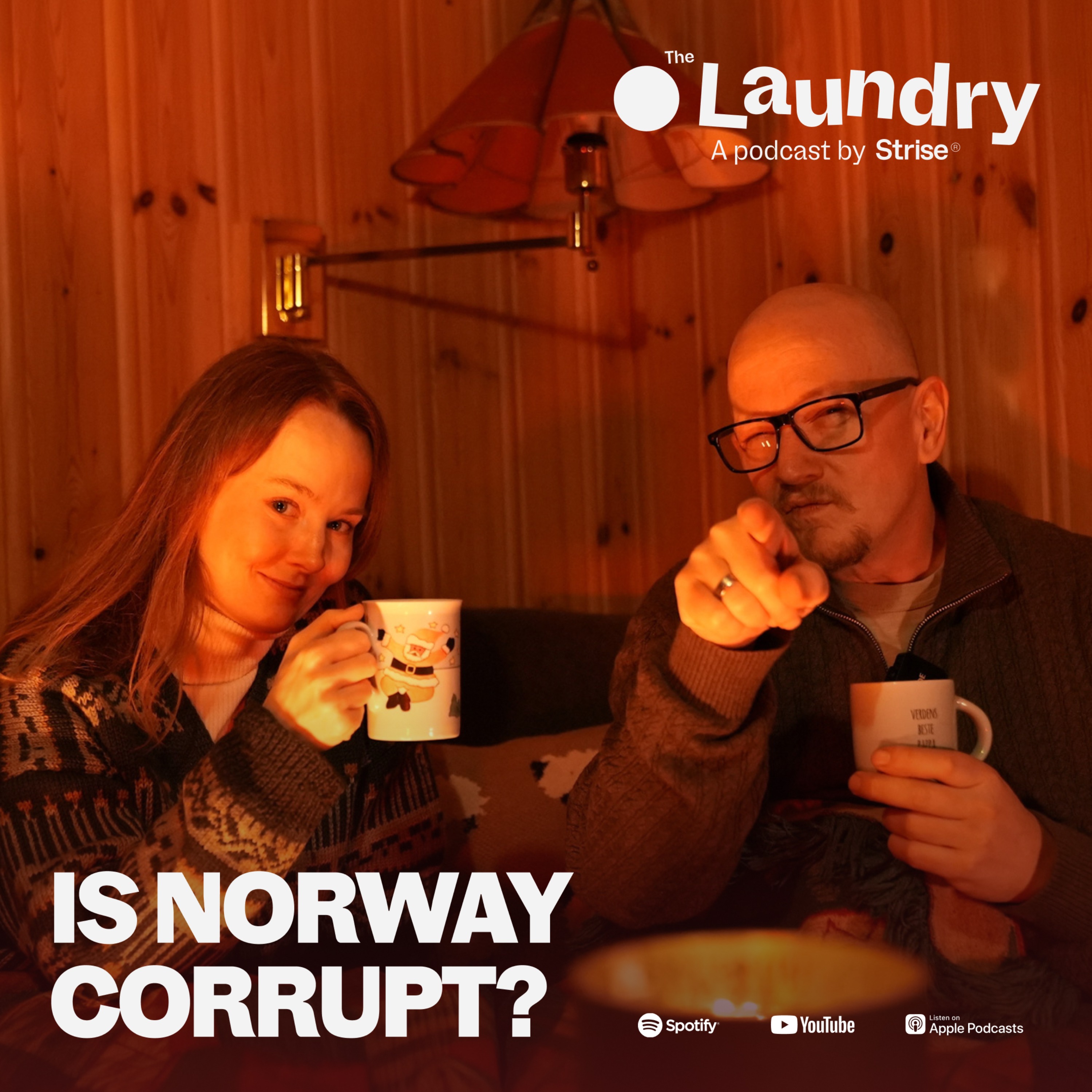
The team is on their annual "KY-Ski" trip, located in a cosy cabin in the Norwegian mountains.
But denting this "koselig" image is a slew of scandals linked to the release of the Epstein Files, which is making Norway rethink its image as one of the least corrupt countries in the world.
Politically exposed persons, undeclared gifts, loans, luxury holidays, Greek villas, the Nobel Peace Prize, the Oslo Accord, and the world's most notorious email leak.
Our expert hosts, Marit Rødevand and Robin Lycka, are asking: Is Norway too cosy to fight corruption?
The pair discuss: recent scandals rocking the nation, how praise from international organisations can hide some ugly truths, and—if we’re building a compliance framework for government and politics—what do we need to see?
Producer: Matthew Dunne-Miles
Editor: Dominic Delargy
Videographer: Loïs Dunford
Get your free ticket for the The Laundry Live Oslo here!
____________________________________
The Laundry podcast explores the complex world of financial crime, anti-money laundering (AML), compliance, sanctions, and global financial regulation.
Hosted by Marit Rødevand, Fredrik Riiser, and Robin Lycka, each episode features in-depth conversations with leading experts from banking, fintech, regulatory bodies, and investigative journalism.
Tune in as we dissect headline news, unpack regulatory trends, and examine the real-world consequences of non-compliance — all through a uniquely compliance-focused lens.
The Laundry is proudly produced by Strise.
Get in touch at: [email protected]
Subscribe to our newsletter, Fresh Laundry, here.
Hosted on Acast. See acast.com/privacy for more information.
Get every episode summarized
Each time The Laundry publishes, we email you a written briefing from the transcript — the topics, who appeared, and any specific claims, with the ad reads skipped.
Email me new episodesFree for 3 shows. No card needed.
Hosts & guests
Transcript ready
244 searchable segments. Every word is indexed and playable.
Full transcript
The Laundry — E155: Is Norway too "cosy" to deal with corruption?. Machine-transcribed; use the interactive transcript above to jump the player to any line.
The laundry is proudly produced by Stryce, your AML automation software for faster onboarding, smarter monitoring and growth without overhead. The diplomat couple, they had Epstein, Threaten, the guy who owned the apartment they rented and made him sell it to them at half price. Wow, it's pretty wild stuff. Welcome to the laundry, the podcast connecting AML, compliance and financial crime to the real world. We're recording this in a ski cabin. Outside, the snow is pure and wide and we got some hot drinks and blankets. It's real cozy here. Surely, surely in a country this beautiful, there couldn't be bad stuff going on.
In this episode, we are asking, is Norway too cozy to deal with corruption? We will be discussing recent scandals that have woken this nation up to some uncomfortable truths, whether paths on the back from international organizations perhaps made us lazy, and if we're building a compliance framework for government and politics, what do we need to see? And to dive into this topic, I'm here with my laundry co-host Robin Leica, solution architect and resident sanctions man at Stryce. Good to be here, Robin. Oh pleasure. And for those who don't know, we are now recording this from a cabin because we are at our annual Keiwai ski trip where we ski in the Norwegian mountains. But before we get into the juicy stuff, corruption, politicians, can you give me something that makes you proud to be in our region? Well, I was thinking about it earlier. We discussed the whole origin story of Kit Kat versus Quick
Lunch. And I have to say, like, it's the tradition of Quick Lunch skiing going to the cabin, like every single kid in Norway knows what the feeling is to go skiing and have a Quick Lunch. And then it was kind of funny because we actually own the fact that we stole the concept. Some people think they argue that the Quick Lunch was invented by someone else, but it was in fact invented by the English. And we just nicked the concept. For those of you who don't know, then Quick Lunch is in our region chocolate. It's the best one. Yeah. And for me, anything that makes me proud to be in our region, I actually hadn't haven't prepared anything. So, top of mind, now I'm thinking about like all our medals in the winter Olympics. That's maybe because I'm competitive and care about these things, but I don't know. Patriotic. Let's dive into the discussion. One of the things that has really been in the media lately in Norway is, of course, the fallout from the Epstein files because Norway has been a lot
in those, unfortunately. And the biggest story dominating Norway right now is in fact that the national financial crime unit Övakokrim is investigating several high profile figures for their alleged ties to the late Jeffrey Epstein. Who are the ones involved here? Let's just go through the list of the key players involved in this fallout scandal. It's Muna Yul, the former ambassador to Jordan and Iraq. She resigned in February after being charged with aggravated corruption. Reports suggest she and her family received significant financial benefits from Epstein. And Muna Yul, she is married to Tyria Rudlashen. He was also a former top diplomat and he is charged with contributing to aggravated corruption as well. And Rudlashen once called Epstein his best friend and is suspected of using his influence to secure visas for Epstein's associates and receiving
undisclosed loans. And also a fun fact is that this couple, this married couple, Muna Yul and Tyria Rudlashen were also the main architects behind the Oslo Accords back in the day. That's something made their names as like top diplomats. Did you see the villa they have in Greece? I was going to mention it because this couple owns a huge villa in Greece and it's something that is definitely out of reach to buy if you work on it like a government salary. So that is also, of course, something that has come to the day of light in the Norwegian public. And then we have two more characters who are now under investigation by the National Financial Crime Unit. Yeah, and I mean, it actually pains me slightly to talk about this because, you know, you talk about people like to be on Yagwang. The man is a national treasure and now suddenly that whole image is,
I wouldn't say shattered, but there are very big cracks at least. So we have Torbjörn Yagla on the foreign prime minister, the investigation. Not only was he the former prime minister, he was also the former chairman of the Nobel Peace Prize Committee. Yes, that as well. And this investigation centers on whether Yagla and accepted improper gifts, travel and loans in connection with his official duties. And the records suggest that Epstein covered travel expenses for six adults on at least one trip. And that Yagla may have asked Epstein for assistance in securing a bank loan. And there is a fourth character here, also a former politician and was up until quite recently the president of the World Economic Forum. And also was a former foreign minister of Norway. So he of course resigned from his position recently when these allegations came out. And he had
also been quite clear in denying any contact with Epstein. And now of course with the Epstein files, that wasn't true at all. And maybe to add insult to injury. Yeah, and also, sorry, I'm interrupting but I just want to say it because one of the also stories that came out is actually the diplomat couple. They had Epstein threaten the guy who owned the apartment they rented and made him sell it to them at half price. Wow. It's pretty wild stuff. And to add insult to injury, as if the Norwegian royalties didn't have enough on their plate with the steps on of the royal couple. Maria's heavy being on trial. We have metamaret surfacing in the Epstein files as well. Her whole dialogue in this may be not pointing towards corruption but just the relationship itself.
Yeah, let's go back to the corruption aspect because there's a lot of benefits that these people have gotten for given away influence and received a lot of benefit. You have family benefits, loans, it's gifts, it's travel expenses, a whole variety. So does this point to Norway having a systemic problem? How should we think about this Robin? Yeah, no, it kind of takes me towards that. I'd rather stick with the devil I know kind of vibes. In a country where you have open corruption, then at least you know how the system works. In a country like Norway where the trust is so high, where transparency is high, you kind of get taken by surprise by it. I think a lot of people in Norway really got taken by surprise and when they realized how deep-knitted this was into politicians
when you surfacing like former prime minister Torbjörn Jogland in this kind of hurts us a bit. It does hurt but what I would say is that it's a good thing that of course we don't have corruption out in the open because that points to like a then it's maybe too late because corruption is such a detrimental like a brutal force. So it's good that we got to see it now and hopefully we can change a bit but I feel people should be more outraged that there were no marches in the streets in Norway let's end corruption. There is nothing. People are just having it having it too good here, you know, to really really feel it. And I just feel that it didn't hurt enough that we should have been much more enraged and we should have demanded much more transparency from the government and now the Nobel Peace Prize committee are saying oh no we cannot give we cannot publicize list of gifts that our committee members have received backward dating. We can only do it going
forward. So I feel that Norway did not react strongly enough. We were just like ah well that's too bad. It is and that's typically how we react to things in Norway. But I think it kind of it does sort of rock a bit with the foundation of what we believe in and it kind of plants a seed of uncertainty whether or not we actually have a systemic problem of corruption because it's so hard to know if you have hidden corruption then that's what I meant by open corruption is easier to deal with. You can like you know that it's there and you know how it works. In a society like Norway with the level of trust we have and the level of transparency and openness you don't know. No and I think that is something we should all be very on the alert of because the as we've heard by a lot of our previous guests even the the head of the Norwegian financial crime investigative unit
Öko Krem also Paul Lundset cited like okay corruption is the most detrimental force in a society and it kind of sneaks into the cracks and it just solidifies in the foundation and once it's there it's extremely hard to be removed and I think people in Norway just like shrugged it off and like let's move on. Fluke incidents. But I mean all of these people were politically exposed people. All of these people were on pap lists impossible not to but do you think from a compliance perspective from a bank perspective that they could have done something differently or that it this should have triggered like an enhanced due diligence like work from an internal perspective in a bank. What do you think? Who knows what it did. Like there could have been multiple reports filed on suspicious activities and some of these activities you wouldn't even see as a bank. If
someone paid for your travel then how would you know there is no transaction. So it's a difficult question. I think there were probably multiple enhanced due diligence processes involved with these individuals but then again going back to pre-2018 with the FATF report that was pretty shocking at least in compliance terms for Norway. There weren't probably that many guardrails in place for catching these things. Maybe a SARS revolving around corruption should be prioritized higher. Yeah. Over money laundering in fraud. Yeah. Even though it's quite difficult to see that happening in practice. Okay, let's say you want to pick up the investigations of a fraud ring because you have so many suspicious activity reports and whatnot and you have all the victims but who is really a victim if a politician got paid a vacation to the Bahamas.
Yeah. And it's very easy to prioritize one over the other but long term the corruption part is going to like be worse for everyone. Yeah. It also points towards the timing of some of these cases if they were during or after. If they were after then you have the whole pep retention period. So if you did screening and you know if your screening exercise is say 18 months then you wouldn't necessarily get a pet pit on them either. That's true. And we did talk about it. It's very very hard to monitor and screen for when someone just pays something for you. So if Tuirbir Nyaglan, the former prime minister got a vacation for him and his entire family paid for by Epstein but he doesn't have any expenses regarding you know the hotel etc. How would you monitor that?
It's almost impossible but what does that really tell us about the limits of traditional AML screening? Should we then put another burden on financial institution and be like okay for every pep that you have you also need to now put an extra layer to monitor whenever they pay outside their geographical region. I'm sure he had you know he bought something with his credit card on such a trip. Do you then then kind of okay we see that our pep customers are now paying in a different jurisdiction. Should we spend an enormous amount of time to figure out if that trip was paid by someone should we ask them to fill out forms wherever they go on vacation. I mean how would we detect this? Yeah and that part of it isn't the bank's job either what you're describing is intelligence and investigation. Part of it obviously the banks do but most of that part is actually on the financial intelligence unit. They're the ones that are supposed to uncover
and prove the financial crime. The bank's responsibility is to file this suspicious activity report but there are other things like in Sweden they have something called the institute against the bribery so as a public person you self-declare if you get a gift and that's to avoid scrutiny on anything or to increase transparency. Oh this kind of reminds me of the UK. There they also have this gift registry so all the MPs have to declare if they get a gift. I'm sure we must have something like this in Norway as well but I just have to say we actually don't. We actually don't. No. Let's go back to this original question. It's Norway too cozy to deal with corruption. I think we can just end the episode right here and now. No it is interesting. It is interesting though. We don't have it. The closest thing we have is probably transparency international or tax justice network. I don't feel proud of being an original. Let's leave the pride of being Norwegian out of it.
No but this seems like such a simple thing to implement. Yes. How hard do we? It's a simple thing to implement but then again you could also argue that it creates a false sense of security so if you have a politician reporting then how do you know that they're not just reporting the things that they would like to and leave the things that they wouldn't like to report out of there because then it looks like they're being transparent. Yeah I guess but also if something comes out there downfall will be pretty hard you know yeah so it's an easier way to also make to keep our politicians I don't know maybe a bit more honest. Oslo. Oslo. Is it just us or is it getting hotter out there? The world of financial crime is heating up and we are about to hit boiling point. On Wednesday March 18th the laundry is going live at salt. We're bringing together an expert panel to break down why thin crime has become the ultimate
front line of global geopolitics and how we keep up and adapt using AI agents and other tools at our disposal and we'll be hosting a very special keynote from the legendary Thomas Seltzer musician documentary maker and one of Norway's most distinctive voices. Come for the insights stay for the pizza and drinks on the house thanks to Streis and Signacat tickets are free but they won't last. Secure your spot at the AML event of the year via the link in our show notes now. Okay take it back to the Epstein files we were of course not the only ones with politicians mentioned in the Epstein files so when it comes to peps and their related people is this about was was there something specific about failings in Norway Norwegian supervision or was there some kind of general problem in your opinion. I mean the downfall for a few politicians in the UK
was pretty hard but yeah well I already mentioned the 2018 FATF report the 2014 FATF evaluation didn't cover the beneficial owners of natural persons so there was a benefit flowing from private individual to Pep family that sat in a regulatory grey zone so there are loopholes that have been tightened but it's it's hard to say if it actually suggested political influence at that point. Being one of the countries high up on the transparency index but this happening should we just conclude that that index doesn't matter at all we've had a few guests or at least one guest in particular who has been quite heavily criticizing this index before Oliver Bolo but I don't know if you would agree with him or if you think that okay no this index actually had hold some value.
It can be questioned whether or not it leads to the sort of underscreening or if you have enough scrutiny on Pep do you have different Pep classifications for people that might have long-term influence should you change your Pep retention period those kind of questions but I don't know I don't know really as I don't know. I'm also thinking about okay let's say we find out that we don't have enough scrutiny of Pep should that really be a bank's responsibility to monitor and screen more or would we put the burden of uncovering corruption somewhere else it seems to me a bit that oh the kind of a conclusion from this is like oh no we need to screen and monitor the Pep's more from a banking perspective because it's so easy for government for the government to just put even more pressure on the financial institutions when maybe the responsibility would lie elsewhere with the government itself implementing anti-bribery anti-corruption yeah initiatives
anti-bribery units anti-corruption units financial intelligence units but with this kind of scrutiny do you think it will become more or less attractive to be a politician or a politician and a Pep in the future I hope it doesn't matter to most politicians today because they should know better like there should never be an incentive to be a politician your incentive should be that you want to serve the people I agree and of course one of the other aspects of this one of the big threats in financial crime that's coming up is of course having a loyal or corrupted employees you know that you haven't really really done proper due diligence on the people that you hire and the world economic forum where burger brand there one of the four characters and the Norwegian Epstein fallouts he was the CEO there and has been so for many years and that is
one of the most powerful non-governmental institutions on earth what should we think about that he was obviously a Pep from his time as a foreign minister and being in government in Norway but should then international organizations be required to do more Pep style screening of their own people as a bank but you do it as an organization I think there will be new requirements to the sort of suitability checks that you need to do and your internal compliance requirements I guess we're all waiting for most of the regulatory technical standards and implementation technical standards to come out of AMLR so we can see more in detail what the requirements should be hard to say many of our listeners are not based here in Norway so what lessons should they take from looking in our current crisis support independent journalism yeah joke aside but I do think now is a
really good time to be a journalist and get the truth out now we can actually see like what value does the free press still holds like what are they willing to stand up for the truth and like serve the public and also uncover what is really going on and I also think that we should take a good lesson that the relationships and friendly handshake agreements and you know you kind of push the limit of what is acceptable to you a bit by bit by bit I think those things need to go we need to get back to like no this is right this is wrong when you're having holding public office so I think the kind of scrutiny will be or the bar needs to be higher for our politicians yeah for any public servant and I do think that we should be quite vigilant in in the path forward and really try to root out any kind of corruption as fast and hard as you can because if it takes hold it's
so hard to go back but I think that I want to see the people of Norway marching against corruption because we don't know how good we have it here and that can suddenly be taken away from us out is even noticing and then it's too late so I really want people enraged by any sign of corruption I agree but we are proud to be we are proud to be Norwegians and you know Norway has this image of being peaceful and transparent and open like all these great values attached to Norway but this European use site your active wrote the case punctures Norway's carefully nurtured image as a principled broker of peace and humanitarian values and now the former leader of the Nobel Peace Prize Committee and how to close ties with Epstein what has this has this damaged our
reputation internationally short term probably something but unfortunately I think long term this will soon be forgotten I agree I also want to give a little plug here at the end to something that we have covered extensively several times and that is culture of compliance now more than ever that is such an important thing to nurture and drive forward within banks and within like government's office and that is also one thing that really has to be done by humans that's something AI can't take over at least not yet so I would encourage everyone who listens everyone who is head of AML head of compliance working with anti corruption anti bribery just like really really try to instill the culture of compliance but before we end this episode in this cozy little cabin I'm going to dish out some quick fire questions for you Robin are you ready you know the drill right yes what's the one change to Norway's pet framework you'd make tomorrow if you could
I do like Denmark and actually create a list of individuals rather than just the roles I agree let's copy Denmark name one industry in Norway you think is materially under screen for corruption risks real estate agents and property I also want to say like public sector grants will these current scandals have a lasting impact on compliance procedures or will we be moving on to things and go on as normal I'd hope to say that things have already changed as we're looking at corruption cases from a decade back and finally which we have asked at the top and also touched upon in the middle of this episode is Norway too cozy to deal with corruption I think it is I think it is too and it breaks my heart but I'm 100% yes on this one and with those grim words that brings the
spin of the laundry to an end hard topic cozy cabin but Robin thank you for joining me and if people want to connect with you how can they do that I'm on LinkedIn slash robin lika robinats try start AI and thanks to everyone who was listening if you've enjoyed this episode check out the back catalog of more than 150 episodes and follow the laundry on your podcast platform of choice we're also on youtube share the podcast with your peers your team drop it in a group chat with other AML enthusiasts that will really help people to find us and if you got something you want to share with us our emails are always open please email us at laundry at strice.ai your host for this episode was me modded your producer was Matthew our editor was Dominic and our videographer was Lois and the laundry is proudly produced by strice we're not a podcast production company but we actually
build software for AML automation but visit strice.ai for more information and we are off skiing so see you next time. Yes. If this was France we'd be burning cars in the streets. The laundry is proudly produced by strice your AML automation software for faster onboarding smarter monitoring and growth without overhead.
More episodes
More from The Laundry

E172: Is this the end of beneficial ownership data?
The Laundry

E171: How do we put the "human" back into AI processes in fincrime?
The Laundry

E170: What does the board need to know about AML?
The Laundry

Re-Spin: How do we stop MLRO burnout?
The Laundry