
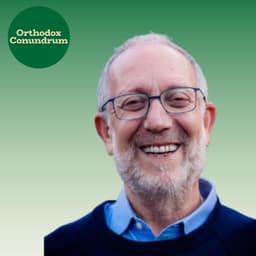
Does Orthodox Judaism Have a Fear Problem? Rethinking Religious Anxiety Before Rosh Hashanah, with Rabbi Dr. Judah Goldberg (304)
About this episode
Check out Orthodox Conundrum Commentary on Substack and get your free subscription by going to https://scottkahn.substack.com/ - and members get this and other episodes of the Orthodox Conundrum Podcast ad-free and with early access and additional bonus content!
Fear can be a powerful religious motivator. It can push us to repent, reinforce commitment to halakha, and help communities maintain standards from one generation to the next. But what happens when fear becomes part of the culture of Orthodox Judaism itself?
As Rosh Hashanah and Yom Kippur approach, Scott speaks with Rabbi Dr. Judah Goldberg about the anxiety that often accompanies the Yamim Noraim, and about what that anxiety may reveal about Orthodox life throughout the year. They discuss the hidden messages we transmit through education, the role of charismatic religious authority and Daas Torah, whether our fear of losing religious commitment causes us to rely too heavily on fear itself, and what it would mean to build a religious culture grounded instead in love, trust, awe, and a secure relationship with God.
But there is a genuine risk on the other side as well: if we deemphasize fear and stress God's unconditional love, might commitment to halakha suffer?
This is a conversation about much more than how to feel differently on Rosh Hashanah. It's about what motivates Orthodox Jews, what kind of relationship with God our communities are trying to create, and what we might gain, or lose, if we choose trust over fear.
Talli Rosenbaum and I have just released Intimacy and Sexuality for Emerging Adults, powered by Intimate Judaism - a new ten-part podcast series designed to give young Jewish adults the kind of honest, thoughtful and Torah-based guidance about relationships, sexuality, and intimacy that too many of them simply aren't getting.
We talk about emotional intimacy and vulnerability, dating and physical boundaries, attraction and sexual desire, anatomy and sexual response, consent and communication, pornography, love and marriage, niddah and building intimacy within marriage, some of the difficult questions surrounding sexual orientation and Torah, and more.
All ten episodes of Intimacy and Sexuality for Emerging Adults are available now; just click here to get it on Spotify or Apple.
Please listen to and share this podcast, and let us know what you think on the Orthodox Conundrum Discussion Group on Facebook (https://www.facebook.com/groups/432020081498108).
If your business is interested in advertising to our engaged Orthodox audience, or if you'd like to sponsor an episode in honor of a loved one or simcha, please reach out to [email protected] to support meaningful Jewish conversations.
Thanks to all of our Patreon subscribers, who have access to bonus JCH podcasts, merch, and more - we appreciate your help, and hope you really enjoy the extras! Visit the JCH Patreon site at https://www.patreon.com/jewishcoffeehouse.
Write to [email protected] to learn all about creating your own podcast.
Music: "Happy Rock" by bensound.com
Get every episode summarized
Each time Orthodox Conundrum publishes, we email you a written briefing from the transcript — the topics, who appeared, and any specific claims, with the ad reads skipped.
Email me new episodesFree for 3 shows. No card needed.
Hosts & guests
Transcript ready
523 searchable segments. Every word is indexed and playable.
Full transcript
Orthodox Conundrum — Does Orthodox Judaism Have a Fear Problem? Rethinking Religious Anxiety Before Rosh Hashanah, with Rabbi Dr. Judah Goldberg (304). Machine-transcribed; use the interactive transcript above to jump the player to any line.
Before we begin, I want to tell you about Intimate Judaism's newest project. Tali Rosenbaum and I have just released intimacy and sexuality for emerging adults powered by Intimate Judaism. A new 10-part podcast series designed to give young Jewish adults the kind of honest, thoughtful, and Torah-based guidance about relationships, sexuality, and intimacy that too many of them simply aren't getting. We talk about emotional intimacy and vulnerability, dating and physical boundaries, attraction and sexual desire, anatomy and sexual response, consent and communication, pornography, love and marriage, needa and building intimacy within marriage, some of the difficult questions surrounding sexual orientation and Torah, and more. All 10 episodes of intimacy and sexuality for emerging adults powered by Intimate Judaism are available now. Just click on the links in the description of this podcast. I think the reason to fall in love with God is the same reason that Avram fell in love with God. He realized that God in his role as creator and King of the Universe is a source of infinite kindness and giving and compassion for all of creation and puts enormous faith in creation to be able to be omitable enough to stand for him, so to speak.
I think that each of us probably has some image or idea of Hashem. How should we think of God on the young and young and old age? And I think God tells us how he wants to think about him. He gives us the adjectives. Hashem, Hashem, Kael, Rachome, Khanu and Erych, Apli, Rachese, and Yemet. We're going to say those words so many, so many times, and I think we should contemplate them for a moment. Who is Hashem for us? The kindest and gentlest personality one could ever imagine, the softest, the most loving, so slow to anger, so quick to be appeased, and as you said, ultimately, who has faith in us, who would not want to fall in love with God of Avram. This is the Orthodox Kanandrum on JewishCoffeeHouse.com. I'm Scott Khan. Fear can be a powerful religious motivator. It can push us to repent, reinforce our commitment to Halacha, and help communities maintain standards from one generation to the next.
But what happens when fear becomes a part of the culture of Orthodox Judaism itself? As Rosh Hashem and Yom Kippur approach, I spoke with Rabbi Dr. Duda Goldberg about the anxiety that often accompanies Yamim Nohrim, and about what that anxiety may reveal about Orthodox life throughout the year. We discuss the hidden messages that we transmit through education, the role of charismatic religious authority and Dastura, whether our fear of losing religious commitment causes us to rely too heavily on fear itself, and what it would mean to build a religious culture grounded instead in love, trust, awe, and a secure relationship with God. But there's genuine risk on the other side as well. If we deemphasize fear and stress God's unconditional love, might commitment to Halacha suffer? This is a conversation about much more than how to feel differently on Rosh Hashem. It's about what motivates Orthodox Jews, what kind of relationship with God our communities are trying to create, and what we might gain or lose if we choose trust and love over fear.
And we'll get to that conversation in just a moment. First, read my articles by subscribing to Orthodox Kanondram Commentary on Substack. It's free to join, and you can cancel at any time. If you'd like even more, you can become a member and receive exclusive bonus content with every episode. In this week's bonus question, I asked Rabbi Goldberg about how the Avodavium Kippur, as well as the story of Akira Yitzhak, helped to reinforce the ideas that he advocates throughout this episode. He and I also discuss the powerful connection between the Akira and Israeli parents sending their children into the IDF. Let me also note that Orthodox Kanondram Commentary members get access to our new monthly feature, the JCH Mailbag, where I host a question and answer session that addresses anything you'd like me to discuss. In our first Mailbag, we talked about issues ranging from the definition of Islamophobia, to the new ultra-Orthodox parties in Israel, to how we should judge leaders who failed to report abuse decades ago, when awareness was not the same as today, along with much more. So make sure to become a member of Orthodox Kanondram Commentary. The link is in the description of this podcast.
Remember to subscribe to the Orthodox Kanondram Podcast, wherever you get your podcasts. Please rate it and write a review. Continue the conversation on Facebook by joining the Orthodox Kanondram Discussion Group. Finally, the best way to promote your organization, your business, or yourself is to create a high-quality podcast, and JCH Podcast Productions can help you make that happen. Whether you want to learn how to start your own podcast, or want to improve the podcast you already produce, we will make it happen. Write to us at Alisa at JewishCoffeeHouse.com. That's ALIZA at JewishCoffeeHouse.com, and let's get started with your high-quality, memorable, and effective podcast. Judah Goldberg holds a BA from Eashiv University, and an MD and an MA in Bioethics from the University of Pennsylvania. He's studied for several years at Eashiv at Haritseon, and received rabbinic ordination under its auspices. He teaches at Miklelet, Mbessera, Yuschalayim, MMI in Yuschalayim, and practices emergency medicine in both Yuschalayim and Florida. He has authored several articles on Jewish and general bioethics, as well as a series on BretaVote and Bretzenai for the virtual Bait Mejrash.
Rabbi Dr. Judah Goldberg, thank you very much for joining me once again on the Orthodox Kanondram Podcast. Thank you so much, Scott. It's a pleasure to be here again. It's always a pleasure to talk with you, Judah. We're recording this about a week before Rosh Hashanah, so that means that the Aminol Rhaim are just around the corner, and that evokes a lot of religious apprehension among some people, maybe even anxiety, so much so that there's often a sense of dread from just having to face these days and the emotions that they can evoke. Now, you've mentioned to me that you don't think this is a matter of just individual temperament. Much more importantly, it might reflect something about the religious culture we've created, and the messages we communicate about God, we communicate about judgment, what we communicate about our own religious worth. What concerns you, then, Judah, about the way many Orthodox Jews experience the Aminol Rhaim, and what do you suggest we do as an alternative? Well, Scott, this is such a heavy and intense topic. You had such an important one. That's because the Aminol Rhaim are not only so weighty in and of themselves,
I think in so many ways they both reflect and influence our understanding of religion all year long. So I want to start this conversation with the Aminol Rhaim, but I don't think it's just about the Aminol Rhaim. I'll start with my own description. The Aminol Rhaim of my youth, they left such a strong imprint on me. On the one hand, they were magical and inspiring. Perhaps they gave me what I would call my first taste of holiness. When I conjure up those early memories, I also remember the undertones of fear and anxiety, not so much in my own house, but more in the community at large. I think of Shul and Rosh Hashanah and Yom Kippur. Of course, they were transcendent themes of God's kingship and His creation of the world and mercy and forgiveness. But probably the most dominant theme of all could be summed up in four words. Miyachia, Miyamut, who is going to live and who is going to die? The feeling was that our well-being was on the line, and more than that, I kind of felt like the more we shuttered about that, the more likely we would emerge intact. Now, it doesn't mean that we were necessarily so nervous, but I felt like we were supposed to be nervous that we weren't more nervous.
Now, you could say that this was the experience of my then-primitive brain. And of course, the Aminol Rhaim are deep within that, and one learns that with maturity. But I want to make two points here. First, I think I was picking up on what I felt from the adults around me. This wasn't just a child's reading of Yom Aminol Rhaim. Intanak Tokaff, that's Filat, and most highlighted, you know, judgment was by far the most dramatic part of Tfilat. Imagine that it holds it in many, many, many shulks. An unspoken measure of a Khazan's piety was the decree to which his voice wavered during this prayer. Maybe even he would cry. This doesn't mean that everyone in shul trembled and shed tears, but a deem did seem to be widely assumed that those were the measures of righteousness, even if many people were comfortable, in fact, with being bayonin. And the second point is that even if my understanding of Aminol Rhaim has evolved over time, I don't think we can ignore the impact that formative childhood experiences. My hunch is that I'm not the only Jew for whom the Yom Aminol Rhaim evoked a pangu dred.
And I wonder whether this is a good thing for our encounter with the Yom Aminol Rhaim and for our experience of Judaism overall. But at the same time, Judah, you just said it yourself. It's called the Yom Aminol Rhaim, the days of dred or aw. So let's say, for example, that many of us have that experience. Isn't that what we're supposed to have? In other words, yes, perhaps we have this dred and maybe that's not a fun emotion, but Judaism is about having fun emotions is about truth. It's about reaching God. It's about an experience of God and that experience can't only include love. It has to also include dread at some point. Isn't that true? I guess I'd say I agree with the first part of what you said that Judaism isn't about feeling good. It is about real truths. But I want to maybe look at what are the truth is two-storene word, but what are the teachings that I call from our tradition around this? I would say that I'm definitely not looking to marginalize the theme of judgment.
It's not the idea of being accountable and standing in judgment before God that troubles me. It is the living and fear of that judgment, appealing to fear as a motivator that I'm concerned about. I have two main concerns here. One is purely textual and one more, you could say philosophical or psychological. On the textual side, the same rabbinic text that teaches about judgment also teach that worship and repentance out of fear is considered suboptimal. Hazal teaches in the sefazima that chuvameh avah repentance out of love is preferred over chuvameh year-a repentance out of fear. Similarly in Sota they tell us Gadolha-usem-e-ahavah your terminate of samir-a greater is one who acts out of love and one who acts out of fear. In other words, one can be motivated to repent out of fear, but this is not at all the ideal that our sages pass on to us. We will look at the Rambham who summarizes all this in his final chapter, Hilkho-chuvah. He says a person shouldn't do mitzvah in order to earn reward or even eternal life and he or she should not refrain from sin in order to be saved from punishment or damnation.
Rather a person should be ovei-me-ahavah worship God out of love. He goes on, says this is the ideal, the ma'allat-a-vrah-hamavino. This is the way that Avram would worship God. And we he ma-ah-ham-a-Allah sh-s-s-yiban-u-ba-karajba-u-ha-idei-moshesh-a-ne-em-a-vya-haf-ta-tash-sham-o-keh-ha. This in fact, this ideal is encoded in tarmits-goat. This is what you are commanded through mosh-e-a to love God-bachhul-ab-khul-na-f-sh-kh-h-h-h-h-h-h-h-h-h-h-h-h-h-h-h-h-h-h-h-h-h-h-h-h-h-h-h-h-h-h-h-h-h-h-h-h-h-h-h-h-h. So first, I think our tradition speaks in a clear voice that fear of bad outcomes is not desirable in the religious life. And if this is true, there must be another way to relate to and experience the judgment of Yamin Nureim. My second concern here about fear as a motivator is more philosophical. You could say it in my attempt to explain why Judaism prefers love over fear. And I would say that in my own life, when I confront the ways in which fear has been a motivator for me personally, I'm struck by how self-centered it is. One who is primarily motivated by fear is preoccupied by one goal, survival.
Now, there are different levels of fear. I can be afraid that God is going to strike me down by lightning. I can be afraid less concretely that bad things are going to happen to me or my family. Or more existentially, I can be afraid not of punishment, but of letting God down, of being afraid that God will be displeased with me or find me unworthy or that I will have to bear shame. But all of them, they're all about me, my standing, my well-being, my flourishing, my sense of worthiness. Although the Mira is always about running away from something, something that threatens me, or will be uncomfortable for me. But the best of Autotashem, I believe, comes from not thinking about myself. And instead devoting myself to something greater now inside of me, to God himself and to help me fulfill his vision for his world. And so I challenge myself, I challenge, I want to challenge our community. How can we rethink the language and experience of the Yameen or Yameen of Chuvah? How can we reframe them in terms of love instead of fear? Okay, but I have a couple of questions based on what you said right now. Even though I agree that that would be optimal.
But when the Rambam and others talk about Avarhama Vinu as worshiping God out of love, we're not all Avarhama Vinu. In other words, getting to that level of being able to worship out of love is an ideal, which we have to strive for. And it almost sounds at times, if we look at certain sources and chazal in the Rishonam, that we go through fear to eventually reach that level of love. Now, I realize there are different ways of understanding what fear means the Rambam himself, defines it in different ways at different times, whether it's fear of punishment or a sense of awe, and also the Rambam can say that fear can come after love. But at the same time, I wonder sometimes, Judah, if I say that we should all be like Avarhama Vinu, that's an aspiration, but is it necessarily realistic? And let me also add one more thing, when you talk about your childhood in shul, and feeling that sense of fear. On the one hand, obviously it's better to just feel God's love, I would think, as opposed to being afraid of His judgment. But a lot of people out there probably don't feel anything at all, or just feel, oh, God, this doubting so long. Or, you know, the Aminthoraiam, it just takes a lot of time, I miss work.
So yes, it would be best to have that sense of Avarhama Vinu, like love of God. But isn't the fear of judgment a really high madrega compared to what a lot of people have, and I don't want to try to undermine that? I've thrown a lot out of you right now, but hopefully that can give a sense of what I'm asking. That's totally okay. I think there are really important questions, and it expresses a real concern. Maybe our stern talk is part of what holds us in line. After all, the first priority of orthodoxy as a movement is to maintain norms of observance. And that's what a bit of religious anxiety is really good at doing. If I'm going to push us to all aspire, am I really so confident that if we lower the tension that stands, it will be maintained? First of all, I think it's a question for Hazal, that there are different levels. But the idea that we really want to climb that ladder and climb that ladder quickly, the Ramam says there is Yerata Ones, there is inspiring people, or maybe inspiring is even the wrong word, motivating people at a fear of punishment.
But he says it's relegated to children to be uneducated. The push to aspire is really strong. And the concern, well, maybe not everyone aspires, or maybe not everyone is going to be inspired. I've thought a lot about this question. Each time I think about it, I realize that there's a deeper question here. What motivates us to be good in the first place? What makes us aspire and want to engage with God? I would say sometimes there's a fear that we took away guilt and fear of consequences we would just stop trying. That if I don't sling some fire and brimstone at my students or congregants, especially around the days of judgment, perhaps they will slack off. But think about for a second how much fear is latent in this very attitude. That itself, I think, is really grounded in fear and anxiety. It totally takes Alibah faith to believe that we want good, that we seek good, that we can be good, and that given the opportunity to be in a love relationship, that we will want to seek that naturally and that we don't need fear.
But I think it's a leap that Hashem wants us to take. I think we can hesitate out of fear, but we'll never know what we've given up by refusing to let go of fear, and we can elaborate about that. Then would you distinguish healthy fear from anxiety and how do you do so? Good. So, not so much from Iba Fur Khazal. We know that you're Ahir Acha Mayim, it's part of our parlance. It can't be that it's really relegated to the uneducated and the children. Where does it fit in? What is the interaction between Ahir and Judiz Mazar read it? So, first, I want to tell you what I don't think the solution is. One might be tempted to think that if there's both Ahir and Judiz experience the auto-existent balance, sometimes love and sometimes fear, or maybe love tempered by fear, the logic sounds reasonable. But I don't think it is actually the right answer to the question. It's just not the sense I get from reading Khazal.
Khazal are very clear. Ahir Achava over year, love over fear. If we go back to the Rambams, close in a hill, Khachuvah, he illustrates the ideal love for God by describing a man who is completely lovesick and infatuated with a woman. Then he says, more than this should be one's love for Hashem. As we are command, there is no tempering of love here, there is no warning, there is no attempt to cordon this off and say this is only for the elite. Moreover, a relationship that has elements of both love and fear is not balanced. It's actually unstable. What psychology we call an anxious relationship where there is love and endearment, but also a feeling that one has to tread carefully. You can't lean into this relationship fully, you're always watching your own step and that same time trying to prove yourself worthy of affection. So then, what is the relationship between love and fear in the worship of Hashem? I think Khazal give us the answer in another amazing description.
They say, again coming back to Abraham, that Yeray-e-Lukimha, more Bavraham, the term Yeray-e-Lukim was Me-Aha-va, that Abraham's Yira was out of love. And I want to try to understand what that means. It seems to me that this kind of Yira that is not undi-electric with love, that grows out of love, should not be translated as fear at all. Rather, what Abraham had was awe and reverence, what our sages call Yirata-Romimut. And let's unpack this a little bit. awe is a totally different experience than fear. Fear gets in the way of healthy relationships. It makes a person feel insecure and preoccupied with the possibility of rejection and pain. But awe and reverence, Khazal tell us, they're outcoats of a healthy, loving relationship. And a healthy marriage, each spouse wants to live up to the expectations of the other, not because they fear the consequences of letting the other down, but because there's so much respect, even awe of their beautiful relationship, that they're inspired to want to do the best job possible.
At the same time, they know that despite their best efforts, they're mishaps. There's room for forgiveness and repentance. I come now back to Yirumnura-Im and ask what I think they could look like. They are days of awe, not of fear and anxiety. And real awe as with Avram comes out of selfless love. We stand before Hashem, not trembling at a panic, but with a shiver in our spines knowing that we are part of something grand and transcendent. Yes, the stakes are extremely high when we're standing before the king of kings. But the secret, I think, is not to worry about ourselves more and dov and harder out of sense of urgency, but to worry about ourselves less and to have faith in Hashem's infinite mercy. This, actually, I think, is the supreme chuvah that the moment calls for, literally coming back to God to think not about ourselves and our scorecard and stand to focus on coming back to our relationship with Akashbarahu. I certainly agree with that. I think that's a very important point, but I want to try to extend this now, Judith, or something larger than just Yirumnura-Im, because the fact that so many people do have a sense of anxiety, at least people who think about these things, when it comes to usashadyyam, kippur, and in our general relationship with Hashem, I think we might actually reflect something broader about contemporary Orthodox culture, our religious culture.
So, for example, whether it's an education in sermons and stories that we tell, I think it's very common for us to have a general sense of fear. I remember myself, when I was in Yashiv after high school, the motivating factor was unquestionably fear. I'm not saying that was intentionally done, but at least as I absorbed it, it was coming from a place of, if you mess up, it will be very bad for you. But once again, I'm not saying that was the message that was delivered, but that is the message that I heard, and I don't think I'm alone. And I believe that there is a lot of, let's call it, heavy-muster that deals with trying to make people really experience the fear of judgment, the sense of, you're in big trouble if you don't shape up and quickly, that there's a sword hanging over your head if you don't. So, do you think that in the broader Orthodox culture, there is this, let's call it, negative fear culture that has been inculcated in many of us. Do you think I'm right about that? I think it's a real concern. Scott, I loved one thing that you said about your own time in Yashiva, that it's not necessarily the message that was said, but it's the message that you heard.
There's a wonderful concept in the field of education called the hidden curriculum, the idea that there's things that you can't find them on paper anywhere, not an Ellie syllabus, but everyone walks out hearing and knowing and absorbing the same messages. And I do think we need to think carefully about sometimes the message is our explicit, sometimes there's a hidden part to our curriculum. And I agree. I like to think maybe reframe the question, what are the barriers to developing a healthy relationship? What is in the way and the cultural loans are certain part of that? But I'll start by talking about a different point. I've learned a tremendous amount from a number of authors who have written about the intersection of psychology and Judaism. And I want to highlight one book in particular attached by Robert Jakob Danisiewski. He works with a psychological framework known as attachment theory.
And I've been an a chef he contains that our relationship with God is a reflection of our relationships in general and only as healthy as our other relationships. I'll give you my rudimentary understanding of attachment theory that basically there's three different attachment styles that people learn from the early experiences. And of course, as an anxious style, someone who's relationships in life taught them that they have to be cautious that love and approval are conditional and cannot be taken for granted. The second is an avoidance style. These are people who experienced real emotional trauma. And they're there for cautious and suspicious suspicious about intimacy. And sometimes you see this in a religious context. If the student or the person who's always cynical or dismissive and is just extremely wary of becoming vulnerable. That's definitely not our topic for today. And finally, there's a secure style. And this is learned from relationships that are not only loving but come with unconditional acceptance. You can feel secure. You don't have to worry about yourself and the integrity of the relationship. Of course, you should invest in a work for the relationship. But only because of your amitokh ava, the awe and respect that come from love.
Not because you're worried that you might be rejected or in love if you don't perform well enough. And my identity. Tewski argues that Judaism believes in and idealizes a secure attachment to God. And he asks and I want to ask. So what are the barriers to that? And I think you're right that some of them are personal, but they're also cultural. And the personal realm. Attachment theory teaches that some people are going to have a difficult time forming secure attachments, even if they want to. Because that is not what they experience in their most formative stages. And so I say on a bashedly that for some people, I think the pathway to I'll call it chuvah back to God to secure attachment with God might evolve therapy. Culturally, I don't know if I'm the best person to diagnose the problem. But I'll note that as a people and especially in the diaspora, we have often been preoccupied with just surviving both physically and spiritually. Now survival instincts definitely have their place. But when they become the norm, they make a person hyper vigilant and always a little suspicious.
In other words, anxious. I think there is a lot of anxiety. In terms of our material lives in terms of our well-being, but also in terms of religious and spiritual anxiety. Not just personally, but the level of our communal well-being, transmission to future generations. From men as a matter of anxiety, am I going to get my students, my children, the community at large, my congregants, to get in line here. And there's a price to pay. And we shouldn't be surprised, I guess, of that anxiety. If we see it rubbing off, or even being transmitted implicitly through a hidden curriculum in all different ways. Well, when you talk about that hidden curriculum, I'd like to add another element which I think is important here. And this is the role of charismatic authority, which is a topic that you and I and your wife Shane have talked about on this podcast before. I have a very important topic. And when I speak about charismatic authority, I'm speaking specifically about people who, to use, I guess, a type of metaphor that you yourself explain to me.
The idea of a shadchan. When someone is a shadchan setting up a couple, the goal of the shadchan is to put them together and facilitate the relationship. And then to get out of the way. And I wonder if sometimes, and again, this is based on what you told me about this. Part of the problem with that religious authority is when the religious authority does not get out of the way and intervenes and interferes in a person's relationship with God. And this may not be fair to those authorities because it may not be their intention. But I find in my own experience that there are some people who, because they act as religious authorities, they don't necessarily get out of the way. And a person then can't think of God necessarily without thinking of that rabbi or other authority in the process. So does that relate to also religious anxiety that we're talking about now? I think so. Yes. Thank you for bringing up that metaphor scarf because when we were talking about this topic, I met it up on the spot. About the shot. I like it. I think it really captures a lot. Thank you. As you said, I think religious education and leadership is at its best when the mentor is able to fade into the background and cultivate a direct confrontation and relationship between student and God.
And the opposite is one that becomes too ever present to the minds of those they mentor. They can become a distraction pursuing the very relationship that religion is meant to nurture. And I think you could talk about. Later and stronger or more severe versions of this, the more benign version is like the shadkhun so you're to see a match succeed that they're meddling too much. The couple sometimes actually looking to please an answer to the shadkhun more than they're actually focusing on their own relationship. Whether it's in shidukhma education, I don't think this behavior is malicious, but it stems towards own set of anxieties. Just like it takes enormous faith on the part of a shadkhun or parents for that matter to send out to young people on their own and hope that they can build something. It takes a lot of faith to quote unquote set up a student with God and deeply believe that it will take off. But I think God deserves our trust that he is worth falling in love with and he doesn't need us to scare students into committing for him.
The other phenomenon you mentioned of educators who bring such charisma to the classroom that they become a focus of attention. I think is more concerning at the extreme as you described it. And we that are very unsettling God and religion can come crowded out by the mentor crowded out of the of the emotional space, crowd out even inside the students own head. But what particularly worries me is that these attachments are almost always severely anxious. These relationships with charismatic figures, they're very often unpredictable, they're hot and cold. And the students, they lap it up when it's there, they come to crave the affection they sometimes receive, but they never know if and when it's going to be there. And almost ends up in an addictive cycle where they so badly want it and they're always looking for it because it is so satisfying when it's there. But it's so full of anxiousness, it's the exact opposite of security. And I'm concerned not only can these kinds of relationships be so I'd like to let psychologically damaging.
But I think to the extent that they're associated with religion with God, they can color ones entire experience of religion. And one's relation to God will end up similarly and unfortunately anxious. I definitely agree with that. And I think that rings true for many people. I'd like to add another factor. And it could be that you're going to disagree with me or have nothing to add to this. But I just want to say something that came up recently on my last podcast with Rabbi Gishek Adlerstein. We talked a little bit about Dastorah. And one of the things that he said, which I found fascinating was that he believes that this is not going to be a political discussion. But in the new, herady political party he's associated with, they're saving Dastorah because he thinks that Dastorah, this idea of certain religious authority figures have a dominant authority of sorts. He said, we're saving Dastorah because it's become perverted, which is that very often in the world today, Dastorah is imposed on other people. Meaning Dastorah is that guy. I don't get to choose who Dastorah is necessarily or at least that's how it comes across. He was arguing that we're saving Dastorah because we believe, of course, you have to ask a person who knows more than you do in this ideology.
But as I understand what he meant, you get to choose who you're going to ask. And I wonder in some ways in the world where Dastorah is told to you, that is the guy who's going to decide for you and you don't choose it. When you talk about security or attachment, sometimes if the authority is imposed from without, and that's the person that you have to listen to, whether you want to or not. And by the way, this hinting can happen if you are in a charismatic teacher's classroom, you didn't necessarily choose that teacher. And this becomes the person who becomes the authority figure. That's very different from my deciding, Asal Kharaf. I'm going to choose the authority figure to whom I'll address my questions. And therefore I remain in control. I wonder if that also can relate to this problem at times or if you disagree with that. That's a good question. I think it does relate to, as you said, that we had the, Shane and I had the privilege of doing a podcast with you on education and trust and for education. I think it touches on that as well. In reflecting on Dastorah, I think I want to look at the intersection between Dastorah and secure attachments.
I haven't mind things that Marie Verbeer of Armanuchtenstein used to say about Dastorah. He was not totally averse to the idea, but I said it had to be, it was relevant to a particular context. I think it's particular about, if you imagine a small chasidic movement where the chasidim have a direct and personal relationship with the Rebbe, where the community is small enough that the Rebbe has a connection and interest and intimacy with everyone. It understands them and appreciates them, but there is a connection. There is what I would call a secure attachment with this authority figure. If you are in the context of secure attachment, I think you have the ability both to consult and even to take directives. I think that's kind of even in our secure attachment with God. Ultimately, we take very, very strong directives. Avraham, who is the pinnacle of love, took the instruction to sacrifice his son. What concerns me is that in a modern world where everything is kind of scaled to size, even Dastorah has been scaled to size.
People are asked and expected to follow authority that they have very little direct connection to, that it feels tenuous. I don't want to speak for other communities, but I do wonder, at least in some context, whether the impulse to follow that authority is coming from love or fear. Is it Giratha Ruma Mout that there is such on reverence or there is a feeling that I am not so sure about this one, but I have to get in line because that's just what we do and I don't know what the alternative is right now. Okay, that's fair, I definitely understand that. Let's get back to the idea of secure attachment when it relates to a healthy relationship with God. What would that look like? And how can that be inculcated? Sure. First and foremost, I think having a secure attachment with God is having, believing that Hashem has faith in us as human beings and infinite love for us.
Tanakh and Arsidur tell us over and over how much God loves the Jewish people, Avaraba, Aftano, you've loved us with a great love. And I think we ought to believe that God's love is unconditional, like that of a parent. We can make mistakes, we can do dumb things, we can even incur God's anger, parents also get angry. But deep down there's abiding and unshakable love. And by contrast, one who is not sure that God will always love them, just like someone who is not sure that their parents will always love them. They're in an anxious relationship. I'll draw from a best-selling parenting book. I'll draw from its title. I think we ought to believe that we are quote, good inside. Nishamashanatatapi taherahi, the soul at our core, it's pure, it's incontamentable. Even if we sin, we are fundamentally good creatures. I think God is optimistic about us. And to live with a lurking sense of inevitable doom within an extinguished bull anxiety, this is the story of Greek tragedies, anyone who is curious can go see the Odyssey.
That's not our tradition. Our tradition is positive, it's full of trust and hope. And God tells us that Kikaro Vilehadavarma'od, Karabakhul believes that being a good person, even if satiq is supposed to be within reach, it's not supposed to be this elusive goal that we desperately try to get closer to, but always feel infinitely far away from. I'll make one more point. The secure attachment is only possible if one has deep trust that one will always be accepted and one's mistakes will be forgiven. And here I come back to Yamimura-e-M, seen through the lens of attachment theory, divine forgiveness is not just a once a year perk, it is the linchpin of the entire idea of having a secure attachment to God. Yamikipura, I believe, is a day of overwhelming and overpowering love. I can only hope that all Jews have the opportunity to experience it that way. The more secure you feel in your relationship with God, the deeper and more powerful that relationship can be, but maybe even more importantly, I think that being in a secure relationship brings out the best in a person.
I know for myself, as a doctor, I'm at my worst when I am worried about my own performance, and I'm at my best when I forget about myself and instead listen intently to my patients and their problems. I think the more you feel God's love and acceptance and feel good about yourself, the more you can spread God's goodness in this world, that I think is chuvah. We have to reach akamokas, not just to command, it's a reality. If you're going to be negative and cynical about yourself, you're not sure that you're deserving of love. You're going to end up projecting that on to others, but one who learns to feel love and accepted to recognize that they are good inside, they will be able to see that in others as well. And for me personally, I think that is the pathway to chuvah to feel less bad about myself and be willing to feel good about myself and my aspirations and to focus my gaze outwardly. That's a beautiful idea that you're saying right now, Judah, and I'll say that what you are talking about reminds me of what my Jonathan Saks Zatzal would say.
I have the quote in front of me, it's pretty amazing. He says, the Talmud is telling us that the existence of humanity can only be explained by the fact that God had faith in man. The real subject of the Torah is not our faith in God, which is often faltering, but his unfailing faith in us. In other words, the key question is often not about our faith in God, but about his faith in us. This idea that we believe that the creation of the universe, he talks about this in his writings on Rosh Hashanah, the creation of the universe is an act of faith by God in his creation that we can make a world that is good and beautiful and loving. And very much what you're saying now is that idea to move the emphasis in a different direction, to understand and accept that God has faith in us. I also say that what you're saying now, I wonder how much the wrong messages that we have about fear are sometimes the nature of what the world says that we believe rather than what we actually believe. And I'll say that I read a book, which I've cited on this podcast before called Constantine Sword by James Carroll. He's a former Catholic priest, still a Catholic, not a priest anymore.
And he wrote a book about the history of Catholic anti-Semitism. And towards the beginning of the book, I believe, he talks about common Catholic attitudes towards what Judaism is supposed to be. And there is a common belief, which he says is not true, but there's a common belief that he said historically that the Catholic church had about Jews, which is that Christianity believes that God loves us. And therefore, you should do good. And Jews believe do good so that God will love you. In other words, love must be earned. And that was the canard that was tossed towards the Jewish people, in which he said, is simply not true. We know that's not true. I wonder how much sometimes we think that deep down that we need to earn God's love rather than accepting what we say in the liturgy, Avarabaf Tano. I love you. And that's not a question or something which has to be earned. It therefore gives us an obligation to treat someone we love, whether it's a spouse or child or God, with certain directives, but it does not mean that we have to earn that love. I think that's a great point. It's really interesting to even bring up the Christian comparison, because as you said, I look at the liturgy.
I think when I started thinking about this topic, I look at our liturgy, I look at Chazal, I look at Tanach, I like to challenge my children that almost every single parasha in Safid Varyim talks about love between God and the Jewish people in one direction or the other sometimes both. But it says it over and over and over. I think the idea of young people or the idea of recovery after the after the Khaite Egel is that there is an unshakable baseline love that yes, there can be sin and contamination. There can be consequences sometimes very severe, but there is there is a baseline love that is absolutely unshakable. And why isn't that more prominent in our daily experience of Judaism? I do wonder, this is totally speculative and I can be opposed on this, that whether the contrast with Christianity has been important, that Christianity was so focused on love and love, then in fact, doesn't really demand all that much behaviorally that the Jewish community distance itself from that.
In a way we to a certain degree embraced the caricature of us that we are the antithesis, the contrast of the Christian community, but I wonder whether we have overshot in that regard. I also like very much what you call from our bisachs, I think in every stage and every way God has expressed not just faith in the world, but also maybe I can say how do we know God through creation? Or I've spoken so much about having a love relationship with God, but we haven't talked about what in fact makes God so lovable. And I think the reason to fall in love with God is the same reason that Alfred fell in love with God. He realized that God in his role as creator and King of the Universe is a source of infinite kindness and giving and compassion for all of creation and puts a normous faith in creation to be able to be omitable enough to stay in love with God. And I think I may be projecting myself onto others, but I think that each of us probably has some image or idea of a sham.
Some way we imagine him more or less concretely, hopefully less when we step before him and talk to him. How should we think of God on the young and young and old ways? God tells us how he wants to think about him. He gives us the adjectives. We're going to say those words. We're going to say so many so many times. And I think we should contemplate them for a moment. Who is that hum for us? The kindest and gentlest personality one could ever imagine. The softest, the most loving, so slow to anger, so quick to be appeased. And as you said, ultimately, who has faith in us? Who would not want to fall in love with God of Abraham? And who wouldn't want to be selfless and giving like him? I forget beautiful. And I'll say that I've told my kids before that there's something very moving for me that the rhombum describes the moment you just talked about.
After the hate of ego, after the golden calf, when God forgives the people of Moshe is astounded by God's mercy. The rhombum talks about that moment as being the height of religious experience that was never achieved by anyone else ever. Hashem let Moshe see his back, whatever that means exactly. That was essentially the height of religious experience. And what happened at the height of religious experience was an expression of God's mercy and love. So to me, the fact that the highest pinnacle of religious experience is then translated for us into the words of love tells us the most important fundamental characteristic of God that we can describe. Absolutely. I have to add that since you brought up Moshe Rabayn was encounter. And what you said is at the heart of Yon Kippur, we spend so much time talking about the sifre Chayim of Me Tim that we want to go to write us into the book of life and Zureynel is in Sabahayim.
And I think about that Moshe Rabayn, no, right? And Moshe's own personal religious zenith in that episode. He's completely self-sacrificing for the sake of the Jewish people. What does Moshe say? Arasmi from your book. And what does that mean? The ramband says it doesn't mean like from the safer Torah means. Moshe says, Arasmi from the safer Akhayim. God, I don't care if you take away not my terrestrial life, not my eternal life. Arasmi from Olam Haba. But I am that's what I am giving up for the sake of the Jewish people. We can be preoccupied with being the safer Akhayim and Moshe Rabayn says, Makhirinam is the safer Akhashakrat Aftal. That's what actually the model of Yom Kippur is to be completely selfless, to be completely thinking of the other. And Moshe Rabaynil walks away with no intention. He was ready to sacrifice everything, not just his life, but his eternal life.
And it's then he walks away with Karnay or with a stature or achievement that is unmatchable. And as he said, what does he see in God? Where does Moshe's own selflessness come? His selflessness is reflection of God. God is completely selfless, has no personal needs and is just completely full of love and kindness and giving. And I can't describe Yom Kippur in any other way. Divine forgiveness is completely irrational. It's extraordinary. And like I said, I hope that everyone contemplates divine forgiveness and just sees in it extraordinary, extraordinary love. And similarly, Moshe Rabaynil, Avramivinil comes away from understanding God and all Avram wants to do is reflect that love, give to others. And I think that's where we should be putting our own focus as well. And if I could just add one more point to that, the parallel to Moshe Rabaynil's experience in Harsinai in Tanakh is Ali Awanubi's parallel experience when he went to the same place and had the same sort of experience, obviously on a lower level because no prophet ever was like Moshe.
But in his way, when he had the same sort of experience when God passed by in the same kind of way, it came across not as noise but as silence. When you talk about God being soft, that sounds to me a little bit like the Kultama Ma'adhaqa, that voice of quiet. However, we define that. That Ali Awanubi experience as opposed to the thunder and the lightning and the loudness which we often associate with fear and fear punishment. And I'd like to add though that we have to also realize that there is a place for the thunder and the lightning. Of course, the epiphany at Sinai for the whole people was accompanied by tremendous fear, was accompanied by Harsinai figuratively going over their heads. And God's saying, accepted or this is where you will be buried. Again, understanding their many interpretations of that piece of Gomorrah in Masekha Chabbat. But there is a place for fear. So I want to kind of push back and go in the other direction. After we've established that the ideal, the highest, the pinnacle is love, that doesn't mean though that we can ignore that fear is a fundamental part of what we're trying to do.
Not just as a part of human reality, but as something which the Torah presents as if it's not quite an ideal, but an important aspect of religious development. So would you agree with that? Let me start with your example of Harsinai which I think is very pertinent. Harsinai was a terrifying experience. As you said, thunder and lightning and the people, they jump back, they recoil, they can't stand near the mountain, we actually quote those pseuchema and rosh Hashanah. At the same time, our khahamim tell us consistently that that was a failure. That was a disappointment. Rosh, he says in part, that he says to Klaysell that you you you amascally, you made me because the uses of the feminine word, that you were not more eager to hear God's word. The fact that you said, most we want you to speak to God and not and not us, the fact that you moved away.
What was, so I step back, what was supposed to happen at Harsinai? I think really the Jews were supposed to, they were supposed to be a shiver down their spine, they were supposed to tremble, they were supposed to tremble in place. They were supposed to stand there, overcome by awe and magnificence and majesty, but to know that they could handle it. In fact, they're very claim is absurd. They say, who can hear the Paschup of Adhanan, who can hear Hashem's voice, what you're saying? It makes no sense, they just did, but you did. The answer is that you did. Fear is so instinctive. It's so instinctive that it even brings us to irrational places. I think one of the problems that barriers to a secure attachment, someone believes I can't really be lovable. I make mistakes on full of flaws. It's irrational that God would love me.
But Moses says, no, Hashem spoke to you and he wanted you to engage. Even a reason I think there's actually ambivalence about veering off topic here maybe, but the Bivalence about Matentora in our own ritual. We do not quote the Asseir de Diabroden or Daily Rituals. The Safri actually contrasts that we choose the Shman instead and the Shman is about to be a half-data Shemlokecha. I'm going to take a hard-line position here, Scott. You're welcome to disagree. I don't think there's any place for fear anxiety. I don't think there's any healthy fear. I think there is a tremendous place for awe and reverence, for Yerat, Amamut and Yerat, Mitoch, Ahvah. Again, sometimes if your child is about to stick their hand in a fire in extreme circumstances, you yell and yell loud and you terrify them. But it is the equivalent of wounding somebody. I would almost say wounding someone in order to save their life.
You can intervene with fear when there is extreme circumstances, but in terms of our regular everyday education and religious life, I don't think it's what God asks for. I don't think it's what Ghazal encouraged. I just do not think it is the takeaway of the exposed reading of our tradition. Okay, I definitely hear that. In fact, if I want to support that, and I don't want to go too far because obviously speculation can turn it to just making things up. But at the same time, one of the ideas that we've heard often from our sages is that the uniqueness of Matthentor, which you disilluded to, that there's a bit of a reluctance to talk too much about Matthentor per se, even on Shavuot. The uniqueness of Matthentor was not that that was the day God gave the Torah. We say, God's voice rings out from Sinai every day. The uniqueness of Matthentor was we were able to hear it. That was the moment that suddenly we were given the ability to hear what's always taking place. And if I were to add to that, we also know that in some mystical sources there's an idea that Ami Surah al-Mashtat that morning they overslept, and perhaps it means that our ability to hear God's voice that day was also combined with our not having been completely ready for it in the right kind of way.
And so if I want to start speculating, maybe I could add that had they've been ready, maybe the experience wouldn't have been as terrifying, it might have been more awe-inducing and love-inspiring. Their inability, they're not being ready for it, which we say was their own mistake. It was not coming from God, it was coming from then. Maybe that's what led them to have a terrifying in the anxious kind of way experience rather than having what it should have been, which was that shiver of awe rather than that shaking of terror. I think that's completely fair and fits into our larger narrative of the generation of that left-wing trial and everything that went right and wrong with them. Using your paradigm, I totally accept, let's think of it, so what are the alternatives? And I can't, I'm not sitting in judgment of God and His choices in the Harsi Nai. But let's say, like you said, someone is not ready to absorb all that reference, all on reverence.
I think the answer is to hold back awe, to deliver it in appropriate doses, but not to replace it with fear. It's not that fear is the standard. I think about Khinuch, education for children. I'll quote a point that once heard from Rabbi Moshe Khan, Allah the Shalom, that position of some of the Rishonam is that when it comes to training your children in Midsfor formal Khinuch, that applies only the Midsfor Tasei and not the Midsfor Lata Say. That we want to give children, engage them in positive acts, but we don't want to be warning them, prohibiting things to them, why not? It's not age-appropriate. It's the Lata Say, the world involved a certain amount of awe and reverence and things to stay away from, but it's just, it's not, they're not ready to absorb that message. It's not so much that it will be injurious to them. It's that it's just not age-appropriate to live out of, we live first out of love and awe and reverence.
Yerami Tochava gets added to the awa, but nowhere in there necessarily, I think if you're on a healthy track, does Yerata Oanesh is that part of the trajectory? I'll add one more concern in this regard, and that is that I totally understand the impulse to turn to fear as a temporizing motivator, whether it's with little kids or whether you sheave a voice that you just want to get them in line, or even congregants at crunch times like the Amim Nouraim and as a young father, I probably turn to fear much more than I'd ever like to admit. But what I've come to appreciate over time is that fear leaves emotional memory, and even after people mature and they're able to understand Yerata Oanesh that they move on cognitively, emotionally, there is still a very deepest association, and that fear leaves lasting impressions. And therefore, I just think it needs to be used very, very sparingly, if at all, always in a calibrated way, and always with an eye towards the possible long-term consequences and effects, and especially when in association with religion.
Okay, then let me ask you a very specific question about the way things are, perhaps here in Israel more than in Hutsla-Arad, but some people have suggested that the Amim Nouraim in Israel are maybe more joyful and less filled with fear, perhaps, at least in some communities, let's say in the Datsi Lumi community, at least, there's such an idea. Using that as a possible paradigm, because maybe it's not even true, but in general, when we downplay fear, I sometimes worry, and sometimes see that there's also a lessening commitment to Torah and Midsphot specifically to Halacha. So there may be people who have this tremendous love of God, and we hear about that, and yet their commitment to keeping Jewish law is not necessarily the same as it would be in somebody who will emphasize fear. I'm not talking about the way we teach them, but just the general feeling of God loves you doesn't that sometimes mean that what you do matters less, and I know you're not saying that, but I think sometimes people do get that message. I can think of certain communities that are more associated with love of God. I'll call it that for lack of a better term, and less with fear of God.
And I also feel that sometimes those communities, certain shrews I can think of here on my page, I'm not sure, that there is more, it's more healthcare, it's more do whatever you want, and it doesn't really matter. And if we overemphasize that, are we not taking a chance that Halacha, which remains the centerpiece of daily Jewish life, are we taking a chance that Halacha will be downplayed? And I think sometimes in real life, we may actually see that particularly here in Israel. Look, it's a it's really great questions and observations, and they really deserve to be taken seriously. The issue of, I would say what the Israeli community and experience teaches us about Av and Europe, it's something that I do, I think about a lot, Shane and I think about a lot, and I weigh very seriously. It is true that Halacha commitment among, I think more of some doti lumi youth is sometimes lacking or even non-existent. And there are a lot of factors that might be contributing to this phenomenon, but right now I want to think about it through the framework we've been discussing.
So let me just add repeat again, we're not talking about people who have religious questions, these are people who are strong believers in God. Yes, yes, in that fact that is what is sometimes. That's what leads them perhaps to be more lenient when it comes to Halacha because I know God loves me no matter what. Coming from my background, the US, I think I was steeped from the culture as we talked more in in your, and then you could find people who are not engaged in religion, did not surprise me, they find people who feel close to connect to God and feel engaged in an AHA of our relationship. And yet their halacha practice is not the most optimal and maybe even beyond that the the phenomenon of not being, halacha practiceing at all was definitely a shock to me and it is a real, it's an important pushback on this whole topic. And the question I want to pose is the way I want to formulate it is why sometimes do love and spirituality not reliably produce your at Haramunut?
Why doesn't it always come with the on reverence that leads to meticulous observance? I'll speculate an answer or say I don't want to say causative, not causally how this happens, but how I would describe this phenomenon. I would say that love that lacks proper reverence and commitment, I would suggest it suffers from the same problem as fear based worship that it's also inwardly focused and it's actually about protecting self and self interest and not about seeing the other. And I'll illustrate that again by going back to our metaphors of other relationships, a man or woman who's swept up by romantic love that doesn't back it up with action is ultimately selfish in that love. They went, they want all the satisfaction and benefit but don't actually respect the relationship enough to make sacrifices for it. Now what's the fix? I wouldn't want that person to now live in fear of letting their partner down. I don't want them to tremble.
And they rather that they learn that for the relationship to be deep and meaningful is going to require looking outside of oneself and making real investment your Amitokh A'havah. I think the same thing is true for a relationship with Hashem. Inspiring spiritual moments that are not backed up by ongoing holochic commitment and sacrifice are ultimately there's something there can be something narcissistic about it. Now this is a real challenge. I really, I stand by A'havah, I stand by the things we've said here, I stand by it because I think Fazal stand by it. And I think that in a sense Judaism's less God stand by it, but it's not without his challenge. How to make sure our A'havah is always communicated together with all on reverence. There's your Amitokh A'havah that is no less aspire, no less meticulous in terms of a holochic observance, that is our challenge. But I don't think the alternative is to to turn to fear and intimidation. The reason one would turn to fear is out of fear.
And to overcome that fear and to trust in the potential of a deep and meaningful connection to God. What I think is the linchpin in all directions is that the committed life calls for selflessness. It calls for selflessness, just not worrying about my own stature and standing and not worrying about my own satisfaction. Selflessness has to be part of the committed life, no matter how it is practiced, no matter what your values are. And ultimately I think selflessness is godliness. And fear without love and love without A'havah don't have that. You know, one of the things that I've argued for a long time is that the process of looking at humus and the story of Kali Israel, which itself can be a metaphor for every individual's own religious growth, is a process of moving from seeing God as the parent or king or judge who is ready to hit you. And moving towards a spousal relationship where later on they're no longer afraid, but instead they have that experience of a spousal to do things for each other because that's what you do because you love each other.
And what you're saying definitely sounds like a lot of those same ideas in the sense that when you think of the ideal spousal relationship, I'm thinking now just a very simple idea that my grandmother and grandfather, Lamish Alam, at night my grandfather would always make my grandmother an orange. And that was just something which they did every single night. Now, if he didn't do that, I don't think he was afraid that she would leave him. That wasn't what it was about. It's more just, I love you and therefore you like having an orange tonight, so I peel an orange for you at night. This is one of billions of examples of things that couples do for each other. Not because if I don't do this, our marriage is over. It's not. But when you have a sense of commitment for somebody, you do things for them. Whether it's doing the dishes, whether it's picking up the kids at school doesn't matter. There's a sense of doing it, but not because I'm afraid of what would happen if I don't, but because when I have a commitment to somebody, when I have a love relationship with somebody, I want to do something for you. And doing it out of fear is better, I guess, than not doing it at all because then you're just being irresponsible saying, well, I know that my spouse is going to love me no matter what.
So I'm not going to do anything is obviously a low level type of relationship and better the person should figure out through fear, I guess, and do what that person's responsibilities are. But ideally, those responsibilities should come because of course, I want to do the thing you asked me to do because I love you. It's I absolutely agree. Genuine love is going to be selfless love. Selfless love is going to involve dedication. It's going to involve commitment. And as you said, there's, I think reverence. I, I, I, I, I speak about myself. I'm privileged to a very special marriage. And I try to exhibit maybe, maybe my wife, Shane would like to see even more of it at times, but I try to exhibit genuine reverence. I think it's something so precious and something to be so cared for both my wife and even more so the marriage, the relationship between us, that there's tremendous investment, there's commitment. And I like the hope that I'm known less meticulous about it. Then I would be if I were afraid of consequences, perhaps even more so.
I also know though that when they are mishaps that it's a very forgiving environment because it's the, the commitment is so, is so genuine. And I think we always have to think about what's the alternative you mentioned, I think in the last question, the idea of that, can we can we afford to take the chance, take the chance with observance. And I think it is about that is about taking a chance. We worry are we gambling and that really investing in Judy is in believing its ideals does amount to a certain leap of faith. But we have to think about, can it come at a price? It might, but we also have to consider what the alternative price is. There might be a price to emphasize in love, but there's also price to emphasize in fear. We worry about whom and what we might lose if we let go of fear as a motivator, but we don't worry about who's turned off, who's unreachable because of our religious culture, what spiritual opportunities are off limits, where we put the ceiling on our own relationship with God, if it always remains an anxious place. We can never know a certainty, the price of one decision or another, but therefore I at least think that the path forward is to embrace trust over fear.
Now here's a bonus question from members of Orthodox Conundrum Commentary. Due to you've mentioned to me before we went on the air, that Abu Datt Yamaqi Purim, the service in the Baytimigdash, Anyum Kipper, as well as the story of the Aqedah, when Yitzhak was bound on the altar, tying beautifully to these themes of love and acceptance, and could you elaborate on that and explain what you mean. Due to his response to this question, as well as our powerful discussion about how the experience of having our children drafted into the IDF have helped us better understand the Aqedah is available for Orthodox Conundrum Commentary members. Members also receive other bonus material, including a monthly JCH mailbag, where you can ask me anything. Become a member today. The link is in the description of this podcast. Due to this, let's bring it home and talk specifically about the Amim Dora Eam as a way to conclude our conversation today. So when somebody is there on Rosh Hashanah, for example, and he's saying, you know, Zakhbraynul l-Lakhayim, remember us for life, or saying, as you say, in a time of Tauqah, when he's talking about these terrible scary things that can happen, Yikh Yami Yammut, who's going to live and who's going to die, who's through famine, who's through flood.
So what should be a person's attitude? What should be going through, if you could prescribe the Davener's head, as he or she is standing before God on Rosh Hashanah, saying these words without falling into a sense of anxiety? That's a great question. The truth is that we've talked so much almost around the Yammut, but we haven't even scratched the surface of actually looking at the Maqsa, or looking at the central rituals or everything that is the trappings of Yammut, or Yammut, or Yammut. I think one general observation about the Maqsa, that a lot of the elaboration upon judgment, I think, is in the later editions to our liturgy, slichot are mostly medieval putym, so to all the putym that we add. If we look back at the core part of our liturgy, that the Amida, the actual Shimonah S-ray, that's written by Qazal, I think it's definitely there also judgment, but that kind of desperate plea is not as present.
But what do I bring to the Amida-ray in general, and all those parts, including all of the Zakhrin al-Kha'yim and so on? I'd ask the question, what a person was a selfless attitude Davener for Anyaman Arayim? How would Avram Avinu Daven with us? If Moshe Rabinu says, Machinin Ami Sifr-Kha, that I'm ready to be erased, so what would he Daven for? And I think in short, I think we can summarize the answer as a world redemption. We commit ourselves to Maqsa-Malchut-Shema'yim and Daven that Hashem's king-chirkshuri manifests in the world. We commit ourselves to the Jewish people in Jewish destiny, and we Daven for the well-being and the redemption of the Jewish people. But we pour our hearts into Davening for the well-being of Jews collectively. But again, not because we are concerned about ourselves, but because I think we understand that God has tied his destiny into the world to that of his people, and God can't flourish, God's presence can't flourish, God's majesty and His love, if you will, can't flourish unless the Jewish people are flourishing.
And more so, Yom Kippur is an aerocious Shana, we commit to being better. We are willing to take an accounting. We take responsibility. We take an accounting, but we also recognize as one person once put it to me that we're invited to. God invites us to be Mithvadele-Fanav. It's not something that he begrudgedly comes to. He extends a hand to us. And we're doing so again, not just that we can come clean if you go about ourselves, but we're Davening for the sake of rejuvenation spiritually for the world, and it's ability to hold the divine presence, I think. Okay, well, that's a beautiful idea, and we can take that with us as we enter Rochishan on Yom Kippur. And Rabbi Dr. Zudogobarga really appreciate your giving such beautiful ideas to us and preparing us, therefore, for the upcoming days of all, rather than days of fear, so we can avoid anxiety and instead experience them as they're meant to be experienced with a healthy sense of awe and a healthy sense of God's love that is endless.
So thank you for joining me today. Thank you so much, Scott, for having me. I think one of the expressions of love for God, as Alan Decade is trying to spread that love to others, and so it's a little piece that we've been able to do here together. God willing. I'd like to offer a word of thanks to our Patreon supporters. Patreon functions as a voluntary tip jar for Jewish coffee house and our family of podcasts. Patreon supporters at all levels, as well as paid subscribers to Orthodox Conundrum Commentary, will have access to our upcoming private Q&A sessions. Your support in either place helps sustain thoughtful Jewish conversation. Additional bonus material, including the long-grapassos with bonus questions, is available to paid subscribers of Orthodox Conundrum Commentary on Substack. No matter how you choose to support this work, we are deeply grateful. Subscribe to the Orthodox Conundrum Podcast, wherever you get your podcasts, and please rate it and write a review. I'd appreciate it if you go to Apple Podcasts and rate and review the Orthodox Conundrum. It takes literally two minutes.
It's just giving a certain number of stars and writing one or two sentences. Please like the Orthodox Conundrum Podcast on Facebook and join our growing Facebook group, the Orthodox Conundrum Discussion Group, where you can feel free to discuss issues in Orthodoxy in an honest and friendly environment. Subscribe to my Substack Orthodox Conundrum Commentary. Check out the link in the description of this podcast to get your free subscription today. Finally, do you have a message that needs to get out? Do you want to promote your business, your organization, or your cause? The best way is by producing a podcast and Jewish Coffee House can make it happen. I have experience producing hundreds of podcasts both for myself and for satisfied clients. Whether you want to learn everything you need in one day, or relax and record and let me do the heavy lifting, Jewish Coffee House Productions will work with you to make it happen and make it even better than you imagined. Let me help you today. Write to us at Alisa at JewishCoffeeHouse.com. That's ALIZA at JewishCoffeeHouse.com and let's get started with your high quality, memorable, and effective podcast. I'm Scott Khan. This has been the Orthodox Conundrum on JewishCoffeeHouse.com.
More episodes
More from Orthodox Conundrum

A New Chareidi Party Challenges the Status Quo: The Draft, Daas Torah, and Israe...
Orthodox Conundrum

Passionate Moderation in an Age of Extremism: Rabbi Norman Lamm's Message for To...
Orthodox Conundrum

Antisemitism, Anti-Zionism, and the Weaponization of Islamophobia, with Dr. Loga...
Orthodox Conundrum
Loving Israel When Israel Disappoints You: Yossi Klein Halevi on Zionism, Critic...
Orthodox Conundrum