About this episode
Best Self-improvement Motivation
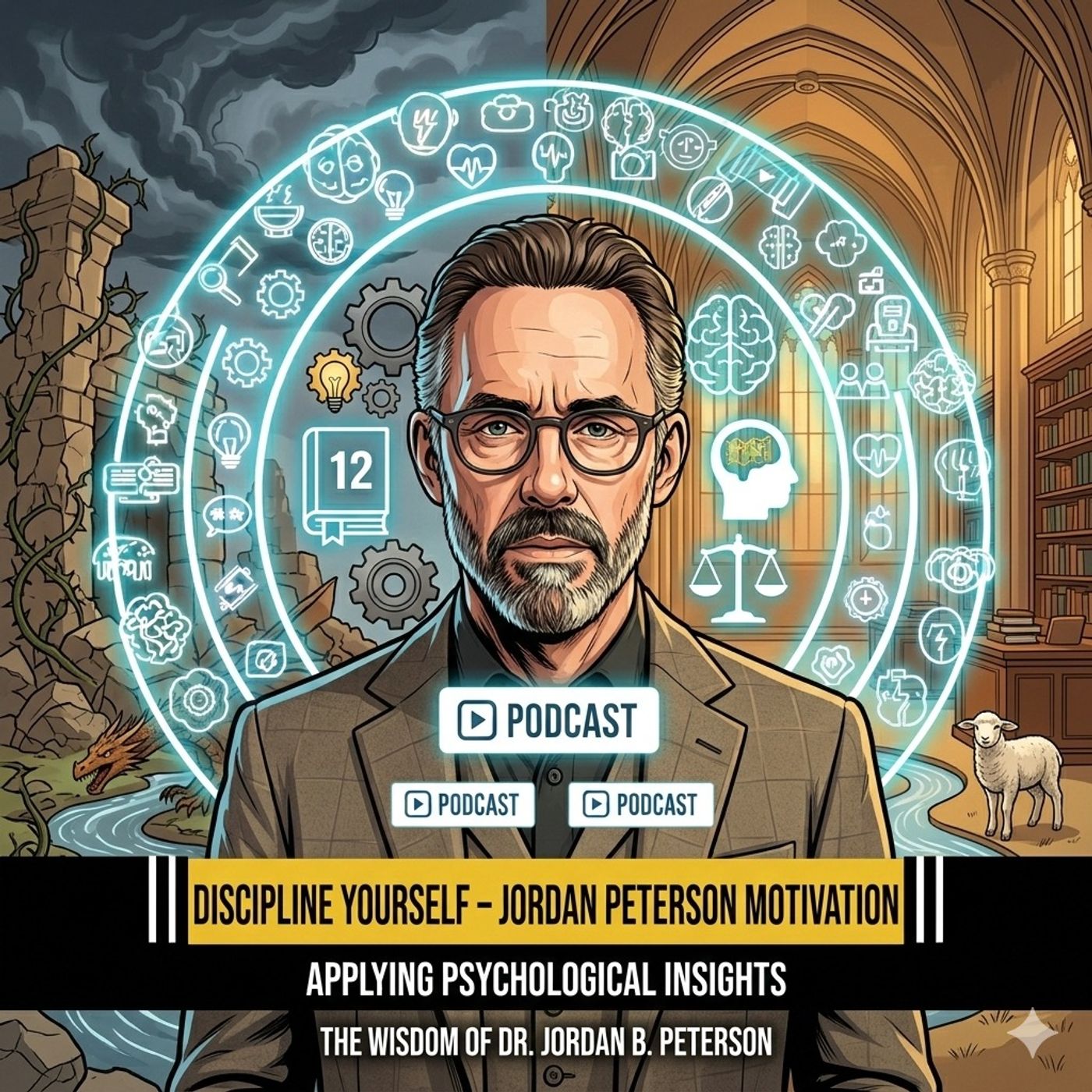
Discipline Yourself – Jordan Peterson Motivation
Be inspired by Jordan Peterson’s powerful motivation on self-discipline, responsibility, and building habits that create lasting success.
We Need Your Love & Support ❤️
https://buymeacoffee.com/myinspiration
#Motivational_Speech
#motivation #inspirational_quotes #motivationalspeech
👉Best Audiobooks for You - 👍
Hosted by Simplecast, an AdsWizz company. See pcm.adswizz.com for information about our collection and use of personal data for advertising.
Get every episode summarized
Each time Motivational Speeches publishes, we email you a written briefing from the transcript — the topics, who appeared, and any specific claims, with the ad reads skipped.
Email me new episodesFree for 3 shows. No card needed.
Hosts & guests

Transcript ready
170 searchable segments. Every word is indexed and playable.
Full transcript
Motivational Speeches — Discipline Yourself – Jordan Peterson Motivation. Machine-transcribed; use the interactive transcript above to jump the player to any line.
If you want to know something about yourself, sit on your bed one night and say to yourself, you've got to mean this, like you've got to be desperate. This is no game this. It's like, my life is not everything I want it to be, and perhaps it's not everything that I need it to be. And by need I mean, my life is so unbearable that the suffering that's attended upon that has made me nihilistic, cynical, bitter, resentful, homicidal, genocidal, unable to have a good relationship, prone to punish people for the virtues because of my jealousy, driving the broclivity to see evil everywhere except within my own heart. Like these are problems, man. And you ask yourself, you sit on the bed and say, okay, man, I'm ready to learn something. What's one thing I'm doing wrong, that I know I'm doing wrong, that I could fix, that
I would fix, it's like, you meditate on that, you'll get an answer. And it won't be one you want, but it'll be the necessary one. You know, and it's often something that will point you to small things. So Carl Jung said, people in the modern world don't see God because they don't look low enough. And so imagine you're in your messy bedroom, you know, and you're sitting on the edge of the bed trying to have an honest dialogue with yourself. And the little voice says, you know, it's pretty disgusting in here. And you think, well, I'm way above such trivial niceties as organizing my room. Well, that's pride, that's arrogance. If you're above organizing what's actually yours, how in the world are you ever going to organize anything else? And so you get on your knees and you think, well, it's time to, you know, take a brush to the toilet. And maybe that's where you start.
And so, and that works, like that works. You start making those micro improvements, like real micro improvements, real on the background, actual micro improvements to things you know that are wrong. You'll improve unbelievably rapidly. Your male and not female, your, your Hindu and not Christian, your tall and not short. You have an arbitrary range of talents and an arbitrary range of limitations, none of which in some sense you chose. It's the cards you're dealt. Now some of those are cards of privilege. No, maybe you're born intelligent. Maybe you're born symmetrical. Maybe you're born healthy. Maybe you're born into a culture where it's much easier not to be absolutely deprived. Maybe your parents are rich. And so all of that in some sense is unearned. Now along with that comes a good dose of existential guilt because at the same time, and this is true for anyone, regardless of their cultural background, the ground we walk on is
soaked in the blood of historical atrocity. And so that's on you because you know people think, well, who's the Nazi? Well it's the fascist or it's the, or who's the radical communist. It's the radical left-wing ideologue and the fundamental truth of the matter is that's best dealt with as a spiritual matter is the adversary is within really most profoundly And so you have to take the responsibility for that historical atrocity onto yourself. I was talking to Guy Ritchie this week about his movie King Arthur. It's quite an interesting movie in many ways. And when Arthur, who could be the hero, takes the sword, he's so overcome by visions of his murderous uncle that he can't pick up the weapon. Well, think about that. Now you have weapons at your disposal. They've been used by your murderous uncle.
I dare you wield them. And the answer is maybe it's easy just to leave the sword on the ground because you do want to be responsible for atrocities going forward and don't think you couldn't be and don't think you might not enjoy it. And so the way you pay for your privileges with your virtue, I mean that most particularly. You have these opportunities and this existential guilt. And the way you expiate that and atone is by doing your best to live the best possible life you can manage to speak the truth, to treat people with respect, to abide by the principles of the dignity of the individual and to put your house in order. And that's how you pay for your unearned privilege. All of us. And we all have our privileges and our curses. All of us have that. That's why it's not useful to be envious of people. You see some, you're a young man, you see someone drive by it and Ferrari with a blonde
and you think, my God, he's got everything and the woman in the car is a prostitute who's got a cocaine addiction and her life is just one catastrophe after another. And he's had to lie and cheat his way into this position and he's afraid that everything's going to come crashing down on him and that's what you're jealous of. And it's just not that profound. You don't want someone else's fate. Man, your fate's enough and your adventure's enough. It's plenty. It's more than you can ever fully realize. And so that's also part of the reason that we all believe that the individual has some intrinsic dignity. It's, don't be so sure that your position in your room is so damn trivial. Might be your attitude towards it that's trivial. And if you're in dire straits and dire circumstances, just look at how much opportunity you have to make things better. Most of us have been raised to believe that the road to a happy life is paved with pleasure
and that the pursuit of pleasure is the path to fulfillment. But as we grow up, we begin to realize that life is not always easy or pleasurable. In fact, much of it is difficult and painful. We all experience loss, disappointment, illness, aging and eventually death. We encounter stress, anxiety and fear. We suffer from the slings and arrows of everyday life. And yet we continue to cling to the idea that happiness is found in pleasure and the avoidance of pain. We try to avoid our painful experiences by numbing ourselves with drugs or alcohol, distracting ourselves with TV or obsessing over our work or our relationships. But the more we try to avoid the basic reality that all human life involves pain, the more we are likely to struggle with that pain when it arises, thereby creating even more suffering. The truth is that happiness is not found in the avoidance of pain, but in the willingness
to face and accept our pain. It is in the willingness to experience our painful thoughts and feelings, to acknowledge them without judgment and to take action in line with our values and goals. It is in the willingness to be present in the moment, to connect with our senses and our environment and to find joy and meaning in the simple things in life. One cannot experience meaning in life without discovering the meaning of suffering, the meaning of suffering. Unavoidable and inescapable suffering alone, of course, can be the deepest possible meaning. The art of being human is learning how to deal with those painful moments. These moments require an attitude of inner willingness to suffer, while remaining in touch, spiritually, with one's own extended dimension. When this inner struggle becomes calm, one can experience how the lower somatic and psychological dimensions influence the higher spiritual dimension, but do not produce or cause it.
One can discover despair, despite success and fulfillment, despite failure. The pessimist resembles a man who observes with fear and sadness that his wall calendar, from which he daily tears a sheet, grows thinner with each passing day. On the other hand, the person who attacks the problems of life actively is like a man who removes each successive leaf from his calendar and files it neatly and carefully away with its predecessors after first having jotted down a few diary notes on the back. He can reflect with pride and joy on all the richness set down in these notes. On all the life, he has already lived to the fullest. What will it matter to him if he notices that he is growing old? Is he any reason to envy the young people whom he sees or wax nostalgic over his own lost youth? What reasons has he to envy a young person for the possibilities that a young person has,
the future which is in store for him? No, thank you, you will think. Instead of possibilities, I have realities in my past. Not only the reality of work done and of love loved, but of sufferings bravely suffered. These sufferings are even the things of which I am most proud, although these are things which cannot inspire envy. Don't aim at success. The more you aim at it and make it a target, the more you are going to miss it. For success like happiness cannot be pursued, it must ensue and it only does so as the unintended side effect of one's personal dedication to a cause greater than oneself or as the byproduct of one's surrender to a person other than oneself. Happiness must happen and the same holds for success. You have to let it happen by not caring about it. I want you to listen to what your conscience commands you to do and go on to carry it out
to the best of your knowledge. Then you will live to see that in the long run. In the long run I say, success will follow you precisely because you had forgotten to think about it. For the first time in my life, I saw the truth as it is set into song by so many poets, proclaimed as the final wisdom by so many thinkers, the truth. That love is the ultimate and highest goal to which man can aspire. When I grasp the meaning of the greatest secret that human poetry and human thought and belief have to impart, the salvation of man is through love and in love, love is the only way to grasp another human being in the innermost core of his personality. No one can become fully aware of the very essence of another human being unless he loves him. By his love, he is enabled to see the essential traits and features in the beloved person. And even more, he sees that which is potential in him, which is not yet actualized but yet
ought to be actualized. Furthermore, by his love, the loving person enables the beloved person to actualize these potentialities. By making him aware of what he can be and of what he should become, he makes these potentialities come true. It did not really matter what we expected from life, but rather what life expected from us. We needed to stop asking about the meaning of life. And instead, think of ourselves as those who were being questioned by life. Daily and hourly, our answer must consist not in talk and meditation, but in right action and in right conduct. Life ultimately means taking the responsibility to find right answer to its problems and to fulfill the tasks which it constantly sets for each individual. Ultimately, man should not ask what the meaning of his life is, but rather must recognize that it is he who is asked. In a word, each man is questioned by life.
And he can only answer to life by answering for his own life. To life, he can only respond by being responsible.
More episodes
More from Motivational Speeches

The Mindset Shift That Will Help You Close More Deals | Dan Lok
Motivational Speeches

The Value of Time: How to Charge What You’re Worth | Dan Lok
Motivational Speeches

The Time I Went on the U-I Talk Show | Dan Lok
Motivational Speeches

The Three Most Powerful Words You Can Use When Selling
Motivational Speeches