Deadly Flooding in Nepal Highlights Asia’s Climate Vulnerability
About this episode
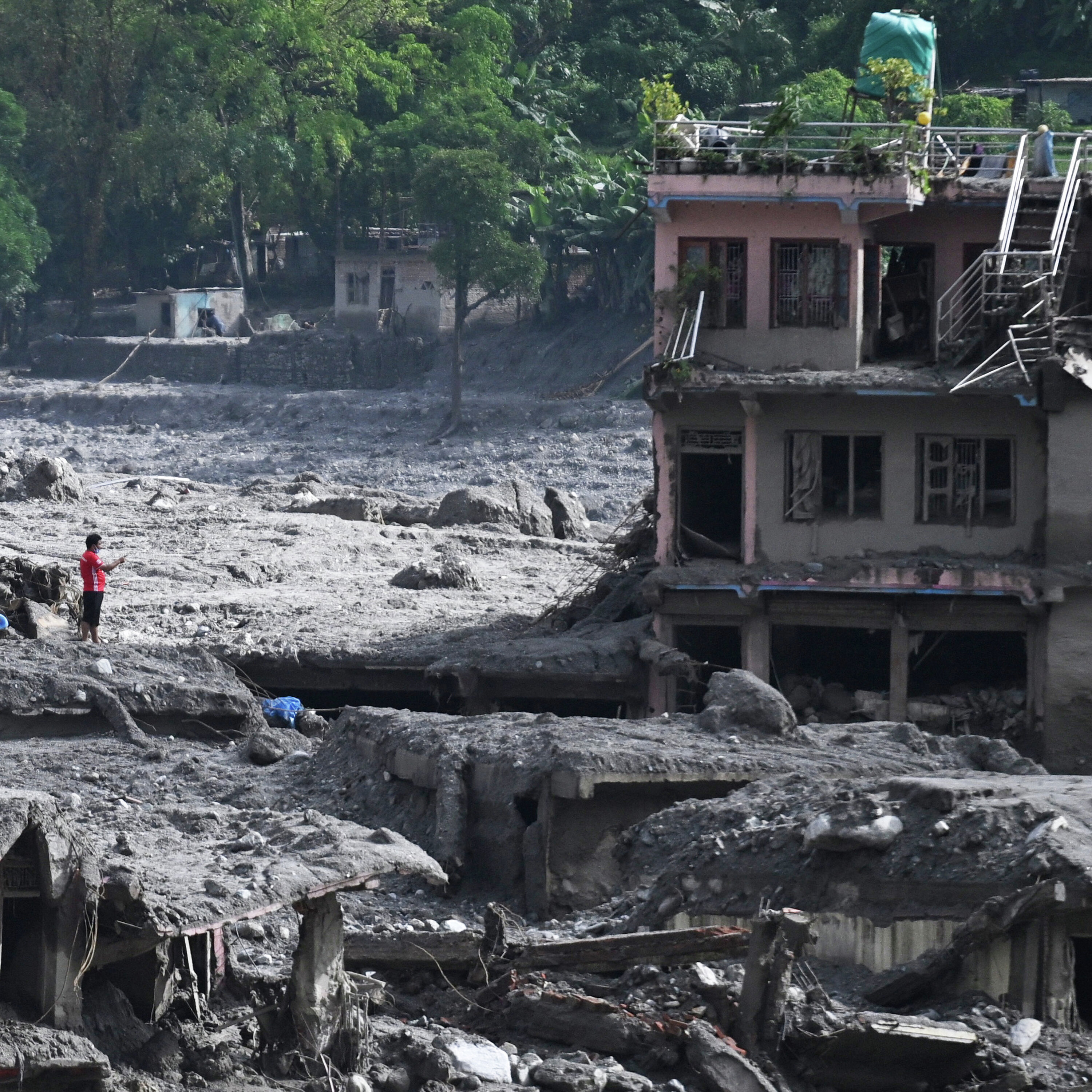
Hundreds of hydropower workers remain missing in Nepal after a glacial collapse caused catastrophic flooding. The disaster laid bare the rising climate risks across Asia and the danger of building in an increasingly volatile environment.
On today’s Big Take Asia podcast, guest host Rebecca Choong Wilkins sits down with Bloomberg’s Clara Ferreira Marques and Bloomberg Opinion’s David Fickling to talk about the human and economic toll of the disaster, why the catastrophe is a warning for the rest of the world and how Nepal’s big bet on clean energy may now be at risk.
We have a special Bloomberg subscription offer for podcast listeners at Bloomberg.com/podcastoffer.
Hosted by Rebecca Choong Wilkins; Produced by Yang Yang; Reported by Clara Ferreira Marques, David Fickling; Edited by Paddy Hirsch, Crispina Robert and Tracey Samuelson.
Fact-checking by Naomi Ng; Engineering by Alex Sugiura
Senior Producer: Naomi Shavin; Deputy Executive Producer: Julia Weaver; Executive Producer: Nicole Beemsterboer.
See omnystudio.com/listener for privacy information.
Get every episode summarized
Each time Big Take Asia publishes, we email you a written briefing from the transcript — the topics, who appeared, and any specific claims, with the ad reads skipped.
Email me new episodesFree for 3 shows. No card needed.
Hosts & guests
Transcript ready
308 searchable segments. Every word is indexed and playable.
Full transcript
Big Take Asia — Deadly Flooding in Nepal Highlights Asia’s Climate Vulnerability. Machine-transcribed; use the interactive transcript above to jump the player to any line.
I'm Josh Manikoots and I hope you'll join us for season five of Dateline Missing in America. In each episode of Dateline's award-winning series, we will focus on one missing person's case and here from the families, the friends, and the investigators all desperate to find them. Maybe you could help solve a mystery. Search Dateline Missing in America to listen completely free or subscribe to Dateline Premium to unlock new episodes early. Didn't catch the latest Roland Martin Unfiltered podcast? Here's what you missed. People wake up and go, oh, damn, wait and hold up. They changed all of that? Yes. It's real. This is a wholesale attack. It is targeting black people in every federal agency. It's wrong. White folks have never allowed that reckoning to last more than a decade. Catch Roland Martin's daily commentary on the Black Information Network. And download Roland Martin Unfiltered on the IHOT radio app Apple Podcast. Or wherever you get your podcasts.
Bloomberg Audio Studios. Podcasts, radio, news. Oh my God, oh my God, what are you doing? Oh my God, what are you doing? For much of the past week, the world has watched in shock as the aftermath of devastating floods in Nepal comes into focus. More than 1,000 people were killed and 1,000 more are still missing. After a glacial collapse swept ice, mud, rock and water through valley communities along the country's border with China. For all of us covering it, the thing that really stood out with the images, the images here we heard of the border, the checkpoint with China, of that sort of flood of water, and the sheer destructive power of that wave, I think really took people aback. Bloomberg's Clara Ferrera Marquez has been covering the disaster. We are still in the early stages of recovery.
There is still a hunt for workers, hundreds of workers on various hydropower projects that have disappeared. Close to 12,000 people have been rescued. And search teams in Nepal are still pulling out survivors. The hope of finding anyone alive is fading fast. It's difficult to access for rescuers, it's difficult for people to come down the mountain themselves. And of course the disaster has affected a lot of the infrastructure, the bridges, the roads, and all of that is complicating this still further. Beyond the immense human toll, the cost to rebuild are likely staggering. Nepal's finance minister has estimated the cost of rebuilding to be four to five billion dollars, roughly a tenth of the size of its economy. Nepal is one of the poorest countries in Asia. It's a 45 billion dollar economy. It had devastating earthquake in 2015, which set the country back billions of dollars in reconstruction costs left hundreds of thousands homeless.
As part of its recovery, Nepal has relied on its tourism industry. It's also invested in hydropower projects, hoping to spur domestic development with cheap, reliable electricity and export surplus energy to neighboring countries. But Clara says the location and the scale of this disaster has threatened both. This is on the border between Nepal and China, so Nepal and Tibet. It's a popular pilgrim route. You have all this sort of administrative structure and military structure, so a lot of people working at checkpoints, health centers, and then you have the hydropower workers. So they really make up a very substantial portion of the people missing, given the sheer scale of a hydropower construction in the wider region and in this area in particular. One thing that we can see very clearly is that these incidents are becoming much more common. David Fickling is a Bloomberg opinion columnist. He says a warming planet is creating special hazards for mountainous regions around the globe.
Because these mountain landscapes are held together by ice and the ice is melting. Eight of the ten worst years for glacier ice losses have been since 2016. And if you look in the eastern Himalayas, land slides are displacing about five times more material now than they were in the 1980s. There's about 15 million people who live at regions of risk of these sorts of floods. About 10 million of them alone are just in high mountain Asia, essentially the broader Himalayan region. This is the big take Asia from Bloomberg News. I'm Rebecca Chung Wilkins in for Wanha. Every week we take you inside some of the world's biggest and most powerful economies and the markets, tycoons, and businesses that drive this ever-shifting region. Today on the show, flooding on the northern border of Nepal has devastated the region and claimed more than a thousand lives.
But Nepal isn't the only country affected by this kind of natural disaster. We look at what triggered the floods, what countries around the world are doing to prepare for similar events, and how one critical industry sits at the centre of the challenge, both as a solution and a potential problem. Scientists currently believe the floods in northern Nepal were triggered when a massive chunk of ice and rock broke away from a glacier high in the Himalayas. That in turn sent a powerful surge of water downstream through the river and into communities. You can't say that one particular landslide was caused by climate change, because landslides in general are contingent on such a complicated array of things that go wrong, a mountain collapsing, seasonal floods and that sort of thing. It's very hard to detect the signal of climate change. But in general, one thing that we can see very clearly is that these incidents are becoming much more common,
because these mountain landscapes are held together by ice and the ice is melting. And Bloomberg opinion, David Fickling, says it's not just glaciers that are melting. Permafrost, ground that's supposed to remain frozen year round, is also thawing, and that can make mountainsides less stable. Roughly a quarter of land area of the globe is what you could broadly call the Christphere. So this is area where ice is predominant. A lot of that is ice cap, obviously, Antarctica and Greenland. But a huge stretch of that is the Permafrost region. The Permafrost is changing quite rapidly. You could have a layer of Permafrost that's underlying a glacier, and when that turns to non-melted soil and rock, it's not nearly as robust as Permafrost, and then the glacier can just slide off like the slow sliding off a shallow roof in spring. The disaster in Nepal has been catastrophic, but it was by no means unique. David's as landslides and flash floods triggered by glaciers melting from warmer temperatures are a growing threat in mountainous regions across the world.
This is quite a common thing around the world. Really on mainly four continents, North America, for instance, do you know the capital city of Alaska? Every year has a glacier lake outburst flood. The last one flowed through just last month. So that's a very common occurrence. Switzerland, of course, many people remember the footage from last year of the little town of Blatton that was obliterated last year by a landslide very similar to this one. South America, you have these sorts of things in the Andes, it's sort of similar geography. And of course, India is probably the country that's most exposed to this. The only comparable disaster this I can think of in recent years is around the town of Kedarnath, which is a pilgrimage town in Otarakan state in the Himalayan portion of India. More than 6,000 people were killed in a series of flooding and landslide and glacier disasters there in about 2013. By some estimates, around 15 million people live in areas at risk from glacial lake floods,
with roughly 2 thirds of them in the high mountains of Asia. As those risks grow, governments are grappling with the same challenge. How to anticipate and prepare for disasters that can unfold with little warning. But countries are not equally equipped. Take the example of that Swiss village we talked about, Blatton last year. That glacier has been heavily monitored and Switzerland has heavily monitored many of its glaciers. For the best part of a century, there's a lot of understanding of what happens there. Swiss authorities began evacuating some residents from Blatton in mid-May 2025. That was 9 days before the glacier actually collapsed. By contrast, warnings in Nepal came just minutes before the water swept through, due to gaps in weather monitoring and data sharing with China. In terms of information sharing, it sounds like a lot of the information sharing has been lacking. But one thing I would add is that these are genuinely very remote regions.
The quality of information collection is just fundamentally not very good. Nepal sits in the middle of a very tense geopolitical situation between India and China. So Nepal sits in a little uncomfortable situation there, and that's been caught up in the geopolitics. But I don't really think this was geopolitics that caused this. One difficulty in Nepal is that the government gets stuck in this reactive cycle. As flooding becomes more frequent, the government is forced to race to fix the problem. Only then to have another disaster hit. State capacity is a huge problem with any of these things. This is though wired, say you need more infrastructure for development and for wealth you need infrastructure. And if you have low quality infrastructure that's not providing as much wealth as much, you know, foreign exchange revenue as much profit for local businesses, then it makes it so much harder to achieve the sort of things in adaptation that you need to achieve. After the break, what can Nepal and other mountain countries do to protect themselves
from these types of disasters in the future? When I was 14 years old, I was kidnapped and health captive for nine months. I survived and I've spent my life exploring how other people survive what should have destroyed them. I'm Elizabeth Smart and these are the survivor files. I just remember this low taunting voice next to my ear saying, shut up, don't say anything. Every week, I'm with survivors who lived through the unthinkable. I knew if he woke up without a doubt he was going to hurt me. I started feeling that there was someone at the end of my bed and I just started screaming. They are abducted, stalked, controlled and nearly silenced. But these aren't stories about what's taken from them. Their story is about what it takes to make it out alive.
Listen to the survivor files with Elizabeth Smart on the iHeartRadio app Apple Podcasts or wherever you get your podcasts. If you're a bookshelf and you're a for-you-page or equally important to your personality, welcome home. This is Pro's Society, the weekly podcast that's part book club, part group chat for thought daughters, pop culture obsessives and anyone who thinks pride and prejudice and love island deserve the same level of discourse. I'm Eli Rallo and every week we're connecting the dots between books, the internet and the conversations everyone can't stop having. I'm going to have to look up this story. From bestselling authors and your favorite book talk creators to the latest pop culture moments, nothing is off the table. So like if you can hide some real messages inside compelling characters and that is a Trojan horse. Whether you're looking for literary deep dives, smart pop culture conversations or a community of readers who love to think a little too much, you're in the right place.
Listen to Pro's Society on the iHeartRadio app Apple Podcasts or wherever you get your podcasts. See you between the pages. Didn't catch the latest Roland Martin unfiltered podcast? Here's what you missed. And the argument is, do you want to win? If you don't win, you have no power. It's real. Those are the very people who I always say vote against their own economic interests and they complained about the very thing they were receiving. It's raw. I knew that the issue of transgender athletes was not going well with a lot of black men. Roland Martin unfiltered. I went off. I said this is exactly what I'm talking about. Y'all go scream at Chanel but you don't want to see a black luxury company in the same bag. Catch Roland Martin's daily commentary on the black information network. 12 C's. Those are moving south. So if you Democrats, you don't wait to 23. You better be hitting the ground going hard in the south now.
And download Roland Martin unfiltered on the iHeartRadio app Apple Podcasts. Or wherever you get your podcasts. Countries affected by the kind of flooding that has hit Northern Nepal are investing in a variety of measures to offset growing climate-related risks. Things like early warning systems to flag potential weaknesses, sponge cities to absorb and store rainwater and big infrastructure projects like dams, river dikes and increasingly hydro power. A lot of the big hydro projects of the 20th century were built not so much for electricity. They were actually built for flood management and for flood control. And the hydroelectricity was the sort of co-benefit that paid for the flood control. That's the case with a lot of the big US dam projects. It's the case with the three gorgeous dam in China. But not all hydro power projects are created equal. David says there are generally two types of hydro power dams. And one can offer significantly more protection against flooding than the other.
One is called storage hydro and the other is called run of river hydro. Now storage hydro is what we normally think about. It's a big dam that makes a reservoir. People are displaced from the reservoir as that fills up. And then you have this new reservoir like Glen Canyon in the US or the three gorgeous in China. That's barely being built in places like Nepal. And what we have instead is something called run of river hydro, which is more like a water wheel. It doesn't create much of a reservoir. It doesn't disrupt the river flow very much. It's cheaper to build. But it doesn't provide the benefits of storing energy and doing flood management that you get from storage hydro. So Nepal is sort of building the cheaper version that doesn't provide flood protection. And yet hydro power is still an important pillar of the country's economic ambitions. It provides cheap electricity at home and is a source of export revenue abroad. But Nepal has struggled to fully capitalize on hydro power's potential. The biggest problem for Nepal is just that it's been a very poor country.
It doesn't have sophisticated electricity grid. About like 13% of electricity is lost every year just by general losses in the grid network. It's got very minimal integration with exports to India. And also these run of river dams, which are the ones that they're building, 90% of them are these run of river dams. They export electricity only when the water is running. They can't store it for later months. And that means they're often selling into the Indian market at the time when prices are lowest. So it's not very attractive. Disasters like the one playing out in northern Nepal right now complicate the picture. There are hundreds of hydro projects in the country, either in development or up and running. But about a dozen of them have been affected by these floods. That's already creating ripple effects through the hydro power industry, as project companies call on their insurers to assess the damage. Obviously an instant like this pushes up the cost of insurance. Insurers have been talking about this for decades at this point.
The frequency of natural disasters is going up and that is increasing their costs. And that interacts with the fact of course that insurers one side of their business is insured losses. And the other side is the investment side of their business. And a lot of their investments have been struggling in recent years as well. So they're sort of squeezed on both ends. It's going to push up the cost of insurance quite considerably. David says that won't help an industry that's been pushed down the list for investment for more than two decades. The funding drought that hit hydro in the 90s has not really receded of all the money that was committed by the major development banks in 2022 to energy. Hydro took just 2.8% of all of that money. And if you look since the Paris Agreement in 2015, the amount committed to hydro has been about 8.7 billion. Fossil fuels has received about 12 billion since the Paris Agreement. So fossil fuels since the Paris Agreement on climate change have actually received more funding
from development banks than hydroelectricity. And that I think is clearly a failure. I think actually the fact that wind and solar and batteries are such a compelling energy generation cocktail is in some ways a problem in itself because it provides a lot of very easy bankable projects that sort of crowd out a lot of this hydro which is quite hard. Wind, solar and batteries provide pretty much guaranteed cash flows between one and five years of getting your financial sign off, whereas hydro is more like 10 to 15 years. Despite all of those challenges, David doesn't see Nepal backing away from its bet on hydro power. I think every country should aspire to development. And I think Nepal has great potential to be an export powerhouse of this sort. That's what we're seeing. A lot of other high altitude countries doing. Ethiopia has stunned very well from building the grand Ethiopian. Nice on this one that was built.
Tanzania just financed a dam which is just recently opened and is simply successful. Laos is another example of this. So there are plenty of examples of countries that can do well from this. Hydropower presents an opportunity for Nepal. But the devastation from the recent flooding shows the risks in developing this industry. Nepal's new government has been in power less than six months. David says to be successful in developing hydro, it needs to make some changes to the way things are done, starting with proper oversight. At the moment, no one's really taking responsibility for the problem. So Nepal, they have a planning law in Nepal, but essentially in these high mountain valleys these are a long way from the arm of the law. So are these buildings and roads being built in stable situations that aren't going to be affected by floods, or are they just being built wherever you can persuade local officials to let you build them? When institutions are actually capable of taking responsibility for this they actually can mitigate some of the damage. The Nepalese government estimates it will cost between four and five billion dollars
to rebuild after these floods. But David notes that this is the third such disaster to hit the region in as many years. And there's no way to tell when the next one will strike. The more you look into it, the more you realise these are becoming annual events and one thing that we see, we've been warning about for many years with climate change, is that you spend all your time just running on the spot basically because of course you're dealing with the previous disaster and the consequences from the previous disaster before the next disaster even hits. This is The Big Take Asia from Bloomberg News. I'm Rebecca Chung Wilkins. To get more from The Big Take and unlimited access to allofbloomberg.com subscribe today at bloomberg.com slash podcast offer. If you like the episode, make sure to subscribe and review The Big Take Asia
wherever you listen to podcasts. It helps people find the show. Thank you for listening. See you next time. Music On all of it with me, Alison Stewart will talk about art, music, theatre, literature, history, food, well, all of it. Here in-depth, insightful interviews with authors like Zadie Smith, musicians like Steve Earle, actors like Kate Winslet and Beyond. You never know who you'll hear next on all of it, but it's always worth listening. That's all of it, available wherever you get your podcasts. Didn't catch the latest Roland Martin unfiltered podcast? Here's what you missed. There should not be a single law enforcement agency that does not have body cameras. It's real. Black farmers have been under attack. This is just the latest example of them just slapping DEI on anything.
It's raw. And I'm sitting here going, they are playing y'all for foals. Catch Roland Martin's daily commentary on the Black Information Network. And download Roland Martin unfiltered on the iHot Radio app, Apple Podcast. Wherever you get your podcasts. Whether you're a seasoned NFL fan or new to the game, there's one place to keep up with all of it. The league's newest podcast. The NFL report posted by me, Andrew Sassiliano. It is your home for everything football. Breaking news, expert analysis, game picks, and here from your favorite players too. Join me and at All Starcast of Experts for everything you need to know from around the league. Get new episodes of the NFL report Monday through Friday, all season long. Listen to the NFL report podcast on the iHot Radio app, Apple Podcast or wherever you get your podcasts.
More episodes
More from Big Take Asia

How Two-Minute Microdramas Became a Billion-Dollar Industry
Big Take Asia

The Unexpected Rise of North Korea’s Economy
Big Take Asia

The Chinese AI Model Rattling Silicon Valley and Washington
Big Take Asia

Introducing: Our Town
Big Take Asia