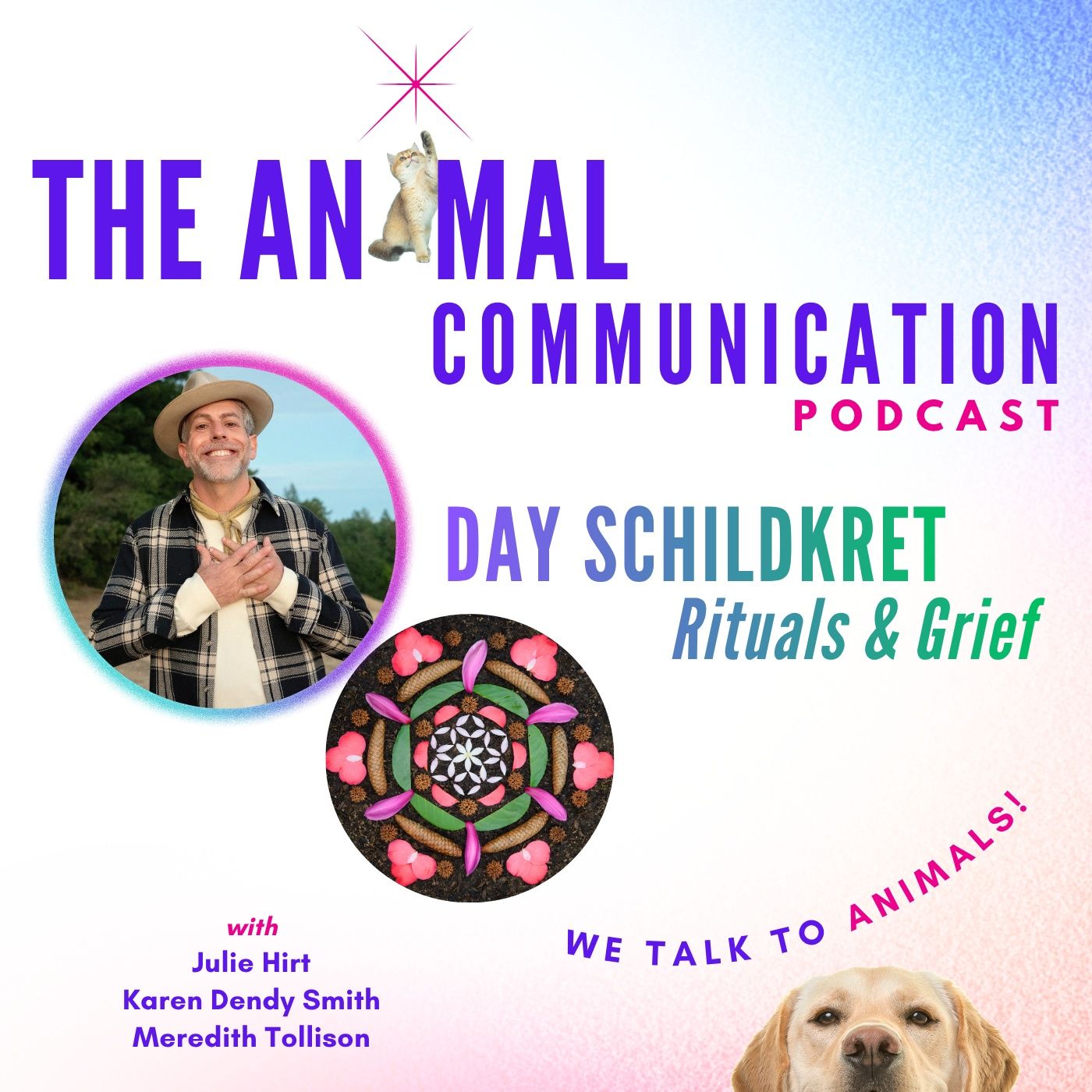
About this episode
RESOURCES:
https://www.dayschildkret.com/
https://www.morningaltars.com/
Teacher Training: https://www.morningaltars.com/teachertraining
Day’s book: Hello, Goodbye
Do YOU want to be an animal communicator or learn more about Soul Level Intuitive Coaching®?
Check out the new classes and Be Open Community offered by our teacher, Danielle MacKinnon. It’s a great place to learn Energy Management, trusting yourself and even finding a great, supportive community.
YOUR HOSTS
Julie is a Soul Level Animal Communicator®, Heart Animal Soul Professional Communicator, Soul Level Intuitive Coach®, Spirit Animal Sacred Alchemy Practitioner and Certified Trauma-Informed Grief Coach. She writes the column “Trust the Animals” on Substack and is a teaching assistant for the Danielle MacKinnon School. Find out more about her and her monthly Pet Loss Grief Circles at her website: https://www.juliehirt-intuitive.com/
Karen is a Soul Level Animal Communicator®, Soul Level Intuitive Coach®, Pangu Shengong (qigong) Instructor and Energy Healer. She is an End-of-life Companion Animal Doula through the UVM certificate program and a teaching assistant for the Danielle MacKinnon School. She is also on the board of NicaLove Animal Rescue and the Founder and a Director of The Animal Communication Collective®. Find out more about her at her website: https://www.karendendysmith.com/
Meredith is a Soul Level Animal Communicator®, Soul Level Intuitive Coach®, Let Animals Lead® Animal Reiki Practitioner, and certified dog trainer with a focus on behavior modification and positive reinforcement. She is also a Director of The Animal Communication Collective®. Find out more about her at her website: https://www.meredithtollison.com/
You can find all of our episodes at MindBodySpirit.fm. Reach out to us with questions or comments via the Contact Us form on our website (https://www.theanimalcommunicationpodcast.com). Learn more about the fundraising work Karen, Meredith and Julie do with The Animal Communication Collective at https://www.animalcommunicationcollective.com/.
This podcast is a part of the MindBodySpirit.fm Podcast Network
Visit us at www.mindbodyspirit.fm
Get every episode summarized
Each time The Animal Communication Podcast publishes, we email you a written briefing from the transcript — the topics, who appeared, and any specific claims, with the ad reads skipped.
Email me new episodesFree for 3 shows. No card needed.
Hosts & guests
Transcript ready
494 searchable segments. Every word is indexed and playable.
Full transcript
The Animal Communication Podcast — Day Schildkret on Ritual and Pet Loss. Machine-transcribed; use the interactive transcript above to jump the player to any line.
The following podcast is part of the MindBodySphere.fm podcast network. This episode is sponsored by Unity.org. Travel with Unity in 2027 and experience the world through a spiritual lens. Journey to Sacred Peru or Mindful Japan or ancient traditions, meaningful practices and kindred spirits invite you to slow down, connect and discover something deeper along the way. Learn more at spirit.tours. Step into a weekend of transformation at the San Diego Transcendence Retriepe, September 19th and 20th at the beautiful Katamaran Resort in Mission Day. Explore quantum consciousness and experience quantum love with world-renowned speakers, near-death experiencers, ET contactees, hypnotic regressionist and channelers. Relax with transcending meditations on the beach and soothing sound baths, while connecting with fellow seekers on a deeper level.
Discover new perspectives for your mind, body and spirit. Visit San Diego Transcendence Retriepe.com for tickets and information. Welcome to the Animal Communication Podcast where we talk to animals. We're your hosts, Karen Dendi Smith, Meredith Tollison and Julie Hirt. Every week we'll share insights and stories from the animals. We'll also share how animal communication is a huge part of our lives, influencing our own growth, as well as deepening the relationship with our animal family. We'll be weaving in special guests and animal communication readings, so join us as we discuss all things animal communication. Welcome back everyone to the Animal Communication Podcast. I'm Julie Hirt and with me are my friends and co-hosts, Meredith Tollison. Hey Karen, Dendi Smith. Today we have a very special guest to help us understand, incorporate and remember,
something we may have never known or maybe misunderstood. And that is ritual. I've been thinking about this topic for a few years now, particularly after losing my two dogs within six months of each other and after losing my dad and I'm coming up on the second anniversary of that loss just next week. What is ritual and how can it help us? Maybe better said though, is how can it support us in that huge space that grief is, can be and creates. Back in 2021, I moved from my beloved anchorage to be closer to my parents in West Michigan. And I had suspected my mom at that time had some kind of memory issue and my dad, well he had had a stroke to use prior, so I kind of felt time ticking and it was pressing on me. And at the time of our move, I was doing some marketing support for my yoga teacher. And as a farewell gift, she gave me one of our guests, 2022 Morning Alters Calendar. I loved it. It is so beautiful and so creative and inspirational.
It was a wonderful way to ground myself each morning when I looked at it and I tried creating my own morning alters for a spell. And of course, to my own criticism and herring and I ended up stopping. But by then, I had subscribed to Dayshield Krezz newsletter and always moved and was always moved in reading his touch points across his mother's dementia, moving her, his familiar relationships and all of it for a number of years. And then on May 28th of this year, he wrote an email about the dog who inhabited his young life, Snickers, and how at the time there was no honoring of her for a variety of reasons. Oh, he's holding up a picture of her for us to see right now. Oh, so lovely. Thank you. How at the time there was no honoring of her and for a variety of reasons, variety of reasons, that was when I thought we all need to hear him. All of our listeners who have encountered pet loss and are still dealing with grief or maybe haven't had the space to do so, this conversation is for you.
So let me introduce Dayshield Krezzio. He is an award-winning author, artist, ritualist, teacher, and is internationally known for morning alters, which Buzzfeed calls a quote celebration of nature and life, unquote. Working for over a decade with individuals, communities, and organizations, Day is helping to heal the culture through a meaningful and creative response to change. Day is the author of Hello Goodbye 75 Richels for Times of Lost Celebration and Change, and as well as morning alters, a seven-step practice to nourish your spirit through nature art and ritual. Day, welcome to the podcast. We are so, so happy to have you here. It's mutual. I'm so happy to be here. This is my, this is one of my favorite topics. Sweet. Okay. This is good. I want to kind of dive right into ritual. So as a way to understand ritual, I thought we could start with the idea that our culture, and I'm speaking here as a white American woman, right, has largely lost its relationship to ritual, especially around these big thresholds of birth, death, marriage, and loss.
Can you talk a bit about what happens to us individually and collectively when we don't mark these transitions? Sure. I mean, I think the first question is what have we lost it to? What have we lost ritual to? And I think, you know, these days we have locked collectively, I think we have confused routine and ritual. Right. And so I think a lot of the time we think our routines are rituals when they're actually just routines and what's the difference between a routine and a ritual, a routine in the word itself has the word route in it. Right. So routine comes, they share the same etymological route and routines are trying to get us from something to the next thing. They're like helping us get through the day. Right. I have my gym routine. I have my coffee routine. I have my nighttime routines. They help us get from point A to point B. Ritual has nothing to do with trying to get you from one place to the next. Ritual's main motivation is number one to let something unseen be seen.
Number two, its purpose is to transform. So it's actually about what's happening right now and to let the under layers of it be seen more. So what's actually happening and then to transform your relationship to the thing. Do you want to hear like a very simple example of that? Okay. So so this isn't a very simple example during the pandemic of when I transform when I changed a routine to a ritual. Because I needed to. It was a really difficult time at the time my mother's dementia was really, really declining. My grandmother was in the hospital with COVID. And then all the other things with jobs and insecurities and all the things I came with COVID. And so I needed my morning to set me right. I did, you know, and I have I drink coffee my coffee in the morning and it was a routine. You know, I just would make coffee and have the routine.
So I needed the morning to feel different. And so the the slight shift I made to transform it from a routine into a ritual is that the night before on my coffee filter. I wrote a reminder to my morning self. Something to do. You know, pause, take a breath, whatever it was. Some and some thing that I learned from the day before I wrote it to my morning perk my morning self. And so in the morning I would wake up and I totally forget about this. I come downstairs and on my coffee filter was something that took that experience of just the normal making coffee and it made it into something deeper. Right. And so it transformed my morning and set me in the right orientation, the right direction. That's a very, very basic small example. Obviously rituals can be a lot more complex, a lot deeper. They can they really accompany and I know we're going to get into this conversations around grief.
They really can hold the space for uncertainty, for grief, for insecurity, for fear. So I'm not sure if the ritual is this is this is the space that can hold that now you asked another question and I just want to make sure I got to it, which is you ask me, the last part of your question, I think was like, what have we lost? Yes, yeah. And I think, you know, rituals, one of rituals main motivation is meaning it's trying to make meaning with things that are hard for us to understand normally like death, like loss, even sometimes like wins and celebrations, you know, births for instance, but it's very hard when we're living our normal lives. And we're doing emails and we're making, you know, we're engaged in work and we're cleaning the house and picking up the kids and like we get to the end of our day and we're exhausted, hard for us to make our lives meaningful. And so ritual creates these temporary spaces, sometimes a minute, sometimes a few hours, where we enter in and can try and get, as I said, make the unseen scene so we can make meaning with our lives.
And so I think that is, you know, you can see it on social media, you can see it in politics right now, like people are really struggling with meaning. What is this all mean? Yeah, yeah, yeah, absolutely. That was beautiful. I have not, I'm glad that you slowed the question down to describe the difference between routine and ritual. Yeah, yeah, it's an important one because I think, you know, as I said, meaning, we like to, we say make meaning. Right. So, but, but I think we use that, but we don't really understand that like meaning is actually something that is made. It's something that is crafted. And so with ritual, it's, I think, you know, with routine, it's like we just do these things, but I don't think people fully understand like ritual is something that needs to be made. It needs to be set aside. We need to do something that is sometimes symbolic.
So that we understand the deeper layer of what we're experiencing in life. Yeah, yeah. And that feels too like part of what when you were saying on social media, you're watching people trying to find meaning because we are in such this productivity routine mode. If ritual is where we can make meaning, but routine is not necessarily that place. So I can see where that separation and which we've talked about as a theme throughout this whole entire season is the separation that we are feeling from everything. Yes. That ritual could help bring us back to the moment. Yes. Yeah. I think there, you know, I grew up when I was 12 years old, I chose to be religious. I was raised as in my Jewish faith and Jewish culture. And I was looking for both belonging and meaning.
And I think that is something that religions give us. For, you know, ritual doesn't just, religions are not monopolizing ritual. Ritual doesn't just belong to religions, although ritual also belongs to religions. My religion taught me so much about ritual. So I have a very deep understanding of its purpose and its mechanisms, thanks to having grown up with my faith. And I'm also an artist, you know, and so I don't think a lot of people realize that ritual is something that is passed down, but it's also something that's invented. It's something that is created. And so you can just make up a ritual if it's meaningful to you. And I think part of my job in this lifetime is to help connect the dots for people that like you can do this. And you can create your own ritual that can address what you are going through in your life right now.
And I'm sure we'll talk today about the rituals I've done around my dogs and their deaths. And that's a, I'll get to that, but that's a great example of creating new rituals. Yeah. I just want to say thank you for sharing that ritual is something that you can create and make for yourself based on your own personal journey with experiences. And I know that a lot of times the animals will ask their humans to please slow down and stop a routine and look at the depth of what they're doing in the moment and allow it to become a ritual. Yes, for closer connection. And so I just love how you you talk about that because animals are constantly trying to like get people to switch routine into something more meaningful. Yes, beautiful. Yeah, yeah, I know that from experience. Yeah. So several things in what you just said resonate strongly with me so much ritual we do associate with religion with religious upbringing.
And there are so many rights and rituals that I love even from spiritual or religious systems that I'm not a part of or that I don't understand. And maybe that's part of being an intuitive is it just it resonates with me that something very meaningful is happening even if it's not meaningful to me. It becomes meaningful to me, you know, but I have my own rituals that I do as almost as part of a routine. So do you think ritual and routine can be one and the same? Absolutely. Yeah, I wrote a I wrote. So in hello, goodbye in the book in my last book, which I kind of call like a ritual cookbook where you can just take it off the shelf and cook up one of the rituals or make up your own. One of the rituals I cooked up in the book was for I had a talk to a friend who had a small daughter. I think she was at the time like five. And I said, what is the what's the ritual you need?
And he said, I need a ritual to put my daughter to bed at night. And I said, cool, what do you do? And so he said, well, you know, I read her books and I put on the sound machine and I closed the curtains and I kiss her to night and I leave the door. I know I close, I leave the room. And I said, okay, so there's like, I think in our conversation, I identified like seven movements in his daughter's room. And I said, what if you did those, the routine, but each one of them also became a question that you asked your daughter. Right. So instead of just closing the curtains, I don't remember what I wrote in the book, but it was something along the lines of like what's something, what is something today that you are, you know, proud of. And kissing his daughter, what's, who's someone today that you love? And like each one of them became a self reflective question. As I said, taking the unseen, something that she knows or unsaid and letting it come out of her and be spoken or be seen and be witness by her dad.
So he was accomplishing all of the routines of the nighttime bedtime routine, but each one of them became a punctuation to slow down and connect with his daughter. Yeah. Gosh, I love that. I love that because I feel like I tend to make up rituals for myself without realizing that's what I'm doing. I was listening to an interview with you and one of your friends. I think it was at the very beginning of the pandemic and you were on an island off the coast of Vancouver somewhere. And you were talking about, I believe this is in the same, the same context. You were talking about your morning, morning alters, how that kind of came to be in Wow, that canyon. Yeah. And the beautiful works of art that you made and how you turned that into a thing. Yeah. I love you used the word forwarding. So each morning, this is my routine ritual that I was asking you about. I go and walk through my garden. I'm a huge gardener. I both rejoice and mourn the passing of seasons, the coming and going of particular plants and flowers and insects.
And I'm so grateful to live in a part of the world where we have annual cicadas. These ladies know how much I love cicadas. So I walk out every morning and sing with the cicadas. And I've always called it my gathering. I'll pick up the pretty leaf or the rock that's in the wrong place or the feather that I found. And I leave it sort of like a little cane on this one table in the back. But I've never thought of that as creating a morning altar. And it's always felt to me a little bit sad. You know, the sense of impermanence about it has felt a little bit sad to me. But after listening to you talk about these creations and the impermanence of it, I'm truly inspired to be a little bit more intentional about finding the joy in that, the reality in that rather than grieving the waves that wash away the suncastles or grieving the frost that takes away the flowers. I've always felt sad about, you know, the monks sweeping away the beautiful works of art that they've made.
But it all makes perfect sense. So I thank you for sharing that. Yeah, I think that there's, you know, for those of those that are listening that don't know, maybe be good just to spend a minute on what we're talking about. Because this thing we're calling morning altars came from when my dad died about 15 years ago. And I also went through a relationship breakup. And I was really, really disoriented and almost like depressed inside of my house. It was my dog Rudy who got me out of my house. And my first book is actually devoted to her because she was the one that, you know, I probably would have hermitted in my home if it wasn't for her. And she got me on these dog walks and I was just ruminating in my head. And she was curious and alive and engaging the world. And anyway, one morning we went to the top of the hill in a park near my house.
And there were these beautiful amber colored mushrooms that were growing under one of the eucalyptus trees that was there. And I sat down under that tree and I just started to arrange whatever was under the tree. And I made it into a beautiful pattern. And I dedicated it to my dad. And something inside of me really shifted that there was like my grief felt like it had someplace to land. And so I challenged myself if I could go back to that spot for 30 days and make another piece of whatever I collected along the way. My mornings became a ritual, you know, it was a way of me making art and making meaning and slowing down and turning the dog walks into something that was very much about like recollecting myself and also recollecting my grief. And so and all of the pieces I've ever made in over the years, it's been, you know, a thousand.
But none of them exist anymore. They're all, as you said, impermanent. And there's something deeply moving. There's something profoundly moving that my creations have changed. Have found their way back to the earth. You know, you mentioned like that you, it made you sad. And it's, I want to just say it's, it's both. Right? It's the impermanent piece is sad. Do I wish that all the things I've spent hours and hours making like still existed? Yes. Do I wish that my dogs who I loved, that Rudy, that I love still existed? I do. I miss her, you know. And at the same time, there's something very life giving about continuing to keep making meaning and beauty with my life and with their memories.
And so it's a both end, you know what I mean by that? Like it's, it's sad and it's beautiful at the same time. And I think that to me is, there's something there that's very important for folks to practice holding in these days is, you know, grief and praise for our lives. And to that point, I'm going to quote you here for a second. In your book, hello, goodbye. You say, grief isn't something we get over. It's something we get under. That when someone we love is dying or is recently died, we're needed, whether we know it or not, that their life and memory are in our hands asking for our whole broken heart to meet them so their life doesn't disappear on our watch. It's making me feel a little bit teary as I say that. So you're talking about this holding space, this holding space with your creations, with your impermanent creations, the grief and the praise coming together.
What can you say about that? What does getting under grief mean to you? Yeah, I think that we have in the culture we live in that is ever addicted to productivity, to competency, to speed, to all the things that are, you know, relatively like immature, in my opinion, when we encounter loss as individuals or collectively, because we have, as my teacher, Steve Jenkinson used to say or still says, the culture is grief illiterate, which means that there's a phobia around loss. And we're trying to get from the loss to the normal as fast as possible. And so we have an intolerance towards being in the discomfort of the loss, the discomfort of the uncertainty of the around the loss, the feelings around that.
And specifically the grief, which is, you know, grief, yes, it's part sadness, but I would say grief is more love. Right, and love towards what you no longer have, but there's a longing for that one, there's a reaching towards that. There's a, there's like the hands are stretching towards that. And there's a, as I said, an intolerance towards like being in that uncomfortable, we're so used to getting the things that we want immediately. Right, the culture is like everything's immediate these days. I want to watch a movie, it's immediate. I want to turn on a light, it's immediate. I want Amazon packages, you know, same day, right, and grief is trying to teach us that it's not immediate. You're in the intermediate, you're in the in between. And so the intolerance is cultural. And so in some ways we have to learn how to tolerate loss and, and to be in that, to practice being in that in between space.
And so my way, and there's many ways to do this, but my way is through beauty. What does it mean to take the pain of loss, to take the complexity of loss, to take the paradox sometimes where it's, it's confusing, you know, of loss. I mean, I'm experiencing it with my mom right now. She's in late stage dementia and half of me wants her here and half of me wants her gone. You know, and it's very complicated, right. And, and so there's something about ritual and there's something about beauty making, like making beauty with the grief that can help us build a tolerance for what we're doing. For what's uncomfortable. And it helps us build a sense of understanding, right, towards what is hard to understand.
It brings a sense of maybe even sanity towards things that feel really, really difficult to digest. And, you know, and and beauty does that, you know, when you see something beautiful, it like, you can receive it. It's, it feels good. You can take it in. It's digestible. And so I think part of my mission in the world is, can we keep transforming our grief into beauty. And meaning, those are my two big things. Can we keep transforming our loss into beauty and meaning and our pain, into beauty and meaning. We continue to relate to everything that's so much bigger than us by approaching it with wonder and curiosity and creativity. I think that's a message that so many people need to hear, especially when you're deep in the throes of grief, loss, anything.
People feel like I don't deserve to recognize beauty. I don't deserve to see me or I don't want to see beauty or meaning I want to be here in my grief. Yeah. But I often tell clients the only way through it is through it. You know, there's no, like you said, point eight point B. Yeah. We're not, we're not getting over it. How can we make this an opening, a beautiful experience? How do we allow ourselves to recognize the beauty and the meaning in the experience? Because I think a lot of people get hung up on. I'm not supposed to be in wonder because I'm in grief. Yeah. Exactly. Can exist together. Yeah. And I think that, you know, I say first and foremost, I have a lot of compassion for that perspective. You know, when we're in pain, it's very difficult to to feel, to let ourselves feel. Right. Beauty is an aesthetic, which really means feeling.
So it's, it's the impulse when we're in pain is to protect, is to withdraw, is to, is to harden because it's painful, you know, to feel. And so I understand that perspective a lot. I have a lot of experience with that perspective. I have a lot of compassion for it. And I think to me, it's like, but the way out of that mindset is to continue to just let yourself be on the receiving end of beauty. Right. And so for instance, just taking a walk and just letting yourself hear the bird songs. Right. There's nothing you have to give to that, especially if you're in a lot of pain or if you're in a lot of grief, but just allowing yourself to, to let your senses receive the beauty of the world as one step towards allowing more in. And eventually, you know, you take two steps and three steps and, you know, for me, then it's about like making beauty, not just receiving beauty. And I think the ultimate, to me, the, the happy place is in a spirit of reciprocity, which is, I'm receiving, I'm giving, I'm receiving, I'm giving, I'm receiving beauty and meaning, I'm giving beauty and meaning.
And that's a better, a better world, a better way. So beautiful. Are you searching for balance in a busy world, looking to nourish your soul and inspire your mind, introducing spirituality and health, a unity publication? Each issue of the magazine brings you insightful articles on mindfulness, wellness, and the profound connection between body and spirit. Spirituality and health is your companion on the journey to a more fulfilling life. Subscribe today and receive three digital issues for free. Visit spiritualityhealth.com forward slash the number three free. Looking for the best of verbo? Discover vacation rentals of the year, top quality homes, guests love from across the country. Our curated list takes the guest work out of planning so you can spend less time searching and more time packing.
Book your next day now with verbo. It's fall in Jeep country and during the drive into fall sales event, get a great deal on four by fours that refuse to be contained like Jeep Wrangler, confidence built into every drive with the most awarded SUV ever, Jeep Grand Cherokee, and freedom that can't be denied with the open air freedom and Jeep gladiator. After 85 years, it's no surprise that Jeep became America's SUV brand. Get a great deal during the Jeep drive into fall sales event. Jeep is one more awards over its lifetime than any other SUV brand, Jeep and the Jeep Grill Register Trademarks of FCA US LLC. And so many thoughts running through my head because of what you're saying and just the honoring the honoring of your own feelings in the moment, you know that you're talking about is such a profound thing for people because they they're so afraid I find the people that I work with a lot of them are so afraid that they'll drown in their freight to drown in the emotions that they'll never get out from under them.
If they allow themselves to really take the moment to feel what they're feeling and honor what they're feeling and find allow themselves to find the beauty in what they're feeling and maybe then look to a small ritual to help support them with what they're feeling and this idea of these small rituals. And allowing people to really be present with what they're feeling is so powerful because I find that a lot of people come and they're so afraid to share what they're feeling with fear that they will be negated ridiculed judged, especially in the world of animal companion loss. Can I say something about that sure please I think that first and foremost I think sometimes the ritual is what allows the feeling rather than feeling the feelings first. But but I think the bigger thing that I want to say before I forget it is one of the things ritual does really well even if it's like a two minute ritual is it has a beginning a middle and an end.
So I come from one of my earlier careers was in the theater so I used to work on Broadway many lifetimes ago and you know when you when you enter into the theater you know you're you're entering into another world right you sit down the lights go down this the curtain rises. You're watching a you're watching a player musical has an intermission you're coming back for act to it's over there's an applause and you leave and you leave the world and and you're willing to enter into those imaginary circumstances and feel for the characters and emote and go into that story and in a very similar way ritual has a beginning a middle and an end. And sometimes people these days call that a container right it's like you enter into a space and it's different right and but the most important thing is to understand you're entering into something and understand you're exiting out of something.
This is like very this is material i'm working on a new book so this is material for my new book but how do you enter in with care so that whoever you're entering in with or if it's you you know that this space is different. And you can feel that safety in that space you can feel witnessed in that space you can feel you can access certain kind of memory in that space you can. Allow the unseen and the unfelt. Hearts to emerge in that space because it's it's held. I think that's a really important thing for for that you know you're saying a lot of people have trouble accessing their feelings but but when they're in a space that they can feel held in that feels distinct and different. I think a lot of people can really settle in and access things that are deeper underneath that and then the ritual because it works with sometimes elements or actions or beauty.
It can help metabolize those feelings right and so it's not there they're not just experiencing their feelings but they're processing them they're changing them so when I first made those altars for my dad just the making of the altars. Just the putting down material and letting myself kind of like get lost in the making that metabolized my grief and so after doing that I didn't feel so burdened by it. I just want I want to acknowledge like the container is really important for ritual that and it doesn't have to be anything fancy it could be like you light a candle right and then you do something and you blow the candle out when you're done. That's the equivalent of like the lights go down the lights come up you know in the theater right yeah. I'm so glad you're talking about these gestures and that they don't have to be so elaborate and it made me realize just speaking to this is the first time I realized how I created a ritual.
To help me process the grief of my cat hockey puck who literally is the reason why even do this work today. He was literally the reincarnation of another cat I had the soul of souls of everything that meant everything to me at the time and it's amazing how I couldn't breathe. I would not breathe when I lost him this was back in 2017 and in order to be able to breathe and process the feelings I was having I unknowingly created a ritual. I'm so grateful to be talking to you about this today because it's an example that I would love for you to share more I would take his picture of my phone and prop it up on a treadmill when I would work out it was the only way that I could even consider getting out of the house and moving at the time and I cropped his picture up on a treadmill and I would run for 20 25 minutes slowly with his picture up so that I can look at him and I have a conversation with him and metabolize the great.
I metabolize the grief because it was the only way I could breathe enough to move the grief up through my chest and lungs and I would cry when I was running but I was having a full conversation and moving the energy that was stuck in my chest and my throat and my abdomen. I did this for a good year in order to help me come to a place where I could get into and under those feelings of grief and I'm realizing now like I literally created a ritual to help me move through this because I had to do it privately and I knew that I couldn't rely on anyone else had to have faith in my own self. So I just cannot thank you enough for talking about it like this. Yeah. Yeah. And so could you share with people like other things, other ways of ritual creation and things maybe that you've done around ritual to help process. I love the one with making art for your dad under the tree.
I'll tell you, you know, you said 2017 was when hockey puck was died. Yeah. And Rudy also died in 2017, which was my dad's dog. And here I'll show you. I want to see you. Yay. This is her. Look at her well. And what her beauty. She was a miniature schnauser. My dad had her for nine years. I had her for nine years. Oh, my. Yeah. And the last month of her life was very difficult. She had a big fall on a walk and her body. I checked out her body. Her body was fine, but I believe that she hit her head on the walk on the fall. And she probably had bleeding in her brain. And so the last month was really, really gnarly. And eventually I had to decide to put her down. And the day of it was like, I was going to cancel, you know, you know,
that feeling of like, I should, I shouldn't. It's time. It's not time. Right? And just riding the edge of that. I don't know what to do. And communicating with her. And, you know, I had to carry her on a walk. Like it was not, it was not good. And anyway, I had a group of friends come to circle me around me as I put her down. And I slept next to her body that night. And the next morning we were going to put her in the ground where I lived by the redwood trees. And I thought to myself, what can I do from my work in the world to accompany her and make this moment less brutal? Because I love that dog so much, you know, I took her everywhere. Yeah. And I thought to myself, I need to, I need to wrap her in beauty. And so I went foraging and all the elements from our walk I collected.
So I collected Camim wild Camimiel. I collected Fennel. I collected Redwood Bark. I collected, you know, daisies. And I put the Camimiel around her paws. And I put the Fennel all up in her belly. And I took the daisies and I just wrapped her eyes and daisies. And the Redwood Bark around her spine. And she was just hovered in an altar. I made her so beautiful. Like it looked like that nature was growing through her. And it was all on this white cotton cloth. And so then I just wrapped her as a bundle. And the next morning we put her in the ground. And then I made an altar on her grave. And yeah, Phil and Tiri I had talking about it. Oh, yeah. Yeah, you know, that was, the beauty was for, like it was a way for me to do something with her.
And it also was a way of me raising her up. Which is really what the word altar means. It means to elevate, to raise up, comes from the Latin altas. And so I was just raising her up, which is what this practice is all about and what this ritual is all about is to take the things we cherish and to raise them up. Yeah, it was helpful for me though to do that. I think if I didn't have that, it would feel like I would be able to do that. I would feel like I would feel a little helpless. And I think a lot of people feel that way when it comes to loss that they want to do something, but they don't know what to do. So I think, you know, giving people something to do. Ritual is a doing thing. It's not a being thing. It's a doing thing. And I think people feel very empowered when they can do something. And I think people are really, really, really proud of it. And I think that, especially when they're, it connects their heart to their beloved animal companion.
And they understand that it's making their soul smile. Yeah. You know. Yeah. Beautiful. Yeah. I think people are really proud of their relationship with nature, with animals, and with all that is, it sits at the center of everything we do as animal communicators. So I don't think I've ever heard it name so directly as the actual heart of ritual itself. So can you talk a little bit about why relationship is so central to ritual? And what that means for people who might not think of themselves as quote unquote spiritual, but who feel deeply connected to their animals? Yeah. I mean, ritual is, is a way of reconnecting. I maybe even, I think a better word right now is, it's the same word, but I'm going to say them differently. Recollecting or recollecting. Rituals help us gather in again. Life is inherently dispersing.
We forget all of the time. Right. And so we forget what we, you know, we were around things that we value, but we forget that we cherish them. We experience things like a shower or food in our fridge and we take it for granted all of the time. We get so familiarized with things and with people and with animals and with routines that we forget to read new our relationship to them. And so in some ways, ritual can be, it's not always, but it can be an act of both renewal in terms of the relationship and recollection or recollection. So I say recollection because the word also means remembering. Right. And so rituals help us to remember. And the word remember means to read means again and remember like membership means to make whole.
Ritual is a way to take what we've forgotten. The love, the value, the cherishingness, the beauty of what we love in this world, or what we've lost. And to remember it. You know, and I think that that is that's so, you know, in a time where we are outsourcing memory to the computers. And in a time where there's more people with dementia and Alzheimer's than ever before and we're forgetting. There's something very ancient here that is asking us to participate in a mechanism of remembering. Remembering where we come from, remembering who we're connected to, remembering what we love, remembering who we are, remembering where we're going. And we can remember we can reorient ourselves back to what's important to us.
And so, you know, you asked about relationships and to me, it's all relationships. You know, the beauty, the value of life is found in our relationships to the places that we live, to the people that we live with, to our neighbors, to our communities, to our ancestors. It's all related, it's all ways of relating. But relationships need tending. Part of good tending is remembering. You know, like, I remember to tend to my mother every day to go visit her. You know, if I stopped remembering, I would stop being a caregiver to her. So it's an essential, you know, I remember to feed my dog. I remember to take her on a dog walker, remember, right? So the remembering is part of the tending. And so when it comes to ritual, it's a way that we can tend the relationships in different ways, in ways that normal life can't allow us to tend to.
And as I said, it helps us to tend to kind of the unseen or the forgotten. Which is even making me think to the, the re could because part of when we have clients who are more are grieving the loss of a pet to have that reconnection moment. Because the human doesn't necessarily believe they're connected. And yet here's the animal saying no, remember this, remember this or let's do this or build this alter, whatever it might be. But that too, even that session is a bit of a ritual. That's right. Yeah, I'd say, you know, there's, there's a way that when, you know, people, we use the word lost, which is a very interesting way to describe our dead, you know, because when you lose like a wallet, you do that to the wallet, you've lost the wallet. But we don't necessarily have to lose our dead. Right. We, in some ways, we can, by remembering them, we can access them again.
And so ritual is a very important way to recollect, to access the lostness, to bring them back into this moment and to presence them again. Yes, they're in a different form. Right. Yes, they're not here in their normal furry bodies or whatnot. But they're, they're accessible. And so the ritual gives us this temporary space to bring the unseen, the invisible, the unheard. It allows us to put aside the logic and the reason and the busy and the productivity and to let this, this, this, this underworld come forward. And in that, we can access a lot of communication. And the communication, it comes from many different places.
Yeah. Okay. So this is all bringing us me to something that you wrote back in May about your dog's knickers. And you shared how you moved away to college and how she had a stroke in pasta way while you were away. And we happen to have that same experience in common. I was a little bit younger, but my dog Andy passed away when I was at Camp Ruma. And when I was 13 years old, and he had a stroke, the way that your sweet snickers had a stroke and passed away while I was gone or was assisted in passing away while I was gone by my then parents. And I mean, you weren't there for the death. And for the last year of her life. And that's, that's such a hard thing to wrestle with. And in the email you were speaking, you know, to the realization that your family never actually honored it. And I had the same strain. I had that same experience. And I felt so lost and like estranged in that moment from honoring my dog, Andy, Andy, you know.
And you know, our cultures do struggle with reef and loss and our adults who have not dealt with loss can really affect their children and their young adults like you. When they don't know how to handle the transition and the loss and any sort of particular ritual to help the younger ones in the family and the process. And for you that happened decades ago and for me that's early had happened decades ago. There was never really marked or honored. And so, you know, as we look at this, an even old loss decades ago loss can still when we call them up feel like they happened yesterday. Yeah. It's never too late to create a ritual. Then is it? And how would you share talk to people about this who have experienced this same experience from childhood or even young adulthood and teenage life with their families. Well, the thing is is that their memories have doorways even after they've even after they're gone. For instance, a very easy doorway is the calendar.
Right. So you named, you know, your dog died in 2017. I bet you could probably tell me the day your dog died. Yeah, actually, Andy, my cat died. Yes, September September 19th, right? So, yeah. So you know, the day and the time that your beloved cat died, I don't know when it comes to Snickers. I don't remember the day she died. But I could put a date on my calendar just to honor her death date. You know, I can create a date. And that could be my annual return of hers. And so, and there's other times in the year, for instance, you know, we have Halloween, like there are other times in the year where we can call in our dead and remember them.
But I think it's very important, especially, you know, we do this a lot with humans, but I think it's important when it comes to our animals. You know, if you know your animals birthday or death date, that those become opportunities to do ritual to honor them and and to call them back to you. And so I think, you know, I haven't done this by the way with Snickers, but like I'm coming away from this conversation thinking like, I should put a date on my calendar to honor her every year. And I'm part of me writing that newsletter was a way of raising her up again and saying like you haven't been forgotten. But now that I'm talking about it, you know, I don't because I was so young, I don't know the day that she died. So, I will put a date on my calendar to honor her and just put something down for her that can help me remember how much she meant to me.
And, you know, I did that last I do that every year with Rudy on her death date, you know, I go and get dog treats and I make a little doggy altar for her outside. And I leave it, you know, I'm sure the critters and raccoons and whatnot eat it or the ants, but I make a little kind of doggy altar for her. And that's just my way of feeding her memory. That's beautiful. And I'm going to start doing that for Andy as well since he passed when I was 13 and I don't I know it was sometime in August, but I don't know. Exactly. So I'm going to just sit with that and see what date feels right. Yeah. I know we're at times sadly because I know we have like so much we could ask you and I and I know this is going to be so, so helpful for our community and all of our listeners. So thank you so much. Yeah, I'll also just add because I didn't name it, but you know in the chapter in Hello Goodbye on pet loss.
There are some beautiful rituals that I've created that are very helpful for kind of the day of and the weeks after you've lost your pet. And so, you know, a lot of the things that I would have talked about here, they're written in the book. So I just want to point people into that direction. Yeah, thank you. Thank you for that reminder and we will absolutely put a link on where to purchase your book to on in the show notes as well so that people can find it. I for I found it really helpful for a variety of reasons. Like I said next week is the anniversary of my father's passing, but then also just to I host pet loss grief circles. So how can we incorporate even more even within the ritual that is the pet loss grief circle. Even more so thank you so much for sharing your your wisdom and your inspiration and your creativity with all of us. We are so very grateful. Yeah, you're welcome and if folks are interested in you know learning more about me, I have a website, which is morning altars dot com.
And I also if I can say so do a teacher training, helping folks kind of deepen in ritual and nature connection and creative expression. And so that's morning altars dot com slash teacher training. Yeah, and I personally recommend it only to I have not taken it, but a really good friend of mine has and she absolutely loved it. It is in the calendars to everything is just so beautiful. You do think you so so much again for being with us today. And we so hope you'll come back and talk more. With such a healing conversation for people to hear all of this. Thank you. We hope you enjoyed today's conversation on the animal communication podcast. Please let us know what you thought we'd love to hear from you. You can either email us or you can download the mind body spirit dot FM app and use open mic feature to record a 32nd question or update for us. We love hearing from everyone. So please feel free to reach out. Thank you again for joining me Julie here and my friends and co hosts.
Aaron, then they smith in Meredith, Talison. We look forward to being with you again next week here on the animal communication podcast. For more information about each of us and to keep up to date on our episodes follow us on mind body spirit dot FM apple spotify and wherever you're podcasts. You can contact us at info at the animal communication podcast dot com with any questions you have and we'll answer it during a future episode. Also, when you have a moment, please leave a five star rating, write a review and either apple podcast or on spotify and share an episode with a friend. Any and all of these actions helps others find us and we're so grateful to you for helping us grow. Thanks for being here and we'll see you next week for another conversation on the animal communication podcast. Hey, it's Kelly Rowland. You may not know this, but I have Xima. So I get how it can steal your time. But why let Xima take over when you can talk to your doctor about epglyce?
Epglyce, lubricism ab LBKZ, a 250 milligram per 2 milliliter injection is a prescription medicine used to treat adults and children 12 years of age and older, who weigh at least 88 pounds or 40 kilograms with moderate to severe axima. Also called a topic dermatitis that is not well controlled with prescription therapies used on the skin or topicals or who cannot use topical therapies. Epglyce can be used with or without topical corticosteroids. Don't use if you are allergic to epglyce. A allergic reactions can occur that can be severe. Eye problems can occur. Tell your doctor if you have newer worsening eye problems. You should not receive a live vaccine when treated with epglyce. Before starting epglyce, tell your doctor if you have a parasitic infection. Paid partnership with Lili. Respect your time. Ask your doctor about epglyce and visit epglyce.com or call 1-800-LiliRX or 1-800-545-5979. It's fall in America. Make it count. At the Ram Drive-In to Fall Sales event. Make it powerful with our strongest Ram 1500 ever. Make it move with the Ram Heavy Duty with an available Cummins Diesel. And make it go the distance with a 10-year or 100,000-mile powertrain limited warranty. Hurry and now for great deals during the Ram Drive-In to Fall Sales event.
Excludes fully electric vehicles applied to 2026 model-year vehicles non-transferable. Visit mopart.com for complete details on a copy of the powertrain limited warranty. Comment as a registered trademark of Cummins ain't Ram and Heavy our registered trademarks of FCA-US LLC. Hey, it's Kelly Rowland. You may not know this, but I have eczema. So I get how it can steal your time. But why let eczema take over when you can talk to your doctor about epglyce? Epglyce, lubricism app LBKZ, a 250-mg per 2-mg-liter injection, is a prescription medicine used to treat adults and children 12 years of age and older, who weigh at least 88 pounds or 40 kg with moderate to severe eczema. Also called a topic dermatitis that is not well controlled with prescription therapies used on the skin, or topicals, or who cannot use topical therapies. Epglyce can be used with or without topical corticosteroids. Don't use if you are allergic to epglyce. A allergic reaction can occur that can be severe. I problems can occur. Tell your doctor if you have newer worsening eye problems. You should not receive a live vaccine when treated with epglyce. Before starting epglyce, tell your doctor if you have a parasitic infection.
Pay partnership with Lili. Respect your time. Ask your doctor about epglyce and visit epglyce.com or call 1-800-LiliRX or 1-800-545-5979.
More episodes
More from The Animal Communication Podcast

Meet Our Producer - Tony!
The Animal Communication Podcast

Solstices and Equinoxes
The Animal Communication Podcast

Kara Daniels - Gaia's Upgrade: Reweaving the New Earth
The Animal Communication Podcast

A Doorway to Your Destiny: Animal Wisdom with Kim Shotola
The Animal Communication Podcast