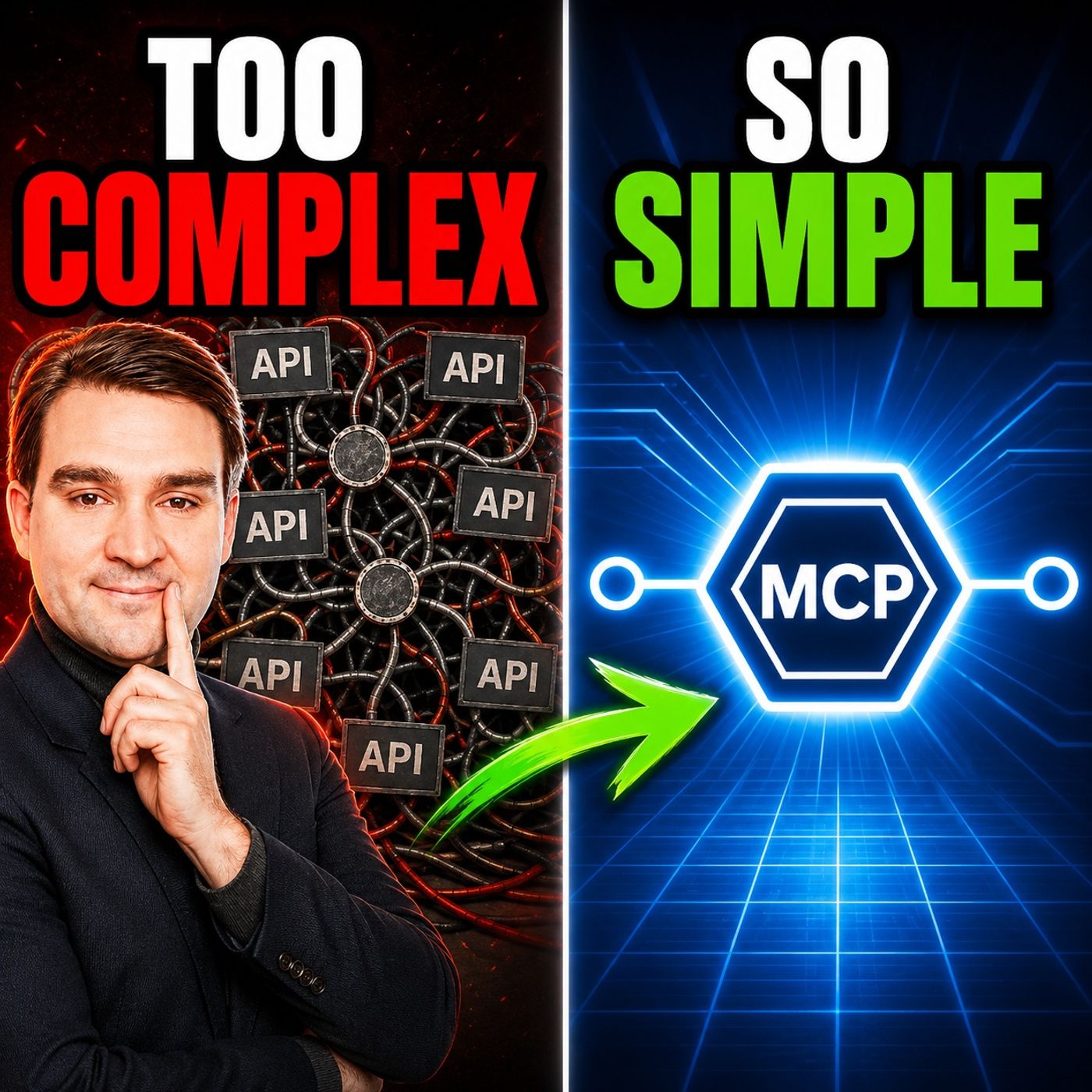
Dataverse MCP: The End of Custom Integration
Get every episode summarized
Each time M365.FM - Modern work, security, and productivity with Microsoft 365 publishes, we email you a written briefing from the transcript — the topics, who appeared, and any specific claims, with the ad reads skipped.
Email me new episodesFree for 3 shows. No card needed.
About this episode
THE HIDDEN COST OF CUSTOM CONNECTORS
Most organizations never intended to create integration sprawl. It happened gradually. One connector became ten. Ten became fifty. Fifty became hundreds. The episode examines how custom integrations create long-term maintenance challenges through:
- Duplicate integration logic
- Security inconsistencies
- Documentation gaps
- Dependency management
- Growing technical debt
WHY AI BREAKS THE OLD INTEGRATION MODEL
Traditional APIs were designed for applications. Not autonomous agents. As organizations deploy AI systems across multiple business functions, integration requirements increase dramatically. Topics explored include:
- Agent-driven workflows
- Dynamic tool discovery
- Autonomous decision making
- Multi-model architectures
- Cross-platform orchestration
UNDERSTANDING MODEL CONTEXT PROTOCOL (MCP)
At the center of the discussion is MCP, the Model Context Protocol. Rather than creating separate integrations for every AI platform, MCP provides a standardized way for AI systems to discover and interact with tools. Key concepts include:
- Tool discovery
- Standardized interfaces
- AI-native integration
- Dynamic schemas
- Permission-aware access
DATAVERSE AS AN AI PLATFORM
One of the biggest insights from the episode is that Dataverse is evolving beyond its traditional role as a business database. Instead, it is becoming:
- A context engine
- An orchestration layer
- A semantic business model
- A governance platform
- An AI-ready control plane
THE DATAVERSE MCP CONNECTOR
Microsoft's Dataverse MCP connector introduces a new way for AI systems to interact with business data. Rather than creating custom APIs and wrappers, organizations can expose governed business capabilities directly through MCP. The episode explores:
- Dataverse MCP architecture
- AI client integration
- Security inheritance
- Tool exposure models
- Governance benefits
PERFORMANCE VS CAPABILITY
MCP introduces additional abstraction compared to direct REST APIs. While this creates some latency overhead, the discussion highlights why raw speed is often the wrong metric. Topics include:
- Token efficiency
- Dynamic schema loading
- Reduced prompt complexity
- Lower AI operating costs
- Better autonomous behavior
THE GOVERNANCE CHALLENGE
Technology alone is not enough. As MCP adoption increases, governance becomes one of the most critical success factors. The conversation explores:
- Data Loss Prevention limitations
- Advanced Connector Policies
- Auditability concerns
- Permission boundaries
- Regulatory compliance
AI IDENTITIES AND ACCOUNTABILITY
One of the most fascinating sections focuses on identity management for autonomous systems. Important questions include:
- Who performed the action?
- Was it the human or the AI?
- Who owns the decision?
- How do you audit autonomous workflows?
MCP SECURITY AND NEW ATTACK SURFACES
Every new architectural model introduces new security considerations. The discussion covers:
- Tool poisoning attacks
- Prompt injection risks
- Supply chain vulnerabilities
- Over-privileged servers
- AI-specific threat models
FROM POINT-TO-POINT TO HUB-AND-SPOKE
A major architectural shift highlighted in the episode is the move away from point-to-point integrations. Instead of building countless custom bridges, organizations can create domain-specific MCP servers that act as centralized integration hubs. Benefits include:
- Simplified governance
- Centralized auditing
- Reduced maintenance
- Faster onboarding
- Greater scalability
DATAVERSE AS A CONTEXT ENGINE
Perhaps the most important strategic takeaway is that AI systems consume context differently than humans. This means organizations must rethink:
- Metadata quality
- Field descriptions
- Relationship modeling
- Business semantics
- Context engineering
Become a supporter of this podcast: https://www.spreaker.com/podcast/m365-fm-a-microsoft-mvp-podcast-by-mirko-peters--6704921/support.
Get every episode summarized
Each time M365.FM - Modern work, security, and productivity with Microsoft 365 publishes, we email you a written briefing from the transcript — the topics, who appeared, and any specific claims, with the ad reads skipped.
Email me new episodesFree for 3 shows. No card needed.
Hosts & guests

No transcript yet
This episode has not been transcribed. Request it and it moves to the front of the queue.
More episodes
More from M365.FM - Modern work, security, and productivity with Microsoft 365

Constraint-Based Scheduling: The Architecture That Makes Production Plans Real
M365.FM - Modern work, security, and productivity with Microsoft 365

A Machine Goes Down. How Should Your Production Plan React?
M365.FM - Modern work, security, and productivity with Microsoft 365

Can Value Stream Mapping Become a Live Data Model?
M365.FM - Modern work, security, and productivity with Microsoft 365

How Finite Capacity Scheduling Actually Works in Manufacturing
M365.FM - Modern work, security, and productivity with Microsoft 365