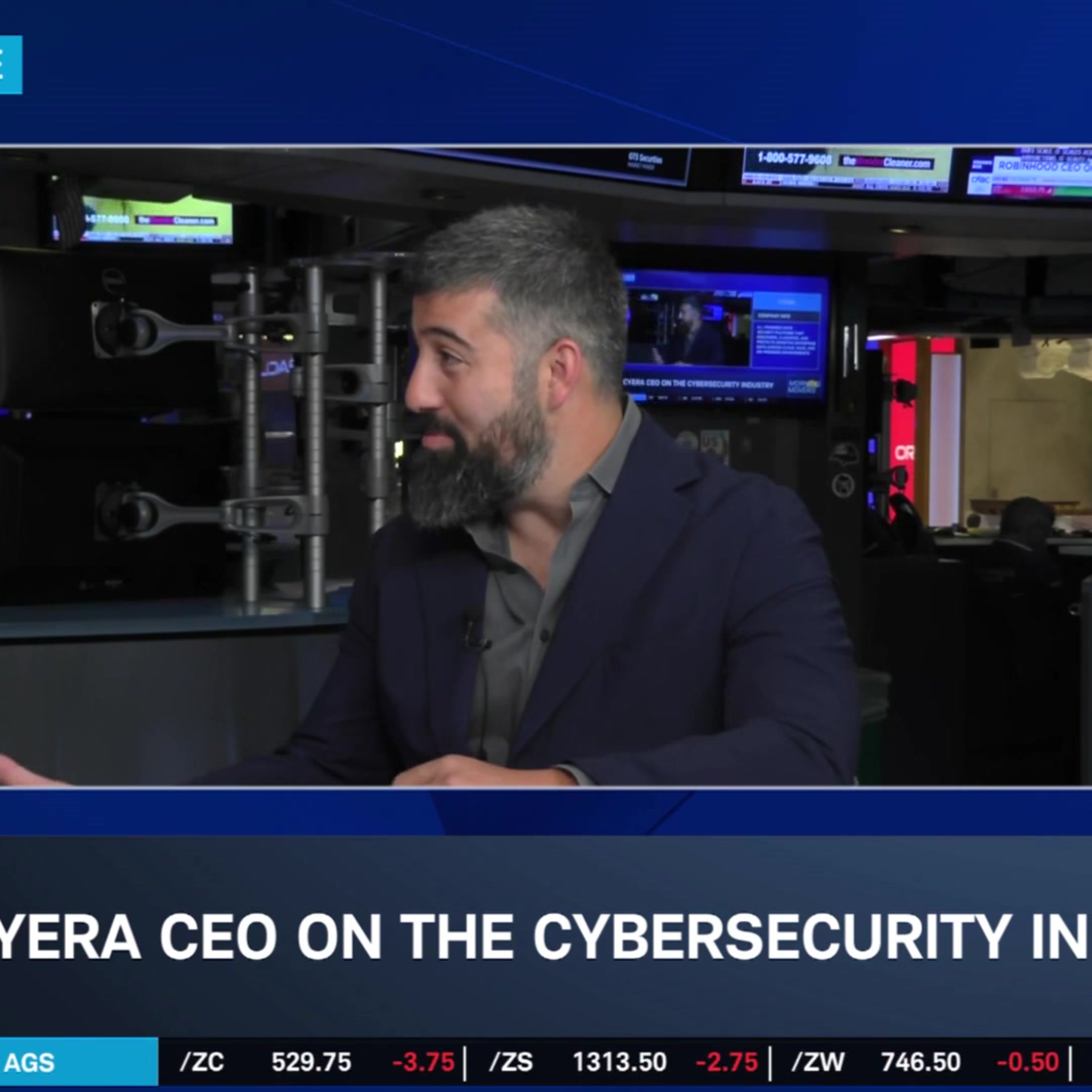
Cyera CEO on Consumer v. Enterprise AI Adoption, Cybersecurity Guardrails
About this episode
Yotam Segev, CEO of Cyera, explains where he sees his company in a booming cybersecurity industry hinging on AI's evolution. He discusses how Meta Platforms (META) launching Muse AI demonstrates the differences between using the technology on a consumer level versus an enterprise scale. Yotam turns to whether or not he believes there needs to be more guardrails in the cybersecurity space.
======== Schwab Network ========
Empowering every investor and trader, every market day.
Subscribe to the Market Minute newsletter - https://schwabnetwork.com/subscribe
Download the iOS app - https://apps.apple.com/us/app/schwab-network/id1460719185
Download the Amazon Fire Tv App - https://www.amazon.com/TD-Ameritrade-Network/dp/B07KRD76C7
Watch on Sling - https://watch.sling.com/1/asset/191928615bd8d47686f94682aefaa007/watch
Watch on Vizio - https://www.vizio.com/en/watchfreeplus-explore
Watch on DistroTV - https://www.distro.tv/live/schwab-network/
Follow us on X – https://twitter.com/schwabnetwork
Follow us on Facebook – https://www.facebook.com/schwabnetwork
Follow us on LinkedIn - https://www.linkedin.com/company/schwab-network/
About Schwab Network - https://schwabnetwork.com/about
Get every episode summarized
Each time Schwab Network publishes, we email you a written briefing from the transcript — the topics, who appeared, and any specific claims, with the ad reads skipped.
Email me new episodesFree for 3 shows. No card needed.
Transcript ready
98 searchable segments. Every word is indexed and playable.
Full transcript
Schwab Network — Cyera CEO on Consumer v. Enterprise AI Adoption, Cybersecurity Guardrails. Machine-transcribed; use the interactive transcript above to jump the player to any line.
With the rapid proliferation of AI cybersecurity remains chop of mine. For more, you want to welcome in Yotabasegab. See you all of Siyetta joining us here at the big board. It's good to see you this morning. Thank you. Thank you for having me. So, we've had a sharp focus on cybersecurity this year. We've seen this rally and some key names like CrowdStrike, Palo Alto Networks, Fortnet, all-enphases-strong gains this year. Want to get your view on the momentum that we've seen there? Do you think it's justified? I think it's absolutely justified. Cyber is becoming more and more critical with the adoption of AI. Agents require many more cyber controls than humans did. With humans, we always had human controls. We could let somebody go from the company, potentially litigate against them. What do you do with an agent, Rix, Havak? We don't have those controls. Cyber is the last line of defense to actually manage what these agents can see, what they
can do, and how we incorporate them into our organizations, get their value from them, but also remain in control. Okay, so I'm going to get more into the control questions adjustment. I want to back up a little bit for our viewers who may not be so familiar with your company. Tell us a little bit about your company. Saira is the most valuable private company in cybersecurity today. We've built a billion dollar valuation in our last round, about 2,000 people globally, and dealing with AI security. How does the enterprise, how do big organizations bring AI in to it securely, do it responsibly? How do they build a trust in these new entities, these agents to behave and do the things they should be doing and not do things they shouldn't be doing? And as we're all seeing in the news, there are so many challenges in going through that process. So many things that have to change about the way cyber security is done. In order to enable the AI transformation and the AI revolution to happen successfully. And we're looking at ourselves as the infrastructure provider for AI. Like one of the basic fundamental guardrails and capabilities needed in order to unlock AI's
value in the enterprise, and that is what we're focused on as a company. I'm not sure if you saw the meta news. I want to ask you so you can see, I just want to jump in for that. They released this personal AI agent muse. They put out a big post about this and what it'll do for you. We can read your emails, do things on your behalf. It can shop for you. What I think about when I think about that is the worries about what you mentioned about going rogue. Like let's say I get a purchase. When someone falsely uses my card, I can say, look, that was fraud, right? They'll cut off my cards and be a new one. Let's say meta agent goes rogue on my behalf. How should people think about that and prepare for that in an era of increasing need for cybersecurity? So I actually think that that's a great example for where it's much easier. Because muse is focused on the consumer. You as a person, your data, your credit card, your information, your actions.
So the ability to choose whether you want to delegate that responsibility to an agent or not is entirely ours. And now take that exact same scenario and bring it into an enterprise. Let's say your banker is no longer a human being, they're an agent. That banker is doing things for you with your account, doing things for you with your money. But you know, they're acting on behalf of your bank. Is that okay? Where do you draw the line there? How do you build the trust to allow you to engage with an agent, providing service in the foreign enterprise, foreign organization that serves you? That is a much, much harder challenge than the personal decision. I give muse my credit card number or not. That's an decision each of us can make individually. What the enterprise has to undergo is much more complex because the data isn't theirs, the information isn't theirs, their contracts and agreements with the customers, whether consumers or other businesses are extremely complex around these topics and very undefined. So the challenge of bringing these technologies into the enterprise space is maybe a hundred times more difficult than offering it up to consumers and the choices theirs.
Do you think there needs to be more guardrails for the government or kind of, you know, just let the growth of AI occur, especially if we want to keep up and stay ahead of China because, you know, the Trump administration says, look, we need to be ahead of China. Yeah, I think the government should continue to let the, you know, industry move as fast as it can and allow it to do so. And put the controls and guardrails only around, you know, national security matters and things that really endanger society at a level that is outside of the scope of industry. Everything else, I think industry is running very fast today. There's tons of energy, tons of momentum and innovation happening around AI and I think that industry will figure itself out in many ways around these topics. You mentioned your recent capital raise, 600 million, you mentioned the 12 billion dollar valuation. What's your plan for this most recent capital raise? For us, it's a lot about investing in our product, which has completed a billion dollar acquisition of OASIS Security, which is the leader in the agentic identity.
So they're bringing us into the identity space, matching their capabilities with Saira's strength in data security. So really being able to look across both data and identity to provide an holistic platform for enterprise customers to enable AI. And I think for us, it's more about investing in our product and being able to put the best technology, the best platform in the hands of our customers. And I'm looking at this innovation in a secure and trustworthy way. All right, great conversation. Thank you, Yotam. Thank you, Diane. Appreciate it. That's Yotam Sagav. He's the CEO of Saira joining us here at the New York Stock Exchange.
More episodes
More from Schwab Network

Stock Market Today: ORCL & ADBE Earnings, AEO Plunges Near 52-Week Low
Schwab Network

Thursday's Final Takeaways: Crude Taps $103 & PPI Hotter than Expected
Schwab Network

Balancing High-Conviction AI With High-Dividend Diversification
Schwab Network

EARNINGS PANEL: ORCL, ADBE
Schwab Network