Get every episode summarized
Each time Carne Cruda Podcast publishes, we email you a written briefing from the transcript — the topics, who appeared, and any specific claims, with the ad reads skipped.
Email me new episodesFree for 3 shows. No card needed.
About this episode
Get every episode summarized
Each time Carne Cruda Podcast publishes, we email you a written briefing from the transcript — the topics, who appeared, and any specific claims, with the ad reads skipped.
Email me new episodesFree for 3 shows. No card needed.
Hosts & guests
Transcript ready
1,487 searchable segments. Every word is indexed and playable.
Full transcript
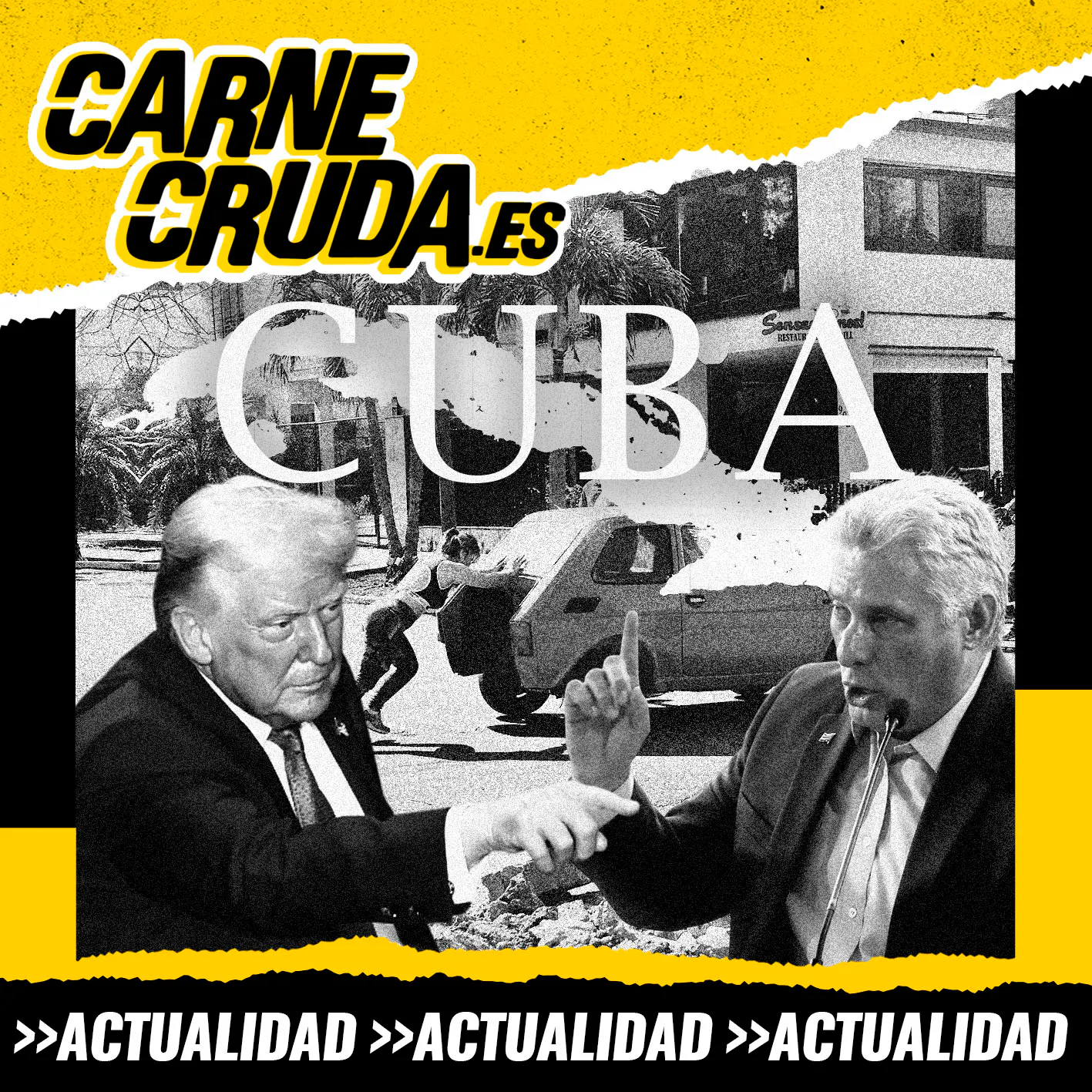
Carne Cruda Podcast — Cuba, ¿el fin de la revolución? (CARNE CRUDA #1625). Machine-transcribed; use the interactive transcript above to jump the player to any line.
The Toyota Tundra and Tacoma are built to keep going, backed by Toyota's reputation for legendary reliability. Step into a Tundra with the available iForce Max Hybrid Engine, delivering impressive torque and serious towing power. Or take a look at Tacoma with an available power lift gate, so gear goes in fast and the adventure keeps moving. Toyota trucks are built to last year after year, mile after mile. So drive one home today, visit Toyota.com to find out more. Toyota, let's go places. First of all, the Apagones that we already have. We really have a situation that generates the elasticity that has been badly damaged for many years, very old, almost obsolete, where it has a constant rupture. Toyota has already, years with less or less combustible, Venezuela was the one who was not saving. Now, with this performance of the blockade network, well, the Apagones are 12 hours, 10 hours. Like at least 10 hours.
And that's almost less. They are not good times for Cuba. André Oleh, come on, come on. Come on, come on. And more for Cubans. We heard Alicet a way of 62 years that he has shared his desire to survive in these days in which the blockade and the United States sanctions seem to be going to fix the country. We remember that in Cuba it is not compatible with almost a month ago and the case is at the top with the island, the edge of the collapse and the people at the edge of the island. Yes, simply because to be able to eat you have to be able to cook. In terms of the current, that is difficult, because many people who have cheap gas, cheap gas are scarce, practically they do not come, and they have to cook with electricity to the new current, then they do not have to be able to do the food. With family members who are like this, who sometimes have not had anything to do with them. But even if you have gas to cook, what are you going to do if you can not afford to buy the food? The basic products like the milk, the chicken, the oil, everything is increased, everything is increased, and so they have disappeared.
For example, the oil bottle is 900 pesos, the equivalent to 32 euros, the eggs are 100, that is, 3 euros and a half, the unit, and of course, so the accounts will not come out. I am a person who I am curious, but I am against to be able to survive, because with 4,000 pesos it was a lot of hunger. And after that, my work in the bottle is sometimes more difficult. In the bottle, that is, doing your stop, because it is not the chance to pay the prohibitive prices that the public and private transport has now, and in the case of the public, in large part, it is suspended. This is how to live in an economy of war. Well, I do not know if it is war, but we have asked us to record audio during the day, and it is hard, as you see, just listen to it. Well, remember, you are of the feeling of chaos during the payment, right? Yes, of course. Well, imagine that it was like that every day. Well, I am Andrea, here I am following a bank goal, you can make money, because from there, that was the correct way, and we could not get out. So today I am in the same way, if I have luck, I will get money, because as I had told you,
the tarjet, not many places, you are not accepting the tarjet. So, you have to pay in effective, and in effective, here in the bank, you are limited, so much that you give 5,000 pesos. And the restrictions and the prices are exorbitated, they also pay the health. For example, Lisette has a route, but she can not go to the dentist to get out, because the pesos do not arrive, and put her in a situation, leading to a pain in the face, when the medicines are more expensive, or the things in the famous are immense. When there is no water, we take three days without having water, my house, we take three days that do not enter water, and there are places that take more days. So, if you have a water reserve, you have to take it from there until the end, and then it is good. All this is a mix of agobio, artadgo and resignation. If life in Cuba is again a supportive route, although the Cubans are accustomed to the difficulties if they live in supervivency, sometimes the strong flakean. Everything is very complex, but the reality is that the Cuban people who are suffering a lot, in other words, they are suffering a lot.
Andrea, thank you for bringing us to Lisette's testimony and to her, because to tell you how the Cubans are, from there, from the island, in these microphones. Thank you very much. The Cuban people suffer and the country is so valid. That's why today we ask if the end of the revolution has arrived. Welcome to Carnegie, free of the water, join us for a danger, exactment, innovations. Cuba is aoga and the organ is fixed for the embargo and the regiment. Sometida, the implacable block of the United States, the island lives now its worst crisis in 25 years. The entrance of Petrolio was cut off from the black belt after the intermission of Yankee in Venezuela, and it was kidnapped by Nicolás Maduro. Trump has renovated the blockade of the island and threatened to punish anyone who was forced to join it. But before that, the Cuban economy had already lived its lower hours. After the coronavirus, the tourism, the main source of the division, was deployed, and it was added to the sanctions to make the GDP fall in 11% in 5 years. The effects are visible,
lack of fuel, basic products, payments that during days, short of water, inflation, and poverty at the moment. So yes, Cuba is aoga and aoga, Cuba is agonized. We also said it by the guilt of a regiment that at 67 years of the Spanish Revolution, brought democracy and continued repriming its people. The revolution that promised and that it achieved sanity, universal education, and free education, reforming the redistribution of wealth and the end of extreme poverty, is the same as the opportunity of the citizens. The same thing that has caused a constant war of immigration, exile, and land. Today we talk about the collapse of a country of a revolution and a severe utopia for all the flanks. And from a people that each day more tired, each day more exhausted, that resists, heavy to everything. But for how long? Cuba is a nation of cli-bis, it seems that it will not be able to survive. I think Cuba will not be able to survive. In the end of January, the President of the United States Donald Trump declared Cuba an extraordinary threat for the security of the United States and announced new arrangements to the countries that sell oil.
Previously, he had cut all the income of fuel, threatening to officially economically go to the island. The Secretary of State of the United States, Marco Rubio, obsessed with Tumbar, the regiment of the country, where his parents born, returned to threaten him. If he had the banner and outside of the government, it would not be worried. The Cuban government has denounced this new return of Turkey. We are born and we say what we want. And we are born under the signs of that fixation with what we always do. And the President of the days, he lost the Cuban resistance, creative, but until where they can and want to resist. To understand the challenges that the island faces, today our partner from Barcelona Abraham Jiménez Noa, who is a Cuban journalist, exiled in our country. He is the founder of the first narrative review in Cuba, and collaborator of the media like Washington Post, New York Times, or Al Yacira, multi-premied by his periodist work, he is also the author of the island or cult history of Cuba, published by the book of the cow. Abraham, you're welcome. Hello, good morning. What do you find in Cuba today? Well, it is
difficult to say, because we have not used that Cuba lives in a specific crisis, but obviously we are in the mother of all those crises. It is a critical situation that to the one who had never been born, has arrived. The one that tells me my family that is there, my friends, what I can see, what I am doing, because, well, I keep reporting even if I am in the island. They are surreal scenes, no? More than 20 hours without light, without electricity, the places, people who do not have how to spend, how to cook, people cooking, the interperia, with milk, a country where the universities have had to be closed, the children stay at home, because they do not have how to go to school, the workers are closed, without public transport, a total disaster, but on the other hand, that situation, and that situation of chaos and chaos, the government continues to reprimand,
there is no reserve for the country, there is a public transport, but yes, to continue to cancel to the people who, well, who want to raise their voice and who want to express themselves, no? So, definitely, I would define the situation of the Cubans, people from the poor, the citizens, who are in the island, they are trapped in an insulated street, on one side, is Tron, and the historical block of the United States, and on the other side, is the government itself, Cubans, no? And those who unfortunately pay all those conditions, that both of us, is the people of the country.
It is not going to survive this year, in the United States,
no one knows if they are negotiating or not, yesterday we were listening to Ten Ericsson, one who had in charge in a government democrat in the past, a specialist in Cuba, and well, he said that no one knows if they are negotiating. I suppose that yes, but it is not at all safe, no? They are in this chair, I think they announced it on the television, in an interview that they are negotiating, but what are they negotiating? No one knows. Of course, it is the liberation of the press of the one who talks to us, which reminds us of what happened in Venezuela, maybe it also tells us that there may be some negotiations between the United States and the Cuban regime. It may be, but this, well, it is the state's secret, of Cuba, nothing comes from the outside that does not surprise us and from the United States, neither. We do not know who they are negotiating, neither, but well, we have to take into account that there is a great community in the exile, especially in the United States, and well,
many Cuban-Americans are also negotiating to invest in Cuba, there is a great need for the reconstruction of Cuba. It is a little similar to what is being done by Donald Trump, also in a future, in Gaza, and all that, as a big promise, a great need for money not in the island, but outside the island, there is a theory. Of course, Abrami, this means that the United States wants to put his hands even through a military intervention in the island. Well, what I have always wanted, there is that, what I have officially did not start now, with Trump, in the existres of 1962. He has always been and has always wanted the United States, let's say, to be able to take care of Cuba. First of all, for the geographical hooks, and second, for the history here among the two countries, the Brevere Cuento, which was Cuba in 1959, it was like a kind of patriotism of the United States,
where the United States went to the end of the week, where there were Casinos, where practically, well, I was talking about Cuba in New Colonia, of the United States, and it will surely be the intention, and has been the historical intention, what happens is that the decades of the revolution and many Cubans have already been born in Cuba, and the later generations have been united, they have seen how, in any way, they want to return to their country, they want also, that it is just their wish, that we have lived, that we have lived for many years, especially also, because there are many people, for example, like me, who has not come out of Cuba, decided, because, in my case, at the same time, he has come out, because he has had to go somehow, or leave, and it was dirty, and it is very difficult, not to live your family, from your home, from your home, from your customs, and all that is in the game. It is legal, that the imperial sanctions, that all this is a cliché,
and that land is burned, it is legal, impossible, but on the other hand, it is also, well, what a little bit says, no, how the Cuban government also to respect, to be able to clean up or to the whole city, and have already been to the whole city, to be able to impose its own narrative, so, well, we are trapped in that oil. Let's summarize, how we have reached this point. The economic block of the United States, Cuba, that is, Abraham, takes stones from the 62, accumulated, of about 170,000,000,000 dollars, to survive, the regime has been historically annihilated, that they exercised against the weight, first the horse, and in the last decade, Venezuela, that came to enviar, 100,000 barrels to the island, to change, mainly, Cuban medical. Cuba consumes between 120 and 150,000 barrels of oil to the island, which produces a third, while the rest matters. Since 2019, things have been
badly worse in the island. First, the new media of Trump, strengthening the block, then the effects of the pandemic and the collapse of the tourism, which still have not been recovered, and now the loss of his key ally by the fall of Maduro, until inflation, deficit, fall from the outside, and a situation of permanent impact to the international creators. It is not even possible to replace the cruel Venezuelan resident who sold in the international market, the revolutionary accounts are no longer square. And that is why the island does not live a so hard moment as it is currently, from the call, special period, the mega crisis that is produced in the 90s after the fall of the Soviet Union. Susanne, we can say that this is a special period, 2.0, as they are calling it, in social networks. I think it is a national emergency. It is much more dramatic, because people in the 90s, when the special period after the fall of the Berlin Wall, the loss of all the societies that had, the socialist campus, and in this,
in this era, there was something that could be built, there was, as a vision, this was to change, for good, for the majority of the Cubans, that then it was not like that, but there was a moment of hope of this total despair, because you cannot ask for it to the population after 30 years, more of the consequences of an economic and permanent adjustment, because they lived in that period, especially in times of peace, and 30 years, that they were creative and that they were still resisting for what? For what? Because the regime is, I think in the Franco-de-Cliven, I don't think we were aware that there was a Cuba, but no one knows what the result is, that's a secret, I think they don't have a lot of respite, and the Government of Miguel Diaz Canel, what he doesn't know, is Cuban, in the sense of having political, public, as a transport, education, not only what he is,
he is also the own incapacity of the Cuban Government to adjust at times and to seek alternatives that are not ideologic, as it was the combination alliance. I think that also it's my point of view, it's like saying, I speak the language, now that we have a language, really, before we were in a long time, it's no longer in any way, and it seems that Mexico is the only country that wants to help Cuba, it was always in Mexico, not in Latin America, that was more solidary with Cuba, that wants to send a humanitarian aid, urgently needed, and also petroleum. Maybe with the new situation of the Aranceles, populated by the justice in the United States, it can happen, I don't know, I don't know which is going to be in the dramatic series, I hope to wait, to resist, and it's not possible. If it is to wait and resist, there is a difference to the blockades and sanctions of the United Kingdom. The first government of Trump applied more than 240 sanctions including restrictions,
trips, views, and travel travel, to trade, transport, fuel and binoculars, to the sector, to the International Cuban Medical Corporation. On the other hand, the President of Cuba Miguel Diaz Canel says that he will resist with the help of his allies. We would be working with allies, and with the international community, with that same Cuban support every year, when it comes back against the blockade, and we are sure that we are not going to be alone and there will be a compression and there will be international news and there will be Cuban support. There will be an impact to have. It happened in Venezuela, including the 32-year-old Cuban soldiers of the Maduro Guardia, a favorable regiment, and friend of the Cuban regiment, and in what way they can help other nearby powers, for example, Mexico. Well, the first thing is that, well, from head to toe, it means a direct blow to Cuba's take, because, well, as they said,
after the fall, they did not forget that in the 90s, Venezuela came to forget those inventions that arrived in the 90s, Cuba and the 80s in industrial quantities, not, it came to be those lives of Cuba. At first, with Chava, it arrived much more, and then the own fall, of the Petrolifer industry, Venezuelan was falling, and the lives were falling, so everything was supported more than 50% of what was needed in the Cuban energy system. Atron decided that in one blow, all that Petrol came to Cuba, Cuba already lost his hand, more than half of the Petrol what the country's energy was trying and, in addition, it means a blow to one of the few international allies that, on the political level, that was left to Cuba, also what happened in January, it means that Cuba, the country,
is something that the Cuban government had denied during many decades, which was not only paid to that Petrol with doctors and teachers, physical education, education, but also to military, with military skills, and the Cuban government had always denied it, and well, it was a secret to you, that all the personal security, both Chava and now, now from Maduro, they were Cubans, and well, and the death of these more than 32 Cubans took them to the light. There was something that right now happened to me, and it was to say that a little also with respect to the blockade, and the United States' measures to Cuba means that they go in two days, because, in a way, Cuba feels that it's being financed and conventionally, for the United States and control, and well, the story, but that's done, that the Cuban government, look at the symbolic level, that the political level with that, because, from there, to declare that they are threatened
by the United States, that they kill the human rights, kill the freedoms, and then they justify themselves in those measures that are not free, so that there is no freedom of association, so that there is no civil society. So, in a way, the Cuban government, in a sense, look at the symbolic level with that threat that is real from the United States. In that sense, neither China, nor Russia, they said almost nothing, well, there are some civil relations,
after the military intervention of the United States in Venezuela, that they will say, they will rescue Cuba, China, this time, as they do business, but at a fairly low level, with Cuba, and Russia, this time, that, well, they were visited by Miguel Diaz-Canel, right now in the Ukrainian passion, or a few later, Cuba was also in this crisis, more to Russia, because they hid it from the South, that was important, but I think that in Russia, neither China will rescue Cuba, or offer, or replace the commercial relations that has already lost, and the European Union, no, the European Union is too worried for Greenland, for the U.S., for the Ukraine, that it will not go, too much Cuba, it will also be divided, the European Parliament is very critical, not very critical with the Cuban government, and the United States has a agreement of cooperation,
and political dialogue with Cuba, with the authorities, but they will not be able to move much, I think it is a low level relationship, so I do not know who they will do these allies of the Cuban regime at this moment, it is quite difficult, maybe in Mexico, but I do not see much more, I do not want to move. We will see it before we want to remember that the bloke was not always the plan, that is why we have asked Christophe Ventura, who is a director of investment in the relationship of international and strategic relations, French, member of the constitutional council of the diplomatic world, about the alternative of a decade in the United States. At the time of the Obama government, Washington realized that that politics was a failure, and that precisely the bloke did not help for nothing to change the political regime in the Obama, and it was precisely the new strategy of Mr. Barack Obama to change all that and propose another life, which was to free the economy,
leave the bloke, or at least eliminate a series of measures of this bloke to free a little Cuba, to its economic model, and also with the idea that at a certain point the liberalization of the economy was to advance to a new situation in which, after the liberalization of the economy, the liberalization of the political system of the life of the Cuban society. Because if you excuse the regime, you have to remember that bloke of decades from the United States to Cuba, here more affected by the Cuban population that has suffered it in its own cars, and that also did not allow it, perhaps to advance towards democracy. Could you have had this strategy of Obama?
Obama is a bloke political policy, the bloke political policy does not have a meaning, it is counterproductive because the regime justifies it, if it refills with the external enemy, or enrolls in the nationalism in the flag because it has the United States threatening the revolution, and in that sense, it had a meaning to remove it, but it is simply a policy towards the American Cubans, the most hard ones that control the Congress. I think it is a more well-known internal policy than the external policy. The external policy does not have a meaning to maintain the embargo. And I think there is no intervention to go back to this point of the United States because the strategy is to take Cuba economically, until it can't go further and something happens. I do not know what is going to happen, I go to a very little humanitarian strategy, very strong for the Cuban population that there are no alternatives.
Cuba, precisely, we are going to go, but before we hope to use Gratius, who is the researcher of the Central Investigation in International Relations of Barcelona, he is the expert in Latin America and Cuba, and the professor of politics at the Autonomous University of Madrid. Thank you very much, Susanne. Thank you very much, you are welcome. Now we are still with you, but before we go to close to the streets of your country. This situation of the American crisis has led to a black market. Where you can continue not to need you, but to pay extra money. Saí Limoreda, director of the Coatel Company. If the actors, technicians and public cannot reach the theater, they do not dare because they do not know how they are going to manage to return to their homes. According to the old man that the function of lack of electricity in the theater assists the theater practically a disparate. There is no tourism,
there are no people who want to rent it. Of course, no one wants to come to Cuba. For me, the situation is collapsed. I think that only a medal can be given to us. But it is really very sad what is happening and Cuba hurts a lot. The mendicity returns to Cuba streets as a symptom of a crisis that can no longer be hidden. The tensions and jubilations do not reach to live. Medications are only in black bags. The salaries are insufficient. The basic canasta is a bitter joke, that you have to ask for the same, a remiss, that a dish of food. Get out of the street, share the soul in several pieces. With this clarity and contundence it was expressed few days ago in an article, the journalist Aurelio Pedroso, responsible in Cuba, of the day of the Boletín de Madrid and collaborator of the Historic Missora Cubana, radio progreso. Aurelio, a pleasure to greet you. Hello, very good afternoon for you.
How do you find the Cubans in which conditions survive today? In reality, the situation is extremely critical. Extremely critical. In all the orders, in all the orders of the situation is extremely critical. The edge of the collapse can be perfectly said. And what are the causes of that collapse of that situation? I imagine this graphically in the following way. The island was threatened by a two-headed snake. No. As it comes from Washington, from the White House, with the measures of President Donald Trump with respect to the island. And the other head, the negative, the attitude continues to continue giving counter-corrientes. That is, it will not be essential, because the problems of Cuba in essence are economic not political. Could you develop this idea?
What do you want to say? Very easy. In Cuba, there is practically no opposition to the government. And and the great fear that is happening at this moment is that the lack of effective economic measures is politicized the question. So it becomes a political problem of economic politics. That is, we are with solid measures related to the Soviet Union at the time of socialism. There are difficulties in the exercise and the development of private property. There is a set of elements that make me think with all the reason that we are giving counter-corrientes. Cuba can not continue under this economic scheme so rigid, so much control. Once that problem is solved I think that in great measure it can be advanced. You have said that Cuba
is about to put a final point to a project associated with the empire and also need renovations and again to face the counter-time. That regime has had the opportunity to do the best when and how. During the entire revolutionary process unfortunately some revolutions that began winning the whole world have lost the legitimacy of the measures that have been advancing and have made mistakes especially on the issue of the economy and I believe that this is the essence Cuba at this moment is not a hacker but if he could be approximately because the absence of combustible is the equivalent to the oxygen of a person and that is carrying problems of all the colors and all the orders you have to live remember a such a critical period like this? The special period was a approximation
to this but in the special period when the collapse of the Soviet Union and the rest of the socialist field it was a very similar time for this but I believe that those who live now are worse and another very tense time the famous doctorate of the missiles that the country had instead of involved in a nuclear conflict that finally that solution of the Cuban government and in the case it mounted a great border with that because it was a direct negotiation between Nikita Crucio and President Kennedy in the United States with Cuba they didn't tell to remove the missiles from the island
that's not a real The popular Indian was such that it had to be limited the Cuban government is making what in a big word is pure poverty and the Cubans are revealing to us Maquillaje and the South of the poor minister who had had an excellent job in his wallet made that profit but also we have to recognize that there was a democracy in the parliament no one left the past no one reposted that's right if there was a normal discussion for the mentality the minister had had that ending but it's that everyone applauded all the delegations the commission in which it was that criteria applauded but frenetically and it was a later that they cut head to the minister but the problem that is faced and is always faced Cuba is to end the interventionist Yankee it's going to be very
difficult I have to say I recognize it because I have lived from the first time of the revolution that Cuba is not in the south Venezuela is completely different from Cuba the Cuban at this time you can find many who are unhappy with the revolution but not unhappy against the revolution two categories completely different being against the revolution is unhappy with the revolution here there is an anti-imperialism in Venezuela that at the beginning of the revolution and many before there is also a very large anti-imperialist very large and I don't think that Cuba is going to fall in I don't think and this means that the revolution could still be changed but to maintain
the Cuban project the direction has that possibility and it's not about doing the concessions inside it's not about doing the concessions inside but about doing the concessions to the own Cuban people who are asking a group of libertades a group of prerogative necessary with a cut to the government or to China and and allow that the productive forces develop and other changes also the political order must also happen but I already tell you I don't have the feeling that those things can be at the moment because the regime is too closed that freedom assumption and that measure has closed has closed a Donma that does not go to any place has closed a Donma that does not go to any place Mr. there is to change and if you have to negotiate with the gringo
you have to negotiate with the gringo all life has been negotiated with them now it can't be a section however the future of the Cuban authorities is that there is no negotiation it can't be a negotiation without violating the principles and without putting anything it can't have to negotiate with them now it's going to be a criticism as we are listening to you can have problems in Cuba I don't want to call me to answer my criteria I could have some problems I could call you because you said with this why do you mention this and do not mention the other and in this profession of journalism one is not to complicate petitions that makes the singers have a cabaret in a club there is a lot of metal things but journalism can't be to complicate petitions I respond to my criteria and defend it and what happens what happens I do not have the smallest of the themes and what do you think is the rest of the island at the level of support from the government today
there is support as you said previously there are a lot of people who are unhappy but do not find the revolution and once it happened the third money in Caracas who killed 32 Cuban in charge of the personal security of the president Maduro the protest practically was spontaneous here nobody mobilized nobody nobody was nobody was nobody and there is the same 100 meters of North American embassy in La Habana they gathered thousands of people thousands of people it is a fair proof of support to revolutionary process the explanation is very good they are not against the revolution but against the situation a situation that some Cubans are not only not to the bloke also to the regime Well, my opinion the Cuban regime is the responsibility of the current situation of Cuba
and it is responsible mainly because there has been spread to the reality and spread to its people it is an elite of privileges that are imaginable for the citizens of the people of Cuba and that is very very important We have lost our opinion Cubans and Cubans and we have reached different messages as the current which seems the diagnosis and especially that accusation of the elites of the regime of living of a privileges that do not enjoy the rest of Cubans That is a matter because everything is depending on who they say and how they say it Who is a matter who is a matter who is aitive is a matter of peaceful who is天 peace But there is a matter Yes for example the subject of privileges Don't you believe
that such privileges in parts on the I hope that the leaders of the country do not believe that there are so many privileges and living from the back to the back, because that also sounds a little bad intentioned, not bad intentioned, that is to say that it goes apart and apart, it does not share completely the opinion of those people, it is a cuban here, the president of the island, who says it or says Marco Rubio. I wanted to ask you just about that, what do you think of Marco Rubio? Marco Rubio, from the origin of cuban, his great obsession, discolored, has been the island, has been Cuba, and I do not think it has very good intentions for her, in the sense of really supporting the cuban people, to accept that Cuba, as a independent country, has brought a completely
different path to what he wants, and really it is a character that here is not going to move many people, the president of trombone at some point says that it is not good, that he died of Donald Tromb and the things that happen to him, mention what he could be the president of Cuba. No one would accept it, but they did not try to impose it, and believe that it is possible an intervention of the United States in Cuba, militarily speaking. Do not have to discard an intervention, militarily, although lately they are changing their subjective, do you see that in the last production, so many of Marco Rubio, as the president of trombone, has been a little bit, well, yes, we are going to leave the Italian government as it is, to change from, that they open their economy, that allow North American companies to participate in the economic development of Cuba, but not
in political changes, a military intervention here would be fatal for them, and for us too. Without any doubt, now I will ask that it has been a pleasure to listen to you, a very strong hug. Well, for you too, Sharti. I am Jenny Taugado, the mother of Duane is David Leont Taugado, my son is 27 years old, and he has been retained in a pressure of maximum security in Cuba. My son has been innumerable, then physical and psychological, and so we live in Cuba, with fear that what can the government do in their power, that the only thing they have to bring to the people is repression, hunger and misery. More than 1000 Cubans are impressed by the repression of the regime, and thousands of them have abandoned the country due to the lack of freedom of Islam. We have wanted to invite another Cubans, such as Abraham, who has also suffered that persecution of the police.
Diana Ferreiro is a journalist with a dedicated experience as a reporter and editor in Cuban media, officialist and also independent, and he is a editorial director of Barrio, a medium-autonomous, centered in vulnerable communities, but we gave him service and human rights. Diana, I thank you for inviting me. Why did you march from Cuba? Well, I must say that at the time I left Cuba, I already had ideas of looking at myself, as it seems to me at some point, looking for change of life, and trying to find opportunities in another place, but it was a plan that we had a long time with time, being able to say goodbye to the families, doing all the things that we had to do, and I had to change it literally at night in the morning, for the repression that there was in Cuba at the time of Sunday, the criminalization that there was at the time of Sunday, which now makes a radical talk about that, and literally at night in the morning I had to buy
a ticket and go out of Cuba, then to be disappeared during five hours and a half in a interrogation, where no one knew where I was, and if it was my partner, who had brought me to the police unit where they had sent me, and there they took me in a car and they took me to a house of protocol that they call it, in a unknown parade, and there I was interrogating me for five hours and a half, they sold me for the night, and well, the next day I did not think about it twice, especially because I had the experience of friends as brothers and other colleagues that what had become his life, not simply the fact of reporting, that I was able to report, it seems to you work, that you asked about that interrogation, basically they are obsessed with money, where the money comes from, who pays you, and their rhetoric is that the government of the United States is who empowers all the journalists who are doing moncuba period separados of the officialism, then it is basically that, in your case it
happened the same, at the age of 33, after being accused of being fired from the CIA, you were kidnapped, threatened and arrested in different occasions, how was the process? Well, it is a very difficult process, since it began to be an independent 2016, until it came out in 2002, the Prisiones de Mecilli area, they intervened in the private communication, they knew everything that I was listening and talking about, they threatened my friends, my family, friends, they had to leave their jobs, leave relationships with me, my father, my mother and my mother, my sister, but they have their jobs, for threat, then I was going to do journalism, they took me to interrogation once, they dismissed me, they took me to a car, they kidnapped me, then they interrogated me, they recorded it and they edited it, they put it in the national television, well, the national television in Cuba is different, because all the television channels have that like this and everything that they put there is no other alternative, then they put things like the Bible, right? Then your neighbor, your friends, your family, your
parents, once they touch you in front of the CIA, well, you go to do an arrest, then in my last, that was during a little more than six years, and of course my final was that I had to go out alone and then take me to a bus and then to be able to talk with strangers, because friends were not able to relate to me because they had interrogated me too, my family I was only sitting in Malcon as if I was crazy to be able to talk with the Recife and even though, well, and they also asked me to leave the country, they called me, they gave me a migratory regulation, there they put me in protestors, dissident, and they also said they retain the passport and they let you leave the country, even though, well, I could leave and I could leave because they called me a little phone, and in one of them they offered me a negotiation, which was or the cancel or they gave me that one, they gave me a sign of my passport that I had never had in three years, they gave me and they promised me that if I did not accept that deal, they gave me
to the cancel and of course, they gave me a plane and that is why I am here today in Barcelona. It is calculated currently there is about 1,200 political prices in the island, most related to the popular protests of 2021. Diana, what do you know in what conditions are these people in jail? What is the accused? How is your process? Look, after the protests of July 11, 2021, I felt that the Cuban government felt the need to select the rest of the country so that it would not happen again a challenge like that day. So what was the way to select? Well, I am going to jail to all that it can, even there were people who did not jail that day or who did not prison that day of the protests, but in the later days, by uploading social networks videos of the protests or by saying their opinion about the situation of the country in social networks, things that continue going on currently, that is, there are people who jailed for few days,
only by posting videos, saying their opinion and telling how they are living in the Cuba today. And they did a huge sum, and they did, they did, they did causes of sedition, of desecration, which are causes that apply to military people, not civil people, and with sentences of employees of 12, 14 years by being publicly manifested or by taking a stone to a crystal of a store in which maybe that person could not buy because he did not have the devices for that, that is, 14 years for something like that, and we know the conditions that are living in Cuba today, they are pauperas, imagine in Cuban carcels, that is, there are people who have died due to illness diseases, or because they do not receive medication, or because of infections that have not been attended as I said, or because of the bad food, the insecurity, that is,
it is in addition to the repression that also continues within the prisons, no, by raising voice by anything, or by asking for something, the treatment between jailers and people in jailers is horrorous, but we understand that there are also different levels of persecution, I tell you because I would not surprise you to hear Aurelio speak critically against the government from within the island, I do not know if this means that the repression is more directed towards the younger ones, to those who use social media, or you can express freely someone within Cuba, I would tell you that not, I would tell you that not, they will be talking about their experience during six years of repression, that was not my experience, for example, I also do independent periods since 2015, with less intensity that they will have, it was more associated with cultural institutions Cuban during that time, although it would be collaborating with independent media, and they did not bother me until 2024, the reason I do not know it,
that is why I say that maybe there is the front that is outside the radar that does not matter I do not know if that is the reason, they are working in such a macabre, I tell you the truth, I think they are very macabre and they are very calculators and their reasons will have, but I also believe that late or early they seek the way to make you pay for the immense crime of expressing the crime, and I also believe that in the case of Aurelio it is called that of course, it would have been that until the point of his opinions are critical, they are critical in the rise of a natural state that can not give the reality of the country, but of course, he can not even that humidity, let's say that he is against the political and economic things in the country, for example, in his radio, in radio progress, it was a lot of things with which I am not
aware of, as the majority of people in Cuba are in favor of the revolution, I can no longer do that type of firmament like this to the light, first because there is no survey, and second, because in Cuba once you have opinions what it is, there is Professor Espresso for to put a cat, the moon can raise us a video and everything, and once you express that opinion under the weight of the law, we do not directly go to prison, but if they need it, if they start to continue, then of course there are types of people like this man who are more entered in years, but they have in another generation, and his opinions, let's say, politicians are a little killed with all their reason, he can think of what he wants, and that kind of people survive, let's say, to that repression, no, I mean, a lot of nuances that he was accused and was already seen that it is very difficult to sustain him and in Cuba.
Yes, we understand that it is an opinion that puts the most to the generalised opinion, even the regime itself, or the most critical thing within the country, and in fact, in order to finish, we want to talk about the future that has that revolution and the future of Cuba. The Cuban revolution had more success by exporting its epic report than any other merchandise, neither the sugar cane, tobacco, or the ron, they compare it. The Che Guevara has become merchandise in the left, the image is toyca de fidel Castro burlando the 600 organized by the CIA. Sartre, Bubuá, Maradona, Guayasameen, García Marquez, are only some figures of renombr who have surrendered to the myth of the heroism of an island that, along with his leader Barbudo, built a precarious paradise, but socialist and happy in the Narices del Imperio Yankee. This is written by Dario Alemani, a partner of Abraham in the Stormudo, in an article called Aujikaida of the Cuban revolutionary epic in Spain in the country. The revolution is definitely voted for.
I don't think there is a Cuban revolution from the age of 60, that is, what means a revolution, what that revolution achieved in 1959, all those reforms, and what it became in the early age of 70, that is, where I showed I think its true face, of repression, with the revolution, all, within the revolution, all, out of the revolution, nothing, when I did much more visible, the artists repression, to people who felt from the government, and from there towards here, I don't see the revolutionary on any side. For me it became, in what I think, it is a dictatorial regime, that has sought and managed to perpetuate the power, and has done it maintaining anger to its citizens, promising some things, omigrating to others, because there
also has to be assumed that they got social and humanitarian questions very high for the standard of the area, for the Caribbean. I think that just that is the sad thing of the subject and the macabre, how somehow I got all that, I got to be able to propose and promote an idea, progressist and social justice, that applauded, as you said a while ago, in the whole world, how not to applaud that, no? And suddenly, all that system, to perpetuate the power, that is, for them to go to be able to take a side all that, all those reforms and all that progressist system, and they put it on top of the table first, the priority to maintain that is to be able to, and it was given to everyone, I don't know, everything that has been achieved, everything, well, everything that is called the great conquests, the revolution, the health, the education, the depot, all that was for a year,
for the simple fact that you have tried the sweet taste of power, and that you have to do with it in the lips, no? I think it is the saddest of the subject. Cuba, also, is the most embezzent country in Latin America and Caribbean, one of every four Cubans has more than 60 years. Diana, what future do you expect from the island if there are no births and the young ones go? What future do you see Cuba? It is very difficult, I see it very difficult, and I feel that the climate within Cuba is of that hope, and I do not know what it is going to happen, no? I think that people are empty of a change, and of a solution that I do not know what it is and where it is going to come, but it has to come at some point. The people right now are focused on surviving the day by day, trying to adequate their salary, which does not correspond with the real cost of life, and eating badly, to have fun, to talk about a place to another, and a little more. So, sometimes you put yourself to think about the utopia or in the future, but what future
can you see if now the same people who are going to live that future or who could build that future do not have a way to sustain themselves, and physically and mentally, and as I said, the Cuban population is so besieged that the women are, and the caretakers who have a greater physical and emotional load are supporting now, because they are the ones who are at home, waiting for the electricity to 3 in the morning, at 2 in the afternoon, at 5 in the afternoon, and at that moment leave everything you are doing, and put yourself to do it all, everything you can cook, wash, plant the uniforms, what is in that moment, and then it will be seen what will happen, right? Of course, a population so besieged also, a foreign population, what is the future that you see to the island and what is coming out of this collapse? I, the truth is very difficult to predict what will happen, but I think that in the end, whatever it will be, it will be a sad and sad final, that no one is going to say, no, I think
that mentally Cuba has left that nation that is in the pretext of many people, and every time the images and it seems like a country that has happened to be passing or just finished a war, and not just a physical war, of the challenges of noise and the most in the classics of the fallen, so it is not also a mental level, a psychological level of all those people, it will be very difficult to advance that country, it will take a long time, it may be the future that occurs, no, that more Cuban government has come to this situation with rage between the feet, and it does not stay much more attentive, because it does not have how, it does not have resources to come out of this situation, which is not sitting, talking with the tone of trombone, because there is no other way out of this situation, and also, although it is that and it is better and it will be a sad final, but what we want
the Cubans to be there and that ends up in this penance, it may be that it is the end, but that the people leave suffering and leave and can eat and can have the Christianity, the basic things, and it can at least be impressive, what is what the Cubans want, the Cubans and the Cubans, those who decide that no one decides for them, neither from within, nor from outside, Diana Ferreiro, Abraham Jiménez, no, thank you very much to the two of us, thank you very much, we are going with the light of the young Argentine Milo Jota, with Silvio Rodríguez, a precious theme about the light of what they do not want to disappear, to see if maybe look at it, to see here, I know that he died, his heart and his reason, Diana Ranja, because we always want to go back to where he was not before, he was happy and we only forget that we live, it is now, it is now, it is here, look at the light that they had,
it comes deep in your heart, I see how there are no rosary, to your arms and your eyes, if I look at your face, I will go back to you, pass the life and you will not fly, I will not touch your face, the dawn, the dawn, the light disappears, with the light of the young Argentine, I will go back to you, pass the life and you will not fly, I will not touch your face, Don't forget, when you're red, you'll see that magic, you'll feel and cry for the night, Plot and I think I'll finish with everything and go back to me,
I'll live my life, because I lost another flower of your heart, I've lost the light, and what do you see? They come deep into your heart, but how is it going? In a rosary, in your heart, I'm yours, if my future is yours, I'll do it, I'll spend my life, and you won't be back I don't see your face, in the rain, I see a star of light They say that the human being is going to spend time, when there's no time But I would look and enjoy every second, I could paint of your presence, that essence is broken, but in the end, I'll leave your absence That essence is the place to resolve it
I think it's a desire that has many Cuban Cubans and Cubans from the exile Come, dream and extract the island Tomorrow we'll go back to a special guest, with the director of the Domingos to Lauda Ruiz de Azúa and the director of Noche Sin Sueño Guillermo Galoé Until then, salud y república y que la radio o se acompaña
More episodes
More from Carne Cruda Podcast

Derroteros: Incendios, bomberos y robles, con Santiago Alba Rico (CARNE CRUDA EX...
Carne Cruda Podcast

“Alerta flequillos”: Adela por Dios, La Prados y Lu Antimorbo en Carne Cruda (CA...
Carne Cruda Podcast

A la fresca con Pepe Viyuela y Fillas de Cassandra (CARNE CRUDA #1694)
Carne Cruda Podcast

Carne Cruda desde Ceuta: donde todo estalla (CARNE CRUDA #1693)
Carne Cruda Podcast