newsJun 13, 20261:27:27pending
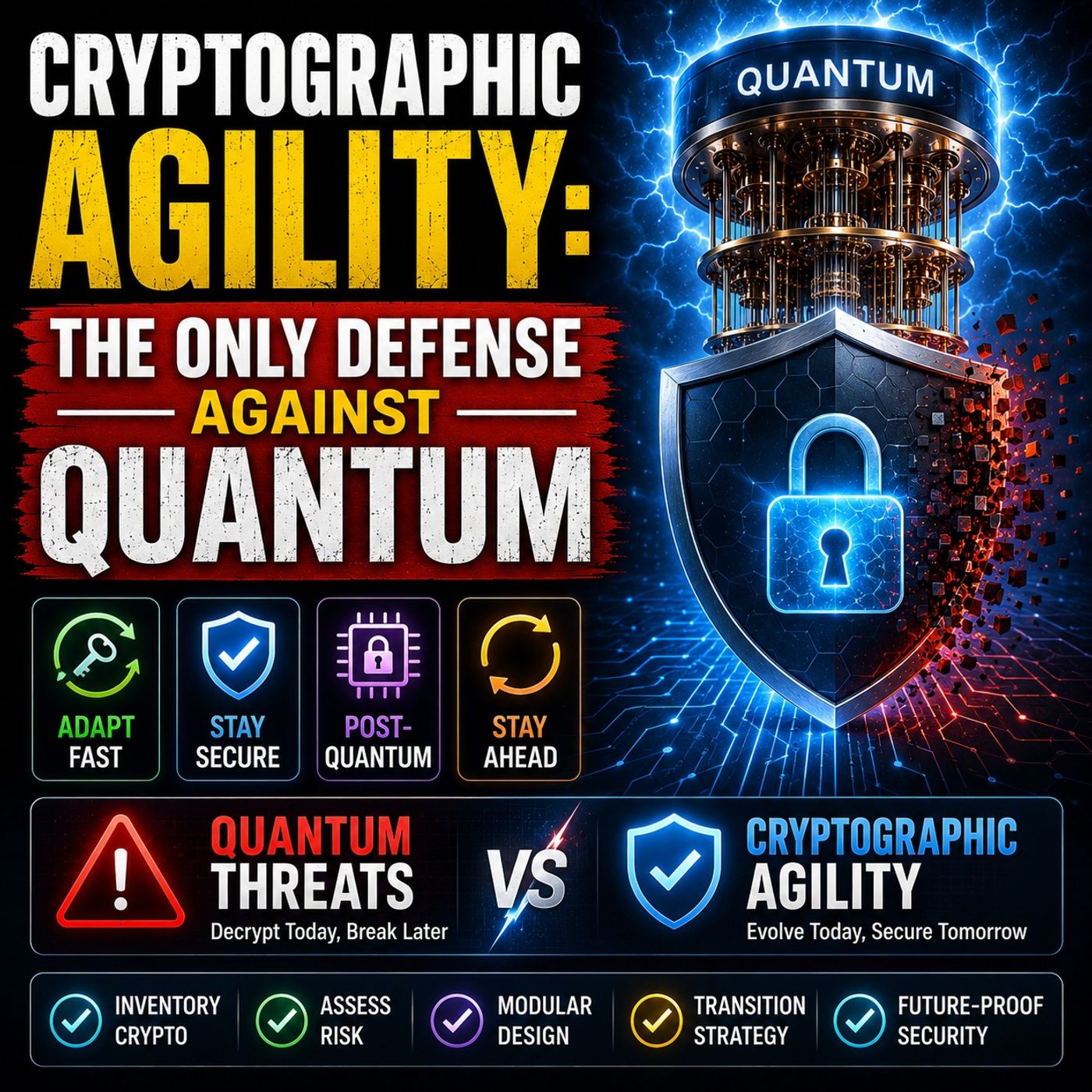
Cryptographic Agility: The Only Defense Against Quantum
About this episode
Most discussions about quantum computing focus on a single question:When will quantum computers break encryption?The better question is this:How quickly can your organization replace encryption when it happens?Because the organizations that survive the quantum transition won't necessarily be the ones that adopt the newest algorithms first. They'll be the organizations that can change algorithms without rebuilding their infrastructure.In this episode, we explore the growing reality of post-quantum cryptography, the harvest-now-decrypt-later threat, Microsoft's evolving quantum-safe roadmap, and why cryptographic agility is becoming one of the most important architectural disciplines in enterprise security.We examine the technologies, standards, governance models, and operational practices required to prepare Microsoft 365, Azure, Active Directory, Entra ID, Azure Key Vault, VPN infrastructure, certificate services, and enterprise applications for a future where today's cryptography can no longer be trusted.If your organization expects data to remain confidential beyond 2030, this episode explains why preparation can no longer wait.
THE HARVEST-NOW, DECRYPT-LATER THREAT
Many organizations assume quantum risk begins when a quantum computer arrives.In reality, the risk started years ago.Adversaries can capture encrypted traffic today and store it indefinitely. Once cryptographically relevant quantum computers emerge, that archived data can potentially be decrypted retroactively.We explore:
UNDERSTANDING QUANTUM COMPUTING
Quantum computing is often misunderstood.It's not simply a faster computer.Quantum systems use entirely different computational models built around qubits, superposition, interference, and entanglement.This episode explains:
THE GLOBAL QUANTUM TIMELINE
Nobody knows exactly when Q-Day will arrive.What matters is that governments, vendors, and standards organizations are already planning for it.We discuss:
THE COLLAPSE OF RSA AND ECC
Modern digital trust depends on public-key cryptography.The internet, cloud computing, software updates, identity systems, VPNs, and certificates all rely on mathematical assumptions that quantum computers threaten to break.We examine:
THE NEW GENERATION OF POST-QUANTUM ALGORITHMS
The replacement algorithms already exist.After years of evaluation, NIST selected a new generation of post-quantum standards designed to resist both classical and quantum attacks.This episode explores:
THE PERFORMANCE REALITY OF POST-QUANTUM CRYPTOGRAPHY
Quantum-safe cryptography isn't free.The computational performance is often excellent.The bandwidth impact is not.We discuss:
WHY MOST ORGANIZATIONS DON'T KNOW WHERE THEIR CRYPTOGRAPHY LIVES
One of the biggest obstacles to migration is visibility.Many organizations cannot accurately identify every location where cryptography is used across their environment.This episode examines:
THE CRYPTOGRAPHIC BILL OF MATERIALS (CBOM)
Before organizations can migrate, they must inventory.The Cryptographic Bill of Materials is emerging as a critical capability for modern security programs.We explain:
CRYPTOGRAPHIC AGILITY EXPLAINED
The most important concept in this episode is cryptographic agility.Rather than hard-coding algorithms into applications and infrastructure, organizations build systems capable of changing algorithms without disrupting operations.We explore the four pillars of agility:ModularitySeparating cryptographic services from application logic.AbstractionUsing APIs and services that hide algorithm implementation details.Policy SeparationManaging cryptographic choices through policy rather than code.Hybrid CryptographyCombining classical and post-quantum algorithms during transition periods.These principles transform cryptography from a static dependency into an adaptable capability.
HYBRID CRYPTOGRAPHY AND THE ROAD TO POST-QUANTUM
The future won't arrive all at once.The transition period will rely heavily on hybrid cryptographic approaches.We discuss:
HARDWARE SECURITY MODULES IN THE QUANTUM ERA
Hardware Security Modules remain the root of trust for enterprise cryptography.But they also need to evolve.This episode explores:
MICROSOFT'S POST-QUANTUM ROADMAP
Microsoft has already begun integrating post-quantum cryptography across its ecosystem.We take a detailed look at:
BUILDING A QUANTUM READINESS PROGRAM
Technology alone isn't enough.Successful migration requires governance, ownership, accountability, and long-term planning.We discuss how organizations should establish:
THE MICROSOFT 365 IMPACT
For Microsoft-centric organizations, the transition touches nearly every platform.We explore implications for:
WHO SHOULD LISTEN?
This episode is designed for:
Become a supporter of this podcast: https://www.spreaker.com/podcast/m365-fm-a-microsoft-mvp-podcast-by-mirko-peters--6704921/support.
THE HARVEST-NOW, DECRYPT-LATER THREAT
Many organizations assume quantum risk begins when a quantum computer arrives.In reality, the risk started years ago.Adversaries can capture encrypted traffic today and store it indefinitely. Once cryptographically relevant quantum computers emerge, that archived data can potentially be decrypted retroactively.We explore:
- Harvest-now, decrypt-later attacks
- Long-term confidentiality risks
- Why encryption can fail years after data is stolen
- The impact on healthcare, finance, government, and intellectual property
- How retention periods influence quantum risk
UNDERSTANDING QUANTUM COMPUTING
Quantum computing is often misunderstood.It's not simply a faster computer.Quantum systems use entirely different computational models built around qubits, superposition, interference, and entanglement.This episode explains:
- Physical versus logical qubits
- Error correction challenges
- Shor's Algorithm
- Grover's Algorithm
- Why quantum computers threaten public-key cryptography
- Why symmetric encryption remains more resilient
THE GLOBAL QUANTUM TIMELINE
Nobody knows exactly when Q-Day will arrive.What matters is that governments, vendors, and standards organizations are already planning for it.We discuss:
- NIST standardization efforts
- IBM quantum roadmaps
- Google Quantum AI milestones
- Quantinuum and IonQ developments
- Government transition mandates
- Expert forecasts for cryptographically relevant quantum computers
THE COLLAPSE OF RSA AND ECC
Modern digital trust depends on public-key cryptography.The internet, cloud computing, software updates, identity systems, VPNs, and certificates all rely on mathematical assumptions that quantum computers threaten to break.We examine:
- RSA
- Elliptic Curve Cryptography (ECC)
- Diffie-Hellman key exchange
- Digital signatures
- PKI infrastructures
- Identity systems
THE NEW GENERATION OF POST-QUANTUM ALGORITHMS
The replacement algorithms already exist.After years of evaluation, NIST selected a new generation of post-quantum standards designed to resist both classical and quantum attacks.This episode explores:
- ML-KEM (formerly CRYSTALS-Kyber)
- ML-DSA (formerly CRYSTALS-Dilithium)
- SLH-DSA (formerly SPHINCS+)
- FN-DSA (FALCON)
- Lattice-based cryptography
- Hash-based signatures
THE PERFORMANCE REALITY OF POST-QUANTUM CRYPTOGRAPHY
Quantum-safe cryptography isn't free.The computational performance is often excellent.The bandwidth impact is not.We discuss:
- Larger key sizes
- Larger signatures
- TLS handshake expansion
- Certificate chain growth
- Network fragmentation
- Mobile and IoT constraints
- Performance trade-offs
WHY MOST ORGANIZATIONS DON'T KNOW WHERE THEIR CRYPTOGRAPHY LIVES
One of the biggest obstacles to migration is visibility.Many organizations cannot accurately identify every location where cryptography is used across their environment.This episode examines:
- Hidden certificate dependencies
- Hard-coded cryptographic libraries
- Legacy applications
- VPN infrastructures
- SSH deployments
- SaaS integrations
- API security dependencies
THE CRYPTOGRAPHIC BILL OF MATERIALS (CBOM)
Before organizations can migrate, they must inventory.The Cryptographic Bill of Materials is emerging as a critical capability for modern security programs.We explain:
- CBOM fundamentals
- Continuous cryptographic discovery
- Dependency mapping
- Vendor risk analysis
- Algorithm inventories
- Compliance reporting
CRYPTOGRAPHIC AGILITY EXPLAINED
The most important concept in this episode is cryptographic agility.Rather than hard-coding algorithms into applications and infrastructure, organizations build systems capable of changing algorithms without disrupting operations.We explore the four pillars of agility:ModularitySeparating cryptographic services from application logic.AbstractionUsing APIs and services that hide algorithm implementation details.Policy SeparationManaging cryptographic choices through policy rather than code.Hybrid CryptographyCombining classical and post-quantum algorithms during transition periods.These principles transform cryptography from a static dependency into an adaptable capability.
HYBRID CRYPTOGRAPHY AND THE ROAD TO POST-QUANTUM
The future won't arrive all at once.The transition period will rely heavily on hybrid cryptographic approaches.We discuss:
- X25519MLKEM768
- Hybrid TLS
- Dual-signing strategies
- Transitional architectures
- Browser support
- Cloud provider adoption
HARDWARE SECURITY MODULES IN THE QUANTUM ERA
Hardware Security Modules remain the root of trust for enterprise cryptography.But they also need to evolve.This episode explores:
- Crypto-agile HSMs
- Firmware-based algorithm updates
- Azure Managed HSM
- Azure Key Vault
- Key rotation automation
- Quantum-safe trust anchors
MICROSOFT'S POST-QUANTUM ROADMAP
Microsoft has already begun integrating post-quantum cryptography across its ecosystem.We take a detailed look at:
- SymCrypt
- Windows 11
- Windows Server 2025
- .NET 9
- Azure Key Vault
- Azure Managed HSM
- Active Directory Certificate Services
- Microsoft Edge
- Azure infrastructure
BUILDING A QUANTUM READINESS PROGRAM
Technology alone isn't enough.Successful migration requires governance, ownership, accountability, and long-term planning.We discuss how organizations should establish:
- Enterprise Cryptography Programs
- Steering Committees
- Migration roadmaps
- Risk prioritization models
- Continuous inventories
- Vendor management processes
- Compliance reporting frameworks
THE MICROSOFT 365 IMPACT
For Microsoft-centric organizations, the transition touches nearly every platform.We explore implications for:
- Microsoft 365
- Entra ID
- Active Directory
- Exchange Online
- SharePoint Online
- Teams
- Azure
- Power Platform
- Azure API Management
- Azure Networking
WHO SHOULD LISTEN?
This episode is designed for:
- CISOs
- CIOs
- CTOs
- Enterprise Architects
- Security Architects
- Azure Architects
- Microsoft 365 Architects
- PKI Administrators
- Identity Engineers
- Infrastructure Teams
- Compliance Leaders
- Risk Managers
- Government Technology Teams
Become a supporter of this podcast: https://www.spreaker.com/podcast/m365-fm-a-microsoft-mvp-podcast-by-mirko-peters--6704921/support.
Get every episode summarized
Each time M365.FM - Modern work, security, and productivity with Microsoft 365 publishes, we email you a written briefing from the transcript — the topics, who appeared, and any specific claims, with the ad reads skipped.
Email me new episodesFree for 3 shows. No card needed.
No transcript yet
This episode has not been transcribed. Request it and it moves to the front of the queue.
More episodes
More from M365.FM - Modern work, security, and productivity with Microsoft 365

Constraint-Based Scheduling: The Architecture That Makes Production Plans Real
M365.FM - Modern work, security, and productivity with Microsoft 365
Sep 15, 20261:51:40queued

A Machine Goes Down. How Should Your Production Plan React?
M365.FM - Modern work, security, and productivity with Microsoft 365
Sep 15, 20261:41:43queued

Can Value Stream Mapping Become a Live Data Model?
M365.FM - Modern work, security, and productivity with Microsoft 365
Sep 15, 20261:48:32queued

How Finite Capacity Scheduling Actually Works in Manufacturing
M365.FM - Modern work, security, and productivity with Microsoft 365
Sep 14, 20261:54:54completed