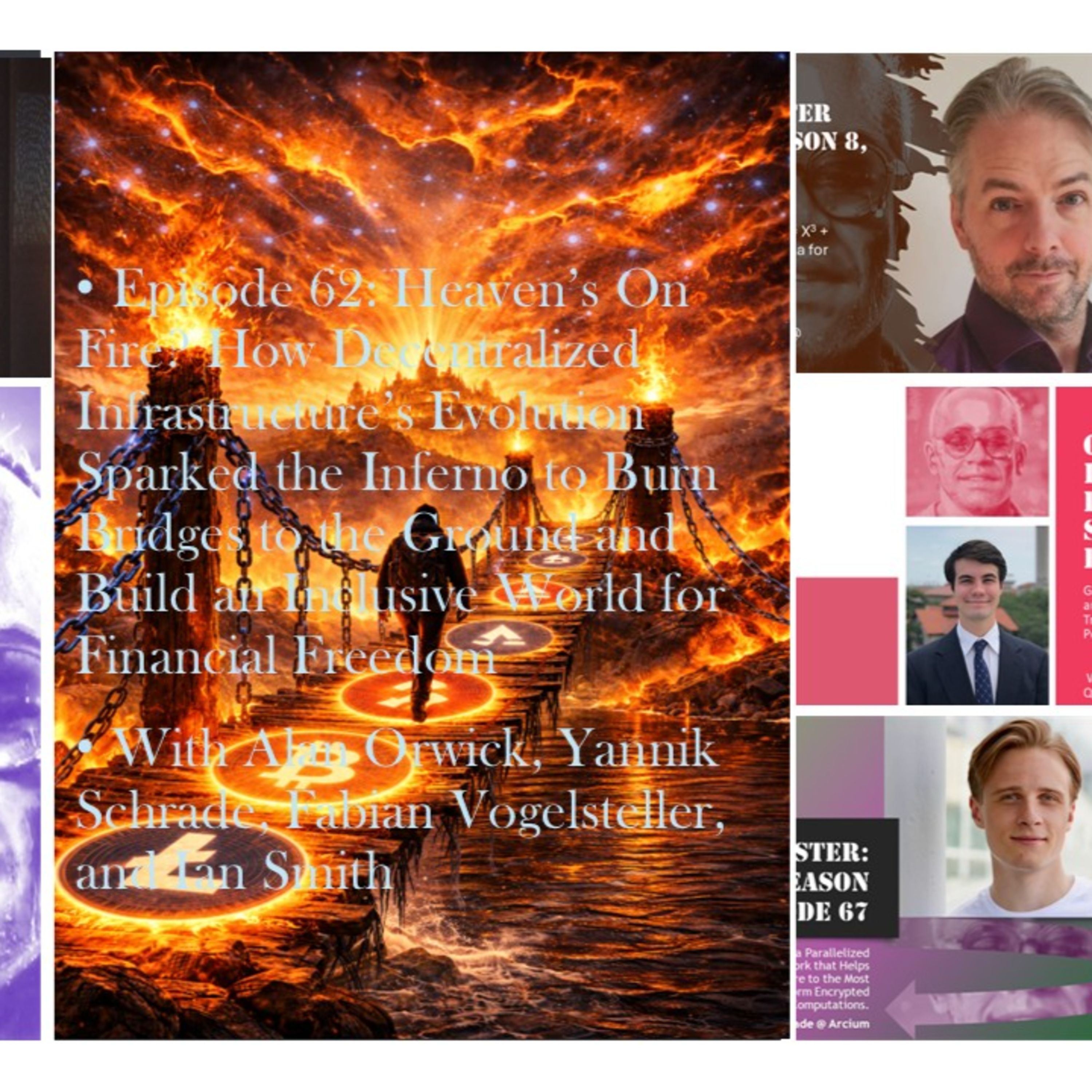
Crypto Hipster's Curtain Calls, E62: Heaven’s On Fire? How Decentralized Infrastructure’s Evolution Sparked the Inferno to Burn Bridges to the Ground and Build an Inclusive World for Financial Freedom
About this episode
This is the sixty-second episode in the Crypto Hipster's Curtain Calls Series, which includes 3–4-minute clips from Seasons 6-8. This compilation draws upon my conversations with:
Alan Orwick, co-founder @ Quai Network (7/2/2024, Season 7)
Yannik Schrade, CEO and co-founder @ Arcium (7/20/2024, Season 7)
Fabian Vogelsteller, co-founder @ LUKSO (6/10/2024, Season 7)
Ian Smith, CEO and CTO @ Quantum EVM (4/12/2025, Season 8)
Get every episode summarized
Each time Crypto Hipster publishes, we email you a written briefing from the transcript — the topics, who appeared, and any specific claims, with the ad reads skipped.
Email me new episodesFree for 3 shows. No card needed.
Hosts & guests
Transcript ready
255 searchable segments. Every word is indexed and playable.
Full transcript
Crypto Hipster — Crypto Hipster's Curtain Calls, E62: Heaven’s On Fire? How Decentralized Infrastructure’s Evolution Sparked the Inferno to Burn Bridges to the Ground and Build an Inclusive World for Financial Freedom. Machine-transcribed; use the interactive transcript above to jump the player to any line.
Hello everybody and welcome to the crypto hipster's curtain calls. This is your host, Jamil Hassan, the crypto hipster, why bring you compilations, compilations from my seasons, previous seasons, in this case, seasons 67 and 8. This is episode 62 entitled Heavens on Fire, how decentralized infrastructure's evolution sparked the inferno to burn bridges to the ground and build an inclusive world for financial freedom. This podcast is a episode, is a compilation of four episodes from the crypto hipsters' previous seasons. Three from season 7 and one from season 8. The first conversation was from July of 2024.
The first three are from season 7 and the final one from season 8. July 2nd, 2024, I spoke with Alan Orwick, who is a co-founder at the QY Network. We talked about QY, she, which is a stable coin by QY, and the serenity effect of transforming compute power into money. Very interesting conversation if you like money, check it out, check out my podcast, actually all these podcasts are available in their entirety anywhere you listen to your favorite podcast. So please check them out on the crypto hipster podcast station. Second, it's a wonderful conversation with Yannick Shrey, who is the CEO and co-founder at Archium. We talked in also in July, July 20, 2024. We spoke about building a parallel lies confidential computing network that helps industries with
exposure to the most sensitive data, perform encrypted computations, it's a mouthful, but that is a very unique and interesting technical conversation. So please check it out. The third conversation was from June 2024, season 7, Fabian Vogelsteller co-founder of Luxo. This is part of my shooting from the hip series, a 15 episode shooting from the hip series, which means we just got on a call, and we shot from the hip, and we talked about why designing excellent technological standards provided the bedrock for global mass adoption of blockchain technology. In the last conversation, it's a really interesting one, really interesting. Check this out. If it's only one to check out, this is one of my favorites, because I spoke with Ian Smith,
who is the CEO and CTO of Quantum EVM, if you're concerned or interested in Quantum, how that's going to affect blockchain, how it's going to affect Bitcoin, so must watch. The title of this was Y squared equals X cubed plus seven, which is the formula that quantum computers are going to use to attack Bitcoin. Why designing the formula for the future of quantum-resistant computing, they're doing quantum-resistant computing, trying to save Web 3, a lot of good stuff in here. That was from April 12, 2025, and that was from season 8, the video clip is in there. So again, this was episode 62, I'm going to 67, it's on the last stretch, and then I said I had something special for you, I do. All these episodes are going to be come books, and not just in the previous season, it's pretty is five, by first five seasons, I used the transcript from the episode from the
conversation. We're going to do a format change. I'm going to talk about the speakers and the third person, I'm going to add some other conversation, other chapters to the book, and we're going to have a readable, really awesome book series for everybody out there. It'll take me a few years to get through on Behave, that's what I do, I'm a podcast or an author, and I love that you're checking this out, and you're joining me for this Carton call episodes. This was episode 62, Heaven's on Fire, how decentralized infrastructure, evolution sparked the inferno to burn bridges to the ground and build an inclusive world for financial freedom. Check it out, thank you for tuning in, and hope to see you all the way to the end, which will be episode 67, and hopefully I'll be done this week.
So talk to you soon, see you soon, see you around, thank you for tuning in. I'm going to ask you about this, because I don't bring it up to anybody, because you know what you're talking about as far as money. We have something in the around the world called COVID, when COVID happened, the US money printer, everybody knows that, everybody knows we went into debt, but what did it do? Enrich the people who were sitting at the top of corporate America, they got more money than everybody else, even though they were failing to lead their companies, their companies were failing, and they weren't able to be leaders, and they were just giving a whole bunch of money, so a masked and entire generation of non-performers, right? So okay, the non-performers got money, everybody else got screwed. You know, the money supply needs to change in order for us to come out of debt in America.
How can people rely on quads to help equalize or bringing that money stock back in the equilibrium so people can see where they're headed in the future? Yeah, I think, for quay, particularly in this use case, you know, thoughts on everything else you said before Assad, and if I were to answer that question directly, it is how do we create crypto that can be perceived in a light of actual experimentation and use case away from traditional forms of money? And so I think to get to quay, you have to kind of go down an existing Bitcoin rabbit hole, right? And like start in Bitcoin or Ethereum and then like work your way and find and discover quay, but we'd prefer that to not be the case in the future, and we'd prefer it in which quay is actually a lot of people's money first time using crypto, and we want that to be open and accessible. So what that means is low fees and ease of use and access. So can you do it in the places that are already frequented in your day-to-day life? So can I go into a convenience store and pay with quay?
Am I booking something on Shopify? Can I pay with quay that way? Can I mask that experience such that you're not even really sure you're using a blockchain or you have a cryptocurrency as part of this transaction? And that's I think limited in many ways, not only by technology, but of like thought and mind of the people that are in blockchain and how they're developing these things and how they perceive the world in the future for it because a lot of people I think do got caught up in sort of the nuance of use cases and research. So creating something very practical in which you can say here is a real product, ship this and get it out to as many people as possible, get people using crypto, that's one of our goals. And allowing that to be something that is sort of unconstrained and able to spread like wildfire is the hope. And so getting people's first time in the crypto in a way that is a good experience because like ultimately that's what I want for people. And I know for me, I think in many ways is product driven and trying to refine this product and something with light crypto is very hard to understand in many different ways.
It's something that people have very visceral and gut reactions to if you talk about crypto kind of across the board. And so I think for us, it's a matter of making that experience more pleasant and thinking about it from first principles in which if you think about how money systems should be thought of, you know, I want to take part in that money system because money ultimately is just kind of value transfer between the people and almost stored time or stored experience and manifesting that and putting that in a way that is able to be digested and able to be used day to day is a meaningful thing. Yeah, I agree. We still need to have that fungible token that everybody can use like the scent that, you know, that you can just use, you know, and not as easy as a store as a vestment, but actually like transactions. And you know, we didn't go down the rabbit hole like stable coins and like how those are being adopted and what that looks like for us to the world.
But there is a very bright future for stable coins as well. You know, there's over $150 billion of stable coin market cap. We're seeing $350 billion plus in terms of volume over seven days. So, you know, people are actually using these things and they are, is demand for the dollar across the globe. So, if anything, the US needs to wake up and see that people want demand for US treasuries and by proxy. These medical companies, these pharma companies that are conducting research with people like me and there, if they use your platform, what will be the benefits to them to be, you know, as part of this clinical research, as part of these trials, what insights could they be able to gain to use and why should they use you? Yeah, so I think there's there's multiple aspects to that one one is that it's impossible without this kind of photography based security and to have this cross entity and collaboration
because the data just under data protection laws cannot be shared and processed in such a way. So, there we have this regulatory limit, potentially, and now what I think is more interesting is that we can have new forms of collaboration even between competitors arise because if you as, and that doesn't have to be in the healthcare sector, right, if we think about, if we think about supply chain, for example, right, we have different logistics players that have data and all players, all competitors would benefit from shared insights or from some shared models, but they can't or are not willing to share any of their sensitive customer company, whatever data with this kind of system they're able to do so. So, completely new intelligence and insights can arise from this kind of collaborative approach. So, I think it's just this win-win situation
where you don't have to give up any of your data. Yeah. Got it. So, I want to investigate this because you probably have a good answer. I interviewed a federated learning company a couple weeks ago and a lot of people use chat GBT. You know, my head rate learning provides a better data set for AI for companies doing your kind of research than just the regular chat GBT social grab. What do you thoughts on why? What was that? Oh, why, why, why, why, why that's the case? Yeah. So, I think it boils down to to sensitive data that can be used. I think the
the patient example really, really highlights that it's really this tension if we think about it on an individual level because that's I think what we need to think about for this healthcare case. It's really on an individual level having sensitive data that has to be protected, right? Again, I'm the biggest privacy advocate and what I found is just that with this kind of technology, I can have both privacy and at the same time get the benefits of confidentially operating over my encrypted data. So, I think it's completely new types of data that haven't been used before, cannot be used. And also where I think in this kind of example with federated learning and blockchain coming to play is the ability to have
better data because there can be a real incentive structure behind the data. So, it can be you provide a good encrypted data set and you can even generate a zero knowledge proof about the quality of your data set, for example, right? And then this training process can happen in a verifiable way. So, everyone can be convinced, okay? This model has been trained on good data and whoever provided the data is rewarded correspondingly. So, I think that just really, yeah, there's more potential. I wouldn't say that in any case the models would be better, but I think there's just more potential that better data and more sensitive data can be used. And I think it's really about also cross-referencing data, right? So, a good example could be
just the government in general. If you, if you were to use text data, social security data, all of that cross-reference, it brain models on that, you potentially would be able to use policies, you want to create and predict the outcome of those policies. Look at social media, for example, you know, you have Twitter, you have Telegram, you have LinkedIn, you have a whole bunch of stuff that's web2 that's centralized really. You know, people are looking for the adoption and the evolution of the centralized social media to be web3 to be fully decentralized. You know, what technological advancements do you feel are necessary for that to happen? I mean, so this is exactly where, is it what are these platforms? And these platforms, obviously, you know, created databases where people can post, you know, and connect and all
of these things. But essentially, there is always a new user account, right? It's a new account system that is not your account, by the way. It is your access, your email and password, is your permission to access their platform, right? And if they wish so, they just could delete your account at any point in time. It's not yours at all, right? They could prevent you from accessing it. They could literally like alter the content at will. It's a complete isolated, you know, it's like a company, it's a centralized system. When we are building a decentralized account, when we have a smart kind of account, we call it universal profiles. When you have a universal profile on Luxo, that profile, that wallet that account is yours 100%. If you don't give access to anyone else, no one has access. The blockchain doesn't have an admin, so nobody can control your account, but you. And so now you could think of building a LinkedIn that uses this account at the foundation. You could build, you know, an X or Facebook or an Instagram that uses
the decentralized account as a foundation. So now you're creating a whole different system. You're creating a system where the user truly owns the account. And ideally, you don't want to just have a database with posts. You want to probably think of some called decentralized version of a post feed system, where people can just post things and some more decentralized version of it. And yeah, when you do that, you, you have the decentralized version of social media or, you know, yeah, but you need the right foundation. That's what I'm trying to get to. It needs to be based on that decentralized account. That's step one. That's the building block number one in that. And if this doesn't exist, you just create a clone of the same old same old and call it and decentralized in some form, right? What's clunky to use? Anyway, so that's where we are starting on the network and the foundational standards so that people can build that kind of future. And in order to have the foundation and have it build properly, the most important thing
that I'm lying at is the standards for that foundation. Exactly. It is, it is, it's where that's the innovation on luck. So it is on the standards level and not only defining these standards, but building out the tooling, right? We build, for example, a project extension that's kind of like the like meta mask, which is for universal profiles. We build out developer tools that can easily interact with this. We're building a mobile app. Anybody could build a mobile app. Anybody could build such a project extension because it's standardized, but we obviously built the first version of it and we built a showcase. What can be done? How can it look like? What website could look like, you know, how you can integrate it? Writing documentation is all about directory education and building the first building blocks for others to make it easier and build cool stuff. But it's about foundations, exactly. So now I have to ask, I mean, you said you're building a foundational comparison of, you know, for identity, like meta mask, right? Here's, here's my concern with meta mask.
Every time I've used it, I've lost money. You know, I use, I don't use meta mask. I use crystal and other things, you know, they, I'm more comfortable with that, but, you know, what are your standard, what are your comparative standard improvements to meta mask? What are those areas? You know, what are you doing this better? I mean, meta mask is not really the best example because meta mask has been around since many, many years. In fact, meta mask was born out of. It was kind of like an improvement or a competition to the Miss Brawl. So back in the day, when we built the first system wallet, you had to run a full node because we wanted to make it a full decentralized way. And then meta mask was like an idea of, okay, let's just do the same like the Miss Brawl. So just in the browser and we don't run a full node, we use some external node. And that's where meta mask came from. Sadly, their UI hasn't really improved in ages.
It's, it's surprisingly bad. And because of this bad UI, people do lose money, right? They go to a scam page, it says, authorize this website or authorize this token, people think nothing bad and pops the wallet just gone. So it's the UI that's bad, but it's also inherently the problem of these wallets that are purely based on a private key. I want to know, I guess this post quantum cryptography, right? How will it help transform the web3 industry? And how will it solve some of the existential challenges to blockchain technology? Well, unfortunately, it runs slower. So it doesn't solve the scalability issue, it makes it much worse. So it would quantum EVM is handling that by doing sharding. And we're treating the virtual machine as a plug and play operation. And we're going to make it so that you can have like Salona and Sui VMs running in parallel
to the Ethereum VM and then have ridgeless transactions between the different virtual machines. So that's what our company is doing to solve running like 120th the speed and not having the scalability tricks that you get with Salona. There's something called snorers signatures, which allows you to combine like 1000 signatures into one and then just check the one and then you know that all 1000 have to be valid, which is great, but we don't have that. We have to check every single signature, every single transaction. So a lot of the scalability that you get in a thin layer twos or roll ups, it just goes away completely. So we're dealing with it with sharding. In terms of like what happens and what are we solving? What happens is that you can't trust smart contracts that are on a classic network. You can't trust that the libraries aren't corrupt, you can't trust the bridges, you can't trust the network, you can't trust the roll ups, you can't
trust any of it. So the problem that we're fixing is that well Web3 will continue to exist because if we didn't do this, it would go away probably in 2027, maybe a little earlier, definitely by 2029, probably by by 2027 or 2028. It's just no more Web3. So we're trying to save Web3 by switching out the cryptography with these giant lattices instead of doing a elliptic curve, which is like this same number looped over itself of your private key number of times. What we're doing is like taking a giant grid of numbers and finding pathways through them. And quantum computers will be able to attack that when they are physically the size of the moon by mass and all of those atoms are mutually entangled to each other.
According to my quantum physics advisor, which means never, probably never, possibly never, my the explanation I have for the way that post quantum lattices work is that imagine that that every sun and every planet in the entire universe is covered in grass. Now find two matching blades of grass. There's only two. It's a hard problem. And there's we have already implemented backup cryptography in case there's a problem with that cryptography. We have different cryptography of its available as well. So we implemented the NIST standard at the crystal stay with EM5, which is the highest security level Bitcoin and BIP360 is proposing to use crystal stay with EM3 at the lowest security level. And we're biting the bullet and saying,
well, the smart contracts take longer to execute. Anyway, we don't want to. We'll deal with will you sharding and we'll have, you know, more transactions per second by having more shards. So quantum community really that really post quantum computing is the key to creating that multi-chain world. Well, that's extra work. The multi-chain world is extra work by us. And we're hoping to have that maybe in June or July, maybe as late as August. But we're hoping to have, you know, our network live in April or May. So April, if we get really lucky and May, if we don't get so lucky, we're kind of rushing to launch or sell Noah's Ark of Web 3 because you have to be on the boat to survive. So you're either on the boat or you got to swim. And the sooner we can launch that,
the more people will begin to adopt so we're rushing launch.
More episodes
More from Crypto Hipster

Crypto Hipster's Curtain Calls, Ep. 66: Bitter Sweet Symphony? How Enduring the...
Crypto Hipster

Crypto Hipster's Curtain Calls, Ep. 65: Edge of Seventeen? How the Failures and...
Crypto Hipster

Crypto Hipster's Curtain Calls, E64: We Didn’t Start the Fire? Why Blockchain’s...
Crypto Hipster

Crypto Hipster's Curtain Calls, Ep. 63: Fire and Rain? Unifying Fragmented Econo...
Crypto Hipster