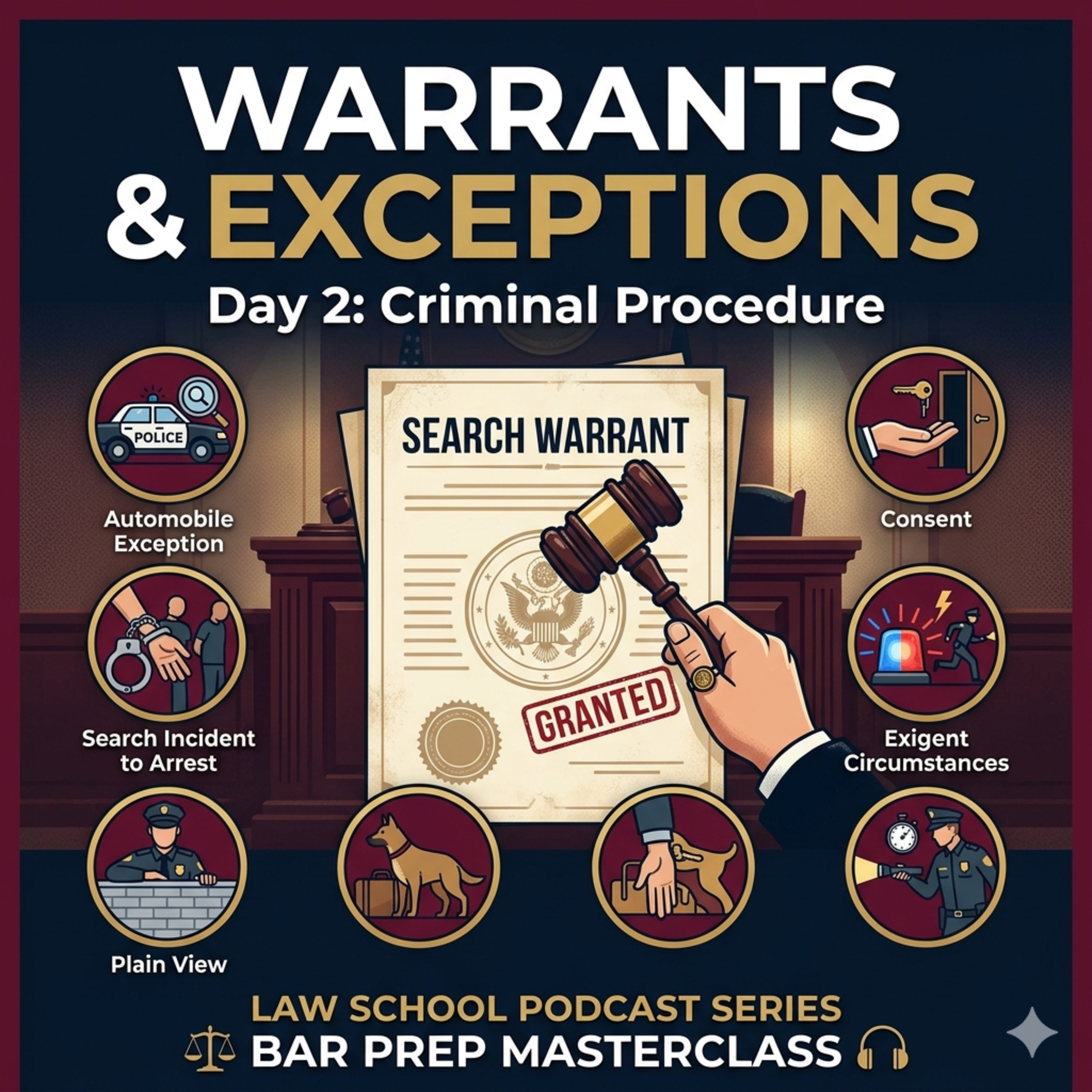
Criminal Procedure Day 2: Warrants and the Warrant Exceptions
About this episode
Study Guide: Day 2 The Core Requirements and the Categorical Bypass
Mastering Fourth Amendment Searches and Warrants: Key Principles and Exceptions
This episode offers a comprehensive guide to the Fourth Amendment’s warrant requirement and its critical exceptions, providing clarity on complex legal doctrines with practical applications for exams and real-world analysis. Whether you're a law student, bar candidate, or just keen to understand your rights, this breakdown sharpens your legal instinct.
Most law students and legal professionals underestimate just how murky the world of search and seizure law has become — especially with the rise of digital technology. This episode reveals how the once clear-cut Fourth Amendment rules have fractured into a landscape of gray areas, traps, and nuanced exceptions that could make or break your exam or court case.
Imagine a legal diagnosis — as straightforward as a broken arm — but suddenly slipping into a complex battlefield of competing interests, shifting contexts, and case law that constantly pushes the boundaries. You’ll learn why warrantless searches are presumed unreasonable, and how history’s fight against colonial arbitrary power shaped today’s stringent requirements. From the infamous British writs of assistance to modern digital privacy, this episode explores the core principles that still underpin constitutional protections — but in a digital age that’s rewriting the rules.
We break down the key doctrines that law students and practitioners must master: what exactly makes a warrant valid? How do the exceptions like search incident to lawful arrest (SILA), the automobile exception, plain view, and exigent circumstances truly work — especially when they overlap? You’ll discover handy frameworks, such as the “wingspan” rule from Chimel, and learn why the scope of a search can collapse with the wrong timing or context. Ever wondered why courts scrutinize movements like flipping a stereo or manipulating a phone? We clarify the difference between mere observation and unconstitutional manipulation, with real-world cases from Riley and Arizona v. Hicks.
Why does modern technology threaten to drown these old rules in confusion? Because new devices like smartphones, encrypted files, and digital data fundamentally alter privacy expectations. You’ll understand how courts are redefining what constitutes a “plain view,” and why digital privacy is the next frontier of Fourth Amendment law. The episode highlights how law enforcement’s need for quick action must be balanced against constitutional safeguards — especially during emergency pursuits or in the Digital Ether of the 21st century.
Perfect for law students studying for exams, bar candidates synthesizing dense doctrines, or citizens eager to know their rights, this episode equips you with a clear, logical approach to analyzing complex search scenarios. Every doctrine is a piece of a puzzle — if you understand their core principles, you’ll unlock the ability to dissect any real-world encounter or exam question.
With expert insights into the evolution of Fourth Amendment law, we guide you beyond memorization into strategic mastery. This is your chance to see how the foundational protections established centuries ago are being challenged and reshaped by today’s technological revolution. Stay disciplined, apply the right framework, and master the art of constitutional analysis — because when the waters get murkiest, clarity is your greatest asset.
Main insights:
The Fourth Amendment's core principle: searches without a warrant are per se unreasonable, with specific exceptions.
The historic distrust of broad government searches—rooted in colonial grievances—shapes modern warrant protections.
Fundamental components of a valid warrant: issuance by a neutral magist
Get every episode summarized
Each time Law School publishes, we email you a written briefing from the transcript — the topics, who appeared, and any specific claims, with the ad reads skipped.
Email me new episodesFree for 3 shows. No card needed.
Hosts & guests
No transcript yet
This episode has not been transcribed. Request it and it moves to the front of the queue.
More episodes
More from Law School

Constitutional Structure: Federal Judicial Power — Judicial Review, Article III,...
Law School

Property Fall Build: Mortgages, Foreclosure, Priority, Fixtures, Water Rights, S...
Law School

Property Fall Build: Covenants, Equitable Servitudes, Common-Interest Communitie...
Law School

Property Fall Build: Adverse Possession and Easements — Hostile Possession, Tack...
Law School