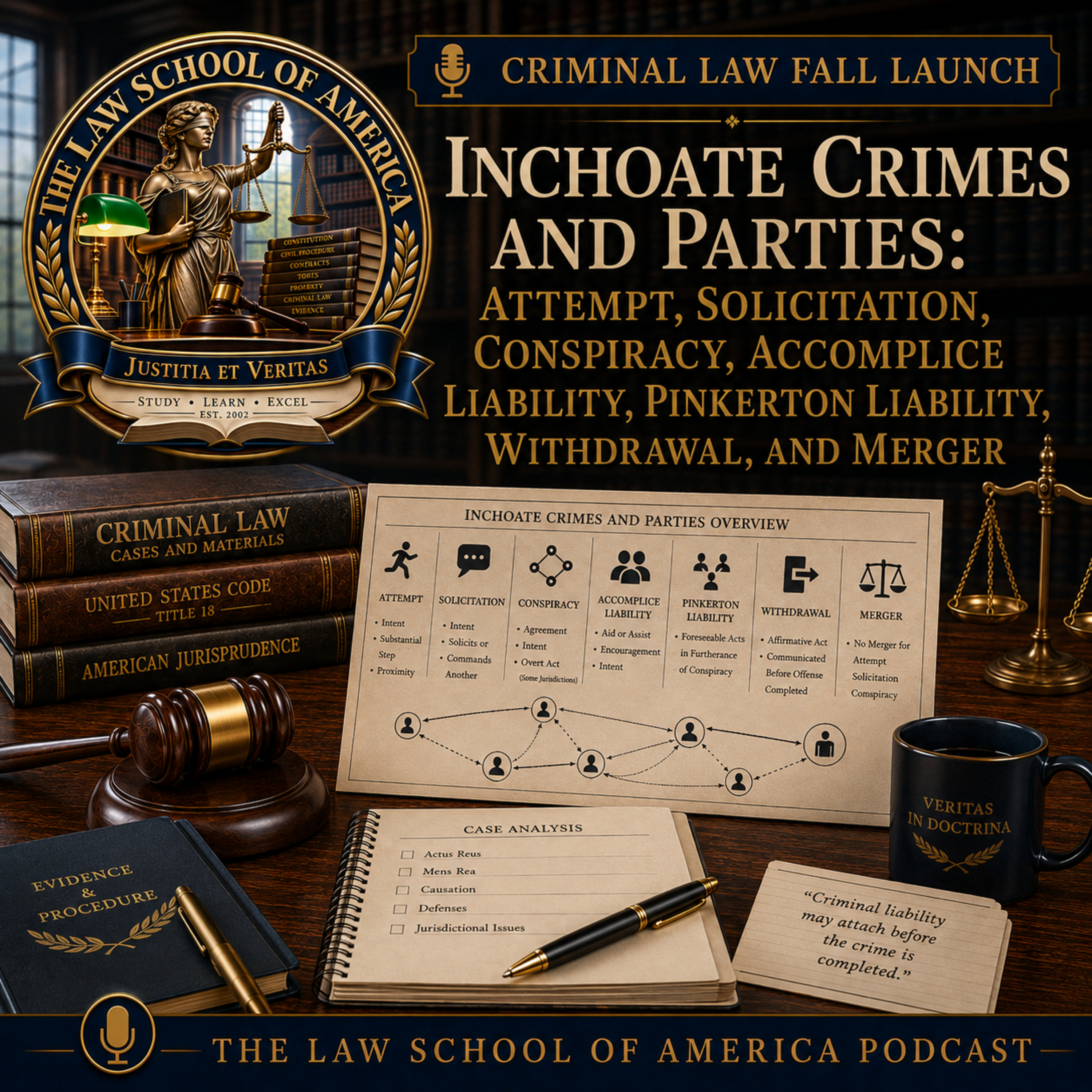
Criminal Law Fall Launch: Inchoate Crimes and Parties: Attempt, Solicitation, Conspiracy, Accomplice Liability, Pinkerton Liability, Withdrawal, and Merger
About this episode
📘 FREE COMPANION STUDY GUIDE 📘
👉 CLICK HERE TO OPEN YOUR FREE STUDY GUIDE 👈
Turn this episode into an exam-ready study plan.
🎧 EPISODE SUMMARY 🎧Criminal liability can arise before, during, or around completion of an offense.
Key doctrines include:
Attempt.
Solicitation.
Conspiracy.
Attempt requires specific intent to commit the target offense plus acts beyond preparation.
For example, attempted murder requires intent to kill; recklessness is insufficient.
Attempt tests include:
Last-act.
Dangerous proximity.
Model Penal Code substantial step.
The last-act test requires conduct at the final step.
The dangerous-proximity test evaluates how close the defendant came to completion.
The unequivocality test requires conduct that unambiguously shows criminal purpose.
The MPC substantial-step test requires a substantial step strongly corroborating criminal purpose.
Factual impossibility is not a defense, whereas legal impossibility traditionally may be.
Abandonment is generally not recognized at common law once complete, though the MPC recognizes voluntary renunciation.
Solicitation occurs upon asking another to commit a crime with intent that it be committed.
Conspiracy requires an agreement and intent to achieve the unlawful objective, plus an overt act where required.
Common law uses a bilateral approach requiring two culpable parties, while the MPC allows a unilateral conspiracy.
Pinkerton liability holds conspirators liable for foreseeable co-conspirator crimes in furtherance of the conspiracy.
Withdrawal from a conspiracy does not erase past liability but may limit future crimes.
Attempt and solicitation merge into the completed offense, but conspiracy does not.
Accomplice liability requires intentional assistance or encouragement; mere presence or knowledge is insufficient.
An accessory after the fact assists a felon only after the crime is completed to hinder arrest or prosecution.
Each theory of criminal responsibility must be precisely identified.
ℹ️ INFORMATION, PRIVACY POLICY & TERMS OF USE ℹ️
The Podcast and Website Purpose
The Law School Podcast and 1L Study Aide webpage supplements law-school and Bar Exam study with strategies, condensed rules, quizzes, and flashcards.
Educational Disclaimer
Content is for educational and informational purposes only. It is not legal advice, creates no attorney-client relationship, and does not guarantee law-school or Bar Exam success.
Privacy Policy
- No account or login is required.
- This webpage uses no forms or analytics to collect personal information.
- Quiz and flashcard activity stays in your browser and may clear when local site data is removed.
Terms of Use
By using this webpage, you agree to use its content only for lawful, personal, noncommercial educational purposes. It supplements—not replaces—courses, textbooks, official materials, or qualified instruction.
Get every episode summarized
Each time Law School publishes, we email you a written briefing from the transcript — the topics, who appeared, and any specific claims, with the ad reads skipped.
Email me new episodesFree for 3 shows. No card needed.
Hosts & guests
Transcript ready
839 searchable segments. Every word is indexed and playable.
Full transcript
Law School — Criminal Law Fall Launch: Inchoate Crimes and Parties: Attempt, Solicitation, Conspiracy, Accomplice Liability, Pinkerton Liability, Withdrawal, and Merger. Machine-transcribed; use the interactive transcript above to jump the player to any line.
usually when we picture a criminal act uh... there's this expectation of absolute completion right yeah exactly it's uh... it's what we're used to seeing right like we're conditioned by movies and tv to visualize crime as this totally finished product you know the bank robber walks out of the vault the bag of cash the alarm is ringing getaway car is screeching away exactly and the police points it well there is the completed crime it's a very satisfying binary narrative the act was either committed or it wasn't it is it provides this um... really comforting sense of closure i mean human nature just prefers guilt to be highly visible we want blame worthiness tied to a tangible absolute result yeah for sure but the reality of criminal jurisprudence well it operates on a much more complex continuum which uh... brings us to the core of today's custom tailored deep dive we're looking at a stack of incredibly dense first-year law school materials outlines in case notes right specifically the criminal law fall launch materials yep the ones covering the weeks of august thirty first
through september six and the mission for this session is to basically strip away that hollywood narrative we need to dissect the deep doctrinal architecture of incoic crimes and multi-party liability we're dining into how the law casts this like incredibly wide net right catching and punishing people who never actually finish a crime or maybe never even set foot anywhere near the crime see exactly this is where we stretch the boundaries of legal blame worthiness to their absolute limits and you know our goal today isn't to just hand you a static list of definitions to memorize no definitely not a deconstruct how criminal liabilities built like element by element and will observe how that liability radically shifts when you alter the defendant's physical act or their mental state or just their level of participation right we are treating this as an intensive exam ready a mastery session because navigating a criminal law exam or i mean just understanding how our justice system actually functions it requires recognizing that liability doesn't just fall on the person holding the smoking gun
yeah it really doesn't we have to explore the legal mechanisms that punish people who attempt or plan solicit or assist in an offense and crucially we have to unpack the underlying logic of why the rules operate the way they do so you can navigate those inevitable traps the professor is going to lay out in a fact pattern well they love their traps they really do but before we get into the weeds of attempt and conspiracy um we need to establish the foundational philosophy of criminal law itself it really helps to contrast it with tort law doesn't it establishing that baseline is essential yeah i mean tort law which you're probably studying simultaneously asks a civil question regarding compensation right who pays for the damage exactly if one person causes harm to another should they pay to make the victim whole it's entirely focused on the distribution of loss but criminal law is an entirely different beast it's way heavier it is it's the law of moral condemnation i mean it's backed by the course of power of the state
to strip a human being of their liberty or well in some jurisdictions their life yeah therefore the inquiry is fundamentally about blameworthiness you have to ask does the defendants conduct combined with their mental state justify the state's ultimate sanction and that standard of blameworthiness gets incredibly complicated when there is no dead body you know no stolen cash no burned down building let's dive right into the concept of the incomplete crime right starting with the doctrine of attempt yeah and the operative legal term in our sources here is incoate right yeah incoate the word basically means just begun or incipient or fundamentally incomplete and the three primary incoate offenses are attempt solicitation and conspiracy okay so these are crimes where the contemplated substantive offense like the target crime never actually reaches fruition exactly the bullet misses or the bank vault is locked or maybe the conspirators are intercepted by law enforcement yet despite the lack of a completed social harm the law dictates the criminal liability
has already attached which i mean immediately sets up a massive philosophical tension for the courts on one side of the scale we have this desperate need for public safety and deterrence right we don't want law enforcement to be forced to wait until a bomb actually detonates before they're allowed to arrest the guy who built it exactly but on the other side of the scale we run into the terrifying prospect of over criminalization like having a dark fleeting thought about harming someone is a pretty universal human experience and it is not a crime definitely not so how exactly does a court draw a definitive objective line between a guilty mind and a punishable act well the law manages that tension through rigorous adherence to specific elements and the absolute most critical element you have to master first is the mental state the mens rea okay the mens rea when you analyze an attempt charge you must instantly recognize that attempt is strictly a specific intent crime this rule is absolute wait absolute even when the completed target offense could be committed with
a lower general intent mental state like recklessness or negligence yes even then you must possess the specific intent to bring about the unlawful result man that feels like the ultimate exam trap like i can see a student reading a fact pattern where a defendant acts incredibly recklessly causes a disaster and they think well the completed crime allows for a reckless mental state so the attempted crime must allow for it to oh it's a classic trap but legally that is impossible let's let's ground this with a classic law school example attempted murder versus depraved heart murder okay let's walk through that let's break the mechanics down murder as a completed offense it doesn't always require the specific intent to kill it can often be charged under a depraved heart theory which is basically extreme recklessness right by exactly extreme recklessness that demonstrates a callous disregard for human life so imagine a defendant who gets drunk stands on the roof of a skyscraper and blindly fires a handgun down into a crowded intersection okay terrifying hypothetical
right they aren't aiming at anyone they don't specifically want anyone to die but if a bullet strikes and kills a pedestrian that defendant is guilty of depraved heart murder their extreme recklessness substitutes for the intent to kill okay but let's change the facts the defendant fires into the crowded intersection but miraculously every single bullet hits the pavement no one is injured can the prosecutor charge that defendant with attempted depraved heart murder they absolutely cannot why not they were acting crazy because the logic is structural you cannot attempt an unintended result the word attempt inherently implies a purposeful striving toward a specific objective you know right you can't try to be reckless exactly therefore extreme recklessness no matter how objectively dangerous cannot satisfy the men's radar for attempted murder attempted murder generally requires the specific conscious intent to end a human life so if we want an attempted murder conviction we need totally different facts we need the defendant to stand on that
roof look through a sniper scope place the crosshairs directly on the chest of a specific rival and pull the trigger with the conscious desire to kill that specific person yes perfect and then if the wind shifts and the bullet misses now we have the requisite specific intent the bad aim doesn't negate the purposeful mental state so the analytical framework you have to apply on an exam is to always identify the target offense first define its required elements then ask the separate independent question did the defendant possess the specific intent to complete those exact elements and if the answer is no the attempt charge fails regardless of how dangerous the conduct exactly the state might charge reckless endangerment or like illegal discharge of a firearm but they cannot charge attempt okay so the specific intent the guilty mind is firmly established but intent alone isn't enough right I mean I can sit in my living room harboring the specific malicious intent to rob the federal reserve but until I get off the couch I haven't committed a
crime thankfully no right this requires us to look at the second half of the equation the actisrius or the physical act the defendant has to go beyond what the law calls mere preparation and reading through these sources defining where preparation ends and an actionable attempt begins it seems to be one of the most heavily litigated gray areas in all of criminal law it really is the difficulty arises because a criminal plot is a continuum it begins with a thought progresses to verbal discussion moves into physical preparation escalates into movement toward the target exactly and then culminates in the final physical act and ends with completion the doctrinal nightmare for judges and legislators is deciding the exact coordinate on that timeline where the state is justified in dropping the legal net right because jurisdictions fundamentally disagree on where that line should be which is why the materials outline five distinct legal tests used to measure the actisrius of attempt yes the five tests and this is prime exam material let's walk through these five
tests and rather than just reciting definitions I really want to use an analogy to keep them mechanics grounded we'll use the firefighter analogy from the case notes I love that analogy it works so well yeah so imagine an arsonist whose specific intent is to burn down a commercial warehouse the law is the firefighter and the legal test dictates when the firefighter is actually allowed to turn on the hose and intervene so the first test is the oldest and most rigid the last act test right the last act test is a strict traditional common law approach under this standard the defendant must perform essentially the final physical movement necessary to bring about the completed substantive crime so it places the threshold of criminal liability incredibly late in the sequence of events very late if our hypothetical arsonist buys gasoline drives to the warehouse pours the accelerant all over the foundation but is arrested right before they can strike the match wow yeah a court applying a strict last act test might actually rule that the defendant was still engaged in mere preparation that is wild so in the context of our analogy the last act test is like a fire
fighter who was forced to wait until the building is already engulfed in flames before taking action pretty much I mean I can see the policy argument for it it absolutely guarantees that we aren't punishing someone who might have had a last minute change of heart before striking the match but it seems practically unworkable for law enforcement it forces police to wait until the public is an imminent unavoidable danger which is exactly why the common law began to evolve the rigid last act requirement gave way to the second standard the dangerous proximity test this was heavily influenced by justice all over wendell homes oh okay how does that one work this test abandons the requirement of the literal final physical movement instead it's a contextual balancing test the court evaluates how close the defendant came to succeeding they weigh the physical proximity to the target the temporal proximity meaning like how much time was left before the crime would occur right the number of steps left in the plan exactly and the inherent seriousness of the contemplated offense okay so the firefighter isn't waiting for the inferno
they're responding to the smell of smoke if our arsonist is standing in the alleyway behind the warehouse holding the gasoline and a lighter just waiting for a security guard to walk past they haven't performed the last act but they are in dangerous physical and temporal proximity right the danger is imminent enough to justify the arrest under that test make sense so what's the third one the third approach is the probable assistance test this shifts the focus slightly from physical geography to psychology interesting the court asks whether the defendant conduct has progressed past the point of no return the line of attempt is crossed when a normal ordinary person in the defendant's shoes would be highly unlikely to voluntarily abandon the criminal enterprise so the law assumes that once you've invested a certain amount of effort your internal momentum just makes assistance improbable but that seems incredibly subjective for a jury to decide like how do you measure the psychological momentum of a hypothetical ordinary arsonist let's move to
the fourth standard which tries to be a bit more objective right the unequivocality test our source is also referred to this as the res Ipsa local order test of attempt yes which translates to the thing speaks for itself right the unequivocality test requires that the defendant's physical actions must clearly unambiguously manifest their criminal purpose the conduct essentially acts as a silent movie oh the silent movie test yeah if you watched a video of the defendant's actions with the sound muted would you instantly know they were committing a crime like merely purchasing a red gas can in a box of matches is entirely ambiguous yeah you might be preparing for a weekend camping trip the conduct has lawful explanations exactly but if our silent movie shows the defendant dressed in all black at 3 a.m. pouring that gasoline in a deliberate perimeter around the warehouse doors the ambiguity completely vanishes there is no plausible lawful explanation for that behavior no the conduct unequivocally demonstrates the intent to commit arson the firefighter can intervene
because the actions speak for themselves okay that brings us to the fifth most modern and arguably most widely adopted standard the model penal code as a substantial step test right the NPC that the drafters of the NPC wanted to allow law enforcement to intervene much earlier than the common law test permitted under the NPC and attempt occurs when the defendant takes a substantial step that is quote strongly corroborative of the actors criminal purpose that phrase strongly corroborative is the operative mechanism there isn't it it means the act doesn't have to be the final act or even dangerously close it just has to provide firm evidence that the defendant's specific intent is real exactly the sources list specific behaviors that the NPC explicitly states can qualify as a substantial step things like lying in weight surveilling or casing the targeted location unlawful entry into the structure or possessing material specially designed for the unlawful act at or nor the scene applying that to our arsonist if the defendant is arrested three miles away
from the warehouse but they're driving a car filled with Molotov cocktails and a map with the warehouse circled in red marker oh wow yeah the NPC would likely classify that as a substantial step the materials in the car strongly corroborate the criminal purpose even though they are geographically and temporarily distant from completion so the NPC is the firefighter who stops the person before they even reach the neighborhood but I mean I have to push back a little here if we are arresting people who are just casing a joint or driving around with suspicious tools aren't we venturing into the territory of punishing pure thought it's a very valid concern right if the substantial step is placed that early on the continuum it feels like the law is saying well we don't care that you aren't actually close to causing harm we care that you are a bad person with bad intentions you have just articulated the central philosophical debate and attempt jurisprudence objectiveism versus subjectivism okay break that down for me well the older common law tests like dangerous proximity and unequivocality they're rooted in objectiveism they demand
that the physical act itself be inherently dangerous and objectively close to completion they prioritize protecting individual liberty even if it means some dangerous people go free because police intervene too early and the NPC the model penal code is heavily rooted in subjectivism subjective this argue that the primary goal of the criminal justice system is to identify and neutralize dangerous individuals if the prosecution can conclusively prove your firm unyielding subjective intent to commit a crime your danger to society is already established so the physical act just serves to confirm that your intent is genuine exactly and that distinction is paramount for anyone trying to analyze a fact pattern the exact same set of facts like driving toward a bank with a scheme asking a note in your pocket can easily be classified as an attempted robbery in an NPC jurisdiction but dismissed as mere preparation in a jurisdiction applying the last act test wow so I always have to identify which standard of controls on the exam okay let's shift the analysis we've established how the prosecution builds an attempt charge but what happens
when the defendant's plan derails this brings us to the defenses to attempt and we really have to start with the concept of impossibility oh impossibility it is a labyrinth of legal theory and I promise you it is a guaranteed issue spotter on any criminal law exam okay so what's the foundational rule here the foundational rule you must commit to memory is the strict bifurcation between factual impossibility and legal impossibility let us state the absolute rule upfront factual impossibility is never under any circumstances a valid defense to an attempt charge okay never a defense I want to make sure I understand the underlying mechanics of why that is factual impossibility happens when the defendant has the perfect specific intent they take a substantial step they do everything in their power to commit the crime but some unknown physical or factual circumstance prevents the crime right the classic textbook illustration involves the crime of larceny uh the pick pocket yes the pick pocket a pick pocket targets a wealthy looking tourist the pick pocket forms the specific intent
to steal the tourist wallet they take the requisite physical act slipping their hand deep into the tourist code pocket but the pocket is totally empty exactly the tourists left their wallet at the hotel when charged with attempted larceny the pick pocket argues well I cannot be guilty it was physically factually impossible for me to steal a wallet that did not exist in that location and the court will reject that argument with extreme prejudice but why if the harm couldn't possibly occur why punish the act because of the principle of culpability the analytical tool you must deploy here is a counterfactual inquiry you ask if the facts had been exactly as the defendant believed them to be would the substantive crime have occurred oh I see in this scenario the pick pocket firmly believed the wallet was in the pocket right if that belief had been true a larceny would have been completed the sheer dumb luck that the pocket happened to be empty does absolutely nothing to erase the pick pockets culpable mental state nor does it erase their dangerous physical
action this societal danger they pose is identical whether the pocket is full or empty another common variation of this is the empty safe scenario right like a burglar uses explosives to blow up in a bank vault fully intending to steal millions only to discover the bank moved all the cash yesterday yep classic factual impossibility the defendant is guilty of attempted burglary or attempted larceny because if the facts were as they believe the crime would be complete exactly but then we cross the boundary into pure legal impossibility and traditionally at common law pure legal impossibility is a complete defense it is an understanding the distinction between the two is critical pure legal impossibility occurs when a defendant engages in conduct that they genuinely subjectively believe is illegal but the conduct is in reality perfectly lawful so the defendant's mistake is not about the physical facts of the world their mistake is about the penal code itself precisely let me try a hypothetical to test this let's say I decide I want to make some fast cash I go to a local herbalist and by a massive bag of dried camomile tea however I am severely
misinformed and I genuinely believe that congress just passed a law classifying camomile as a highly illegal schedule one controlled substance okay I see where this is going right so I take my bag of tea stand on a street corner at midnight act incredibly suspicious and sell baggies of camomile to people whispering that it's you know the illegal stuff I possess a deeply guilty mind I took substantial steps I completed the sale am I guilty of attempting to distribute a controlled substance under the strict traditional common law framework you are completely innocent really yes this is the essence of pure legal impossibility you possessed a culpable mental state but the physical act you performed and the exact act you intended to perform which was selling camomile is not prohibited by any statute the foundational principle of legality dictates that the state cannot punish a citizen for attempting to commit a crime that does not exist on the books no matter how wicked their internal thoughts might be that makes sense you can't be imprisoned just for being bad at
knowing the law but as with the attempt tests the model penal code disrupts this traditional common law approach doesn't it it does the NPC approaches impossibility from an intensely subjective act eccentric perspective the drafters of the NPC were deeply frustrated by courts struggling to distinguish between factual and legal impossibility because you know they often blend into what scholars call hybrid impossibility right so what do the NPC do the NPC largely abolishes the distinction entirely under the NPC framework if you act with the culpability required for the offense and you take a substantial step under the circumstances as you believe them to be you are guilty of attempt full stop wow yeah the NPC evaluates your conduct based on your internal reality so under the NPC my camomile t-hustle might actually land me in a temp charge because in my mind I was distributing narcotics yes it might that is a massive expansion of liability does the NPC offer any safety valve for absurd situations it does offer a very narrow provision known as inherent
impossibility the NPC grants a judge the discretion to dismiss a prosecution or significantly mitigate a sentence if the defendant's intended conduct is so inherently unlikely to result in the commission of a crime that the defendant poses no genuine public danger okay this is the classic voodoo doll hypothetical isn't it precisely if a defendant forms the specific malicious intent to murder their neighbor and takes the substantial step of crafting a voodoo doll and stabbing it with needles while chanting a magical curse well the NPC recognizes that standard attempt liability is inappropriate there because even though they have the specific intent to kill the means chosen are so objectively devoid of scientific reality that the person isn't a danger warranting a standard penal sanction exactly the inherent impossibility provision allows the legal system to filter out those wildly impossible cases okay so we've explored what happens when the facts or the law prevent the crime but what if the only thing stopping the crime is the defendant's own conscience like what if they take a substantial step but then simply change their mind and walk away this introduces the
defense of abandonment or renunciation and the timeline is the sole governing factor here on an exam you must track the exact chronological moment the defendant crossed the threshold into attempt okay so under traditional common law what happens under traditional common law the moment the defendant's conduct crosses the line from mere preparation into an actionable attempt the inquiry defense is instantly complete the liability attaches the very moment that line is breached so therefore a common law you cannot abandon an attempt oh wow so if I break a window to enter a house with the intent the steal but as soon as my foot touches the living room floor I feel a wave of overwhelming guilt turnaround and run away without taking a single item the common law says too bad you are guilty of attempted burglary you can't unattempt a crime anymore then you can un-rub a bank by mailing the money back the next day that is a harsh reality but the model penal code recognized that we probably want to incentivize criminals to stop before harm occurs right yes so the NPC introduced an affirmative defense of renunciation but the standards to meet this
defense are exceptionally rigorous the renunciation must be complete and it must be purely voluntary meaning it must stem from a genuine internal moral awakening a true change of heart and the case law is littered with examples of defendants claiming they voluntarily renounced only to have the court rejected so what specifically does not qualify as a voluntary renunciation well the legal sources explicitly categorize several scenarios that failed the voluntary in his test first decisions motivated by a sudden fear of detection is never voluntary like hearing sirens right if you're picking a lock and you hear police sirens approaching dropping your tools and running as a taxical retreat not a moral renunciation second a decision to postpone the crime is not a complete abandonment like deciding the bank has too many security guards on duty today so you'll come back next Tuesday exactly that fails the defense third switching targets negates the defense if you intend to mug a specific pedestrian but realize they look too physically imposing and you
decide to walk down the street to find a more vulnerable victim you haven't abandoned your criminal purpose you have merely optimized your strategy okay so the defense only applies if the defendant essentially says I have realized the gravity of my actions I am abandoning this criminal lifestyle and I am permanently walking away completely unprompted by any external difficulties or risks precisely that's the only way it works let's transition from physical actions to the legal power the doctrines of solicitation and conspiracy demonstrate how criminal liability can attach based almost entirely on communication let's start with the earliest possible legal intervention solicitation solicitation really represents the furthest extension of the inco-8 net a defendant is guilty of solicitation if they command encourage request or invite another person to commit a criminal offense acting with a specific intent that the target crime actually be committed and the mechanics of when this crime is complete are fascinating unlike attempt which requires a
progression of steps solicitation is instantaneous isn't it yes it is the crime is legally complete the very millisecond the request is communicated it is entirely irrelevant how the other person responds wait really so if I walk up to a mechanic and say I will pay you ten thousand dollars to cut the breaklines on my business partners car and the mechanic immediately calls the police I am still fully guilty of solicitation you are the social harm the law seeks to punish and solicitation is the act of trying to infect another person with your criminal purpose the law views the request are as inherently dangerous because they're actively attempting to recruit others into illegality which multiplies the risks to society and in many jurisdictions the request doesn't even have to be successfully received if you mail a letter soliciting a contract killing and the post office loses the letter in transit you are still liable for solicitation the moment you drop it in mailbox because you perform requisite act with the culpable intent now some listeners might wonder about the first amendment here if the crime is just speaking words isn't that protected
free speech we don't have time to dive deeply into constitutional law but the short answer is no speech that is integral to criminal conduct like offering a bribe or soliciting a murder is a well-established categorical exception to first amendment protection exactly right but let's move the timeline forward what happens if I make this solicitation and the mechanics is yes I will cut the break lines now we've crossed the threshold into the most complex and heavily tested area of multi-party liability conspiracy conspiracy is fundamentally the crime of agreement the core elements require an agreement between two or more persons an intent to enter into that agreement and an intent to achieve the specified unlawful objective and most modern statutes require a fourth element correct an overt act yes under pure common law the naked agreement itself was sufficient the moment two people agreed to commit a crime the conspiracy was complete but today the majority of jurisdictions and federal law require the prosecution to prove that at least one
member of the conspiracy committed an overt act in furtherance of the agreement we need to contrast this overt act requirement with the substantial step required for attempt because they are structurally very different a substantial step for attempt has to strongly corroborate the criminal purpose it has to be significant but an overt act for a conspiracy charge can be incredibly trivial candidate it can be legally insignificant on its own yes the overt act does not need to be illegal nor does it need to be a substantial step toward completion it merely serves as physical evidence that the conspiracy has moved beyond the realm of abstract conversation and into the real world so if you and I agree to rob a bank the overt act could be something as mundane as buying a pair of generic sunglasses or placing a phone call to check the bank's public operating hours or even just driving past the bank on your way to the grocery store any physical manifestation of the agreement satisfies the element okay I want to present a hypothetical that highlights one of the most critical doctrinal splits in conspiracy law this is guaranteed to show up on an exam that's here I decide I want to
orchestrate a massive art heist I approach my colleague and pitch the plan I say I will bypass the alarm you drive the van my colleague nods shakes my hand and says I'm in we have an agreement I have the specific intent to steal the art okay however plot twist my colleague is actually an undercover FBI agent wearing a wire they have absolutely zero intention of ever stealing the art they're simply feigning agreement to gather evidence against me am I guilty of conspiracy the resolution of this hypothetical depends entirely on whether the jurisdiction applies the traditional bilateral approach or the modern unilateral approach if you are operating under the traditional common law bilateral framework you are not guilty of conspiracy I can hear students screaming at their outlines right now why not I formed the intent I made the agreement I am clearly a danger to society the bilateral approach is rooted in the literal definition of an agreement it requires a genuine meeting of the minds by definition you cannot have an agreement by
yourself it requires at least two genuinely culpable minds possessing the shared intent to commit the unlawful act oh I see because the undercover agent is feigning agreement and lacks any culpable intent there is no meeting of the minds the legal fiction is that the agreement never actually existed therefore you cannot be convicted of conspiracy you would however be guilty of solicitation for asking the agent in the first place that structural rigidness feels like it creates an absurd loophole allowing a deeply culpable defendant to escape a conspiracy charge purely based on the secret mental state of the person sitting across the table which is precisely the policy argument the model penal code use to reject the bilateral approach the NPC adopted the unilateral approach to conspiracy and how does that change things the unilateral framework fundamentally shifts the focus away from the group dynamic and isolates the individual defendant's culpability under the NPC the law asks only one question did this specific defendant believe they were entering into an agreement
and did this specific defendant possess the requisite intent to achieve the unlawful goal so under the mtc's unilateral view it is completely irrelevant that the person across the table is an undercover cop or a confidential informant or even just a civilian secretly planning to call the police the societal danger emanates from my willingness to bind myself to a criminal enterprise because I believe the agreement was real I am fully liable for conspiracy exactly when analyzing a fact pattern the presence of an undercover officer or a feigning co-conspirator must act as a massive red flashing light demanding a bilateral versus unilateral analysis let's scale this up we've talked about a two-person conspiracy but criminal enterprises are rarely that simple how does the law determine the scope of a conspiracy when you're dealing with a massive syndicate where participants don't even know each other's names yeah that gets complicated the materials emphasize distinguishing between a single overarching conspiracy and multiple separate conspiracies right the architecture
complex criminal networks is generally categorized into two structural models the chain conspiracy and the wheel conspiracy the chain conspiracy operates as a linear sequence of interdependent transactions much like a legitimate supply chain the classic application is narcotics distribution so you have a manufacturer in another country who smuggles the product to a national distributor who sells to a regional wholesaler who supplies a local mid-level dealer who finally sells to the street level dealer in that chain the street level dealer has absolutely no idea who the international smuggler is they've never communicated they don't know each other's names and they're separated by thousands of miles can they really be charged as co-conspirators in the exact same agreement yes they can provided the prosecution can establish that the participants understood they were part of a broader interdependent scheme the legal mechanism here is the shared community of interest like everyone relies on everyone else right the street dealer knows that someone somewhere
had to manufacture and smuggle the drugs the smuggler knows that without a network of street dealers their product has no monetary value the success of each individual link in the chain is entirely dependent on the success of the entire operation because they share that overarching criminal objective the law treats them as participants in one massive single conspiracy okay so that's the chain the other structural model is the wheel conspiracy I always visualize this like a corporate franchise that's a very apt analogy in a wheel conspiracy you have one central figure or group the hub who conducts separate independent illegal transactions with various individuals the spokes okay imagine a corrupt physician who runs a pill mill the physician is the hub the physician sells fraudulent prescriptions to 30 different patients who are the spokes the legal puzzle is determining whether this constitutes one giant conspiracy involving 31 people or 30 separate isolated conspiracies between the doctor and each individual patient and the determining
factor is what the law calls the rim of the wheel we have the hub we have the spokes but we need to see if a rim connects the spokes together precisely to establish a single conspiracy the prosecution must prove the existence of that rim the spokes must be aware of each other's existence and they must share a common purpose or rely on the success of the broader network so if the 30 patients are just individuals seeking drugs for their own personal addiction unaware of each other and in different to the doctors overall business model there is no room the structure collapses into 30 distinct separate conspiracies right but if we change the facts and those 30 people are actually insurance fraud specialists who were taking the prescriptions billing Medicare and picking back a percentage to a shared slush fund that pays the doctor's legal fees now they rely on each other the success of the whole operation keeps the doctor in business which benefits all the spokes the rim exists and it is one giant conspiracy yes exactly and understanding the scope of the conspiracy whether it's single or multiple is absolutely vital because it directly dictates the application
of our next major topic expanding the net the moment you are placed inside a conspiracy you are exposed to the most terrifying doctrine in all of criminal law bigger than liability oh boy pinkerton yes pickerton v united states is a landmark 1946 supreme court decision involving two brothers Walter and Daniel Pinkerton who are operating in illegal bootlegging operation Walter committed several substantive offenses like illegally selling the whiskey while Daniel was actually sitting in jail so Daniel couldn't possibly have committed this sale right yet the supreme court held that Daniel could be convicted of the substantive crimes Walter committed simply because they were partners in the conspiracy the pinkerton doctrine established the rule of vicarious liability for co conspirators I need to push back hard on this concept because it offends the basic intuition of fairness you are telling me that if I join a conspiracy to commit a low level felony like operating an illegal underground poker game and I am just the guy dealing the cards if one of the other organizers
gets into an argument with the player and shoots them dead I can be convicted of murder a crime I didn't plan didn't execute didn't want and wasn't even in the room for I am held liable for the rogue actions of my partner yes that is the awesome sweeping power of pinkerton that is insane it is extreme but it is not unlimited a prosecutor cannot simply charge you with every crime your co conspirator commits the prosecution must rigorously satisfy four specific elements to trigger pinkerton liability okay what are they first the substantive crime must have been committed during the active time frame of the conspiracy second the crime must have been committed in furtherance of the conspiratorial objective third the crime must fall within the scope of the conspiracy and fourth and this is where the most aggressive litigation occurs the crime must have been a reasonably foreseeable consequence of the unlawful agreement so applying that framework to the poker game scenario the murder happened during the conspiracy was it in furtherance of the game possibly if the victim was trying to steal the pot the murder protects the enterprises assets
but the critical battleground is for seability right if this is a friendly low stakes neighborhood game among friends a defense attorney will argue that a sudden homicide was entirely unperseable it was a bizarre departure from the plan but flip the facts if the underground poker game is a high stakes armed operation run by a violent organized crime syndicate and it is common knowledge that the organizers carry loaded weapons to enforce debts a jury could easily conclude that violence up to and including murder was a highly foreseeable consequence of engaging in that specific criminal enterprise and if it is foreseeable pinkerton dictates that you are just as guilty of the murder as the person who pulled the trigger exactly pinkerton liability forces criminals to bear the risk of their partner's collateral behavior but the law doesn't always automatically allow a conspiracy charge just because two people agree to break the law we have to discuss the exceptions starting with Wharton's rule Wharton's rule is a fascinating limitation borne out of the common law
the rule asserts that if the definition of a substantive crime logically and inherently requires the participation of two people you cannot charge those two people with both the substantive crime and conspiracy to commit that crime because it would be redundant right the agreement is already baked into the definition of the offense so charging conspiracy would unjustly multiply the punishment let's look at the historical examples dueling you cannot have a duel by yourself it inherently requires two individuals agreeing to step onto a field with weapons therefore if two people engage in a duel you charge them with dueling you cannot add a charge of conspiracy to duel exactly the same logic applies to big me adultery or the illegal sale of contraband because the sale logically requires both a willing buyer and a willing seller however the law loves its exceptions and Wharton's rule is subject to the third party exception the limitation only applies if the exact number of people logically necessary to commit the crime are the only ones involved if more participants are involved then are strictly required by the definition of the offense
the rule vanishes and everyone can be charged with conspiracy right so let's apply that adultery requires two people if person a and person b commit adultery no conspiracy chart but if person c actively orchestrates the affair pays for the hotel room and acts as a lookout we now have three people involved in a crime that only requires two the third party exception is triggered and a b and c can all be charged with conspiracy to commit adultery exactly that covers logical necessity but what about statutory design what if the legislature writes a law that deliberately punishes one side of an illegal transaction but intentionally remains silent on the other side this brings us to a major statutory interpretation doctrine the jibbari principal the jibbari principal originates from a 1932 supreme court case involving the man act the man act was a federal statute that criminalized transporting a woman across state lines for quote immoral purposes the text of the statute heavily punished the person doing the transporting but it conspicuously omitted any
punishment for the woman being transported even if she fully consented and agreed to the trip but prosecutors eager to secure convictions decided to get creative they thought well if she agreed to go she is a co-conspirator and they try to target the transported woman under the general federal conspiracy statute and the supreme court in jibbari shut that down the court ruled that because congress affirmatively and deliberately chose not to criminalize the transported woman's participation under the specific substantive statute prosecutors could not use the general conspiracy or accomplice statutes as a back door to punish her anyway it would ruin the whole point of the statute exactly to allow that would fundamentally frustrate the clear legislative intent to grant that specific class of persons immunity so if a statute deliberately leaves a necessary party unpunished the jibbari principle acts as a shield against conspiracy or accomplice liability and this isn't just an archaic rule from the 1930s the sources highlight how this exact principle is heavily litigated in modern white collar criminal defense specifically pointing to the recent
Hoskins case involving the foreign corrupt practices act or fcpa the Hoskins litigation provides a brilliant modern application the fcpa criminalizes the bribery of foreign officials however congress specifically drafted the statute to target american companies american citizens and foreign persons who commit acts while physically present within the united states okay Hoskins was a foreign national working for a foreign subsidiary who never set foot in the united states but he helped orchestrate bribes on behalf of an american company from abroad so the department of justice couldn't charge him under the direct text of the fcpa because he didn't fit the jurisdictional requirements instead they tried the exact same tactic as the prosecutors in the 1930s they charged him as an accomplice and a co-conspirator to the american companies violation which forces the court to grapple with the jibbari principle did congress intentionally structure the fcpa to affirmatively immunize foreign nationals acting entirely abroad and this sparks a massive debate over judicial methodology the materials discuss two distinct ways courts approach this
the narrow variant and the broad variant break those down for me how does a judge choose which variant to apply well the narrow variant treats the gabardi principle as a strict rule of statutory construction the judge looks exclusively at the text and the structure of the statute if the law defines a crime that requires multiple parties but the text explicitly leaves one out the immunity applies it is objective and text bound and the broad variant the broad variant however allows judges to look far beyond the text judges will dive into legislative history committee reports and broad policy goals to attempt to divine what congress secretly intended regarding accomplice liability our sources strongly caution against the broad variant if judges are allowed to just rummage through ambiguous legislative history to find a reason to grant a defendant immunity it creates a massive risk of under criminalization it allows courts to invent exemptions that aren't actually written in the law the narrow variant keeps the judiciary anchored to the actual words passed by the legislature
all right let's pivot away from the crime of agreement and move to section five of our analysis accomplice liability and accessory after the fact what happens when you don't necessarily plan the crime but you help someone else commit it we refer to this as aiding in a betting or a accomplice liability and accomplice is an individual who intentionally assists encourages or facilitates the commission of a crime by the principal offender just like attempt a accomplice liability requires a two-pronged analysis you must establish the physical act of assistance and you must establish the requisite mental state let's dissect the physical act first what actually qualifies as legally actionable assistance if i hand a bank robber a loaded shotgun or park a getaway car outside the bank with the engine running the assistance is obvious but what if my involvement is passive like what what if my friend gets into a vicious bar fight and i simply stand behind him crossing my arms looking massive and intimidating specifically to ensure nobody else steps in to break it up i haven't thrown a punch i haven't spoken a word am i an accomplice to
assault this scenario tests a critical doctrinal boundary the universal baseline rule is that mere presence at the scene of a crime is never sufficient to establish accomplice liability you do not have a legal duty to intervene or play superhero furthermore mere knowledge that a crime is occurring does not make you an accomplice right however your bar fight scenario is not mere presence by purposefully standing in a manner designed to intimidate bystanders and protect the principal offender your presence transforms into an affirmative act of psychological encouragement and physical facilitation when presence is wielded as a tool to assist the crime it satisfies the act is reiss for accomplice liability so purposeful intimidation counts as assistance now let's look at the mental state this is where we get into the classic knowledge versus purpose debate suppose i manage a hardware store a customer walks in grabs a heavy titanium crowbar slams it on the counter and tells me i am going to use this tonight to break into the jewelry store down the street
i ring up the sale charge him the standard retail price of twenty dollars and wish him a good evening i had absolute knowledge of his criminal intent i provided physical assistance by supplying the tool am i an accomplice to burglary under the strictest traditional formulation of the law the answer is no knowledge alone is legally insufficient to be an accomplice you must act with the purpose of facilitating the crime you must share the criminal intent even though i knew yes selling an ordinary legal item at the standard retail price does not necessarily demonstrate that you share the burglars criminal purpose it merely demonstrates that you want to complete a retail transaction and make your twenty dollars but how does a prosecutor prove purpose in a commercial transaction then the law looks for factors that elevate knowledge into purpose if the hardware store manager charges the burglary two hundred dollars for a twenty dollar crowbar extracting a felony premium that demonstrates a vested interest in the crime i see right if the manager offers
specialized advice saying actually you want the titanium model it defeats dead balls much faster that active counseling shows purpose or if the end of being sold has no legitimate lawful use supplying it infers a shared criminal intent now once a person is firmly established as an accomplice we have to revisit a concept that feels terrifyingly similar to the pinkerton doctrine it is called the natural and probable consequences doctrine this is a highly controversial common law rule that vastly expands the liability of an accomplice the doctrine dictates that if you intentionally aid and abet a specific target crime for example you agree to act as the unarmed look out for a residential burglary you are not only liable for the burglary but you're also vicariously liable for any other collateral crimes the principal offender commits right any crime provided those crimes were a natural probable and foreseeable consequence of the target crime this means if i am the look out and my partner breaks into the house gets surprised by the home under waking up panics and shoots
the homeowner dead i can be charged with murder even if i explicitly told my partner no weapons and i had no idea he was carrying a gun if a jury decides that a violent confrontation is a foreseeable consequence of breaking into a home at night the doctrine holds me completely liable yes and that exact dynamic has drawn massive sustained criticism from legal scholars and reform advocates the critique is that the natural and probable consequences doctrine violates the fundamental constitutional requirement of personal moral blameworthiness it effectively substitutes a negligence standard asking what was reasonably foreseeable for the actual specific malice required for murder the materials highlight that jurisdictions are beginning to push back against this specifically pointing to california senate bill 1437 as a major legislative reform right california's sb 1437 was a seismic shift in multi-party liability the legislation essentially abolished the natural
and probable consequences doctrine as a pathway to murder convictions under the reform law you cannot be convicted of murder simply because a death was a foreseeable consequence of a felony you assisted so what's required now in california to be liable from murder in california now you must be the actual killer or you must personally possess actual malice of forethought or you must be a major participant in the underlying felony who acted with a reckless indifference to human life it forcefully realigns criminal liability with the individual defend actual state of mind okay let's look at one more variation of assistance everything we've discussed involves helping before or during the crime what happens if the assistance arrives entirely after the fact this requires you to draw a strict definitive chronological line on your exam timeline at what exact moment to the substantive crime legally conclude if person a plans a robbery and person b agrees beforehand to wait three blocks away in a running cart to facilitate the escape person b is deeply involved in the planning and execution person b is an accomplice to the robbery and likely a co-conspirator
but let's change the timeline i am sitting in my living room watching a movie suddenly my friend kicks in my front door covered in dust holding a bag of cash and screams i just robbed the bank the police are right behind me hide me okay i panic but out of loyalty i push him into a secret compartment in my four boards and lied to the police when they knock am i an accomplice to bank robbery you are not the chronological timeline protects you from the robbery charge yeah the bank robbery was legally complete before you ever became involved because you possess no advanced knowledge and provided no advanced assistance you cannot be retroactively liable for the principal offense but i'm not innocent obviously no definitely not by providing assistance after the felonies complete with the specific intent to help a known felon avoid arrest trial or punishment you have committed an entirely separate distinct offense accessory after the fact the punishment for this is generally significantly lower than the punishment for the principal crime reflecting the lesser degree of societal harm so the timeline dictates the charge which leads us perfectly into the next major
doctrinal hurdle withdrawal and merger what happens when a criminal wants out you're deep into a conspiracy or you've already provided assistance as an accomplice and you suffer an attack of conscience how do you legally suffer your liability well the most common mistake law students make is conflating the rules for withdrawing from a conspiracy with the rules for withdrawing from accomplice liability they have entirely different mechanical requirements and legal consequences let us analyze conspiracy withdrawal first okay i have joined a conspiracy to hijack a shipment of electronics we have an agreement we bought the ski masks the conspiracy is active but a week before the heist i get cold feet i send a text message to every single member of the crew stating i am out i want nothing to do with this do not contact me have i erased my conspiracy charge absolutely not you must remember the chronological trigger the crime of conspiracy was legally complete the moment the agreement was formed and the overt act was committed you cannot retroactively uncommit a completed crime the
conspiracy charge will stand out however communicating your unequivocal departure to all co-conspirators is still vital because a successful withdrawal cuts off your future pinkerton liability by a officially severing yourself from the enterprise you ensure that you will not be held vicariously liable for the actual hijacking or any collateral crimes your former partners commit going forward so withdrawal from a conspiracy doesn't save you from the conspiracy charge itself it just stops the bleeding of future liability now what about withdrawing from accomplice liability suppose i gave my friend the master key to the electronics warehouse intending to help him rob it but the next day i regret it i call him and say i withdraw my support do not use the key i am out is that verbal repeatation enough to save me from an accomplice charge no words are legally insufficient if you have already provided tangible physical assistance to effectively withdraw as an accomplice the law requires you to completely neutralize the assistance you introduced into the criminal plan you must
successfully retrieve that master key and if you won't give it back if your friend refuses to give the key back your withdrawal is incomplete in that scenario your only remaining option to sever liability is to contact law enforcement and warn them in time to prevent the robbery from occurring you must affirmatively undo the facilitation you provided you have to clean up your own mess let's address the final piece of abstract doctrine before we move to our grand synthesis what happens to all of these in co-8 charges when the criminal is actually successful if i attempt a robbery and i succeed am i punished for both attempted robbery and robbery this is the merger doctrine right the rules of merger dictate which preliminary offenses are absorbed into the completed crime shielding the defendant from multiple punishments for the same conduct the rule for attempt and solicitation is straightforward they merge into the completed target offense so if you solicit someone to commit an assault and they complete the assault your solicitation charge merges and you are punished as an accomplice to assault if you attempt
an arson and succeed the attempt merges and you are punished solely for arson but conspiracy is the great outlier here isn't it it is conspiracy does not merge into the completed target offense the legal theory behind this is that the act of forming a criminal agreement creating a syndicate generates a distinct independent and heightened danger to society a group of criminals benefits from a division of labor psychological peer pressure that makes abandonment less likely and the ability to execute more complex crimes so because the agreement itself is a unique societal harm it doesn't merge exactly you could be fully convicted of and consecutively sentenced for both conspiracy to commit robbery and the completed robbery and we must explicitly clarify a point of confusion for students do not confuse the merger doctrine with double jeopardy yes that is a crucial distinction double jeopardy is a constitution protection found in the Fifth Amendment that prevents the state from subjecting you to multiple trials for the same offense it prevents serial prosecutions the merger doctrine is a substantive rule of criminal law that operates within
a single trial dictating whether multiple charges on a single indictment can result in multiple convictions all right we have navigated an absolute mountain of legal doctrine today we've deconstructed the tests for attempt the nuances of impossibility the mechanics of conspiracy the terrifying reach of pancreatin and the rules of accomplice liability now the true test of legal mastery is application oh absolutely how do you synthesize all of this chaos when presented with a brutal multi-party fact pattern on a final exam the materials refer to this as the Saturday method exam application the Saturday method is a strategic framework for organizing complex criminal law analysis when a professor hands you a fact pattern involving five different characters committing a cascade of interwoven crimes your initial instinct will be to panic or worse to write a disorganized narrative summarizing the events that guarantees failure so what's the secret the secret to conquering these essays is strict methodical organization first you must draft a chronological
timeline of every legally significant event second and most importantly you must structure your analysis defended by defendant rather than offense by offense let's demonstrate this with a massive integrated hypothetical i'm going to read a dense fact pattern and then we will apply the Saturday method to dissect it here are the facts Albert decides he wants to rob a high injury store Albert approaches Ben and asks Ben to help him pull it off then agrees while this conversation is happening Charlie is sitting in the corner of the room silently listening to the entire plan but he says nothing okay classic start the next day Ben goes to a rental agency and rents a fast getaway car Albert goes to a costume shop and buys a realistic disguise they approach David a massive former boxer and ask him to stand outside the store during the robbery to look intimidating and keep any curious customers from walking in David agrees got it on the day of the heist Albert enters the store wearing his disguise however a silent alarm is tripped and the police arrive before Albert can smash any display cases Albert sprints out of
the store jumps into the rental car driven by Ben and they speed away during the chaotic high-speed chase Ben recklessly swirves onto a sidewalk in severely injures a pedestrian okay things are getting messy later that night Albert shows up at Charlie's house Charlie who just watched the news report about the botched robbery allows Albert to hide in his basement to evade the police manhunt that is a standard messy exam hypothetical where do we begin we begin by completely separating the actors you write defended Albert at the top of your page and you run a complete exhaustive diagnostic on his liability ignoring the ultimate fate of the others for a moment okay so Albert we ask the fundamental questions did Albert personally complete the target crime of robbery no he fled before taking anything did Albert attempt the robbery yes he possessed the specific intent to steal and physically entering the store in a disguise easily satisfies the NPCers a substantial step test and likely the dangerous proximity test right did Albert commit solicitation
yes he intentionally asked Ben to join the crime did Albert commit conspiracy yes Albert and Ben formed an agreement with the shared intent to rob and Ben's renting of the car or Albert's purchase of the disguise satisfies the overt act requirement but what about the pedestrian Ben was driving the car can we charge Albert with a vehicular assault this is where we trigger the pinkerton analysis the escape is legally considered part of the active conspiracy timeline we run the four elements was the assault committed during the conspiracy yes was it in furtherance of the conspiracy specifically the escape yes was it within the scope yes and the fourth element finally was a reckless driving accident a reasonably foreseeable consequence of fleeing a bank robbery in a high speed chase a jury would almost certainly conclude that it is highly foreseeable therefore Albert is vicariously liable for the assault on the pedestrian despite merely sitting in the passenger seat Albert's liability is massive now we draw a line and we write defend it Ben Ben's analysis is slightly different Ben is guilty of conspiracy due to the agreement
Ben is also liable for attempted robbery but not as the principal actor Ben is liable as an accomplice to the attempt he intentionally facilitated the crime by renting the vehicle and driving the principal to the target and of course Ben is directly personally liable for the vehicular assault as the actual driver okay now we move to Charlie Charlie is the classic law school trap he was in the room during the planning phase and this is where precision earns you points during the planning phase Charlie was merely present sounds is not constituted an agreement so there's no conspiracy charge silence does not constitute physical or psychological assistance so there is no accomplice liability for the first half of the timeline Charlie has committed no crime but then we look at the end of the timeline Charlie hid Albert in the basement after the attempted robbery was complete with full knowledge of the crime specifically to help Albert evade a rest right this affirmative act of post crime assistance makes Charlie strictly liable as an accessory after the fact finally we analyze David the intimidating boxer standing outside David never entered
the store so he is not the principal however David as presence on the sidewalk was not mere presence he was positioned there purposefully to intimidate bystanders and secure the perimeter that is an affirmative act of facilitation making David fully liable as an accomplice to the attempted robbery so by isolating each defendant and running the checklist did they complete attempt solicit conspire assist are they vicariously liable did they help after the fact the impenetrable chaos of a multi party hypothetical transforms into a highly structured manageable mathematical equation that is the essence of doctrinal mastery you separate the actors you define the exact moment in time liability attaches and you rigorously apply the elements without blending the theories together this has been an incredibly exhaustive breakdown of first year criminal liability to recap the overarching themes of our deep dive the legal net is vast attempt captures the defendant who takes a step but fails solicitation punishes the mere act of recruitment conspiracy
criminalizes the danger of group agreements accomplice liability and snares anyone who purposely facilitates the act and doctrines like pinkerton act as a massive multiplier shifting the weight of one person's crimes onto the dolders of another and i want to leave you with a final overarching concept to consider as you review your outlines we have spent this session meticulously diagramming the sheer awesome power of the state to construct liability but as future legal professionals you must always question the policy behind the doctrine right because there are huge implications when we allow frameworks like the unilateral approach to conspiracy to flourish or when we apply the sweeping vicarious liability of pinkerton doctrines that can literally sentence a human being to decades in a penitentiary for a murder they never intended never agreed to and perhaps actively wished to avoid we must ask ourselves a profound question are these doctrines successfully and righteously dismantling dangerous criminal syndicates or in our relentless pursuit of public safety and deterrence are we dangerously deluding the most foundational sacred requirement the
criminal justice system the demand for individual moral blame worthiness wow it brings us right back to our opening thought we desire guilt to be a simple visible absolute but the deeper you dive into the architecture of encoic crimes and multi-party liability the more you realize the mechanisms of justice are profoundly complex often counterintuitive and deeply controversial we are navigating a legal landscape where the boundary between a dark thought a bad association and a life altering criminal conviction is defined entirely by the rigorous unforgiving elements we have explored today it's a lot to think about thank you for joining us on this deep dive use this session to pressure test your outlines apply these analytical frameworks to your practice exams and respect the immense power of the doctrines you are learning until next time welcome to today's highly doctrinal explainer on encode crimes and parties if you're studying for an exam or preparing for the bar you already know these multi-party liability doctrines are absolutely notorious for devastating grates and why because it is incredibly easy to fail to separate the actors and the timelines
so today we're undertaking a rigorous uncompromising masterclass we are going to map out exactly how criminal responsibility extends well beyond the person who actually completes a substantive offense we'll be diving deep into the architecture of encode liability and multi-party complicity which are honestly some of the most historically contested and intellectually refined areas of substantive criminal law let's get right into it to master this dense web of liability will proceed systematically through the timeline of crime we'll look at the continuum itself then attempt solicitation and conspiracy complicity and pincerton liability the crucial defenses like withdrawal and merger and will finish with a step-by-step exam attack framework section one the continuum of crime every criminal plan develops along a specific continuum it starts as a mere thought moves into discussion then preparation movement toward commission the final act and finally completion your central analytical skill as a law student is pinpointing exactly where on this timeline
each defendants actions fall now we have to focus heavily on the underlying policy rationale here there's this constant inherent tension in criminal law between the states desired to intervene early to prevent harm and the fundamental constitutional requirement of legality we do not and we simply cannot punish mere thought crimes the state's course of power requires a specific doctrinal threshold to be crossed before liability can actually attach and that brings us to encode crimes the term encode literally means just begun or in the early stages these incomplete offenses prove a vital point a completed bad result is not strictly necessary for a criminal conviction instead these doctrines allow the state to bypass the requirement of a completed harm substituting it with a legally sufficient demonstration of dangerousness and culpable intent as long as the defendant crosses one of the specific doctrinal thresholds the state is justified in its early preventive intervention section two attempt and crossing that doctrinal threshold
attend liability requires two distinct things a highly specific mental state and a legally sufficient act let's start with the mens ria attempt is a specific intent crime you must absolutely possess the specific purpose to commit the target offense now this is a classic exam trap so pay close attention you can never allow a strong intent showing to substitute for physical conduct nor can you assume general recklessness satisfies attempt liability let's walk through a hypothetical imagine a defendant shooting blindly into a crowded train car if someone dies it's to praved heart murder right because that only requires extreme recklessness but if he misses everyone he is not guilty of attempted murder why because attempt requires the specific conscious object to kill you literally cannot purposely attempt an unintended reckless result moving over to the actus rius element jurisdictions vary wildly on what physical act actually goes beyond mere preparation this is heavily tested so let's detail exactly how a single factual scenario plays out across
the different tests imagine an assassin driving to a victim's house with a loaded weapon under the traditional last act test are assassin practically has to pull the trigger for liability to attach merely driving to the house entirely fails the test under the dangerous proximity test which evaluates physical closeness and remaining steps driving to the house probably still struggles to qualify unless he's standing right outside the victims front door but under the model penal code substantial step test the very act of driving to the target location with the weapon is a substantial step that strongly corroborates his criminal purpose that triggers liability much much earlier the model penal code section 501 radically shifted this doctrine by focusing heavily on a substantial step that strongly corroborates the criminal purpose the mpc allows law enforcement to intervene far earlier than the traditional common law approach ever did under this mpc formulation police can arrest a bank robber while he's still sketching the floor plan in his car or lying in wait or simply possessing specially designed criminal materials long before he ever takes a step toward the bank's front door section three solicitation and conspiracy stepping back into the discussion phase so at
what exact moment is the crime of solicitation actually complete the answer is instantly solicitation is complete the very instant a person intentionally commands encourages or requests another to commit a crime with the specific intent that the crime be committed it literally does not matter if the solicit a person actually agrees refuses or just walks away but watch out for this common hypothetical what if a defendant writes a letter soliciting a hitman but the letter is intercepted in the male well under traditional common law this might fail because the request was never actually communicated but under the model penal code section 5.022 an uncommunicated solicitation is still fully culpable because the defendant's dangerous intent was fully formed now let's look at conspiracy which focuses on criminal agreement jurisdictions are deeply split on what actually constitutes an agreement under the traditional common law bilateral approach you need a genuine meeting of the minds between at least two genuinely culpable people but under the model penal codes unilateral approach only one
person needs to genuinely intend to agree let's flesh out the classic undercover cop scenario if your client agrees to traffic drugs with a man who is secretly an FBI agent common law dictates an absolute acquittal there is no bilateral meeting of the minds because the cop is feigning agreement but the NPC is unilateral it only cares about your client's culpable mind resulting in a firm conviction on the exact same set of facts keep in mind an agreement does not need to be a formal written contract prosecutors can and frequently do infer the conspiracy from circumstantial evidence we're talking about coordinated conduct shared planning or dividing criminal proceeds however mere parallel conduct without communication is not an agreement furthermore many jurisdictions require an overt act in furtherance of the conspiracy and crucially unlike the act as re-as for attempt the overt act for conspiracy can be entirely legal and completely trivial vying a skim ask renting a van or simply placing a phone call are all sufficient as long as it demonstrates
the conspiracy is actively at work section four complicity and pinkerton liability this is where we separate agreeing to a crime from actively assisting in it does mere presence at a crime scene make you an accomplice absolutely not accomplice liability is a derivative liability that demands both an act as re-as in a highly specific mens rea the rule here requires dual intent the accomplished must intend to do the physical act of assisting and they must have the specific intent that the underlying crime actually succeed let's say a store owner sells a gun at a premium to someone they know is going to use it in a robbery are they an accomplice not necessarily if the seller merely wants the profit and doesn't actually care about the success of the robbery itself you must intentionally provide affirmative assistance with the specific purpose of promoting that exact defense whatever you do on an exam do not collapse these two distinct doctrines accomplice liability requires actual intentional assistance pinkerton liability on the other hand is vicarious liability born strictly from a conspiracy under pinkerton you can be held strictly liable for a partner's
substantive crime simply because you were in a conspiracy together but you have to break down the three explicit pinkerton elements the crime must be one in furtherance of the conspiracy two within its scope and three reasonably foreseeable let's test the boundary if you conspire to rob a bank and your co-conspirator totally deviates and commits a sexual assault during the robbery is that foreseeable usually no pinkerton liability would not attach to you for the assault though it absolutely would for the armed robbery section five withdrawal merger and impossibility these are the critical defenses and doctrines that neutralize liability or consolidate charges when spotting impossibility issues you absolutely must preserve the doctrinal distinctions always ask first what did the defendant actually believe the circumstances to be factual impossibility is never a defense think of a classic hypothetical pulling the trigger on an empty gun fully believing it's loaded you are still guilty of attempted murder legal impossibility traditionally was a defense these are situations where the
intended conduct wouldn't actually be a crime even if the circumstances were exactly as the defendant believe them to be for example if a defendant firmly believes it's illegal to import talcum powder and sneaks it across the border they aren't guilty of a crime because even if the facts were exactly as they believed no law was actually broken however modern statutes drafted after the model penal code aggressively restrict and often effectively abolish the legal impossibility defense the policy shift here focuses squarely on the actor's subjective intent if an individual demonstrates dangerous criminal propensities the modern approach evaluates their conduct based purely on the circumstances as they believe them to be the law holds them fully accountable for their dangerousness rather than letting them off the hook based on a hyper-technical distinction between factual and legal impossibility so let's say you shoot a stuffed deer believing it to be a real deer out of season under modern NPC approaches your culpable state of mind makes you guilty of attempt now let's analyze the merger doctrine when a crime is successfully completed attempt and solicitation
generally merge into the completed target offense you are not punished for both however conspiracy does not merge the policy rationale here is absolutely crucial the law views group criminality as a distinct compounding societal danger a group agreement to commit a crime is a separate unique harm from the crime itself which is exactly why it survives merger therefore a defendant who successfully robs a bank with a partner will be convicted and punished for both the conspiracy to rob the bank and the completed robbery itself what about withdrawal effective withdrawal requires strict adherence to several requirements it must be timely unequivocal and meaningfully communicated to all co-conspirators in some NPC jurisdictions it actually requires the actor to successfully thwart the crime but here is the doctrinal absolute you must remember withdrawal from a conspiracy may cut off your Pinkerton liability for the subsequent future substantive crimes of your co-conspirators but it does not erase the conspiratorial agreement you already completed you cannot unring that bell the conspiracy charge remains section six the exam attack framework let's synthesize
these rules into a precise method when you are attacking multi party fact patterns precision is everything by rigidly applying the step-by-step methodology you prevent the liability created by one defendants conduct from being casually and incorrectly attributed to everyone else first draw the timeline then put each defendant under a separate heading let me give you a strict rule never use the word they to describe criminal actors on an exam analyze defendant a then analyze defendant b if you blend their conduct you will fail the strict element matching required by the grading rubric you must analyze direct liability then in co-ate liability and then derivative liability strictly in that sequence for every single actor in your fact pattern you must systematically ask and answer every single one of these seven questions did they personally commit it did they attempt it did they solicit agree assist or trigger Pinkerton liability and pay really close attention to that final point did they only help after the felony was completed helping someone escape after the crime
is entirely complete does not make you an accomplice to the underlying crime it's a separate lesser offense known as accessory after the fact address each actor and each element individually criminal liability is built elements by element and one timing detail alters the entire web I want to leave you with a brain teaser to test your mastery if defendant a perfectly withdraws from a conspiracy but his past assistance is exactly what allows defendant b to complete the crime months later where it is his accomplished liability end and his Pinkerton withdrawal begin the answer lies in the precise timeline of elements the dual intent requirements and the strict boundaries of derivative liability we just covered master the timeline master the elements and you will master the doctrine
More episodes
More from Law School

Constitutional Structure: Federal Judicial Power — Judicial Review, Article III,...
Law School

Property Fall Build: Mortgages, Foreclosure, Priority, Fixtures, Water Rights, S...
Law School

Property Fall Build: Covenants, Equitable Servitudes, Common-Interest Communitie...
Law School

Property Fall Build: Adverse Possession and Easements — Hostile Possession, Tack...
Law School