technologyJul 29, 202546:01pending
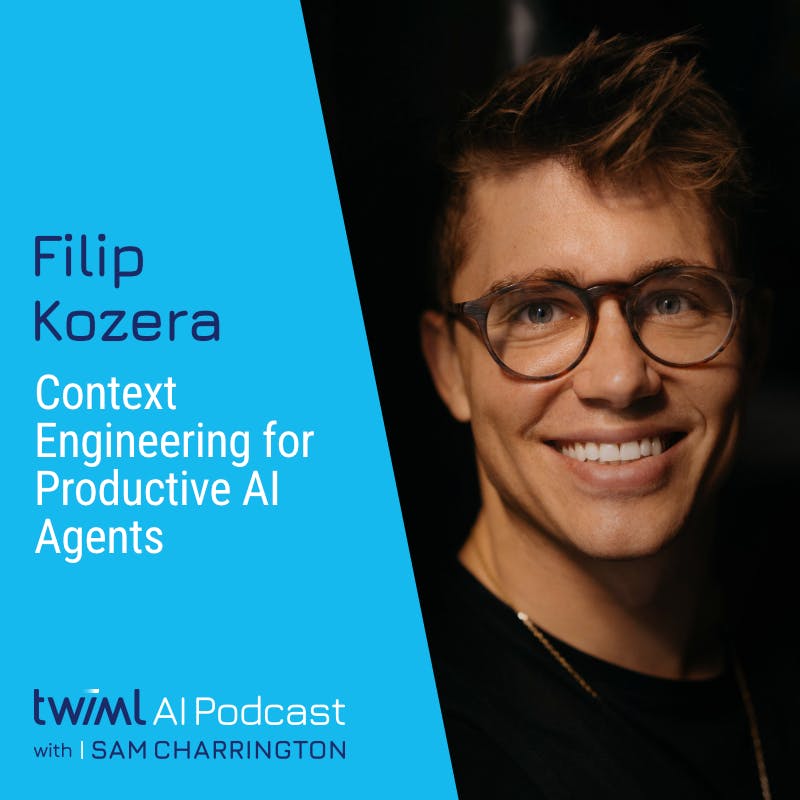
Context Engineering for Productive AI Agents with Filip Kozera - #741
About this episode
In this episode, Filip Kozera, founder and CEO of Wordware, explains his approach to building agentic workflows where natural language serves as the new programming interface. Filip breaks down the architecture of these "background agents," explaining how they use a reflection loop and tool-calling to execute complex tasks. He discusses the current limitations of agent protocols like MCPs and how developers can extend them to handle the required context and authority. The conversation challenges the idea that more powerful models lead to more autonomous agents, arguing instead for "graceful recovery" systems that proactively bring humans into the loop when the agent "knows what it doesn't know." We also get into the "application layer" fight, exploring how SaaS platforms are creating data silos and what this means for the future of interoperable AI agents. Filip also shares his vision for the "word artisan"—the non-technical user who can now build and manage a fleet of AI agents, fundamentally changing the nature of knowledge work.
The complete show notes for this episode can be found at https://twimlai.com/go/741.
Get every episode summarized
Each time The TWIML AI Podcast (formerly This Week in Machine Learning & Artificial Intelligence) publishes, we email you a written briefing from the transcript — the topics, who appeared, and any specific claims, with the ad reads skipped.
Email me new episodesFree for 3 shows. No card needed.
Hosts & guests
No transcript yet
This episode has not been transcribed. Request it and it moves to the front of the queue.
More episodes
More from The TWIML AI Podcast (formerly This Week in Machine Learning & Artificial Intelligence)

How Capital One Delivers Multi-Agent Systems with Rashmi Shetty - #765
The TWIML AI Podcast (formerly This Week in Machine Learning & Artificial Intelligence)
Apr 16, 202654:18failed

The Race to Production-Grade Diffusion LLMs with Stefano Ermon - #764
The TWIML AI Podcast (formerly This Week in Machine Learning & Artificial Intelligence)
Mar 26, 20261:03:18failed

Agent Swarms and Knowledge Graphs for Autonomous Software Development with Siddh...
The TWIML AI Podcast (formerly This Week in Machine Learning & Artificial Intelligence)
Mar 10, 20261:16:14failed

AI Trends 2026: OpenClaw Agents, Reasoning LLMs, and More with Sebastian Raschka...
The TWIML AI Podcast (formerly This Week in Machine Learning & Artificial Intelligence)
Feb 26, 20261:18:55pending