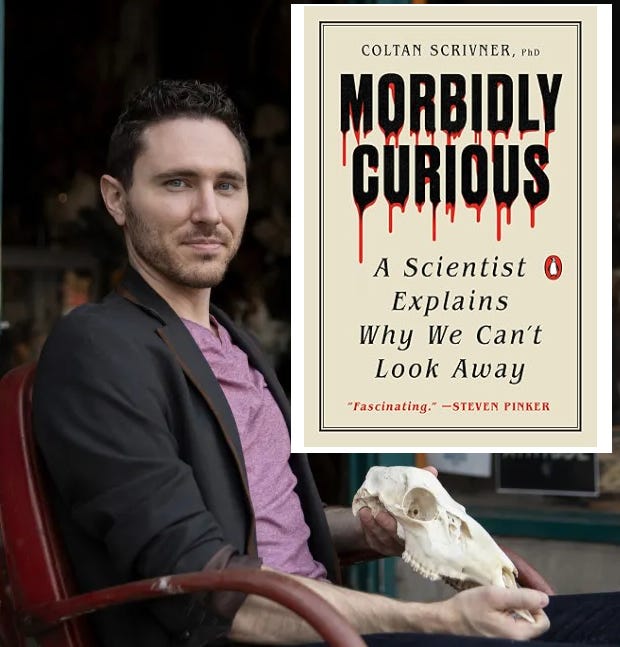
Coltan Scrivner: the evolution and psychology of horror
About this episode
Today, Razib talks to Coltan Scrivner, a behavioral scientist, horror entertainment producer, and author, whose work centers on the psychological and evolutionary roots of our fascination with darkness, horror, and true crime. He is affiliated with the Department of Psychology at Arizona State University. Scrivner also serves as the executive director of the Nightmare in the Ozarks Film Festival and founded the Eureka Springs Zombie Crawl. He has been featured in The New York Times, CNN, The Wall Street Journal, NPR, TIME Magazine, National Geographic, Scientific American and Forbes. He is the author of Morbidly Curious: A Scientist Explains Why We Can’t Look Away, where he explores how our fascination with horror functions as a survival-oriented, yet deeply human, impulse.
Though working in psychology and behavior, Scrivner’s original training is in biological the sciences, and Razib first probes him on the possible evolutionary origins of our persistent interest in horror, and why we might actually be attracted to the phenomenon in the first place. Scrivner also explains how the horror genre differs from other narrative forms, in particular, the power imbalance that makes heroic action and tension much more difficult. Horror, in fact, primarily leverages our intuitions about how predator and prey interact, more than a battle between peers. Scriver also discusses the relationship between fear and our dreams, and the various psychological and evolutionary theories for why we might have so many nightmares.
Get every episode summarized
Each time Razib Khan's Unsupervised Learning publishes, we email you a written briefing from the transcript — the topics, who appeared, and any specific claims, with the ad reads skipped.
Email me new episodesFree for 3 shows. No card needed.
Hosts & guests

No transcript yet
This episode has not been transcribed. Request it and it moves to the front of the queue.
More episodes
More from Razib Khan's Unsupervised Learning
Kyle Orton: Muslims before Islam
Razib Khan's Unsupervised Learning
Gabriel Rossman: the late marvelous Dr. Arday and the state of sociology
Razib Khan's Unsupervised Learning

Monologue: Jason Arday, Nathan Cofnas and the wages of DEI
Razib Khan's Unsupervised Learning

Nikolai Yakovenko: the wages of the Hugging Face hack
Razib Khan's Unsupervised Learning