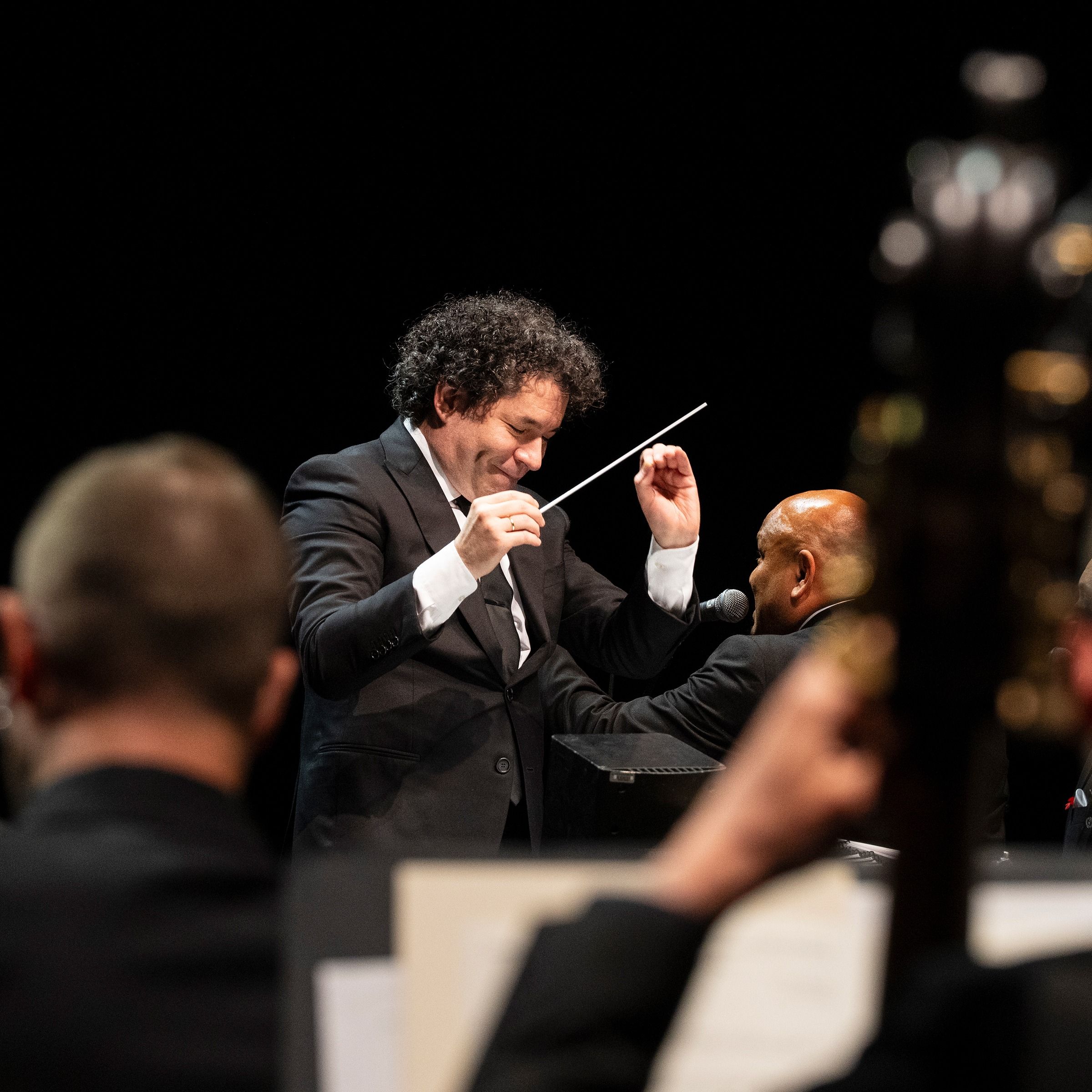
About this episode
This week marks the start of the Gustavo Dudamel era in New York.
The superstar conductor was just 28 when he became the musical director of the Los Angeles Philharmonic in 2009. A native of Venezuela and a product of its El Sistema musical training program, Dudamel quickly established himself not just as a great conductor, but also as a cultural force of nature. In his time in Los Angeles, he expanded the Philharmonic’s repertoire, created a successful youth outreach program, won prestigious awards and ingratiated himself with Hollywood elite.
Now, after 17 years in Los Angeles, Dudamel is taking the helm at one of the world’s most famous and storied orchestras: the New York Philharmonic. It’s a job once held by Leonard Bernstein, and Dudamel is hoping to follow in Bernstein’s footsteps to make the Philharmonic and the music that it plays a bigger part of the pop culture landscape.
On today’s episode, Joshua Barone, who covers classical music for The Times, discusses Dudamel, what he’s accomplished and the high hopes for his tenure with the New York Philharmonic.
Music Featured (in order of appearance, all conducted by Gustavo Dudamel):
- Johann Strauss, Tik-Tak Polka, Polka Schnell, Op. 365, Weiner Philharmoniker (Sony Music Entertainment)
- Dmitri Shostakovich, Festive Overture, Op. 96, Simón Bolívar Youth Orchestra (Deutsche Grammophon)
- Gustav Mahler, Symphony No. 5 in C-Sharp Minor IV. Adagietto, Berlin Philharmonic (Berlin Philharmonic Recordings)
- Antonin Dvorak, Symphony No. 8 in G Major, Op. 88, B. 163, III. Allegretto grazioso- Molto vivace, Los Angeles Philharmonic (Deutsche Grammophon)
- John Williams, “The Imperial March” (From “Star Wars: Episode V — The Empire Strikes Back”), Los Angeles Philharmonic (UMG Recordings, Inc)
- John Adams, “En un Día de Amor Yo Bajé Hasta la Tierra,” The Gospel According to the Other Mary, Los Angeles Master Chorale and Los Angeles Philharmonic (Deutsche Grammophon)
- Gabriela Ortiz, “Kauyumari,” Los Angeles Philharmonic (Platoon)
- Ludwig Beethoven, Symphony No. 7 in A Major, Op. 92, IV. Allegro con brio, Simón Bolívar Youth Orchestra (Deutsche Grammophon)
- Thomas Adès, “XII. The Thieves — devoured by reptiles,” Dante, Los Angeles Master Chorale and Los Angeles Philharmonic (Nonesuch Records)
- Ludwig Beethoven, Symphony No. 5 in C Minor, Op. 67: I. Allegro con brio, Simón Bolívar Youth Orchestra (Deutsche Grammophon)
- Ludwig Beethoven, Symphony No. 5 in C Minor, Op. 67: I. Allegro con brio, Simón Bolívar Symphony Orchestra (self-released)
- Leonard Bernstein, “End Credits” and “The Dance at the Gym: Mambo,” from “West Side Story” (Original Motion Picture Soundtrack), Los Angeles Philharmonic and New York Philharmonic (Hollywood Records)
On Today’s Episode:
Joshua Barone is an editor for the Culture section of The New York Times who works on classical music and dance coverage. He also writes criticism about classical music and opera.
Background Reading:
- Gustavo Dudamel’s Long Goodbye to L.A., and Long Hello to New York
What Makes Superstar Conductor Gustavo Dudamel So Good?
Photo Credit: James Estrin/ The New York Times
For more information on today’s episode, visit nytimes.com/thedaily. Transcripts of each episode will be made available by the next workday.
Subscribe today at nytimes.com/podcasts or on Apple Podcasts and Spotify. You can also subscribe via your favorite podcast app here https://www.nytimes.com/activate-access/audio?source=podcatcher. For more podcasts and narrated articles, download The New York Times app at nytimes.com/app.
Hosted by Simplecast, an AdsWizz company. See pcm.adswizz.com for information about our collection and use of personal data for advertising.
Get every episode summarized
Each time The Daily publishes, we email you a written briefing from the transcript — the topics, who appeared, and any specific claims, with the ad reads skipped.
Email me new episodesFree for 3 shows. No card needed.
Hosts & guests


Transcript ready
996 searchable segments. Every word is indexed and playable.
Full transcript
The Daily — Classical Music Is in Crisis. Gustavo Dudamel Is Here to Save It.. Machine-transcribed; use the interactive transcript above to jump the player to any line.
Hey, what's up guys, it's Hayley Bailey. Okay, I need to tell you about something. I just got YouTube Premium. It's got tons of awesome features like offline downloads, so I can download my favorite videos before I travel and watch them whenever I don't have Wi-Fi. Because we all know airplane Wi-Fi is the worst. I get to add free, I get back room play, and there's like a ton more in there. You should try it. If you like YouTube, you'll love YouTube Premium. Try it now for two months free at youtube.com slash premium. Trial eligibility varies, terms apply, cancel anytime. That's a mouthful. Hey, it's my goal. If you are not yet a New York Times subscriber, we have some news for you. You can get full access to the times without a paywall for 30 days. All you have to do is download the New York Times app to get your first month completely free. And if you're already a Times subscriber, well then thank you. Okay, here's today's show. From New York Times, I'm Michael Babaro.
This is the daily on Sunday. Classical music in the United States has long been in trouble. And the orchestras that perform it have been battling for their survival. The possibility of reinventing classical music has seemed out of reach until... And he is, here comes Gustavo Dutamel. Gustavo Dutamel. Maestro Gustavo Dutamel. Came onto the scene. And took classical music by storm. The word on the street is that this guy's kind of a rocker in the world of conductors. The it man of the conducting world. The shaggy-haired prodigy from Venezuela was become classical music's newest rock star. Now, Dutamel is bringing his revolution to New York as the new musical director of the city's premier orchestra, opposed he officially begins this week.
Today, my colleague, classical music writer, Joshua Barone, on the dawn of the Dutamel era, and exactly what's riding on his success. It's Sunday, September 6th. The day of the day. The day of the day. Joshua Barone, welcome to the Sunday Daily. Thank you. So, on the way to work this morning, I passed a poster on the subway with the face of a man that will be the subject of this episode, Dutamel. And a few days ago, I opened my mailbox, and I got a big brochure with Dutamel's unmistakable head of hair on it. This man is kind of everywhere right now in New York. But for listeners who do not live in our fair city, let me begin with a very basic question. Who is Dutamel?
Even for people who don't live in New York, they might be familiar with him, and because we're talking about a man who might be the most famous conductor alive today. Gustavo Dutamel is one of those musicians who transcends classical music as a genre, as an industry, and really is a star in the realm of pop culture. Because this is someone who works a lot outside of the concert hall. He's been in a trolls movie. Where ever the conductor led, we followed. Me, me, me, me, me, me, me. He has a star on the Hollywood Walk of Fame. He does, he does, he does, yes. We now declare today Gustavo Dutamel Day in Hollywood. And even this old series on Amazon, Mozart in the Jungle, the conductor character was inspired by him. Galgas Hibernell had this wig. Here the hair. The slogan for this orchestra was here the hair, which was very much inspired by Gustavo Dutamel. So wronged by this dramatic people on the track. Oh, okay. Oh, come on. My straw, my straw.
I am very sorry about the must we heard. So this is someone who has been, whether people realized or not, seated in the pop culture world. And that was all before his biggest assignment yet, which is to be the next music and artistic director of the New York Philharmonic. And this season for the first time in its history, the orchestra will be led by a Latino music director. This is the oldest orchestra in the country. It has a bit of a dusty reputation in recent years. In New York, that matters. This isn't just the start of a new tenure. It's the start of a new chapter for the Philharmonic. And so Gustavo Dutamel is bringing, not only his reputation, but his whole ethos, which is a mixture of joy, celebrity, and honestly a celebration of music and its potential to this orchestra to revitalize it. And in the process, perhaps if he's successful, this will be challenging, but if he's successful, prove that classical music really has a place in pop culture today. Which would be a pretty big leap for many of us to fathom.
Talk about the precise state of classical music now because there's been open hand-wringing for years about shrinking audiences for the live performance of classical music in the very few times that I have been to hear the New York Philharmonic. I have observed the age-idness of the crowd. How bad is the situation? Yeah, I think you're not wrong to notice an age-idness because I think the last time classical music really held the status of pop culture in America was when a lot of those people were children. And so it's been a half century at least since this thing really mattered in the culture, but there was a time when it really did, starting in the 19th century, a lot of European music that had been imported to the United States was played in homes. It wasn't unusual for people to play Beethoven's symphonies
at the piano at night. And then as you entered the 20th century, you had the dawn of recording. And this was a big time, perhaps the first celebrity conductor which was Arturo Toscanini. You are about to hear a concert in Carnegie Hall, New York, conducted by Arturo Toscanini, who founded a symphony orchestra for NBC, so he was on the radio, releasing countless recordings. And this was when people were starting to listen to classical music at home in a really widespread way for the first time. And then in the next generation, another sort of face of classical music emerges, and that's Leonard Bernstein. Of course. And what Toscanini did for recordings, Leonard Bernstein did for TV. Now there are so many examples of this melodic technique, I almost don't know where to begin, but let's take for one example our good old stand by Beethoven's fifth here, one on your mark.
Two, get set. Three, go. He brought classical music to primetime television, also in a time when there were very few channels. So there were few options of what to watch. So imagine you have three choices of what to do with your Thursday night, and one of them is to watch Leonard Bernstein conduct the New York Philharmonic, regardless of where you are in America. Right. Must C-TV was Leonard Bernstein. Exactly. Conducting. Exactly. Then you are philharmonic. Yes. So this is the Hadei. And then there's the Loday. And there is a reputation that develops where classical music is seen as a litus. I of course would never claim that that's true. I don't believe it personally, and I think musicians don't believe that either. But there is this popular conception that classical music is a litus. But regardless of what you're doing, you're not going to be able to do it. And you're going to be able to do it. And the conception that classical music is a litus.
But regardless, over time, classical music, which started, let's say, those people who you see in the audience who look older today, those people grew up with the idea that you would subscribe to an orchestra. So you would commit to say every Thursday or Friday night for a whole season of seeing this orchestra. And that system of ticket buyers just doesn't exist anymore. So people buy a ticket to maybe one thing. And they might go once a year, once every three years. And some people are intimidated. I mean, there are these rules. You can't talk. You can't be on your phone. You can't clap between movements of symphony. Right. And unless it's extraordinary. Exactly. Exactly. But again, somebody else is supposed to decide that for you and the audience who knows it better than you and then maybe you can finally clap. Yeah. The result of all this is that it has become a niche art form. And so what all of that means for the New York Philharmonic, especially in the past half century, is that you had an audience that was not necessarily replenishing itself. The concert hall at Lincoln Center was pretty drab.
It didn't have good acoustics. And the conductors who were coming through after Leonard Bernstein just didn't have the charisma that he had. And so you had this sort of old European guy at the podium, a lot of empty seats in this beige room that just did not encourage you to love classical music. And actually in recent years, all of that has been done away with. During the pandemic, the hall was gutted and renovated. It's much more colorful now. The acoustics are fantastic. They're really crisp. And the last thing they needed to revitalize the orchestra was a new conductor. And that conductor, of course, is Duda Mel. Tell us the story of how he became the man upon whose shoulders. The New York Philharmonic and to a larger degree classical music has placed all these hopes and possibilities. How did he come to represent all of that? So Gustavo Duda Mel is born in Venezuela in 1981.
And both of his parents are musicians. He doesn't get born into a big city. He's not born in Caracas. He is born into this system of music education that transformed music in Venezuela and really provided a model for the world that's considered the most successful music education system of the modern era. And that's called LCSTAMA, which on the surface looks a little bit like a pyramid scheme. Basically, it's that anyone can arrive at the sort of, let's say, community center, pick up an instrument and learn it. And whoever learns it can then become a teacher and open up their own community center. The idea is that it would then spread. And now we're talking about well over half a million musicians who are part of LCSTAMA. And that is Gustavo Duda Mel. My favorite game at home was to arrange my toys like an orchestra and conduct them.
That for me was the most fun part of the day. I was still quite young, you know, 11, 12 years older. So he is showing up for one of these sessions with his fellow musicians, people from around town, and the conductor is late. I was there. The conductor didn't arrive. And so as a bit of a joke, he gets up on the podium and he starts waving around and conducting his students. I start as a game with the orchestra to conduct them. And the thing is his teacher did arrive in the middle of all that and just stayed back and watched him. Very cinematic. Exactly, exactly. And suddenly everything became serious. But serious in the most funny way, because for me still is like a game. Presumably he's totally unqualified to be conducting. Yes, I mean, usually people come into conducting at a much later age. But Gustavo, like every child, his idea of conducting is you wave your arms. And if he's lucky, he has a sense of how to conduct a beat,
which is actually a very specific sort of choreography in conducting. But two people realize things in this moment. Gustavo Dutamau realizes he really likes what's happening. He likes this exchange of energy between him and his fellow musicians. And his teacher realizes that this kid has got a gift that's showing itself immediately. So eventually Gustavo gets the attention of the founder of Elsie Stammer, Jose Antonio Abrea, who takes him under his wing, teaches him conducting. At this point, Gustavo had been a violinist. And by the time he's 18, he has given the Simone Bolivar Youth Orchestra, which has since changed its name, but this was the sort of face of Elsie Stammer. The best of the best were put in this orchestra. And Dutamau at 18 was given the baton. And Gustavo Dutamau coming on to the stage, here at the Royal Abort of the Seeming, conducting the Simone Bolivar Youth Orchestra of Venezuela,
to this capacity audience here. And this is Gustavo Dutamau's tenth symphony. I mean, that is Mozartian, to be conducting a symphony at 18. And we're talking about a period of, you know, five, six years between him picking up a baton and taking over a national orchestra. Very impressive. And then from there, the successes came very quickly. In 2004, there's this new conducting competition called the Gustavoff Moller International conducting competition. And it's for young conductors. And young in the conducting world means under 35. But at this point, he's in his early 20s, and he enters the competition, conducting Moller's fifth symphony, which is something that people well into their 70s struggle with conducting persuasively. Why is it so hard to conduct? Yeah, I mean, just look at the fourth movement,
which is this very famous movement called the Adagioito. It's been used in a lot of films. It's very romantic. It's lush, and it has just sort of a single flowing lyrical expression. That's actually very hard to pull off in music, because if you think about that, I can say I love you for 10 minutes, which this piece of music does. Right. But to maintain a sense of, say, tension of sincerity, of honestly discipline, throughout those 10 minutes, of really slow moving expressive music is not easy. This is sort of the heart of what differentiates a competent music performance from a great one. And despite all of that, at 23, he is able to persuade all these judges, the musicians on stage,
and the people in the audience, that he is better at conducting this music than anyone else there. And he wins it. He wins the first competition. But crucially, at this competition, one of the judges is a very famous conductor named Essepeca Salinin, who at that point was the music director of the LA Philharmonic and was looking to move on. So he gets on the phone while he's still there at this competition, and he calls the president of that orchestra, and says, you've got to hear this guy. Wow. And then, due to Mel gets booked, he conducts at the Hollywood Bowl, which is a massive amphitheater that the LA Phil performs at every summer. And before he knows it, he has a job in the US, and he is the new music director of the LA Philharmonic. Wow. For the second time, in what must be either a stroke of luck or just a genuine measure of his talent, two very important figures are in a room with him, and say you're the one. You're the one.
Exactly. And once he arrives in LA, he really takes the town by storm. We have the pleasure of watching a new chapter unfold, the evolution of Gustavo Dutamell, from young phenomenon to mature music director and interpreter, ever deeper and wider in the repertoire. It is a good time to be a music lover in Los Angeles and in the world. He transforms the orchestra's reputation and its footprint in the city, and he really, truly, becomes the superstar conductor he is today. All right. Well, we're going to take a very quick break. And when we come back, we're going to talk about how Dutamell did all of that in Los Angeles. We'll be right back. Hey, what's up, guys? It's Hayley Bailey. Okay, I need to tell you about something. I just got YouTube Premium. It's got tons of awesome features, like offline downloads, so I can download my favorite videos before I travel, and watch them whenever I don't have Wi-Fi. And if you're interested in making your own videos, you can find them on the website, or you can find them on the website,
or you can find them on the website, or you can find them on the website, or you can find them on the website, or you can find them on the website, or you can find them on the website, or whenever I don't have Wi-Fi. because we all know airplane Wi-Fi is the worst. I get at free, I get at Back Room Play, and there's like a ton more in there. You should try it. If you like YouTube, you'll love YouTube Premium. Try it now for two months free at youtube.com slash premium. If you like YouTube, you'll love YouTube Premium. Hi, I'm Sean Evans from HotWanz, and I want to tell you about YouTube Premium. It has offline downloads, so you can watch without Wi-Fi. Background play, so you can lock your phone and it still plays, baby. Oh, and it is completely ad-free. Yes, I said it, ad-free. Try YouTube Premium for two months free at youtube.com slash premium. Trial eligibility varies, terms apply, cancel anytime. Your sales team is at risk of missing quota. Don't panic. Just ask Rippling AI.
Built on your real-time people in business data. Rippling AI can pull metrics from Rippling and your CRM into a meeting-ready dashboard showing quota attainment, head counterjectory, and revenue to quota by region. In seconds, you'll see what's behind your quota risk and fix it before it's missed. Head to Rippling.ai slash the daily. To get the only AI built to give you full visibility and take complex actions across your whole business. R-I-P-P-L-I-N-G dot ai slash the daily. Sign up today. So, Josh, when do you smell arrives in LA? How is it that he becomes this rock star there in the city of angels? So he arrives incredibly ambitious. And the great thing is he arrives at an orchestra that's willing to match his ambition with a lot of money. The LA Philharmonic is one of the wealthiest orchestras in the country. The musicians are happy and well-paid. The orchestra makes money from both its fancy Frank Gary concert hall as well as the Hollywood Bowl where they book pop-ax.
And because of this, Duda Mel who is at heart a populist is able to spread his message far and wide throughout the city. So a big part of that is that he wants to replicate Elsie Stemma in Los Angeles by providing music education for young, often underprivileged kids. And so he found the Uthur orchestra of Los Angeles better known as Yola. And he has that bass in Inglewood, far from downtown where the Frank Gary concert hall is. If you sing that in the shower... You know, ta-la-la-la-la-la-la-la-la-la-la-la-la-la-la-la-la-la-la-la-la-la-la-la-la-la-laa-la-la-la-la-la-la-la-la-la-la-la-la-la! But it also has outreach throughout the city and he's able to develop that, cultivate a sort of music culture and he's able to be in neighborhoods in a way that other conductors might not be able to, because he's also a Spanish speaker and an immigrant.
And he really gets the people on his side early on. So right away he seeks to, and it sounds like succeeds in establishing himself as the people's conduct in LA. Exactly. At the same time, he is in LA, which is the land of Hollywood. And that is a reality that anyone who is going to be a luminary of Los Angeles, but more importantly, a fundraiser in Los Angeles, they need to ingratiate themselves in the Hollywood community. And this is something, due to Mel, does quite naturally. In fact, over the years when he's in Los Angeles, he books a lot of celebrities for concerts, which is something you don't see at work. For example, last season, he did a performance of Beethoven's Music for Eggmont, which was this play from Beethoven's lifetime that isn't really performed, but Beethoven wrote incidental music for it. And he wanted a sort of narration throughout the entire thing. So he had Cape Blanche at do it. Brilliant. And only then did I scream,
you wake up, you must wake up. He recently had a program with Anthony Hopkins around music. And due to belt, makes himself available for Hollywood soundtracks. And so if he gets the orchestra in the studio, he's performing music by the likes of John Williams. The famous cinematic composer of works for Star Wars. And Schindler's list, his work is indelible. When it comes to symphonic movie music, it's John Williams or no one else. Like he is the guy. And due to Mel becomes a friend of his. Basically, he is turning the Los Angeles Philharmonic into an orchestra that's not too good or too self-important to be above Hollywood.
Right. Which makes a lot of sense because Hollywood produces movies that are watched globally by tens of millions of people. Right. And it's not unusual to see celebrities in the audience at Disney Hall. OK, so due to Mel is achieving populism, he is flirting with celebrity. What else? He's really making a case for classical music as a vital art form. He is sort of flattening music as a culture of saying there isn't high art and low art. He's saying all of these things are the same thing. We are here to hear an orchestra play music that can be with a pop star, that can be with a violinist. It doesn't really matter. It's all the same and it's all there for your enjoyment. So he's really sort of offering this to the people. And at the same time, he clearly wants to and becomes a champion of new music, new symphonic music. So he works with John Adams, for example, who is the greatest symphonic composer alive in America.
He discovers, if you will, or puts on the map, a composer like Gabriel Ortiz, who's good for LA because she's from Mexico City and she has a really exciting sound. And he is able to use his celebrity platform to elevate her. And when the LA Philharmonic turned 100 in 2018-19, they commissioned 15 new pieces. Wow. And he was there conducting a lot of them. That's extraordinary. So he's very much ensuring the future of this genre by commissioning all this work. Okay, but what about what many people would probably see as the main reason for him getting this job, the main event, the entree of the meal, which is him standing there conducting the classics, the canon. People buy a ticket for Beethoven. Regardless of everything we're saying.
Yeah. So this is where, due to Mel distinguished himself early on, when he was still in Venezuela, when he was conducting in Europe. And what he shows to people in Los Angeles, and as he continues to rise, he's just extremely lively. There's a kind of choreography to conducting. That's really mysterious. And that's the reason why not everyone is able to do it. I mean, people think that a conductor is there to tell people, this is beat one, beat two, beat three, et cetera. But that's really, anyone can do that quite easily. What Dutamel does really well is, I think, he embodies scores. He embodies music in a way that he's able to channel very specific moments across an orchestra to say the percussion in the back, or the French horn, or something. And he is able to anticipate moments in the music that he wants the orchestra to play.
And he's able to redirect them. It's a sort of oceanic force that he's constantly in control of. That is how you get a good sound out of an orchestra. But there's another element to this, which is how do you get an audience to follow along? Right. Because when you go to an orchestra concert, you are buying a ticket to sit in a chair and watch people sit in chairs and absorb a sound. And I'm not saying that he's a ham. He's not up there flailing on the podium. But he, in the same way that he subtly communicates with every musician on stage, he does the same thing with the audience. And so if you're watching him from the front, you might be able to read his face. You might be able to see a bit of excitement in anticipation. If you're seeing him from behind, you might see a little bit of a looseness in his body as he communicates that moment to the orchestra.
And if you're seeing a moment of absolute excitement, he is matching that in his body, which makes him actually very exciting to watch. That is a very alive. Don't you want to move your body when you're here? I'm literally swinging my tush around in the seat, yes. You know, it's interesting. The role of a conductor has always been to me. And I suspect to many a little bit mysterious, right? The old joke is that it's basically air guitar. And let's be honest, Dutamell as a very young conductor does go up and kind of fake it in front of his classmates, peers, and it kind of works. And I'm being a little bit teasing. But from what you're saying, no, there is a real art and kind of magic to what he's up to. I guess my question for you, because you wear many hats at the times,
one of them as critic is what he's doing, technically speaking good, or is it just extremely lively? I think it's extremely lively and technically uneven, if I am. Really? So we've been describing a lot of things like art, magic, energy, but music is also a craft. And it is a lot of rehearsal time. It's a lot of practice. It's a lot of discipline, really. And this is where I think Gustavo Dutamell struggles the most, because especially in the classics, pieces that people have in their heads and know very well, you can hear the ways in which he keeps you interested, he keeps you excited, but maybe misses some of the details, some of the nuances of the score. I sometimes think of him, you know Mickey Mouse and the Sorcerer is apprentice, like sort of at the cliff sculpting big waves.
And less someone who's interested in the fine details of what every instrument in your orchestra is playing. But I guess the counterargument to that would be that it's a very small and specific group of people in an audience who are listening for that level of technical fidelity. You can just say me. No, I think that's a really smart observation actually, and I think it's why, although I have reservations about Dutamell's conducting, I see him ultimately as a force for good in music. And I think it's important to note that he's getting better as a conductor. He actually has recorded a few of the Beethoven symphonies twice, once in the mid-2000s and once in 2017. And you can really hear, even if you're not a musician or trained ear, you can hear the difference. All right, well, I will bite. Let's play the older Dutamell and the newer. Yes. This is the opening of Beethoven's fifth symphony.
People will recognize at the moment they hear it. Okay, and we'll start with the older version. Okay, now let's play Dutamell years later. Okay, I can hear a difference, but yours are the trained ear. So tell me what I'm hearing. Let's start with the old one again. This you can almost hear as a young person's idea of what this symphony should sound like. It's big, it's dramatic, but it's also rushing a little bit. It's pummeling this theme. Okay, so now let's hear the newer one one more time. You can already hear just from those notes how much slower and more patient this version is.
Right, this is Beethoven being allowed to breathe. Let's go on to the next bit first with the earlier version. You can hear it's still pretty dramatic, but also a little undisciplined, especially in the violin's that they almost slur their way through these phrases. I can hear that. Now let's play the newer version of that same moment. I'm going to jump in, I'm going to jump in, because I have a thought. Okay. I know I should be letting you describe this, but I'm even noticing that the violin's, they're more consistent, they feel that crisper. I don't quite have the right words for this, but there is something different. Is that right? Exactly. This is the same orchestra across years, of course, but this is the same orchestra that he's working on. I'm going to jump in, I'm going to jump in, because I have a thought. Okay. That's the same orchestra that he's working with.
And as you're describing, the violins are so much more articulate here. And as I was saying earlier, there's a lot more patience. In fact, over the course of the entire movement, it's about a minute longer than that earlier recording. Right. And not just racing to the next kind of volcano exactly of a mountain moment. And I think, conversely more tension in that, I think this is ultimately a recording that has more conviction, more confidence, even though he was of course very confident in his mid-20s. You can hear someone who has maybe a touch of wisdom. I don't want to read his mind, but you can hear someone who trusts the music a little bit more this time. That's fascinating. And I think that growth combined with everything that we've been talking about is part of why he's been such a huge success in LA. Okay. Well, we are going to take one more break. And afterward, try to understand why someone who is such an astonishing success in LA
would risk trying to replicate that success in New York. We'll be back. If you like YouTube, you'll love YouTube Premium. It's destroying, athlete, creator, and YouTube Maxer. YouTube Premium enhances how I use YouTube with awesome features like offline downloads so I can download my favorite training videos before I hit the gym. So no Wi-Fi doesn't turn leg day into loading day. Plus, I get ad-free videos, background play, and so much more. YouTube Premium is like YouTube got some extra gains. Try YouTube Premium for two months free at youtube.com slash premium. Hey, what's up, guys? It's Hayley Bailey. Okay, I need to tell you about something. I just got YouTube Premium. It's got tons of awesome features like offline downloads so I can download my favorite videos before I travel and watch them whenever I don't have Wi-Fi. Because we all know airplane Wi-Fi is the worst. I get ad-free, I get background play,
and there's like a ton more in there. You should try it. If you like YouTube, you'll love YouTube Premium. So try YouTube Premium for two months free at youtube.com slash premium. Try eligibility varies, terms apply, cancel anytime. That's a mouthful. 17 courts, hundreds of matches, thousands of points, all happening simultaneously during the US Open. And you can't possibly be there for everything. That's why IBM helps bring together billions of data points with more than 20 years of player history, with scores, stats, insights, and highlights behind every moment. So nothing gets missed. IBM, let's create smarter business. So Josh, we just heard about all the ways Dutamell succeeded in LA and re-invigorated classical music there. And now we're gonna turn to the whole reason why we're talking about Dutamell in the first place, which is that in the coming days, he is gonna be taking over as the conductor of the New York Philharmonic, where Leonard Bernstein once stood,
and I'm wondering how did the New York Philharmonic get Dutamell to come here? What was their pitch to him? So do you remember when I mentioned that conducting competition in the president on the phone who immediately booked him in LA? Fast forward, let's say 15 years, and she is now the president of the New York Philharmonic. Of course she is. And she is overseeing this glamorous renovation of the hall that's going to fix its acoustics, fix its sort of unfriendly appearance, and the last thing, the sort of capstone of the presidency will be a conductor. And so she described her courting of Dutamell as a heat seeking missile. She did not see any other possibility other than Dutamell, but the challenge is that this guy had a pretty good gig in Los Angeles. So in order to get in with Anthony Hopkins. Exactly, exactly. Who wouldn't want to hang out with Hannibal Leiter?
And so she spends multiple years trying to talk him into taking this job and making promises, and it's all done in secret because Dutamell for optics doesn't want to be seen as shopping around, and he wasn't shopping around. But she was following him to different locations around the world, and she would find ways to sort of not be seen entering his hotel so they could meet. There was a time when she gave him a tour of the new hall while it was under construction, and they almost got away with it, but they bumped into Lin-Manuel Miranda outside who wants to know what they were doing there. And so there's this multi-year courting process, and eventually she talks him into it, making promises of not necessarily replicating Yola in New York, but doing something similar, saying he can have whatever community programs he wants. He can have something similar to the Hollywood Bowl of a summer season somewhere in the tri-state area.
He has this new hall, which is very similar to entering LA and having Disney hall. Right. And so there are parallels, and there's the fact that he had been in LA for like 15 years at that point. And it might be ready for something new. Yes. So he is successfully courted. I assume some meaningful amount of money is also assured to him as compensation. What is the response once he says yes from the musicians in the New York Philharmonic? So I was actually on the stage of David Geffen Hall when the musicians learned that for you was I happened to be there in the room when the orchestra learned, they were just wrapping up a rehearsal and actually they were wrapping up a rehearsal with Essepeca Saladin, who's the conductor who discovered him. It all comes. It's all cosmic. And at the very end, this president, her name is Deborah Borta, gets on stage and tells the musicians that she has news.
And a few of them sort of slouch their nervous, they're worried it's something bad. Right. I'm cutting for him. Exactly. And then she just says very calmly, our next music director is going to be Gustavo Dutamel and they immediately cheer. Wow. It's the reaction that you would expect of fans, not colleagues. It's as if you have poached Jalen Brunson from the Nix to your team. It's as if you have persuaded Steven Spielberg to direct your next movie. You're saying everyone in that room suddenly feels like their future is quite bright. Right. And I would say freshly energized. Well, given the Philharmonics less than perfect reputation, in this moment, I have to imagine everyone understands, including the players in it that Dutamel has his work cut out for him. So what does he start to do right away to signal how he's going to try to revive the Philharmonic? So I think in this moment, I need to tell you how
classical music works scheduling wise, which is quite funny. So Dutamel is hired in 2023. And he doesn't start until September, 2026, which is a long lead time. Everything in classical music tomorrow means five years from now. And so Gustavo Dutamel has a lot of time to prepare for this job. But he also has a lot of impatience. So what happens is, before he even has the job officially, he starts programming these wild concerts that the Philharmonic would not have done and have not done ever. So for example, he took the Philharmonic to Radio City Music Hall for the first time ever last season. And other place he goes to is the United Palace Theater in Washington Heights. Muy buenas noches. And this is not a concert hall by any means. But what he does is he takes musicians from the New York Philharmonic and pairs them with the Spanish Harlem orchestra. And does music that is really exciting and sophisticated,
but never on the stage of the New York Philharmonic. And so before he even arrives, he is signaling to New York, this is not going to be business as usual. Once again, there will be a kind of populism. Exactly. To this. And now that he's actually arriving, he's laid out his opening concerts. And he is somehow accomplishing seven different programs, so seven different types of concerts in three weeks in September. And part of what makes him so distinct is because the venues will be distinct. So he is returning to Radio City on September 10th for his first concert. But again, you're not really going to hear Beethoven there. He's going to have Lizzo on stage with him. It's going to be hosted by Lee of Shriver. And the next afternoon, he's going to be at the World Trade Center on September 11th at the Promanard Center to present a 25th anniversary 9-11 concert, which is of course a very different mood. But even then, he's incorporating musicians from the military band.
Right. And putting himself and the Philharmonic very much at the heart and the soul of New York City at this 25th anniversary of this trauma. And then a few days later, he'll take them back to a place they know well, which is Lincoln Center. So he is opening this program with a piece by John Adams, the California composer, here at Champion There. He has a world premiere, which is very due to Mel. And then in the second half, he'll conduct a symphony from the classical canon that people will be familiar with. And so outside the box is the message. Exactly. Literally outside the box of Lincoln Center for the first concert. And even within the box of Lincoln Center, something unexpected. Right. And I just described the first week. Right. This is what he is quite literally just getting started. And it's interesting because a lot of conductors have come through the New York Philharmonic with a lot of ambition, with things that they want to conduct, or if they want to be champions of contemporary music, and they just haven't had success.
And already they have this leader, whom they respect a lot, whom they like a lot, and whom they're willing to do a lot of new things for. And let's see where that goes. This already sounds like it's off to a pretty promising start. But I wonder when you think we and you will know that this experiment of Dutamell and the New York Philharmonic is working. And if this man can really not just do what he did in LA in New York, but deliver on this larger promise that really wherever he goes, classical music is remade. I think there will be two things to look out for. One, will be if you go to a New York Philharmonic concert and you start to see less gray hair. Because in LA, the age range is pretty wide at all of his concerts. And his concerts in New York have already sold out. Really? As a norm. If you see the same kind of audience diversity in New York,
that will be a huge success, because that will, I wouldn't say, solve this generational crisis of classical music, but it would bridge it. But it would bridge it, exactly. And another will be if you just start to see the Philharmonic more period, because I think I remember a time when you really wouldn't see New York Philharmonic ads outside of Lincoln Center. There might be banners on the street, things like that. Right now, I can't ride the subway without seeing Gustava Dutamil. And I realize that's a marketing push and that's their job to promote him as he arrives. But I will also say that in Los Angeles, that never ended. And the question is, away from Hollywood, then can he take this local success and make it big again? Can he make the New York Philharmonic an orchestra that you might see on prime time? He already took one step for that. The New York Philharmonic musicians were on the field at the World Cup this summer. They were sharing the stage with muppets,
but they were there. Right. And a lot of cameras were there, and a lot of eyeballs were there. So the project of making this transcendent is already underway. Yeah. And I think, frankly, classical music people might scoff at someone playing with muppets or being in a trolls movie, but this isn't so different from what Leonard Bernstein was doing in this heyday of classical music pop culture. He was presenting classical music to the whole country, but he was also talking about it. He was saying, you know, when you hear this thing, it means this. And he was cultivating a kind of literacy but also normalcy of music. And that's why even though he might not be the most perfect conductor, and there are plenty of talented conductors out there to fill that gap, I think Gustavo Dutamel is ultimately, and I keep saying this, but it's true. I think he really is a force for good in music, and there is no downside to that.
I do have one last question. Is there a piece conducted by Dutamel that we should end this episode on? At the risk of making yet another connection to Leonard Bernstein, I think it would be delight to listen to Dutamel conduct West Side Story. ["Dutamel and West Side Story"] Well, Josh, thank you so much for being here today. Appreciate it. Thank you for having me. See you at Lincoln Center. See you there. ["Dutamel and West Side Story"] Today's episode was produced by Tina Antillini. It was edited by Wendy Dorr, fact check by Alex Barron, engineered by Sophia Lamman, and contains music by Dan Powell. That's it for the Sunday Daily. I'm Michael Bavaro. See you on Tuesday after the holiday. ["Dutamel and West Side Story"]
Bye-bye! Why do most running brands force your toes into tight, pony shoes? At Ultra, we think shoes should be shaped like actual feet. That's why our shoes have the Ultra Fit, with room for your toes. Your toes engage for powerful strides, your feet are comfortable, and you get natural balance. Check out Altar Running shoes at AltarRunning.com slash the daily, and use Code Daily 10 for 10% off your first purchase. Exclusions in terms of apply. Plus, you can use your HSA FSA funds with TrueMed. Check your eligibility at truemed.com slash Altar.
More episodes
More from The Daily

Naomi Klein and Astra Taylor Say the End of the World is Now on the Table
The Daily

The Lives That 9/11 Keeps Taking
The Daily

A Couple Breaks Up. Who Gets Custody of Their Embryos?
The Daily

Trump’s War on Mail-In Voting
The Daily