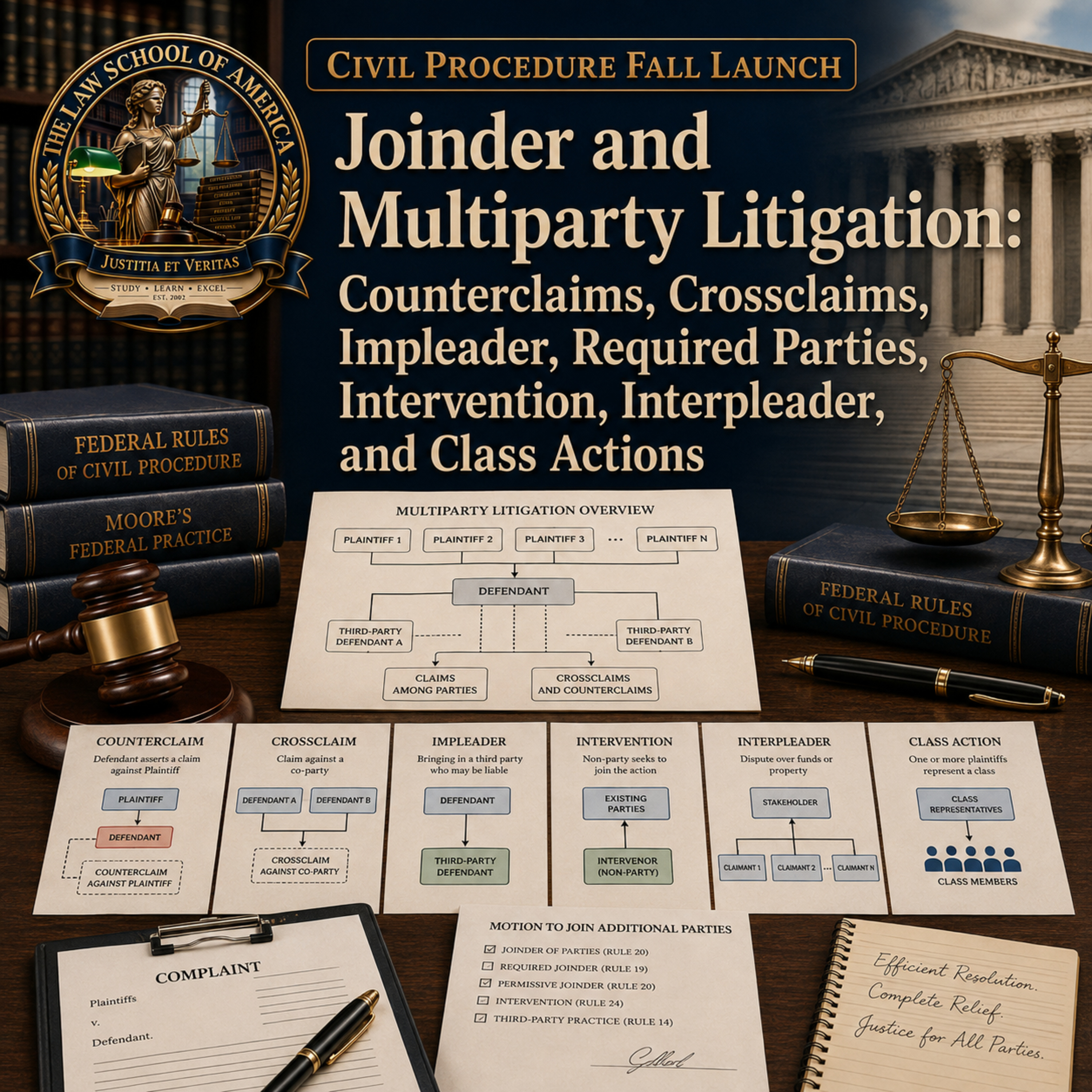
Civil Procedure Fall Launch: Joinder and Multiparty Litigation: Counterclaims, Crossclaims, Impleader, Required Parties, Intervention, Interpleader, and Class Actions
About this episode
📘 FREE COMPANION STUDY GUIDE 📘
👉 CLICK HERE TO OPEN YOUR FREE STUDY GUIDE 👈
Turn this episode into an exam-ready study plan.
🎧 EPISODE SUMMARY 🎧
Federal joinder doctrines govern expanding litigation beyond a single plaintiff, defendant, and claim.
Every joinder issue involves two distinct inquiries: procedural authorization and subject-matter jurisdiction.
Claim joinder allows a party to assert all claims against an opponent, but each claim must independently satisfy subject-matter jurisdiction.
Compulsory counterclaims arise from the same transaction or occurrence and generally must be asserted or forfeited. They usually fall under supplemental jurisdiction.
Permissive counterclaims do not arise from the same transaction or occurrence and require an independent jurisdictional basis.
Crossclaims are permissive claims asserted against a co-party arising from the same transaction, occurrence, or property.
Impleader allows a defendant to bring in a third party based on derivative liability (indemnity, contribution, or subrogation).
Required-party analysis follows three steps:
Determine whether the absentee is required (due to incomplete relief, impaired interests, or risk of inconsistent obligations).
Determine whether joinder is feasible considering personal jurisdiction, venue, and subject-matter jurisdiction.
If joinder is impossible, balance equitable factors to decide whether to proceed or dismiss.
Permissive joinder allows multiple parties to join if their claims share a common question of law or fact and arise from the same transaction or occurrence.
Intervention permits third parties to enter a lawsuit either as of right (to protect a direct interest) or permissively (via common questions), subject to jurisdictional requirements.
Interpleader protects a stakeholder facing multiple competing claims to the same property or fund under either Rule 22 or statutory interpleader rules.
Class actions require satisfying four prerequisites—numerosity, commonality, typicality, and adequacy—plus an authorized class category (prejudice, injunctive, or damages).
Effective analysis requires party mapping: identifying all parties and claims, applying joinder rules, and verifying jurisdiction, venue, and procedural barriers for each claim.
ℹ️ INFORMATION, PRIVACY POLICY & TERMS OF USE ℹ️
The Podcast and Website Purpose
The Law School Podcast and 1L Study Aide webpage supplements law-school and Bar Exam study with strategies, condensed rules, quizzes, and flashcards.
Educational Disclaimer
Content is for educational and informational purposes only. It is not legal advice, creates no attorney-client relationship, and does not guarantee law-school or Bar Exam success.
Privacy Policy
- No account or login is required.
- This webpage uses no forms or analytics to collect personal information.
- Quiz and flashcard activity stays in your browser and may clear when local site data is removed.
Terms of Use
By using this webpage, you agree to use its content only for lawful, personal, noncommercial educational purposes. It supplements—not replaces—courses, textbooks, official materials, or qualified instruction.
Get every episode summarized
Each time Law School publishes, we email you a written briefing from the transcript — the topics, who appeared, and any specific claims, with the ad reads skipped.
Email me new episodesFree for 3 shows. No card needed.
Hosts & guests
No transcript yet
This episode has not been transcribed. Request it and it moves to the front of the queue.
More episodes
More from Law School

Constitutional Structure: Federal Judicial Power — Judicial Review, Article III,...
Law School

Property Fall Build: Mortgages, Foreclosure, Priority, Fixtures, Water Rights, S...
Law School

Property Fall Build: Covenants, Equitable Servitudes, Common-Interest Communitie...
Law School

Property Fall Build: Adverse Possession and Easements — Hostile Possession, Tack...
Law School