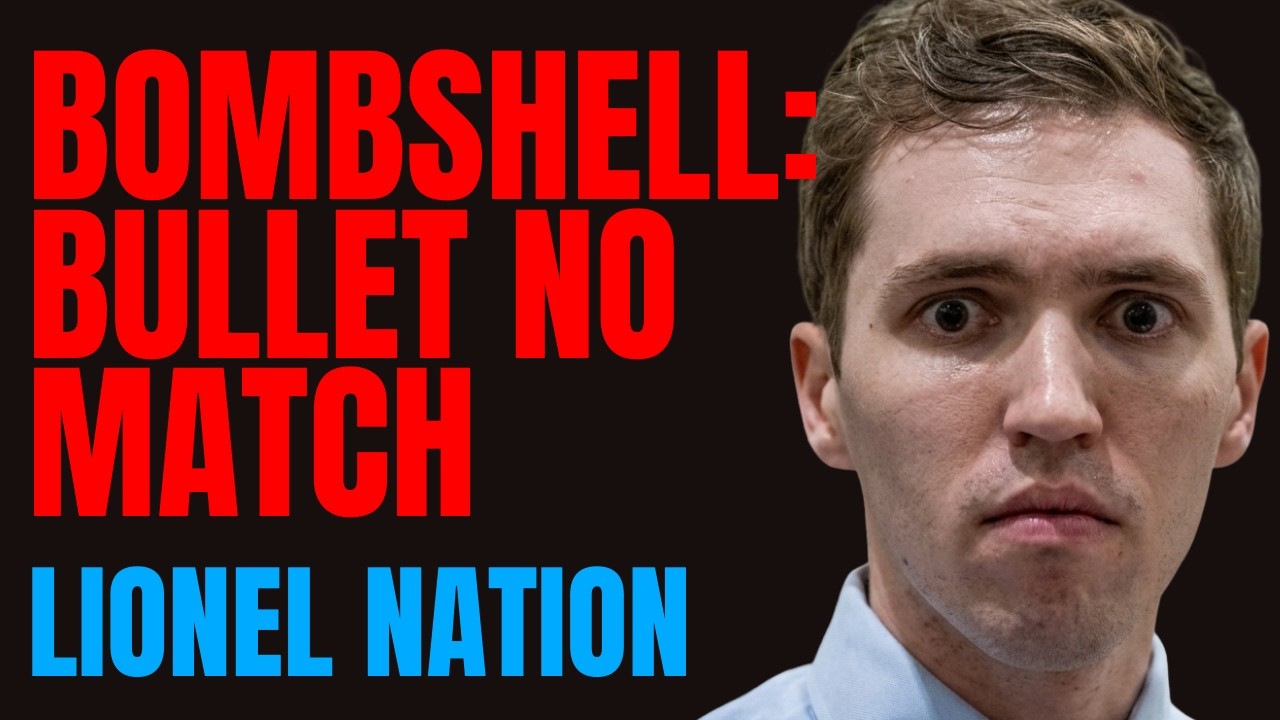
Charlie Kirk Ass*ssination Bombshell: Bullet Does NOT Match Tyler Robinson Rifle – Case Cracking
About this episode
Charlie Kirk Ass*ssination Bombshell: Bullet Does NOT Match Tyler Robinson Rifle – Case Cracking
Get every episode summarized
Each time Lionel Nation publishes, we email you a written briefing from the transcript — the topics, who appeared, and any specific claims, with the ad reads skipped.
Email me new episodesFree for 3 shows. No card needed.
Hosts & guests
Transcript ready
139 searchable segments. Every word is indexed and playable.
Full transcript
Lionel Nation — Charlie Kirk Ass*ssination Bombshell: Bullet Does NOT Match Tyler Robinson Rifle – Case Cracking. Machine-transcribed; use the interactive transcript above to jump the player to any line.
My friends, this is big news. I don't want to say breaking news. I don't even know what the hell breaking news means. But let me tell you something right off the bat. You know and I know that we haven't bought any of this story regarding Tyler Robinson. Nothing. But this, this is huge. Something just happened in this case that changes everything. And if you're paying attention, I mean really, really super duper paying attention, you will understand exactly and immediately why this is not just another courtroom development. Not just another filing, not some extraneous bit of subjudicy nonsense. That's just another technicality buried in legal, juridical language. This is the kind of detail that cracks the case wide open. That I say it to you speaks, speaks and yells reasonable doubt. Remember, nobody has to prove Tyler Robinson is innocent. They've just got to present a reasonable doubt,
a reasonable doubt as to whether the state of Utah can prove beyond and to the exclusion of every reasonable doubt. And with the degree of moral certainty that all of the elements of murder can be proved, because now right now, according to a new defense filing, the bullet that extensively killed Charlie Kirk may not match the rifle prosecutors say was used by Tyler Robinson. Let that sit for a second. I don't care what you say. You're going to qualify it. Oh, there is what that doesn't mean that it was ruled out. No, no, you have to affirmatively prove that. This is the biggest, this is the biggest piece of not guilty there is. This is reasonable doubt. What are we talking about after? If I can't prove, if you can't prove, if they can't prove that this 30 out six grand daddy shooting iron was the one responsible for the dispatch of of of Charlie, that's it. What are we talking about? What? Martians did this? Let this sit in for a second. Let's let let this marony. The bullet doesn't match the weapon. You see this right here? You know what this is?
This is the hand soap. It doesn't match the weapon either because it didn't use, it wasn't used. And the case built around a narrative of a targeted killing, a three hour drive, a three hour drive, all of a sudden this man, he decides I'm going to do this by God. I'm going to stop what I'm doing because I've got to stop Charlie Kirk because whatever reason, a weapon that is tied to the suspect, the confession, a confession to his father, which as Candace Owens has indicated and others, there's going to be no confession. Watch that be refuted. So forget that. All right, go ahead. Try let's let's let's work with that one later, but that's going to be that's going to fall flat. But besides that digital messages, which are weird to begin with, the planning, the intent and everything, everything lined up, everything presented as claimed and overwhelming. This is what they want you to believe that single detail cuts straight through the center of it and it eviscerates
the state's case because in any serious prosecution, serious, especially a capital case, theoretically capital case, especially one where the death penalty is on the table, theoretically, the chain of evidence is everything, the evidence is everything, the cause of death is everything, the ballistics or everything, not part of it, not most of it, everything, dola, mean thinly. Now, and ballistics is not peripheral, it is fundamental, critical, the gravamen, you were telling a jury that this man used this weapon to fire this bullet that killed this victim, right? Right? I mean, that's the that's the spine of the case. And if that connection weakens, even slightly, the entire structure collapses, like a controlled demolition, it's like a building seven collapse. Now, the defense is saying that the bureau of alcohol, tobacco, and firearms, ATF, and explosive could not match the bullet recovered at autopsy to the
rifle allegedly tied to Tyler Robinson. That is not a small discrepancy. And it's not a footnote. That's a rupture. And it is a it is a hemorrhage. And it doesn't stop there on Na Na. The defense is also pointing to DNA complication, complication, yep, DNA, multiple contributors on key pieces of evidence, complex mixtures that require expert analysis across disciplines, not just one scientist, not just one report, but layers of interpretation, validation, and challenge. Didn't know this did you? That means uncertainty. That means ambiguity. That means reasonable doubt. And reasonable doubt can stop the train. That means the kind of doubt that defense attorneys will build entire strategies around. Remember what I'm telling you. Remember who I am. I'm a
former prosecutor. I'm a lawyer. I know what I'm talking about. I'm not just some guy giving you an opinion. I'm telling you the truth. And then there is the volume. The volume. 20,000 files, audio, video, documents, discovery that is still being processed, still being collated, evidence that has not even been fully analyzed yet. The defense, the defense is asking for time, months of it to go through what the prosecution is presenting. And they'll get it. By the way, I'm sorry, Ericka Kirk's motion for speedy trial, not withstanding or recommendation of speedy trial. That alone tells you something right now. See, this is not a simple case as you know. This is not clean. This is not locked down in the way that they would like it to be. Not the way that it was initially presented to the public. Oh, no, no, no, no, no, I say because early on, the narrative was straightforward, too straightforward, a suspect identified, a weapon tied to him,
a timeline established, a confession to his father, text messages suggesting awareness, very strange, weird phrases, using words like the vehicle. Anyway, text messages, concern, even attempts to manage evidence, got to get grandaddies, got to get grandaddies shooting iron. And don't forget cash, Patel. Take it easy, cash. You're the, you're the FBI head. Let don't don't, don't, don't contaminate a potential jury. Just sit back. Plus, this isn't even federal. This is state. Back off. Go back to your girlfriend. Play some country music and back off their sparky. It, it, it, it, it's all felt so decisive, but cases are not decided in headline. I think you know that they're deciding courtrooms, lawyers, adversaries, expert witnesses and the rules of evidence. And in courtrooms, details matter. Every inconsistency, every gap, every unanswered
question matters. Big time. Take the rifle. Please, little honey, young in there. The prosecution says it was a family weapon recognized by the suspect's father, turned over to authorities after an alleged and alleged aputative confession. That's powerful, right? That's emotional. That's persuasive. Theoretically, but if the bullet done fit, it's going to have to acquit shades of Johnny, if the bullet doesn't match the rifle, then what exactly are we looking at? What is, it's a rifle? You know what this is? This is a lint brush. So what? What does it matter? And what if the, what if it's the wrong weapon? Was there another weapon? What, what is this weapon have to do? How about a machine gun? How about a Thompson, a Tommy? It's not even linked as well. Was there contamination? Was there misidentification? Was there error? What? What? How do
you work around this? Remember, you're going to make, and by the way, the prosecution cannot just say, let's just, let's not worry about the firearm. Now, let the defense bring it up to them. You don't, you don't get to just move past this. And then you layer in the digital evidence, the text messages, that are weird. That supposedly suggests planning, that concern about, don't be surprised if Tyler said, I don't know what those messages are. I didn't say them. I don't even write like that. I didn't write like that. This is nuts. There's this concern about leaving the evidence. And also, why would, why would he want his fuzzy headed gay lover, girlfriend, whatever, it thing, whatever to, to, to, to, to retrieve it? Hey, honey, would you find that? Would you go? And you've also mentioned, by the way, Jimmy Dordard, a great piece of this. Remember the screwdriver that was used to, to, to, to break the, the, the weapon down in the,
and then build it back up. I mean, it doesn't make any sense. Oh, I'm excited about this. Why? Because I want justice. You see on their face, all the messages look damning theoretically, but even their context matters. Are they complete? Are they interpreted correctly? Are they corroborated by physical evidence that, that holds up under scrutiny? See, because if the, if the physical evidence becomes, or begins rather to fracture, to collapse, to shatter, then the interpretation of everything else becomes less certain. And this is where cases turn and drop and turn flat. And you can quote me on that. Not in dramatic moments, not in emotional appeals, but in quiet, technical revelations that force everyone to step back and reassess what they thought they knew. And make no mistake. The stakes here are as high as they get. Imagine he walks. Tyler Robertson walks. This is the capital case, my friend. The possibility of the death penalty is real. Theoretically,
I mean, he's there. The standard is not probably. The standard is beyond and to the exclusion of every reasonable doubt, not close, not convincing beyond. So when you introduce a discrepancy, at the level of the bullet itself, you are not just raising a question. You are injecting doubt, doubt directly into the core of the prosecution's argument. And once that doubt is there, it doesn't go away. And the prosecution will respond. They will argue context and additional evidence. And they'll say, well, you know, it'll be cumulative. And now this other evidence, perhaps will, you know, outdo outweigh this particular discrepancy alternative explanations. They'll point to the totality of the case, not just one element, but the defense doesn't need to win every argument. They need to create reasonable doubt, reasonable doubt, stops the train. And this is now what you must understand. This is how that happens.
Slowly, methodically, through details that cannot be easily dismissed. And at the same time, the public narrative continues to turn, turn ahead of the court and reality. Statements from political figures, of course, media challenges, media coverage at this already frame, everybody, every internet lawyer is going to weigh in every expert. Let them, let them tee this one up. Oh, man, get around this one, Sparky. Go ahead. They're going to call, calls for the, for the harshest possible punishment. Okay. Let them talk. But you need evidence to get a conviction. And you can't get punishment without a conviction or a plea of guilty. And they sure is only going to be any plea of guilty. I'll just stay off from something that is so ridiculous, so manslaughter, what? And that creates another layer of complexity. Because juries are supposed to be impartial. And they're supposed to evaluate evidence. Not headlines. But in the case of this high profile with this level of attention in that area, that becomes increasingly difficult. The defense is already signaling concern about the
prejudicial media coverage. And that matters. Because if the perception of the case who shaved before the evidence is fully tested, then the integrity of the process itself comes into question. And that's due process. And the defendant, Mr. Robinson, is entitled to a speedy and a public trial and a fair trial. Meanwhile, Erica Kirk is calling for transparency. Whatever the hell that means for cameras in the courtroom and for full visibility into the proceedings. You share about that. Okay. You sure you want cameras. You sure about that. You sure about that. Okay. That's understandable. I guess. By the way, this isn't, this isn't abstract. And really, this isn't your call. You're not involved in this. You can say whatever you want. This is personal. This is lost. This is demand for answers. And yet transparency cuts both ways. Because what happens if, if what is revealed in court doesn't match what people of the thought that they believe was right, what happens if the case becomes more complicated, not less? See, that's the most important thing right now. That's the moment we're approaching, not a conclusion, not a resolution,
a turning point, because a turning point USA, because once a case that felt certain begins to show signs of uncertainty, everything changes. The burden doesn't shift, but the perception does. And in a courtroom where life and death can hang in the precision of evidence, the perception and proof, they're not the same thing. Perception and proof are not the same thing. That's where this case is now, right on that line. My friends, let me tell you something. This got really, really interesting. Believe me when I tell you that. I don't say that usually. I don't say that just for fun. I'm telling you this got real interesting. And remember, reasonable doubt stops the train.
More episodes
More from Lionel Nation

CANDACE Is the Only One of the Bunch Who Never Gave Up the Fight for Justice for...
Lionel Nation

It's A Fight TO RECLAIM CHARLIE'S LEGACY and CANDACE Has Thrown Down the Gauntle...
Lionel Nation

CANDACE Refuses to Let the Real Ass*ssin(s) Go! It's FOR FOR CHARLIE: Keep Askin...
Lionel Nation

THE DEBATE THAT MUST HAPPEN: Candace Owens vs. Erika Kirk — 90 Minutes, No Moder...
Lionel Nation