About this episode
Interactive timestamps
Jump to segmentGet every episode summarized
Each time Today in Focus publishes, we email you a written briefing from the transcript — the topics, who appeared, and any specific claims, with the ad reads skipped.
Email me new episodesFree for 3 shows. No card needed.
Hosts & guests

Transcript ready
442 searchable segments. Every word is indexed and playable.
Full transcript
Today in Focus — Chaos in the Gulf. Machine-transcribed; use the interactive transcript above to jump the player to any line.
0:00This is the Guardian. Today, chaos in the Gulf as a ronde's future hangs in the balance. Parle-tu français? Parle-us espagnol? Parle-italiano. If you've used Babel, you would. Babel's conversation-based technique teaches you useful words and phrases to get you speaking quickly about the things you actually talk about in the real world. With lessons handcrafted by the 200 language experts and voiced by real native speakers, Babel is like having a private tutor in your pocket. Start speaking with Babel today. Get up to 55% of your Babel subscription right now at Babel.com-acast. Spelled-ba-b-e-l.com-acast. Rules and restrictions may apply. This Saturday started like any other for Ed.
1:02He has lived in Dubai for most of his life and says he's always felt completely safe there. I've always seen it as like a mixture of the best parts of Europe and the best parts of America kind of squeezed into one. And you don't feel like you're in the middle east. When he first heard the loud bangs at work on Saturday morning, he thought it was building work. Then his friend showed him a text message. It was from the UK Foreign Office, warning of rocket attacks and telling them to seek shelter. Who's like me, it's all kicking off. And then from there it just kind of escalated. We were getting told to stay put, to stay indoors, stay away from windows. And within like an hour, just went from zero to a hundred. Ed was rushing back to his apartment when more rockets hit their eyes. I had a sunroof in my car, so I looked up and I could see these these bangs that threw the sunroof. And then that's when the fare month hotel, which is probably
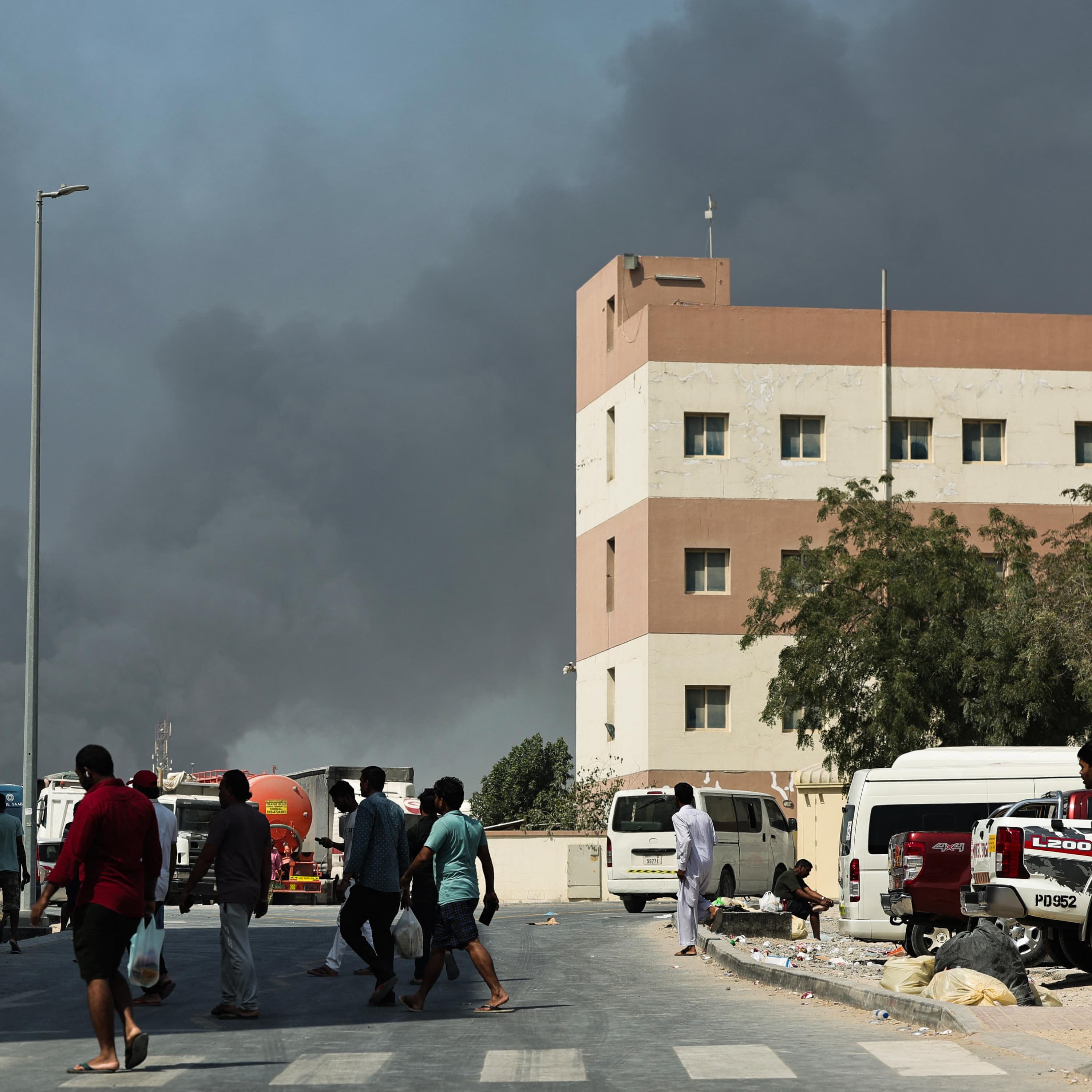
2:02200-300 meters away from where I live. That blew up something dropped into that and exploded. I think a bit shrapnel from one of the drones. And then I was running up to my flat and then the building shake in and then I'm like, it's like a party. So I got my stuff and then I got out there. Not knowing when I was going to come back. The war started with the US and Israeli assassination of a Ram supreme leader on Saturday. Hundreds of Iranians have already been killed, including more than 165 in the direct air strike on a school. Iran retaliated with air strikes on U.S. bases in the UAE and across the Gulf. For years, many countries in the Gulf have worked very hard to market themselves as a luxurious safe haven for expats and holiday makers. And now as the war arrives at their doorsteps,
3:03it could all be coming apart. I was actually sleeping. I just got woken up by an emergency alert on my phone. We heard these bomb sounds outside our window and the windows were shaking. You know, this people's lives are at risk as a result of these sort of decisions have been made by people in some safe place somewhere. You never feel that pressure that we're actually very close to these countries that are going through conflict like Yemen and Syria and Iran. But something like this obviously makes you realise how close we actually are to all. As the region reels, Trump says the worst days of this war may still be to come. And we have, right from the beginning, we projected four to five weeks. But we have capability to go far longer than that. We'll do it whatever. From the Guardian, I'm Annie Kelly. Today in focus, can the crisis in the Gulf be contained?
4:03So Julian Borgia, you're a senior international correspondent here at the Guardian. We're speaking to you on Monday afternoon and things are really moving at a dizzying pace since the US and Australia strikes. Took out a ransom-prem leader at a company on Saturday. You've been covering this region for a long time for decades. Have you ever seen any of this? Have you ever seen any of this? Have you ever seen any of this? Have you ever seen any of this? Have you ever seen anything like this? No, this is quite unlike anything we've seen in the past. Of course, there was the invasion of Iraq in 2003. But also, you can look back to Libya and the killing of Ma'amah Gaddafi. It's similar in some ways, because it was done from the air. They bombed. They weakened the regime. And then ultimately, it was Libyans, and basically a Libyan mob, who found Gaddafi and killed him. And it does look like that is what Trump is thinking would happen will happen in Iran that it will be the people who rise up
5:05and bring down the regime. But what happened in Libya was it broke up into pieces became a chaotic state, a failed state. If that happens in Iran, which is so much more powerful, more advanced state in even more cities, state in even more strategic position in the world, then the consequences are potentially far, far worse. And in terms of just the kind of audacious nature of that strike on the Supreme Leader on Saturday, did you see that coming? Did you expect that? I am really surprised that Ayatollah Ali Khamenei thought it was a good idea to invite all his top defense aides to a meeting in one place in central Tehran in his compound labeled Supreme Leader Headquarters at a time when it was clear that an attack was imminent and that clearly triggered the attack on Saturday,
6:08in fact that these people came in at one place and offered this target of opportunity. And it's not really clear is it if the US or Israel expected to run to retaliate or be able to retaliate, but they have done. How have we seen them strike back? They've struck back pretty much like they did last June, which is just to fire a lot of missiles. This time they've fired off missiles and drones at a broader range of targets because they went after Israel, of course, but they also aimed at US bases in the region. But just like in June, it hasn't really worked because the countermeasures, the defenses in Israel and along the Gulf are strong enough to intercept almost everything and just set a few, that must have been factored into the planning for this, that there would be retaliation, Iran would fire up everything it had,
7:08but there is growing confidence. You see among US and its allies that it has the countermeasures, it has a ways of protecting, as it said, to minimize the damage that Iran can do. And which countries have commander attacks since that day from Iran? Pretty much all the Gulf countries and even including Iran, which had been very much on Iran's side. This is what's so surprising about Iran's decision making. Iran was really, it's, you know, it's main advocate in Washington, but it is the site of a US base as has been Kuwait, Saudi Arabia, United Arab Emirates both Dubai and Abu Dhabi have all been hit so pretty much the whole Gulf. And you said that their air defenses have proven to be pretty effective, but what has been the overall impact of these strikes on the region so far in other ways? Well, first of all, the price of oil took spike because of worries about attacks and there had been a couple of attacks on tankers.
8:10Shipping companies and insurance companies are being conservative and not going through the state of Hummus, which is really the choke point into the Gulf and the dangerous point in the transit. And then, of course, there is, for example, Dubai Airport has been hit and that is one of the business airports in the world. It's a hub, international hub. So that has closed down. The tourist industry, of course, along the Gulf, which is important to the Gulf, because the Gulf countries have really over the decades presented themselves as the sort of safe place for investment, safe place for expats and all that, safe place for tourists. And that, of course, has taken a real knocking. All my days over the beach club is f***ing minted. Look at that. They were so loud in the safest city in the world. And that is really the question mark over what Iran thinks it is doing because a lot of the population, certainly in the Gulf states,
9:12would have been very sympathetic to them coming under fire from the US and Israel. But after these counter strikes by Iran, really turned that around and Iran is now seen as the biggest threat. And it's possible that the Gulf Arab states will get involved now against Iran. And in terms of this, I mean, I think everyone's seen the videos over the weekend of tourists stranded in Dubai, in Qatar, you know, people on the beach kind of looking at missiles. I mean, the Gulf countries are going to want to shut that down pretty quickly, aren't they? Tourism is hugely important to them. Yes, they're going to want this to be over. And this is probably the argument that Washington is making, Israel is making. This will last a few days. It'll be a few days of disruption, but then we will have solved your problem and the security problem in the Gulf forever. The regime will have gone and we will have destroyed all the missiles
10:15and the nuclear program will be hobbled and this long festering saw in the Gulf will be solved once and for all. That is probably the argument the Washington is making now. We have hit hundreds of targets in Iran, including revolutionary guard facilities, Iranian air defense systems just now, with the announced that we knocked out nine ships plus their naval building all in a matter of literally minutes. I do think that will be a compelling argument that the Gulf countries would respond to. I think everything depends now on the resilience of the regime and how many bullets it has left in its magazine, what else does it have? For example, there was a thought at some time in the Britain recent weeks that they would have swarms of underwater and surface and aerial drones that would close in on an American Navy vessel and overwhelm its defenses.
11:16They wargamed this over the years in Washington. They love a war game and each time with this war game prop more or less they would be one or two US ships have gone down. We haven't seen that yet and maybe that threat has been neutralized by the thought of defenses of countermeasures and so it hasn't happened or it may be that Iran hasn't played that card yet. You have kind of alluded to the fact that Iran seems to be making these fairly irrational decisions for instance attacking Iran. Can you just explain, is there a strategy behind that or is it just panic, do you think? I think if there is a strategy, it's not a good one. After their missiles failed in June to have much effect and get through the defenses, the Israeli defenses, they just went back to making more missiles and have followed the same route again, firing off a lot of missiles and haven't got through the defenses. Then in firing at the Gulf Arab states,
12:17they have made a lot more enemies in the world. They are pretty much totally isolated now. There is question marks over the strategic thinking of the regime but we sort of knew that these aren't necessarily great strategists. Right. But how dangerous a moment is this? Even if Iran is hobbled by bad decision making and potentially very limited military capabilities, is there still a bit of a perilous moment for the region? Absolutely because of the great potential for chaos, for anarchy, for conflict because once a great multinational nation state comes apart as we've seen in Libya and Iraq, you don't know what's going to happen. Iran is a cobbled together country ethnically. Obviously, you have a good chunk of Persians but there are also Baluchi Kurds, there are Arabs, Azeris.
13:21There are separatist movements along the borders. We don't know how strong, so there is that potential for implosion and we don't know how close the regime and the country is in terms of falling apart and how long the regime can hold on. But it is really on the brink of something potentially very violent, very long-lasting and very destructive. And tell us a bit about the recent history between Iran and the Gulf states. What's that relationship been like? Well, it has been a long-running enmity because Iran is a sheer power in a Sunni neighborhood but a sheer power that is seen itself as the regional superpower, the Hegemon. And that has for decades, whatever since the Islamic Revolution in 1979.
14:24And before, under the Shah, being a source of tension. But in more recent years, there had been a certain amount of deterrent compared to the long history of the region. China broke a non-aggression deal between Saudi Arabia and Iran and China then became kind of an important broker in the region and China has interests on both sides. So it comes at a time when the tensions with the rest of the Gulf, the Arab states were not at a particular peak, they were somewhat stifled. But now, all that enmity, of course, come back to the surface. And Julie, in the Itolla was not just a political leader. He was also a religious leader for millions of years across the world. How could his assassination be a factor in what comes next across the Gulf but also beyond? Yeah, I think that's a major factor looking forward in terms of global instability.
15:24Because he was seen as a figurehead of Shia Islam. But also wider Islamic leader who stood up to the US and Israel in the way that other Islamic leaders happened. And so, to many people across the Islamic world, he's a hero who didn't suffer under him. He has a much better reputation outside Iran than inside. And of course, you have a Shia majority in Bahrain. You have Shia minorities elsewhere in the Arab world. To what extent will they react to what they're seeing unfold in Iran? We've already seen unrest as far away as Pakistan. So I think there are many factors here in terms of the Islamic world and terms of Shia Islam that we've yet to see play out. And what about the Gulf states and their relationship with Israel? Israel, obviously, major player in this in these strikes and seems to in fact have been kind of leading the US into the timing
16:26and the nature of what's been playing out. What's the relationship between the Gulf region and Israel like? Well, different from the different states. So the UAE and I did Arab Emirates very close to Israel. Almost hand in glove on a lot of issues. We're hearing now that Saudi monarchy played a part in convincing Trump to go in on this attack. So taking the same sort of backing up Netanyahu's arguments from Israel. Other countries are Qatar, Assad and Iran are a gas to what they're seeing. So it is very much from that point of view a divided region. It's really complicated then. You've got this like really complicated relationship between Iran and the Gulf and again, you've got Israel's relationship with the Gulf and very fragmented in terms of their different relationships. What could you just on the Saudi point? Can you explain why would it be that Saudi would be encouraging Trump to go in and take out the regime's leaders at this moment?
17:31Well, I think on the point of view of Saudi Arabia, the long term threat to the kingdom is Iran. It is the other major power. It has missiles. It has a nuclear program. And the capability of down the line one day making nuclear weapons. And the Saudi said long hinted that if that happened, they would get nuclear weapons of their own. But this offers another solution to really nip in the bug Iran's ability to threaten Saudi Arabia and the region and really takes it down as a regional power. The question is what comes next because what comes next if it is not stable if it's chaotic could be much worse for Saudi Arabia. For example, just in terms of getting oil out of the Gulf and trade into the Gulf if there is long term instability, that could be disastrous for Saudi Arabia but also for the rest of the Gulf. But maybe, you know, do you think it's in anyone's interest that Iran does descend into this kind of fragmentation in chaos?
18:34Well, I've seen some reporting in the Israeli press that suits Israel and this government quite well for different reasons. Their focus is on the capabilities. So if you take out the missiles, make sure they've got no missiles to fire and you take care of the nuclear program and make sure that's not going anywhere, then that feeling of existential threat that Netanyahu has always emphasized that goes away at least for the time being. And they don't really care if Iranians are killing each other and chaos to a certain extent keeps Iran weak, which from Netanyahu's point of view is a plus. And of course, he's coming out to elections. If there is continuing instability going on in the region, then he can continue to present himself as his Churchillian war leader. He can put off the reckoning A for the corruption charges against him but also that question mark about how much he and his government were to blame
19:35for letting their guard down and allowing the 7th of October attacks in 23 to happen. War, instability, bit of chaos, that suits his purpose is very well. And how influential would his voice be in Trump's ear, do you think? From what we hear, he was able to shape Trump's view of Iran and told him what Iran was like at the only kind of language that Iran would understand and what would happen in Iran and how easy it would be to oust the Islamic Republic regime. So it does look like Netanyahu took the part of a senior aid, a senior adviser to Trump. And I mean, we talked at the top of this interview about how extraordinary it was that you saw the Ayatollah and some of the most senior figures in the Iranian regime taken out like this. It's probably worth pointing out that this is the first time that Israel has gone in
20:35and killed the leader of a country along with the US. Yes, these are extraordinary steps to take to go in and use assassination as a tool, especially at a time when you are in the middle of negotiations with that country to go and assassinate the leader of that country while negotiations are going on just you're not only throws away the rule books but sort of incinerates them and we are in a new world now. And that must matter as well in terms of how other countries, other nations can trust what the Americans are saying. We know that Trump has made, for instance, huge efforts to broker close relationships with the Gulf both diplomatically and some would say for other personal financial reasons. Isn't this also a huge risk for him dragging the region into a war that he can't control and they perhaps don't want? Absolutely. A risk to him if not only just an oil price shock in the months leading up to midterm elections
21:44that could be very damaging because really one thing that voters' mind is the price of petrol at the pumps. It's historically been shown to be politically damaging. I mean in terms of how much he's damaging America's place in the world. I mean we've seen this unfold over an accelerating pace during his second term in office and this really hits a high point. In the near term I think countries can be very and leaders are going to be very wary of making a cross. This is a very capricious volatile, mercurial figure. So in the near time everyone is going to play nice because if you can be wiped out if Trump wakes up in the morning and decides he doesn't like you and you'd be better out of the way these are very risky times to be the leader of any country. But in the long term it is not surely going to be in America's interest to have that role
22:48on the world stage and you could see I think a gravitation towards China as an opposite pole that is at least a consistent power that doesn't use a random violence that has a pretty consistent message and consistent economic based interest. And what about Iran? We spoke a bit about their decision making, like how they've responded since the strikes. We talked about how you can't really see much logic in, for instance, them striking a man or doing these kind of widespread hits across the Gulf. But surely they don't want to provoke the Gulf states into retaliatory strikes while they're under fire from the US and Israel. Yeah, they did make a run up to this. They did make a round up to the Gulf and saying if we strike back is only against the Gulf. It's not against you. But of course once the missiles and the drones start flying and they start hitting hotels and airports
23:48all that talk is for nothing. And that is the great floor in their deterrence strategy. But I don't know whether there was a workable deterrent strategy that they could have chosen because against the overwhelming might of the US, Israel, how can a country that does not have a nuclear weapon defend itself? And that is that maybe one of the most worrying, disturbing, when it comes to potential fallout is that other countries look at what's happened. They look at what happened to Iraq, Iran, Libya, and what hasn't happened to North Korea and draw the conclusion the only way that we can defend ourselves is to have a nuclear weapon. Coming up, can Europe stay out of the war?
25:01If you've used Babel, you would. Babel's conversation based technique teaches you useful words and phrases to get you speaking quickly about the things you actually talk about in the real world. With lessons handcrafted by the 200 language experts and voiced by real native speakers, Babel is like having a private tutor in your pocket. Start speaking with Babel today. Get up to 55% of your Babel subscription right now at babel.com slash a cast. Spelled B-A-B-B-E-L dot com slash a cast. Rules and restrictions may apply. And how willing is Europe to get involved more generally? I mean, we've talking about the fact that this conflict could escalate across the Middle East. You know, a UK based in Cyprus has already been hit after the UK government allowed the Americans to use. That is a launch pad for strikes.
26:03Can Europe and the UK avoid getting fully drawn into this conflict and also keep Trump on side, which they also need to do? In a way that the attacks on the Gulf Arab states have opened a door for the Europeans, Britain, France, Germany, to fix their rift with Trump because they didn't want any part in the initial act of aggression, the war of choice. Now, their allies in the region have been attacked. They've now said, well, we will enter in a defensive way. And so that, to some extent, solves their problem with Trump. You know, to what extent it will be a problem for them domestically because the predominant view of this is the war of choice by Trump. Deeply unpopular figure in Europe. And so it will be seen by many in the electorate in these countries as joining in Trump's war. I want to be very clear.
27:03We all remember the mistakes of Iraq, and we have learned those lessons. We were not involved in the initial strikes on Iran, and we will not join offensive action now. Iran is pursuing a scorched earth strategy. And it's been interesting, isn't it, the language that's been used around condemnation of Iran, but no condemnation of the US or Israel? Yes, very merely mouth words of well. We must take up for international law, but without really sort of mentioning the US or Israel at all. I mean, the Iranian regime diabolical in so many ways that brutal, brutal repression of those protests a few months ago just one indication of that. But when it comes to international law, these strikes are in no way compliant with the US or Israel's obligations. Are they? No, but in a way that boat has long sailed.
28:05Trump has shown and Israel under Netanyahu have shown they have no time for the niceties of international law. Obviously in Gaza, Trump in Venezuela, and so on, this is not something that concerns them. And to some extent, you know, the Trump's creation of the border piece is that was aware of getting around all that and all the complications and restrictions of the UN Charter and set up his own parallel organization where he could get to make up the rules on the spur. Trump in particular has created a chaotic world. How do you think it's going to play out over the coming days between Iran, the Gulf, Trump and Israel? Will this escalate into a full-blown conflict across the Middle East? It has the potential for escalating in ways that the planners in the Pentagon could not have foreseen that's the nature of war. I think the likelihood of Gulf retaliation gets higher with everyday passes where Iran's firing at their hotels and ampers has only so much they can stand because they are vulnerable.
29:19But they have to bear in mind that if they do that, if they join the fight, then there's a lot more that Iran could do in retaliation. They have oil refineries, they have liquefied natural gas sites that could be blown up, that could be targeted and it could get very nasty indeed. I think that the GCC, the Gulf Corporation Council just want this to end as soon as possible and we'll be trying to put pressure on Iran, threatening Iran to get it to stop firing but also asking the US and Israel to wrap up as fast as they can. What Washington is counting on is that Iran basically runs out of bullets. It runs out of missiles, runs out of drones and then everything quiets down and then it either collapses or it comes up with a leader that the US can do business with. It gives up nuclear program, missile program and probably agrees to hand over oil.
30:23Whether that will happen, whether the regime is that sort of regime that was flexible in the same way as the Venezuela was where you had a second in command ready to do business. That's very much in doubt. This is a highly ideological regime that has held on for 47 years by being disciplined, holding together ideologically. It will be a very brave man and certainly be a man in Iran that will break from that and say offer the US a deal. So if Trump is thinking this will work out like Venezuela, he'll probably be disappointed. Thank you so much, Julian, for talking to us today. Thank you. Thank you for having me on. And that's it for today. That was Julian Borgia, the Guardian's Senior International Correspondent. You can keep up with his reporting and analysis at TheGuardian.com.
31:24This episode was produced by Eli Block, Hannah Adden and Alex Atak and presented by me Annie Kelly. Sound Design was by Brian McNamara and the Executive Producer was Hama Khalili. Nushin will be back in your feeds later today with the latest. This is The Guardian. The Guardian Speaking Spanish Speaking Italian If you've used Babel, you would. Babel's conversation based technique teaches you useful words and phrases to get you speaking quickly about the things you actually talk about in the real world. With lessons handcrafted by the 200 language experts and voiced by real native speakers, Babel is like having a private tutor in your pocket. Start speaking with Babel today.
32:25Get up to 55% of your Babel subscription right now at Babel.com slash Acast. Spelled B-A-B-B-E-L.com slash Acast. Rules and restrictions may apply.
More episodes
More from Today in Focus

Gloria Steinem’s revolutionary life
Today in Focus

‘Thuggish’ far-right protesters descend on Dover and Portsmouth – The Latest
Today in Focus

Why Meta started losing in court
Today in Focus

Black Box: The Chatbots | Spirals | Ep 1
Today in Focus