About this episode
Economist Podcasts is made possible by:
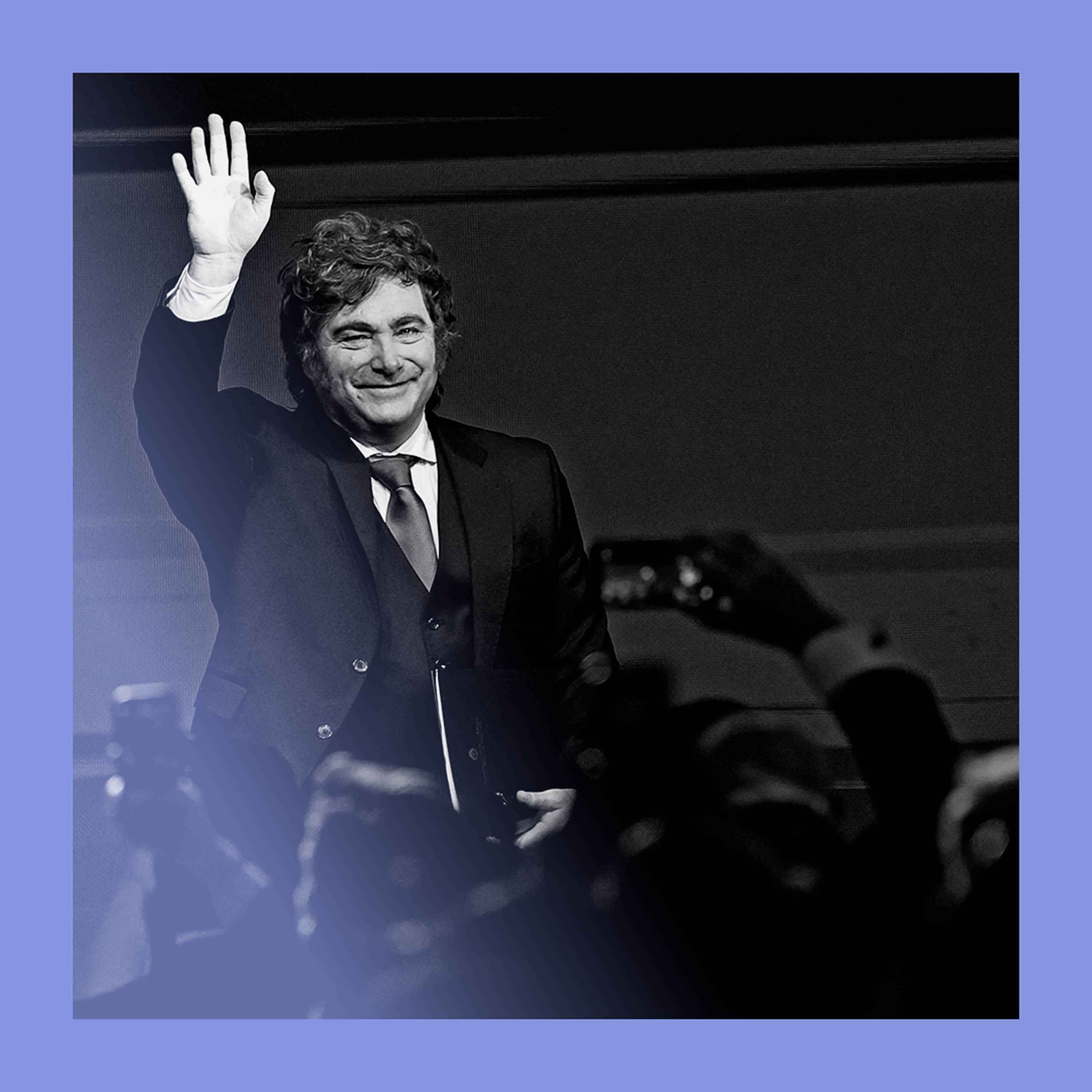
President Javier Milei has tamed inflation and improved the lot of many Argentines. But an election season approaches, and the promised economic and wage growth are not materialising. As LIV Golf files for bankruptcy, we ask where it went wrong in trying to disrupt the sport. And the growth that is good for India’s people is bad for its elephants.
Guests and host:
- Kinley Salmon, Latin America correspondent
- Henry Tricks, US technology editor
- Abhishek Kumar, India writer
- Rosie Blau, co-host of “The Intelligence”
Topics covered:
- Argentina, Javier Milei
- golf, LIV Golf, Saudi Arabia
- India, elephants
Listen to what matters most, from global politics and business to science and technology—subscribe to The Economist.
Hosted on Acast. See acast.com/privacy for more information.
Get every episode summarized
Each time Economist Podcasts publishes, we email you a written briefing from the transcript — the topics, who appeared, and any specific claims, with the ad reads skipped.
Email me new episodesFree for 3 shows. No card needed.
Hosts & guests

Transcript ready
224 searchable segments. Every word is indexed and playable.
Full transcript
Economist Podcasts — Chainsaw sputtering: Milei’s experiment falters. Machine-transcribed; use the interactive transcript above to jump the player to any line.
Support comes from wise, the smart way to manage the currencies you need around the world. Your life is global, your money should be too. Some providers promise no fees on overseas transfers. Don't be fooled. Extra costs often hide in bloated exchange rates. Choose wise. You can send, spend and receive money in over 40 currencies. Count on the exchange rates that you'd usually see on Google. That's how millions save billions on hidden fees. Be smart, get wise, visit wise.com, season C's apply. The Economist Hello and welcome to the Intelligence from the Economist. I'm Rosie Blur. Today on the show, what went wrong for golf in Saudi and the curious case of the disappearing elephants.
But first, as we stepped into the office of President Havien Millet in Argentina, right in front of us, was a large gold chainsaw with its teeth glinting at us. I sat down with two colleagues to talk to Millet and he said to me, that is my favorite toy. It's of course his famous campaign sample for cutting spending, slashing taxes. And he told me in our interview that his chainsaw is working all day long and that he's looking forward to really letting it rip after he gets reelected next year. Millet gets energized about his chainsaw above all. But compared to when I last interviewed him back in late 2024,
I saw him much tired of this time. He seemed to be perhaps struggling with some back pain. He's still very capable of charms and jokes, but volatile as he was then perhaps even more so. But something certainly stood in the hands of an entrepreneur. He says to me, artificial intelligence and Argentina is going to be embraced like Noah else and that will help the country become a world power like the United States, perhaps in just 20 years. With a grin, he told me, get ready for Millet, reload it. Canley, that sounds like a very confident proposition a year out from the election. Tell me how is Argentina doing right now? In reality, it's a delicate moment for Argentina and for Havier Millet. Let's be clear, he inherited an awful economic mess, inflation at 13% a month, all kinds of red tape across the economy. He's deregulated and he's pulled that inflation down impressively. It's about 2% per month now.
Voters rewarded that in midterms last year. But the thing is now they care more about jobs and their wages than they do about inflation. On that side, growths and jobs are struggling. He's not got very long now to make further reforms that would help with that before this election in October next year. So this radical liberal economic experiment, which I think is fastened a lot of people and it's spired free market is around the world now hangs on the balance. And this question I think is now whether Millet reloaded it is what's going to win that election for him. He's had quite a lot of success in office though, hasn't he? He absolutely has. I think we should really recognize that. Improvement on inflation has been crucial to Argentina, even if their priorities are now changing. That inflation improvement also has cut poverty in Argentina by about a third to around 28% at the national poverty line. Those are big real achievements and financial markets who are, frankly, a key player in the whole Argentine political economic dynamic. I'm really pleased he's been paying interest on the debt.
He's paying back some debt. The IMF is very positive about his program. He's also on some things a very optimistic guy. He's a huge technochemist. He says AI can only do good things. The only harm that can come from artificial intelligence is if states get in the way. He wants to give artificial intelligence run companies full legal rights. So he's very optimistic and very committed to this free market vision in all its applications. That's quite a lot of positives on the economic and business front. What about foreign policy? Well, as foreign policy has been above all, just extremely tight alignment with the United States and Donald Trump, as well as very tight alignment with Israel. The alignment with Trump has paid off, I think it's fair to say, at a crucial moment before the midterms, they were under really big pressure. The pisser was in danger of collapsing and the United States stepped in with a $20 billion swap line. It directly purchased the pisser to back it up. That, frankly, I think helped stave off what could have been a really nasty defeat. Possibly one
that would have really made him a lame duck kind of a president and turned it into a strong win. So that foreign policy has been a great success. I mean, the other big thing for Argentina is course China, which is a huge trading partner. And he's shown pragmatism on that. On the campaign trail back in 2023, he called the Chinese leadership assassins. China is a great social commercial. In fact, it's also very commercialized with China. He now says working with them is very agreeable. He says we've deepened our trade relations. And that's paying off too that Chinese renewed a $19 billion swap line just last month. Yet you say this is a delicate moment. What are the biggest challenges he faces? Well, the biggest challenges are more about jobs and wages and growth. Let's be clear. The country is on track for consecutive years of growth. That's actually a real rarity in Argentina, but it is much slower than planned. And that growth is concentrated in sectors like oil and mining and agriculture. And the trouble is those don't generate that many jobs and not that labor intensive. And the sectors that are labor intensive like manufacturing
or tourism have really struggled than not as much activity in those sectors as there was even when he took office. What's the result? 230,000 fewer private sector jobs than 2023. And he also, both, we've also cut 80,000 plus public sector jobs. But that is hurting families, of course. And if you look at salaries in the formal private sector, they are still below where they were in Malay took office as well. And the public sector they're dramatically below. He says that's the point. That's what we've come here to do. But again, Argentines are struggling. If you look at what's happening in another way, nearly six million Argentines are now more than 90 days behind on some kind of debt payment. So people are just struggling to make ends meet. And that's partly because Malay is so focused on inflation, he's kept interest rates really high. And as a result, people can't pay back. And that's also weighing on growth. High interest rates and limits lending. So he's going for tackling inflation, but there's a cost on the other side. Now, he frankly says there is no cost on the other side. He says my fight against inflation has not hurt growth at all. There's no direct tradeoff there. It looks to me like there are diminishing
electoral returns at least to carrying on just so exclusively focused on inflation. Because voters say I care about other things now. Kinley, I should say that sitting in Britain, most people think about Argentina only with regard to the Falkland Islands, which of course Malay has made some quite interesting comments on recently. Was that something you discussed? It did come up. And he was crystal clear to us. He says the Malvenas, as Argentines call them, are Argentine. Malvenas sonar kendinas. No, that's a long-standing position. But after our interview, he then ramped up this rhetoric even more in this national broadcast, certain sanctions against oil companies that might operate there. And they've since escalated further. And the government says it will file criminal charges against a company leading the first commercial oil drilling project in the Falklands. Look, I think this is about distracting a little bit, trying to ramp up the base and maybe focus on something that people can get behind even if they're not feeling so good in their wallet. But it's also indicative of the anger that there is with Malay. I mean, he raged to get
Stagentine journalists to us. That is, son, accusations? Periodisticas. Y ya sabemos los sucio que están los periodistas en Argentina. He posts sometimes dozens of times a day on X in extreme terms. He calls Argentine journalists human shit and worse on a very regular basis. There is a fury about that. So, Kinley, we are a year away from elections. It's a long time off, but not that long. How do you rate Malay's chances right now? Well, the worrying thing for Malay is that his net approval rating is close to minus 30. So that's a tough starting point. He also relates from sounding super confident. He'll be a walk in the park, but actually more often sounding kind of resigned. He says, I won't change what I'm doing just for the sake of winning an election. That's quite an extraordinary thing to say when you consider that really the most important economic policy in some sense in the next 14 months is winning that election. If he doesn't,
this political experiment may be a footnote in history. There is still some time to get wages to approve, to get more jobs to improve growth, and that might help him over the line. I think though his biggest advantage, arguably, is his rivals. The most likely challenger is Axel Kisilov. He's the governor of the province of Buenos Aires. That's where about 40% of Argentines live. But his negative ratings are about as low as Abduyemi Lais. And he says to us, we spoke to him too, that right now he's not a candidate, but he's associated with all the excesses of the past of overspending. And then his opposition is also divided. And that, I think, helps Milay too. But one thing that really struck me is that when you look at approval ratings, the person with better ratings than either Kisilov or Milay is someone called Miriam Bregman. Well, she's a trotsky-ite leftist. So the sense of division in the country is huge. And with kind of the main contenders so dislike, it's people like her third party options that are high-ing and run. I think Milay is still the favorite, just. But as long as the economy is it looks uncomfortably tight.
The smart way to manage the currencies you need around the world. Your life is global. Your money should be too. Some providers promise no fees on overseas transfers. Don't be fooled. Extra costs often hide in bloated exchange rates. Choose wise. You can send spend and receive money in over 40 currencies. Count on the exchange rates that you'd usually see on Google. That's how millions save billions on hidden fees. Be smart, get wise, visit wise.com. Teason sees apply. Let's say you take some of the best golfers in the world. Split them into teams and shake up the format. On paper, Liv Golf might have sounded like a good idea, but its success was always a long shot. Saudi Arabia A country that looks like a bunker but has no tradition of golf. Try to disrupt one of the world's snootier sports. The slogan golf but louder, with pop blasting the fairway, was never likely to
go down well with sporting conservatives. Nor was changing the way the game was actually played. Last month, Saudi Arabia's sovereign wealth fund pulled the financial plug. Yesterday, Liv Golf filed for bankruptcy. Around five years ago, the Saudi Arabian sovereign wealth fund led a wave of investment into sports around the world. And now it appears to be in retreat. Henry Tricks is the US technology and media editor. The failure of Liv Golf is perhaps the most high profile example, but it also seems to be the case with some of its other international sports investments too. The sovereign wealth fund recently published a strategy for the next five years. And the word sports was mentioned only seven times in about 50 pages and six of those referred to e-sports which is gaming rather than the physical version.
Aside from golf, what else did they invest in then? They had investments in many international sports. Possibly the most high profile one besides golf was football. They invested in Newcastle United and also the Saudi government paid to attract major international soccer players such as Christian Ronaldo to Saudi Arabia to play in its clubs. And there was also investments in tennis, in boxing, in martial arts, and in motor racing, Formula One. So it was a really wide spectrum of sports. Before we get on to what's happening now, what was the appetite for all that sports investment? So the main reason where they got involved in this in the first place was as a form of kind of projecting Saudi Arabian soft power on the world. We know everyone knows that Saudi Arabia is
rolling in Pedro Dollars and this was a way of showing that actually it could diversify its economy a bit beyond oil into sports and also adjacent activities like tourism. So the idea was to attract tourists to Saudi Arabia in order to watch some of these mega competitions. Now of course, at the time many people accused Saudi Crown Prince Mohammed bin Salman of sports washing the phrase that they use to try and divert attention away from questions about his human rights record and that sort of thing. And I think that partly misses the point. There was a very strong effort to use sport as well to galvanize activity within Saudi Arabia to get the young people more active, to get them off the couch and out onto the playing fields. And they're still trying
to do that. But despite the ambition Saudi Arabia's interest in sports investment, especially on the international stage appears to be waning. So what's changed? Well, I think the first thing is that Saudi Arabia has other things to do with its money. I mean, one of the things that it has achieved in the last five years is to attract the World Cup to Saudi Arabia in 2034. And that requires a lot of investment internally in stadiums and that sort of thing. But I think they've also realized money doesn't buy you everything in sports. Sports is about more than money. And just looking at their experience, you can sort of draw three lessons from its retreat. And I would say the first one that it probably underappreciated is literally the importance of fans. Saudi Arabia may have loads money, but it's difficult to buy your way into supporters hearts. And the live golf
experiences a good example of this. They spent five billion dollars on it since 2021, hoping to create a kind of arrival to America's PGA tour to bring a new form of razzmataz to the game. But it turned off golf's well-heeled supporters. And so even though they got some pretty high profile players into live golf with too few fans, they couldn't generate enough broadcast income for this to be sustainable. Money can't buy you love in other words. Okay. You said there are three lessons. What are the others, Henry? The second lesson is the creative destruction is hard. As business journalists, we're always looking at examples of disruption in industries that have been around for ages. And sports is one of those. It's been here for generations. It seems as though it must be right for disruption. And many try to shake up established sports. Sadly, many of them fail as well.
So we saw a recent example of this in football when a few big investors tried to buy a chunk of FIFA and take control of the world cup. And this was partly an attempt to weaken the dominance of Europe in world football. And it was an abject failure. And they retreated with their tails between their legs. Something similar has happened in athletics. Grand slam track, which was started by Michael Johnson, the former American sprinter. Again, it was meant to create an alternative athletics league. But it filed for bankruptcy last December, less than a year after its first fixture. It sounds then like it's just not a great time to be investing in sports. Curiously, this is a time when there is actually a lot of investment in sports, especially from financial institutions who see it as a great long term investment. And a good example of this
is the sale of the LA Lakers basketball team, not long ago, which was sold by its former owner, Mark Walter, to the head of a New York venture capital firm, as well as to Bob Iger, the former boss of Disney, for $12.5 billion, which netted him $2.5 billion more than he'd paid a year earlier. So there is interest, but time or timing is important. And therein lies the third lesson, if you like, building a winning sports franchise can take generations. We've talked about the World Cup and we had the World Cup in America and Mexico and Canada this summer. It looked as though American soccer really started to come into its own this year. And that's great, but it's 50 years after the great Brazilian footballer, Pele, went to play for the New York Cosmos for the
first time. So it takes really a long time for these kind of changes to embed themselves. So perhaps the Saudis were not prepared to wait around for generations for their investments to pay off. Henry, thank you very much. Thank you Rosie, great talking team. In Ertasastra, an ancient Indian manual on state craft, elephants were prized assets. Abhishek Kumar writes about India. Kings presented them to forge alliances, generals relied on them to break enemy ranks and destroy the gates of forts. Ganesha, the elephant headed Hindu God, is worshipped as the remover of all obstacles.
But that reverence has not translated to protection. Last year a survey by the Wildlife Institute of India counted 20% fewer elephants than in 2017. So why are India's elephants vanishing? Part of the problem is geography. Villages are scattered in the forests of a densely populated India. Elephants live in confined narrow corridors of habitat and even those are shrinking. As infrastructure like roads, railways and power lines cut through forests, elephants find their way onto farms and into local villages. Mining sites also get in the way. As do humans, often driving elephants away with loud noises. And in some cases, fireballs and crackers, even though the supreme court has banned them from doing so. Electric fences can also be a problem. But elephants, those magnificent intelligent beasts
have learned how to break them with their tusks, which are poor conductors of electricity. There have been some improvements though. Pouching once rampant has fallen since the 1980s. There was hardly any coordination between forest departments, police and the customs. India now has a wildlife crime control bureau and states have anti-poaching plans. Last month, India's supreme court appealed the removal of commercial activity from an elephant corridor in Tamil Nadu. And rightfully so, elephants are architects of the ecosystems. They disperse seeds, shape forests and fertilize soil. They open canopies to allow sunlight and new plants to grow while also keeping invasive ones in check. Their dung sustains insects. They keep wetlands alive by digging in. Arthasastra advised rulers to protect their elephants forests. Those in charge today
would do well to remember. That's all for this episode of The Intelligence. We'll see you back here tomorrow. Support Support comes from wise, the smart way to manage the currencies you need around the world. Your life is global, your money should be too. Some providers promise no fees on overseas transfers. Don't be fooled. Extra costs often hide in bloated exchange rates. Choose wise. You can send spend and receive money in over 40 currencies. Count on the exchange rates
that you'd usually see on Google. That's how millions save billions on hidden fees. Be smart, get wise, visit wise.com, season C's apply.
More episodes
More from Economist Podcasts

Working through it: the AI jobs boom dawns
Economist Podcasts

TRAILER: Shire folk
Economist Podcasts

School of shock: teenagers get dimmer
Economist Podcasts

All right on the night: AfD’s victory
Economist Podcasts