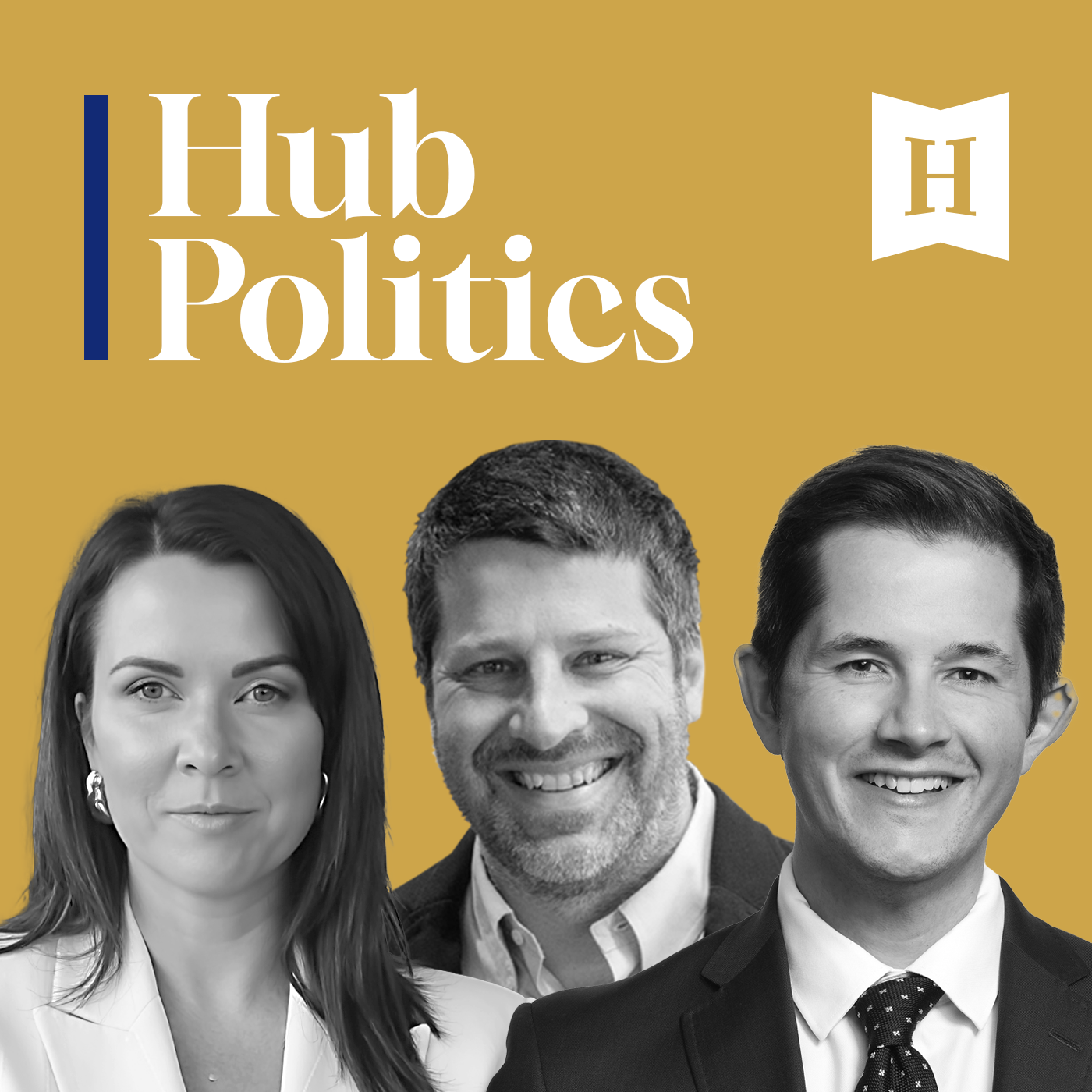
About this episode
If you are enjoying the free version of Hub Politics, subscribe to become a Hub Hero or Fellow to access the full version every week: https://thehub.ca/join/
The Hub is Canada's fastest growing independent digital news outlet.
Subscribe to The Hub's podcast feed to get our best content when you are on the go:
https://tinyurl.com/3a7zpd7e (Apple)
https://tinyurl.com/y8akmfn7 (Spotify)
Follow The Hub on X: https://x.com/thehubcanada?lang=en
CREDITS:
Amal Attar-Guzman - Producer
Alisha Rao - Editor
Sean Speer - Host
Hosted on Acast. See acast.com/privacy for more information.
Get every episode summarized
Each time Hub Podcasts publishes, we email you a written briefing from the transcript — the topics, who appeared, and any specific claims, with the ad reads skipped.
Email me new episodesFree for 3 shows. No card needed.
Hosts & guests
Transcript ready
243 searchable segments. Every word is indexed and playable.
Full transcript
Hub Podcasts — Carney vs. chaos: How global shocks are strengthening his hand. Machine-transcribed; use the interactive transcript above to jump the player to any line.
We'll cover both of those topics in today's episode of Politics, as always, I'm grateful to be joined by Amanda Galbereth, co-founder and principal at Oyster Group, and David Colletto, the founder and chairman at Advocates Research. David and Amanda, great to connect. Great to see you both. But guys, last week we marked the one-year anniversary of Prime Minister Carnie's tenure, and as his week came to an end, he got a nice gift from Advocates Research that showed an 11-point lead in the polls. I think, David, the largest that you've had at Advocates going back at least a year. Why don't you set out those results and their significance? Yeah, I mean, it's even beyond that, Sean, you've got to go all the way back to August of 2021 to find a time when the federal liberals had that kind of lead.
And if you remember, at the time, Mr. Trudeau, at the time, felt pretty good about that, so went into an election and didn't get anywhere near that. I think what we see is a bunch of things, right? That's, I often think, the vote intentions often, the lagging indicator. It's actually more about Mark Carnie right now, government approvals at 56%. Each pollster asks it slightly different. We have a neutral zone, which leaves quite a few people there. That's high. That's the highest for the Carnie government. Mr. Carnie's personal numbers have hit another high. And again, I've talked about this in the past. The overall mood of the country is not incredibly optimistic. Not everybody feels everything's great, but the gap between those who think the country's head in the right direction versus those who think the world is has opened up to the largest it's been since before the pandemic. So you look at every indicator across the board, and we're obviously not the only pollster that shows this. This is, you know, is this the peak from Mark Carnie? I don't know.
There's another poll out today that's from ECO, so they've always had the little slightly ahead. But nonetheless, there's still maybe room still to go. And this is all happening, you know, at a time when Mr. Polly of is getting more attention, I don't think this is so much about him. I really do think this is about Mark Carnie and the moment and Canadians increasingly seeing, you know, a lot of alignment between, again, how they're feeling and what they believe Mark Carnie's able to do for them. I'll come to Amanda in a minute, but David, just to stay with you for a follow-up, previous rounds of strong polling for Mr. Carnie and the Liberals principally had the government polling support from the NDP. So the Conservatives could tell themselves a good story that even though the Liberals had a lead, the conservative vote share was holding relative to the April election. As the Liberals extend their lead, talk a bit about where it's coming from.
To what extent is it squeezing the NDP further and to what extent is it starting to pull from people who say over the past 12 months have identified at various points as conservative leaning? Well, I think, you know, there's not much juice left to squeeze out of the oranges there. So it's a little bit from them. But I do think that there's something coming from the Conservatives. I mean, there's also an indicator that some are moving maybe to undecided, so it's not so much that, because we're looking at those who have a choice, a committed choice. But look, throughout much of this year, there were upwards of one in five of those who said they would vote conservative, who still approved of Marcarnie. And I do think that what's happened in the last few months, whether it's Venezuela, whether it's Iran now, whether it's, you know, named the external shock that's kind of getting people's attention. And we've known this for a while, that every time those global or Trump-related issues rise in salience and changes, you know, we're not an election, but there's still like the
idea of a ballot question, or the thing that voters are asking themselves evolves as well. And so you could have been a conservative supporter, you know, five months ago, when I asked the question, how would you vote? And then also say, well, I like Marcarnie, and I think the government's doing an okay job, but really cost of living is my most important issue, and I still think the Conservatives are best on that. And that's why I'm going to vote for them. Whereas today, we're seeing the gaps between the Liberals and the Conservatives on who Canadians think are best able to handle those micro-economic issues has shrunk. The Conservatives still have a slight advantage on cost to living, a slight advantage on the economy. But the overwhelming gap that the Liberals have on Trump has sustained. Now, we'll see whether Mr. Pauliiv's trip to the U.S. does anything to buffer that. But, you know, I do think that's what explains this. So maybe there are some of those conservative-oriented Canadians who right now are saying, look, the top focus for me is a global one. And I think Marcarnie is doing a good job, and so if I have that chance today, I might
actually vote liberal. Amanda, why don't you respond to David's polling? It's worth noting for our listeners and viewers that is David alluded at various points over the past 12 months. This is tended to be slightly lower on the Liberals than some of the others in the industry and so in some ways, what makes David's poll significant is that it shows a larger gap than, as he says, Abakus is showing for some time. Yes, I certainly take comfort in David's polling at times when the gap is not as wide as even though it's a B. I also think I take comfort because he's good at what he does, and he's usually pretty active. So those are all things that are important. Yeah, I mean, we touched on this a little last week when I think his metaphor around no more juice to squeeze out of that orange is very apt, as I say, as I were orange today.
There's like five caucus members left there now. You know, they're having a leadership that almost no one knows about. And they're on the precipice of electing someone who I believe is going to be broadly viewed as unelectable while a lot of mainstream Canadians. So I think they're going to have a bunch of issues and challenges there. I also just think the state of play right now is, as we've seen repeatedly, is that every time Trump is up, Trumping about and making big threats and whatever, it just, it wanted to just decreases the kind of the newsfall or the political space to have conversations outside of that. And in Prime Minister Kherney, who has spent, I think there was analysis of his travel. He spent 20% of his time over his first year overseas with other world leaders. The closest one was Kretcher, around 10% or something of that nature. That that's where Canadian is clearly one. And see, it's where he's comfortable. I continue to believe that that chicken will eventually come home to roost when we don't have this massive existential threat.
But right now, it's, it's a good place for him to be clearly. I also think it's probably the right place for him to be as far as forging these alliances and being in those spaces, which is why I think you see Peer Pulliav making the pivot that he's making around going to the US and going to Europe, and I think that's a smart pivot on his part. So we are seeing kind of a flip on its head. Normally, Keney, don't give too much of a, you know, what about seeing their leaders overseas, unless we get like nice plots and applause in other media and other places. But I think that's probably job number one for the Prime Minister right now, which is why the, the peer pivot to me makes a lot of sense. Yeah, we'll talk about Polliav's trip to the United States on the, on the back half of the show, Exclusive for Hub Heroes and Fellows. But David, take up Amanda's point because it's precisely where I wanted to go next with regards to foreign policy or, or geopolitics, non-domestic issues looming so large. We're all roughly the same age. I think you have to go back to the 1980 election to find a time where non-domestic issues
loom so large over our politics. As a pollster, just talk a bit about how, how you're thinking about that, how it relates to previous episodes or, or moments that you've, you've followed and, and what, what it means for political actors in Canada. Well, I actually think Sean, I would even like challenge the 1988 example because that was a choice where we're making to engage with the US. And so I think in this case, if I can find an equivalent, I think you have to go back to like the early 70s where again, it's global events like we're having, oil shock, bargos, forced, you know, the Trudeau government at the time to debate whether to bring in, you know, price and wage controls because external events were affecting domestic politics. And I think, I think it's, I think it's very rare, right? And this is, this is the, this is the nuance, I mean, not even nuance. This is the obvious shift in, in the impact that this has is that, again, when you ask Canadians,
how do you feel about this moment that lost that lack of agency, that, that, that sense that like not even our own government can control a lot of what's happening in people's lives. They see the price of gas spike and they now know it's not because of a carbon tax or it's because of a choice that Ottawa or their provincial government's making. It's simply because the President of the United States and Israel decided to strike Iran and that has created this another moment of uncertainty. And so that leaves people, again, thinking about where's that threat coming from? And that threat now is external. And so it changes the calculus in people's minds, it gets them to say, less about who's going to solve this problem immediately to who's most likely going to protect me from it getting worse or helping navigate us through that moment. And so maybe for two-itously, maybe not, I think, Karni's travels, you know, maybe before the beginning of this year, some would have said could be seen as a liability, that he's
not in the country dealing with the things that that are happening here. I think now we're probably looking at his trip to the UK this week and others as evidence that you need to kind of be outside the country because that's signaling to the public that you are trying to use as much leverage and do as much as you can to try to help engage globally because that's the threat that people feel. So I think that's also why we're going to talk about again, Mr. Pauli of his finally in a way decided to also play in that space, recognizing that there's very little he can do here when people are so focused externally. Yeah, Amanda, you've done politics for a long time. David's framing around control and lack of control is an important one, it seems to me. If the main issue or the most salient issue for a lot of Canadians is one for which you don't have control, how does a government manage the politics of that? At some point, isn't there a risk that people start to have concerns that the government
is whatever the government is doing is not seeming having a fact on their concerns or circumstances? It can be a risk, but you know, that would have to mean there's a rational counterpoint right? Like right now we have, if you look at, I know it kind of runs me a little of COVID and that COVID, we had this big existential threat to ourselves. There was this incredible rallying around governments at all levels. We suspended a lot of our normal freedoms, which I had objections to at the time, but everyone was like, final listen, we'll do what you say. I won't touch my family for years and all these sorts of things. But governments got reelected on massive majorities at the time or big mandates because there's this rallying around the flight when there's an existential threat, especially when the existential threat is not rational, predictable or something we've seen before. And I think that's again, weirdly Trump is a bit of that space, right? It's he's not rational, so we can always kind of blame him.
I think the government has played politics around the US threat, you know, they won't, no one wants to say that out loud, but Karni absolutely dials it up as needed or dials it down. I think he's cautious around not obviously destabilizing the country, but they use that politically and people should be, and they should, like, I mean, listen, they shouldn't, but they should, if they want to be effective at winning elections and winning by elections and all those things. So I think you're not just seeing a rallying around institutions, whether it's the CBC, whether it is the Prime Minister or himself, whether it is the government, and there's not a lot of space for the Canada's broken, you know, Canada's not serving you in conversation even if people feel that way, which is why I think we've seen Polly Eve shift. That will eventually write itself. I do believe that we're not going to live in this, you know, Iran gas prices crazy, etc. But I also think people are normal, like, people are rational beings. They don't expect the Prime Minister to fix the price of gas, but they do expect them to look like he knows what he's doing, which is currently what he's really, really good
at. And I think he's meeting the moment right now in a way that is an often lead, opposition leader. It's impossible to do. Yeah, well, that's the final question I want to put to you, David, in this part of our conversation. I was with a really smart and experienced political strategist this week who said that in a way, the last campaign was a fight over ballot question. Was it a ballot question around Trump or was it a ballot question around household finances and affordability, and that it was rational for Polly Eve not to try to win the battle on a carnies ballot question, but try to win the argument in favor of his ballot question. That's an argument incidentally that you've made on the pages of the hub and elsewhere through through the election and in parts of 2025. Is that's still the right way to think about politics in light of your polling and others showing both the salience of Trump and the liberal dominance on that issue?
Well, I think the first thing depends on your objective. If your objective is to ultimately convince more people that you are the right person, the right party to govern than I think in this moment, I'm not sure the old strategy really applies anymore. Because now we've had over a year of Donald Trump in office, especially in this first three months or three months of 2026, more external kinds of shocks, permacrisis and events than I think we've seen in the previous year. That means in the short term that you're not going to win that argument or not in an election campaign, you have equal time almost to be able to try to pull the conversation in your way. You don't have that outside of that campaign and you especially don't have that in an environment like we're in today. So I do think it's almost as if you just have to recognize this is the wave and instead
of what I think Paulie was trying to do was fight it, was to break it, was to buffer it, you kind of have to write it right now and hope that there is no election in the next few months because if there is, it's going to be very hard, I think, to go into that. I think what he's trying to maybe do is signal to the public that whenever the next moment comes where they can pass judgment on who they want to lead us, they will remember at least he was part of the conversation. He had something to show for it as opposed to just constantly saying something that the rest of the country was like, well, why are you talking about this when I'm really focused on that? And I think that's not everybody. There's still a sizable minority, mostly in the conservative universe that would much rather have conversations around crime, immigration and affordability, but he no longer needs to only talk to that audience because I think the leadership question at least for now is settled with the party, it's with the broad membership of the party.
Will and the first half of the conversation they are for the free members of the hub community and pick back up on the second half's shows, Lucifer Upheroes and Fellows, where we'll talk about Mr. Polly of Strip to the United States. Goodbye for now. We'll pick up in a moment. Bye-bye.
More episodes
More from Hub Podcasts

9/11, Europe, and the fight over immigration
Hub Podcasts

How much slack is left in the global oil market?
Hub Podcasts

Canada’s low-quality trade war debate
Hub Podcasts

Andrew Coyne says we are at war, but is that true?
Hub Podcasts