About this episode
Rudyard Griffiths and Sean Speer discuss the Liberal Party's sweeping byelection wins, allowing Prime Minister Carney to form a Liberal majority government just over a year since his leadership win. They examine whether Carney's success stems primarily from anti-Trump sentiment uniting a diverse coalition, or from his personal charisma and credibility. They then explore the coalition's sustainability and whether Carney will use his political capital for transformative economic reforms or settle for transactional politics.
Subscribe to The Hub's podcast feed to get all our best content:
https://tinyurl.com/3a7zpd7e (Apple)
https://tinyurl.com/y8akmfn7 (Spotify)
Watch a video version on YouTube: https://www.youtube.com/@TheHubCanada
Follow The Hub on X: https://x.com/thehubcanada?lang=en
CREDITS:
Amal Attar-Guzman - Producer
Elia Gross - Editor
Rudyard Griffiths and Sean Speer - Hosts
Christinne Muschi/The Canadian Press - Photo Credit
Hosted on Acast. See acast.com/privacy for more information.
Get every episode summarized
Each time Hub Podcasts publishes, we email you a written briefing from the transcript — the topics, who appeared, and any specific claims, with the ad reads skipped.
Email me new episodesFree for 3 shows. No card needed.
Transcript ready
201 searchable segments. Every word is indexed and playable.
Full transcript
Hub Podcasts — Carney's Liberal majority: Will he deliver real reform?. Machine-transcribed; use the interactive transcript above to jump the player to any line.
It's a clean sweep, three in done, Mark Carney has his majority winning all of yesterday's by-elections. What does it mean for candidates now have a majority government? How is this going to affect our politics, policy, the economy, and so much more to help break it all down? I'm joined by Sean Spear, my co-founder and editor at large. Well Sean, the moment is upon us a liberal majority. When you ever have thunk it, going back to that election, what a type rope, Mark Carney walked through that campaign to get, yes, a strong majority, but short of a majority, and now what, Sean, less than a year later, he's a majority premise. Yeah, I'm glad you started there, Roger. You and I have been doing this at the Hub for five years. We've been adjacent to the world of policy and politics for most of our professional careers. You were slightly longer than mine. And really, you have to see, I think, the past 18 months or so as virtually unprecedented.
Remember last January, betting markets had the concerns at a probability of a majority government north of 90%. Justin Trudeau was liberal leader and we had a growing number of liberal MPs announcing that they weren't running in the next election because they saw the writing on the wall. Mark Carney, who had no political experience, decides to run for liberal leader at a time when I suspect some people thought he was crazy. And I don't know if it was naivete or supreme self-confidence. But I think you have to say, Mark Carney has dominated our politics for the past 12 months. And yesterday's clinching of a majority is kind of the culmination of this really, as I say, unprecedented political rise. Not to take anything away from Mark Carney, his political sagacity, everything he's accomplished in less than 12 months. But does this majority of his, a combination of floor crossers and now these by-elections, does that majority run right through the Oval Office and the Resolute Desk of Donald
J. Trump? Yes. Yeah, I think that's right. As it was noted in a column yesterday, even the liberals kind of understand themselves as an anti-Trump coalition. And I think that's a useful way to think about it. What connects the dots between socially conservative, former conservative MP, Marilyn Gladio and the former deputy leader of the Ontario NDP? How do they belong in the same political party? What's the one piece of connective tissue? It's Donald Trump, amongst other things, maybe. So I say that because I think as long as Trump looms large, managing such a broad and diverse coalition will be probably manageable. But as the Trump issue dissipates, which ostensibly it will in the coming months and years, do you think those, because Sean, I was thinking about that this morning, we've got the midterms coming up. I think there's going to be all kinds of high drama, regardless whether this war is settled or not. I would say that, I think we're in a violent agreement here, that there's an inversely
proportional relationship between how bad things are going in the United States, the Donald Trump and these Canadians, perceptions of that and Mark Carney's political star in his appeal to Canadians and voters. And I have to think that the run up between now and the midterm elections, I agree with you though, if what looks like is going to happen, which is a blue wave, at least right now, if you extrapolate that forward, Democrats potentially controlling not only the lower House, but the Senate too, then Sean, what if it's a lame duck presidency and a really lame duck presidency for Donald Trump in the back half? Do you think that creates more political oxygen in Canada for the NDP, for the conservatives? And do Canadians move off this flight and fright kind of political modality that they're in right now where they've kind of run to the Liberal Party, a lot of conservatives, older boomer conservatives are there. We've got people, former NDP, Ontario deputy leader now in the Liberal Caucus, it's remarkable
how that flight, flight, fright instinct has just animated so much of our politics, does that go away after that? Yeah. So, to this point about the anti-Trump coalition, one thing I was thinking about last night is, in some ways, the state of Canadian federal politics reminds me a bit of Quebec politics in the 1990s and early 2000s, where federalism versus separatism really trumped everything else. You were in a coalition with people who you didn't agree with on taxes or size of government or other issues because you shared that one defining issue and so you're right, I think for now our politics is organized around anti-Trump or neverTrump versus whatever however you characterize the other side and what's interesting is you recall when the sovereignty issue was diminished in Quebec, the politics changed and people could return to being involved in politics based on other issues, other things and so I think you're right, I think that
is ultimately the risk for Mr. Carney is that as the Trump issue declines in salience, the people who are part of the coalition start to look around and say, wait a second, what am I doing with this guy? And that's a huge opportunity, I think, for Abbey Lewis and possibly Pierre Paulier. Yeah. It's interesting to think though that this kind of fright reaction and flight into the liberal party has been generated by what Sean, yes, a lot of hot rhetoric from the president and yes, some sectoral tariffs that have been painful, but if you pull back for a moment and you look, I mean, we have an effective blended tariff rate in the single digits with the United States, there's lots of things that may happen to Kuzma, we don't know, but the fact is, are you surprised, I guess, because I'm trying to argue against ourselves here for a moment, are you surprised at the extent to which, if you want to begin, be really tough with ourselves and say, what is the full extent of the American threat at this point?
We're not going to war you and us tomorrow, are not picking up broken ranger cold rifles with their busted, busted wood stocks or fiberglass stocks, no, that's not happening. So are we maybe discounting that there's something else about Mark Carney? Maybe there's a certain charisma, he's got that JFK kind of short, you know, cropped haircut a bit like you, those of you watching here on YouTube. Yeah, yeah, he's also a runner shot, he kind of cuts a pretty, a pretty spelt figure in those, you know, $5,000 bespoke suits, I don't think you have one of those either. So look, I'm partly joking here, but, you know, to be fair to Mark Carney, do we need to acknowledge maybe that this isn't just about a Trump, that this guy is charismatic, he's enjoying himself, he's self-deprecating, he for a lot of Canadians is very important,
he represents the country on the world stage in a way that embodies a lot of nostalgia about an era where Canada was relevant internationally, people are proud of it, they're proud of what he represents. So I just want us to, you know, bring that into the analysis here, because I do share that the Trump, you know, the Trump factor is a critical part of this majority, but I also want to give work credit, is credit, do, and that this Prime Minister has done a pretty remarkable job. Yeah, I'm glad you put that on the table, let me respond in this way. One way I've come to think about the 2015 election where Justin Trudeau beat Stephen Harper is that although it was interpreted as a change election, if you think about it, Justin Trudeau was offering a lot of continuity with Stephen Harper, he would keep tax rates mostly unchanged, he would keep the parts of the Harper agenda that people liked mostly unchanged, if anything, he would kind of deepen it. And so if you were going to the polls, you could say, I get the parts of Harper I like,
but in a nicer, more pleasant, more charismatic package. So now, fast forward to 2026, they didn't like that Justin Trudeau and hindsight seem kind of flip and superficial and kind of ideological. They liked Pierre Paulier's relative kind of hardheadedness, his relative focus on kind of meat and potatoes, economic issues, but you get all of that with Mark Carney, you get the kind of parts of Paulier that you like, we'll see, we'll see, I mean, he hasn't actually you get some of those parts though, but you get a pipeline maybe as a happy warrior. Yeah. And so I don't know, sometimes I wonder if conservatives feel down because they feel like they're losing the battle of ideas. And that's obviously part of it, but both Trudeau and Carney have offered a degree of continuity with some thinking around economics, but in a nicer, more pleasant, more happy warrior
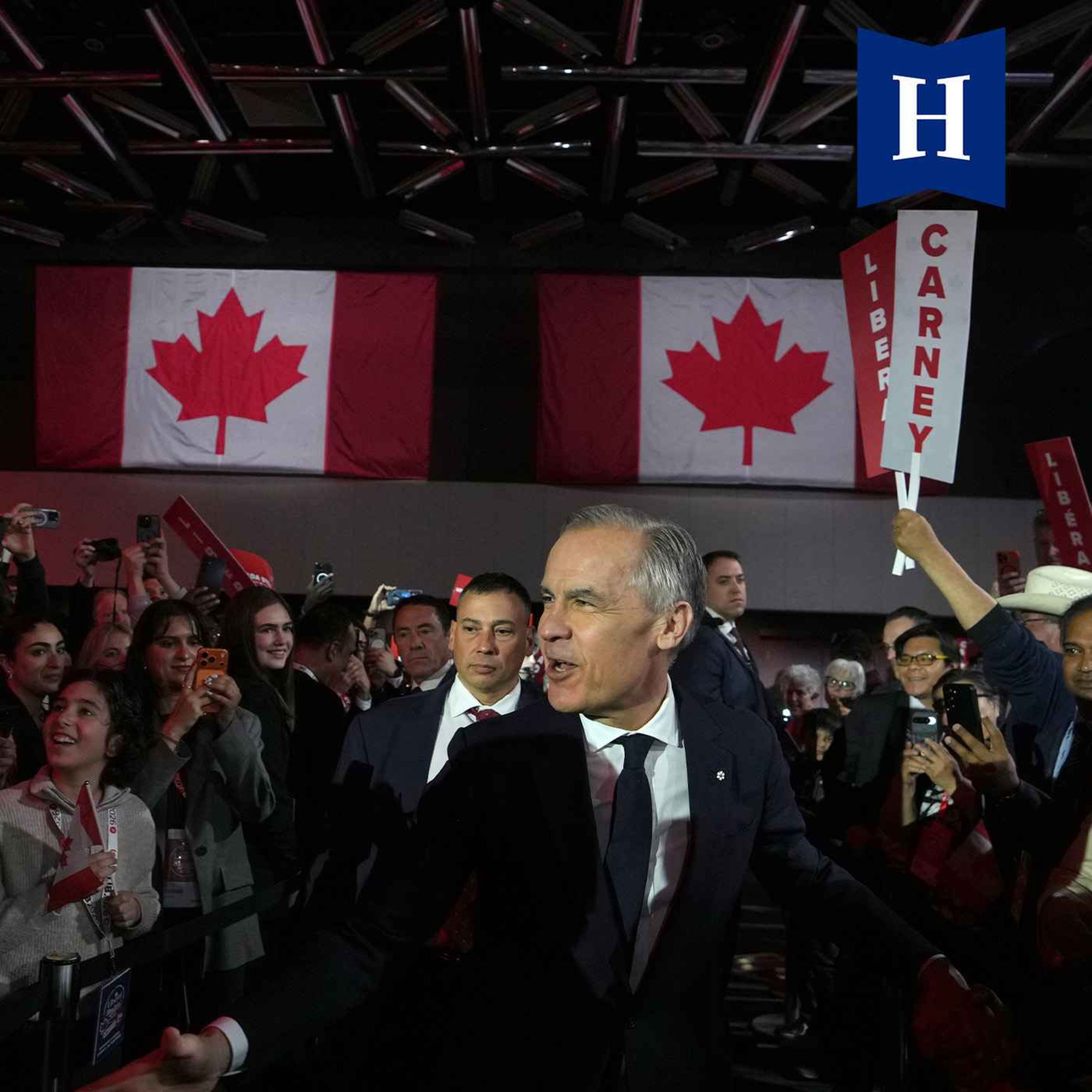
package. Maybe there's a lesson there. Yeah, Sean, look at this photo we have up. I mean, the guy, he's good looking. You know, he looks like a winner. People like, you know, people like winners, but in the remaining moments, let me be a little more serious. We're going to have a spring economic update. And there are, there's talk already that that update is going to include relief. If you're watching, you see my air quotes, you know, two Canadians because of the increasing affordability crisis triggered by the Iran War. And there's speculation that we might see as we did last fall, more checks flying out of Ottawa. Those were grocery rebates, HST rebates. Are we going to have federal tax rebate on, you know, on fuel fuel at the pump or some other gimmick? I think that'll be a key moment. I was talking with journalist Andrew Coyne yesterday over at the Monk Debates or other YouTube channel.
And you know, I think we both agreed that Carney has a majority and B, he's got a 12 or more percent lead over the conservators on a party basis. And on an individual leader basis, he's 20 or more points. So he has both the political power, ie, he can get whatever he wants through parliament legislatively. And he's got political capital. And I, for one, will be profoundly disappointed if this spring economic update doesn't see him start to spend that political capital on things that require the capital, L word, leadership, leadership on taxation, on productivity reform, on competition reform, on all these bigger things that he knows as an Oxford trained PhD economist who's led to significant central banks. He knows what's wrong with the Canadian economy, he knows it's sclerotic, it's underperforming,
it has too little competition, it has too big a role of government, vis-a-vis the total share of GDP, it's got declining per capita GDP, there's this chasm opening up between the average wealth of Americans and the average wealth of Canadians, which is creating a brain drain where our best and brightest are fleeing across the border to better lives. He knows all this. So I don't know Sean, I'm going to look carefully at that statement because if we see things like, you know, a chicken in every pot, a check deposited in every bank account, then I worry that what we have is instead of a truly maybe visionary change-making prime minister, we have what's happens to a lot of prime ministers, including your former boss Stephen Harper, is they like the job, you know, who doesn't like being popular, who doesn't like going to the Habs game and have people getting up and giving you a standing ovation. That's why a lot of people go into politics in the first place.
Yeah, what a great take right here, I think that's exactly right. You know, you think about it, at this point, if you step back and you ask yourself, what is the kind of theory of the case for Mr. Carney? It's the rupture thesis, isn't it? That's the kind of single biggest idea that he's put on the table, which is the basic assumptions of Canadian political economy for like the past several decades is fundamentally broken, irreversibly broken. You have a maximalist diagnosis like that and your prescriptions are, as you say, marginal tax and transfer policies to solve for immediate concerns around monthly living costs. There's just this enormous golf between the two. And so if he really genuinely believes that our relationship with the world's major superpower is irreversibly ruptured, then we need to start to see an agenda that is proportionate to that diagnosis.
And so you're right. I think we won't get the totality of that plan in the spring. We'll have a budget, ostensibly in October, but we need some down payment. Some sign that the Prime Minister is prepared to take this majority for a spend to meet the moment. Otherwise, as you say, I think people will increasingly ask themselves, is this someone who is setting up these big grandiose speeches, but ultimately offering us the kind of transactional politics that we've come accustomed to? Yeah, big grandiose deficits and basically a preservation of the status quo that we know isn't working for the country on a variety of different levels. Okay, the jury is out. Congratulations to the Prime Minister for having a liberal majority, but now the hard work begins, Sean. I don't think he can hide. He's got to deliver. So we will continue to watch this carefully here at The Hub. Thanks for tuning into our YouTube channel and listening to us on your favorite audio
app head over to our website, triplew.thehub.ca, for more terrific analysis and insights on everything related to Canadian economics and politics we got you covered. See you again on the next Hub. Bye-bye.
More episodes
More from Hub Podcasts

Trump trade war: Is Canada destined to lose?
Hub Podcasts

Will private capital solve Canada's infrastructure crisis?
Hub Podcasts

Could AI become Alberta’s next source of national leverage?
Hub Podcasts

Trump's sinister trade war does not excuse unhelpful responses
Hub Podcasts