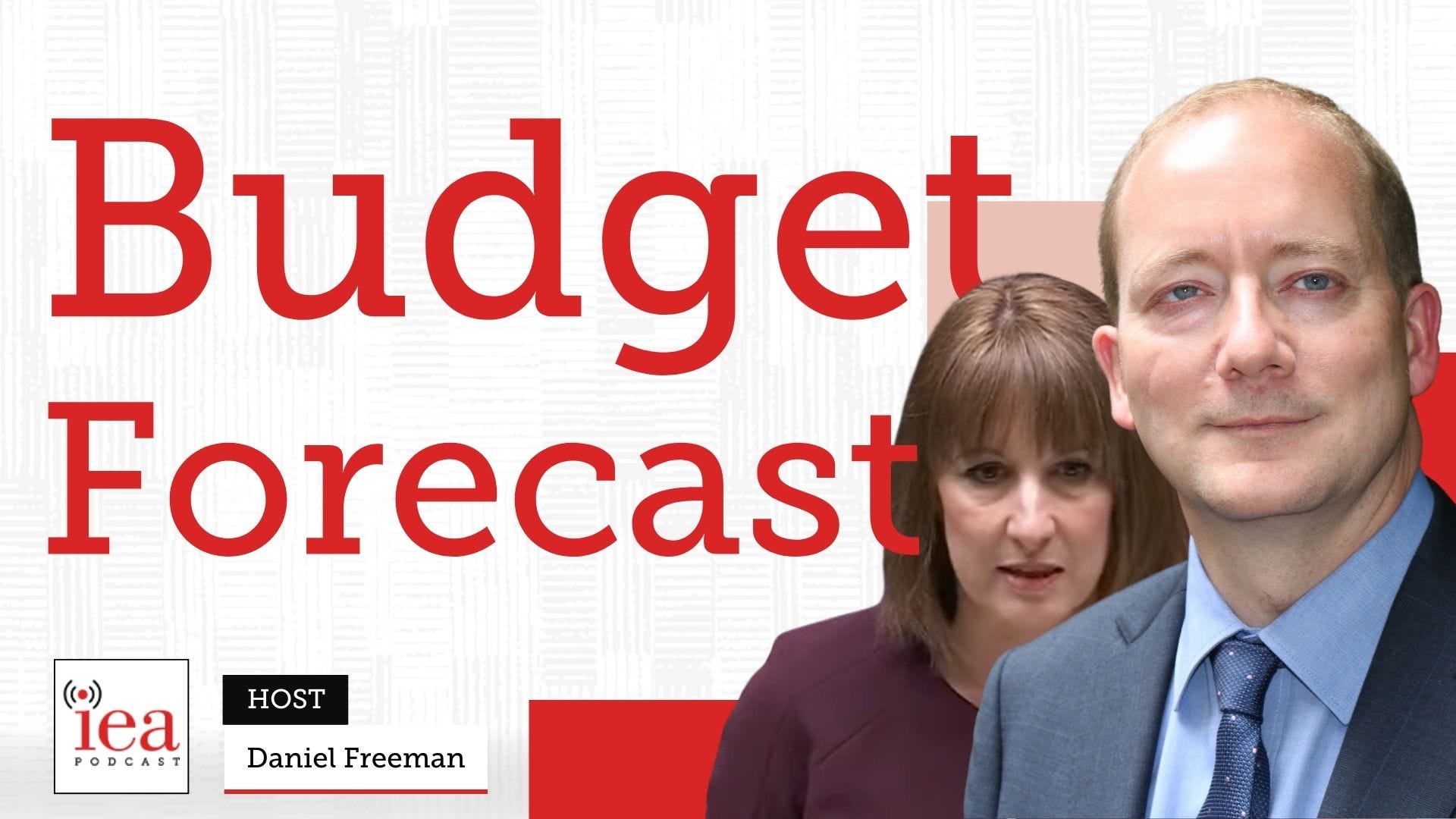
Budget 2025 Forecast: Why Rachel Reeves' Tax Plan Will Backfire
About this episode
Read the full paper here: https://iea.org.uk/publications/2025-budget-briefing-tax-policy-preview-options-and-possible-impacts/
With Chancellor Rachel Reeves set to deliver her Autumn Budget on Wednesday 26th November, IEA Economics Fellow Julian Jessop joins Managing Editor Daniel Freeman to discuss his new budget briefing paper. Jessop warns that the Chancellor faces a financial hole of up to £30 billion and will likely attempt to fill it through a combination of extending the freeze on personal tax thresholds and what he describes as a “dog’s breakfast” of smaller tax measures. While the largest component of the hole – around £20 billion – stems from a long-overdue downgrade to the OBR’s productivity forecasts, the remainder results from Labour’s own policy decisions, including abandoned welfare reforms and increased spending commitments.
The discussion explores why attempting to raise £20 billion from numerous small tax changes is economically risky and likely to prove unreliable. Jessop argues that such a patchwork approach – potentially including higher Council Tax on expensive properties, closing Capital Gains Tax loopholes, imposing National Insurance on rental income, and increased sin taxes – creates greater uncertainty and unintended consequences than a simpler rise in broad-based taxes like income tax or VAT. He reveals that the government reportedly abandoned a “two up, two down” plan to raise income tax rates by 2p while cutting employee National Insurance by 2p, likely due to political concerns about breaching manifesto commitments rather than improved economic forecasts.
Jessop makes the case that the root problem is spiralling public spending, which is forecast to rise by £200 billion over the next five years from £1,150 billion to £1,350 billion. He argues that simply restoring productivity in public services to pre-COVID levels could provide the same services for 4% less money, eliminating the need for tax rises altogether. The conversation also covers broader tax reform possibilities, including abolishing stamp duty and National Insurance, and why successive governments have failed to rationalise the VAT system despite cross-party agreement among economists that it’s deeply flawed.
This is a public episode. If you'd like to discuss this with other subscribers or get access to bonus episodes, visit insider.iea.org.uk/subscribe
Get every episode summarized
Each time IEA Podcast publishes, we email you a written briefing from the transcript — the topics, who appeared, and any specific claims, with the ad reads skipped.
Email me new episodesFree for 3 shows. No card needed.
Hosts & guests

No transcript yet
This episode has not been transcribed. Request it and it moves to the front of the queue.
More episodes
More from IEA Podcast

COVID Was the Biggest Event Since WW2 — And We've Learned Nothing | IEA Podcast
IEA Podcast

Why Are Young People Giving Up on Work? | IEA Podcast
IEA Podcast
Has The Left Already Won Britain?
IEA Podcast

Britain Is Poorer Than Every US State | IEA Podcast
IEA Podcast