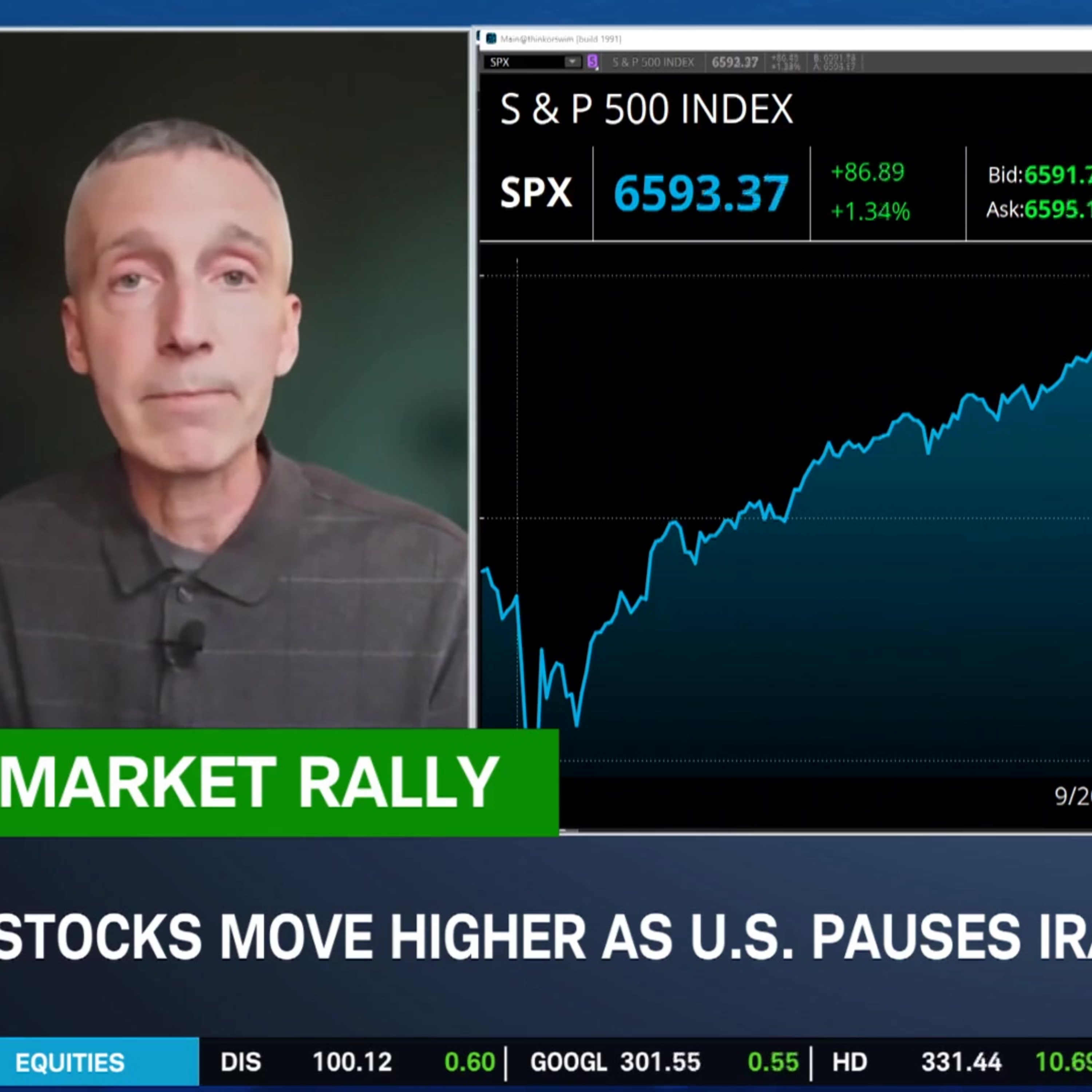
Brian Jacobsen Gauges 2026 Recession as U.S.-Iran War Continues
About this episode
Brian Jacobsen highlights how quickly markets can move on social media posts during the U.S.-Iran war. He discusses the economic impacts: if gas prices are above $4 per gallon, that would start to really hurt consumers. Sustained high prices for a few months could start market participants worrying about recession. Brian explains what economic data he’s looking at to watch out for cracks and the narrative he thinks the Fed is writing.
======== Schwab Network ========
Empowering every investor and trader, every market day.
Options involve risks and are not suitable for all investors. Before trading, read the Options Disclosure Document. http://bit.ly/2v9tH6D
Subscribe to the Market Minute newsletter - https://schwabnetwork.com/subscribe
Download the iOS app - https://apps.apple.com/us/app/schwab-network/id1460719185
Download the Amazon Fire Tv App - https://www.amazon.com/TD-Ameritrade-Network/dp/B07KRD76C7
Watch on Sling - https://watch.sling.com/1/asset/191928615bd8d47686f94682aefaa007/watch
Watch on Vizio - https://www.vizio.com/en/watchfreeplus-explore
Watch on DistroTV - https://www.distro.tv/live/schwab-network/
Follow us on X – https://twitter.com/schwabnetwork
Follow us on Facebook – https://www.facebook.com/schwabnetwork
Follow us on LinkedIn - https://www.linkedin.com/company/schwab-network/
About Schwab Network - https://schwabnetwork.com/about
Get every episode summarized
Each time Schwab Network publishes, we email you a written briefing from the transcript — the topics, who appeared, and any specific claims, with the ad reads skipped.
Email me new episodesFree for 3 shows. No card needed.
Hosts & guests
Transcript ready
78 searchable segments. Every word is indexed and playable.
Full transcript
Schwab Network — Brian Jacobsen Gauges 2026 Recession as U.S.-Iran War Continues. Machine-transcribed; use the interactive transcript above to jump the player to any line.
As we know, today's market action is served as a pretty good reminder of how quickly narratives can flip from oil prices to inflation fears to what the Fed will focus on next. So to tell us more on this and some of the broader geopolitical tensions weighing on these overall markets, I'd now like to welcome Brian Jacobson, Chief Economic Strategist at Annex Walth Management. So Brian, first and foremost, thanks so much for joining us to kick off this trading week. It's already been a busy Monday, of course, here so far. So walk us through really the broader reaction we're seeing to some of the news and developments over the weekend and really what your biggest takeaway has been so far today. Yeah, thanks for having me. When I was talking to some reporters early on Saturday, a lot of the discussion was around how much negative we were going to open on Monday, mostly because of the threats against Iran as far as giving them a 48-hour deadline and what would that really mean in terms of the intensity of the fighting and how realistic is it to kind of wrap up the operations in a short time frame? Well, that whole narrative really flipped this morning when President Trump said that he had a really good
tone or conversation, tone, tenor, all that with Iran and that he's going to not target infrastructure, energy infrastructure for the next five days and then it was off to the races. And I think that just really highlights how quickly these markets can move and really driven by just social media posts as far as what's going on in terms of the depth and the duration of the conflict in the Middle East because that's what everybody's really waiting for. Are we going to have $120 barrel and oil for two months or is it going to be more than that for like six months? Very different economic outcomes and market implications for each. Brian, I think today really highlighted just how quickly information can move and how quickly financial markets can move on that information. We reminded of that last year. We're reminded of that again this morning setting aside sort of the short term price distortions as we get the latest headline. What would have to happen in terms of whether it's duration of the conflict,
types of structural damages done to infrastructure for the big picture economic picture in the US to truly change? Yeah, I think that's really to change the picture. We would have to have basically think about average price of gasoline, right? That's easier to think about than in terms of dollars for the price of a barrel of oil. So if it's four dollars or more for three months or longer, those are kind of my guideposts in terms of that's when you start doing a lot of damage. Near term, it can do some in terms of people maybe they're not saving as much or they have to draw on to savings, but when they actually change their behavior, it does have to tend to be a little bit more persistent. So and by persistent basically three months at those types of levels, that's where then all of a sudden I'd be thinking is a recession in the cards. Now that was not my base case because I was taking President Trump at his word when he said this was going to be a four to five week operation, meaning that we would see the big adjustment in the price of oil,
price of gasoline, but hopefully most of that reversing after the operations are over. And maybe that's the way it's playing out. It seems like the market is thinking that right now too. Okay, so as far as some of the refocus on the labor market, what labor indicators matter most from here and what would signal to you met? The labor market is weakening enough to maybe alter than the Fed's next course of action. Yeah, I think those are unfortunately actually two separate questions because I'm really looking at the higher frequency data like the ADP weekly employment numbers. We're going to be getting some more of those coming up here soon on Tuesday. They release those as long as those are staying positive, I'm going to view that as being a positive for the economy and the markets. And of course you have the initial jobless claims. So those are the two high frequency ones I look at. Now the Fed on the other hand, they do tend to look at the Bureau of Labor Statistics. Yes, they do look at a whole kaleidoscope of different indicators, but I think that the majority of the people on the committee still focus on that unemployment rate.
And it was interesting how in the comments or in the in the statement that they released, they said that really the unemployment rate hasn't moved anywhere anytime lately, which isn't really true. If you look back at where we were a year ago, I mean the unemployment rate has moved up. We've gone from 3.4%, we're now above 4.4%. That is not a trivial move. So I think that's part of the problem is they're almost trying to craft a narrative around why they shouldn't have to cut rates in this environment because of the labor market. So perhaps a little bit of spin because they are still worried about those latent effects from tariffs and now compound onto that, the effects on inflation from oil prices. But they don't actually want to come out right out and see it. Brian is sort of a bigger picture question just from a thinking standpoint. There's so much going on at once. We've been talking about the war. We've been talking about labor market and some of that is distorted by this world-altering technological breakthroughs
that were watching take place in real time. Combine that with an inflation that has just been sticky and frustrating for consumers, this K-shaped recovery. How does someone who's trying to make sense of this take all these different variables and try to come up with an answer? So the way that we do it is basically through a committee process. So you're bringing in a lot of individuals to hopefully tone down the emotions because a lot of it, when you look at it, it can get a little bit emotionally charged. So if you have a diversity of views coming together, maybe you can kind of filter out some of the emotion from it. But really focus on profits. I just always ask myself, you know, before you were talking about Apple, right? What does this mean for the profitability of Apple? What does this mean for the profitability of X, right? You can name whatever company it is that you want. What does this particular situation in these different scenarios? And just remember that over the long term, right, has been grand the famous investor once said that
the market is a wane machine in the long term. And the short term, it's a voting machine, right? This swings in the sentiment. But maybe if you can kind of just focus on the fundamentals, are you buying these companies at what you think is a reasonable price for a three to maybe seven year hold? I think that's how you can kind of ride through it. Yeah, and I hope that the markets continue to ride through it. I will say some of the resiliency of these individual sectors has been impressive. But as we all have said, there's still this looming thing of uncertainty that doesn't seem to be entirely gone or even necessarily avoided today, even though we got some positive developments over the weekend. But so appreciate your time to kick off our week. And of course, today, Brian Jacobson, Chief Economic Strategist at Annex Malth Management.
More episodes
More from Schwab Network

Stock Market Today: ORCL & ADBE Earnings, AEO Plunges Near 52-Week Low
Schwab Network

Thursday's Final Takeaways: Crude Taps $103 & PPI Hotter than Expected
Schwab Network

Balancing High-Conviction AI With High-Dividend Diversification
Schwab Network

EARNINGS PANEL: ORCL, ADBE
Schwab Network