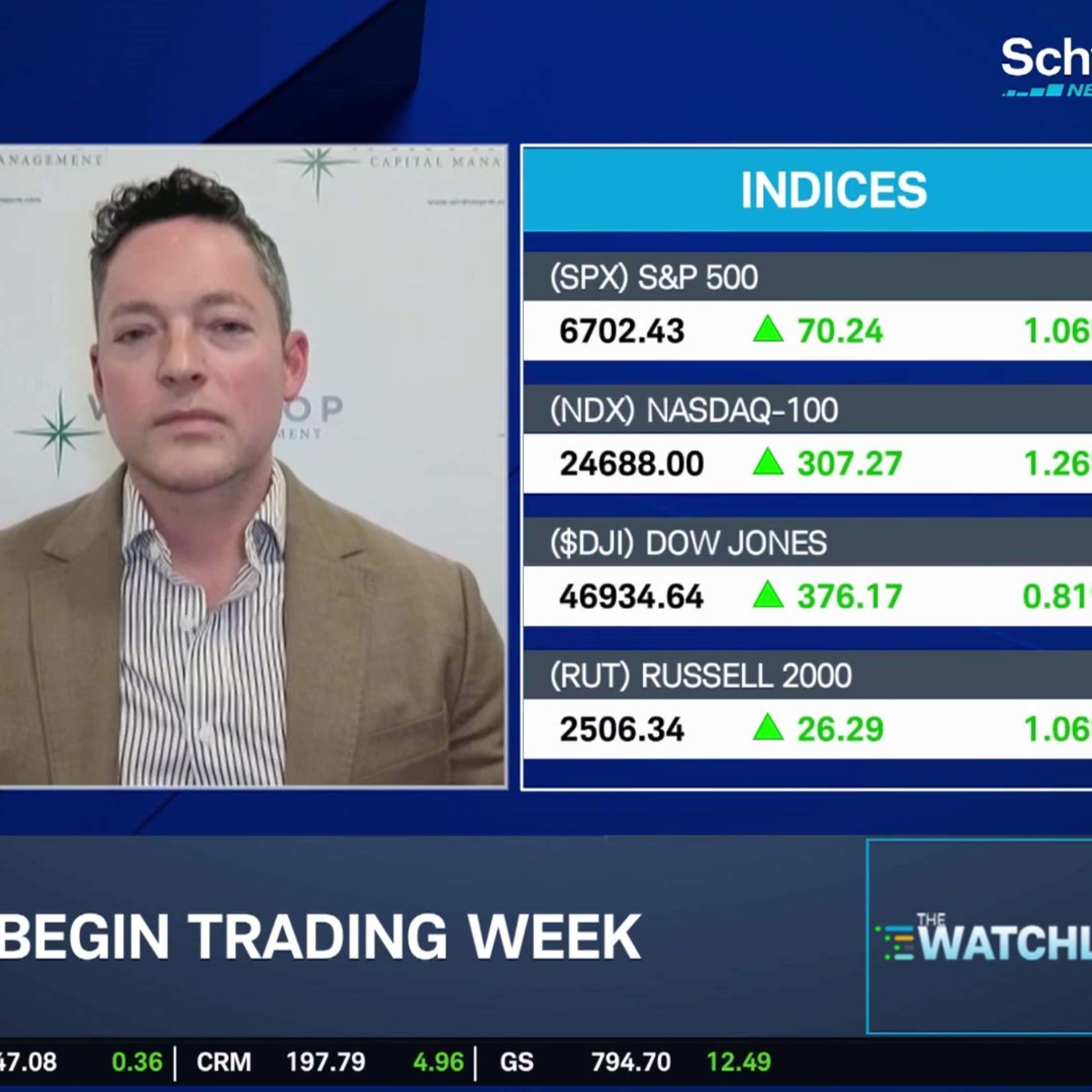
Boosting Portfolio Defenses: Adam Coons on Combatting Volatility & Software Sell-Off
About this episode
As the U.S.-Iran War continues, Adam Coons suggests investors maintain a "buying list" as certain stocks sell off in the geopolitical pressure. "Look for high quality" companies, says Adam, referring to companies with solid earnings sustainability and little to no debt. Software is one sector he believes got beaten down too much, pointing to Intuit (INTU) and ServiceNow (NOW) as especially oversold.
======== Schwab Network ========
Empowering every investor and trader, every market day.
Subscribe to the Market Minute newsletter - https://schwabnetwork.com/subscribe
Download the iOS app - https://apps.apple.com/us/app/schwab-network/id1460719185
Download the Amazon Fire Tv App - https://www.amazon.com/TD-Ameritrade-Network/dp/B07KRD76C7
Watch on Sling - https://watch.sling.com/1/asset/191928615bd8d47686f94682aefaa007/watch
Watch on Vizio - https://www.vizio.com/en/watchfreeplus-explore
Watch on DistroTV - https://www.distro.tv/live/schwab-network/
Follow us on X – / schwabnetwork
Follow us on Facebook – / schwabnetwork
Follow us on LinkedIn - / schwab-network
About Schwab Network - https://schwabnetwork.com/about
Get every episode summarized
Each time Schwab Network publishes, we email you a written briefing from the transcript — the topics, who appeared, and any specific claims, with the ad reads skipped.
Email me new episodesFree for 3 shows. No card needed.
Transcript ready
81 searchable segments. Every word is indexed and playable.
Full transcript
Schwab Network — Boosting Portfolio Defenses: Adam Coons on Combatting Volatility & Software Sell-Off. Machine-transcribed; use the interactive transcript above to jump the player to any line.
Adam Coons is with us Co-Chief Investment Officer at Winthrop Capital. I'm great to see you, some of your thoughts on the market. Yeah, I mean, look, the market is going to be really sensitive to what's happening with the conflict in Iran. I think that's what you're feeling today is just that some of that pressure coming off because it just looks today like this maybe closer to the end than to the beginning. And so I think, you know, markets, at least investors should expect markets in the near-term to be really sensitive to that and everything else could kind of be pushed to the side. But there are a lot of things moving right now in the market. I think, you know, when you look at tech, when you look at AI and how it's evolving and how the markets are digesting, this increase in capital spending, and then obviously you've got the kind of the big story that seems to be hitting at least every other day in the private credit market and how that's flowing through the BDC type stocks. So there's still a lot of things under the current that are happening.
But regardless, the focus, the thing is really going to shift markets. At least, like I said, in the near-term is just going to be this conflict. So what do you think? What's your strategy here going forward then? Well, you know, you need times like this to have your buying list, to have the things that, you know, you've kind of put to the side that maybe we're too rich and you're kind of looking for them to cheapen up. This is your time to start looking at those lists. But I think the reality is overall, the market is still relatively strong. I think, you know, I said, we obviously had some choppiness here over the last several weeks. But when you look at earnings, right now, earnings growth is still robust. And as long as that remains intact, I still think you want to be a buyer of this market. Now, you want to be, you know, with somewhat nimble here, you want to be able to play defense. But where you do have some kind of dry powder, like I said, when you see those pullbacks, dislocations, that's the time to start
to buy right now. Unless we see some bigger kind of chains or shift fundamentally to the earning story, like I said, I think right now you still want to be a buyer of these markets. So the defensive stocks, when you're overweight, defensive stocks, what kind of stocks are we talking about? Yeah, that's a, you know, a slogan put on a strategy that has evolved quite a bit over the years, whether you're kind of a value tilt or just a low beta. I think you kind of what you really want to look at is high quality. I think that's the best defense you can play is to invest into higher quality stocks. And that may seem somewhat obvious. But when we say quality, what we mean are that their earnings have, you know, substantial growth on a more robust business model. There's free cash flow. There's low debt. So there's more stable companies. They could be more mature, but not necessarily. It's just all about the sustainability of the business model. You know, we kind of live through this through the pandemic and you saw all those
stocks. They were able to kind of live through that without too much pain. So those are the type of stocks we look at when we put the, you know, nomenclature of defense on it. Sometimes it kind of comes with a dividend. I think that that helps. That's obviously a buffer to any price movement and it gives you some cash to reinvest to kind of naturally. So just generally, you're looking for less volatility, more stability in the names that you're buying and trying to, you know, not necessarily chase those high fly high beta names and just kind of waiting the storm for a moment. And then when you see those opportunities, being able to jump on them, if you're fully invested in, you know, your yolo high beta stocks, it's really difficult or impossible to kind of pivot your portfolio. So that's where the defense can kind of play a role. So I did notice IGB and some of the software stocks have been bouncing back a little bit. Even while we were selling off, what do you think of that? Was the group just oversold with the SaaS apocalypse overdone?
What do you think about that? Yeah, a little bit. I mean, look, it was kind of one of those things. And this is fairly normally markets is the slogan, throw the baby out with the bath water, is you just kind of get caught up in the rush that can be to your benefit on the upside or to your detriment on the downside. And that's where you really have to dig in and not assume that all companies are the same. And so as this kind of landscape evolves and trust me, it is far from being over this kind of evolution of the SaaS space. But you got to look when you see these big sell-offs and start to kind of pick at that and say, there's little chance that all of these companies should be down 40%. And so yes, it was oversold broadly. And then that's where we kind of started to pick the different names we saw. We really looked at the business model and said, how is this impacted or affected by AI? And those that you can see where it actually can improve or enhance the business model long-term, those are the names you want to be in and just specific ones for us or into it or service now. Our good example is of software companies that
just really got beat up. But from our standpoint, the business model actually can be enhanced by AI, not replaced. And then looking internationally, you like LVMH. I mean, this is the parent of Louis Vuitton and Moette Champagne. There's room here for more room to go. Yeah, there is. I think this is a slightly different story. One, we wanted some international exposure. I think the trend of capital flows moving away from the US. We think we'll continue. We saw that tremendously last year and this year has been no different. So that's part of the play here. And then, frankly, it is this K-shaped economy story that continues to go around. It's true, is that from our standpoint, when you want to play the consumer, right now, we think that you want to stay in that top 10% type consumer. When you look at the staple names like your Walmart
and Costco, those are way too expensive for what they are. And so ironically, these specialty retail, like LVMH, they have very specific brands. They are a little bit of, you know, kind of fad centric. And so you got to ride the wave. But right now, the brands within that portfolio would take your strong. And like I said, it's a way to play that kind of upper echelon in the K-shaped economy. And then just quickly, the international plays. Do you like emerging markets? Do you like certain countries over others? We do. We're kind of like a mixed bag. We're more regional than specifically saying emerging or developed. And we really like the Southeast Asian kind of region as a whole. We want to stay away from Europe. We think there's just too many headwinds, too many issues there. But yeah, I mean, we like a lot of names in China. We like obviously Taiwan's semiconductor on the tech side. South Korea is a region we like. And we still like some pockets of Japan. So it's really concentrated when we're looking internationally at that region over a broad
allocation, like said, to kind of some low growth out of Europe. And then we want to thank you right there, Adam Coons. Thank you. Winter Capital Management. It's really nice to see you. Glad you were able to be on with us today, Adam.
More episodes
More from Schwab Network

Stock Market Today: ORCL & ADBE Earnings, AEO Plunges Near 52-Week Low
Schwab Network

Thursday's Final Takeaways: Crude Taps $103 & PPI Hotter than Expected
Schwab Network

Balancing High-Conviction AI With High-Dividend Diversification
Schwab Network

EARNINGS PANEL: ORCL, ADBE
Schwab Network