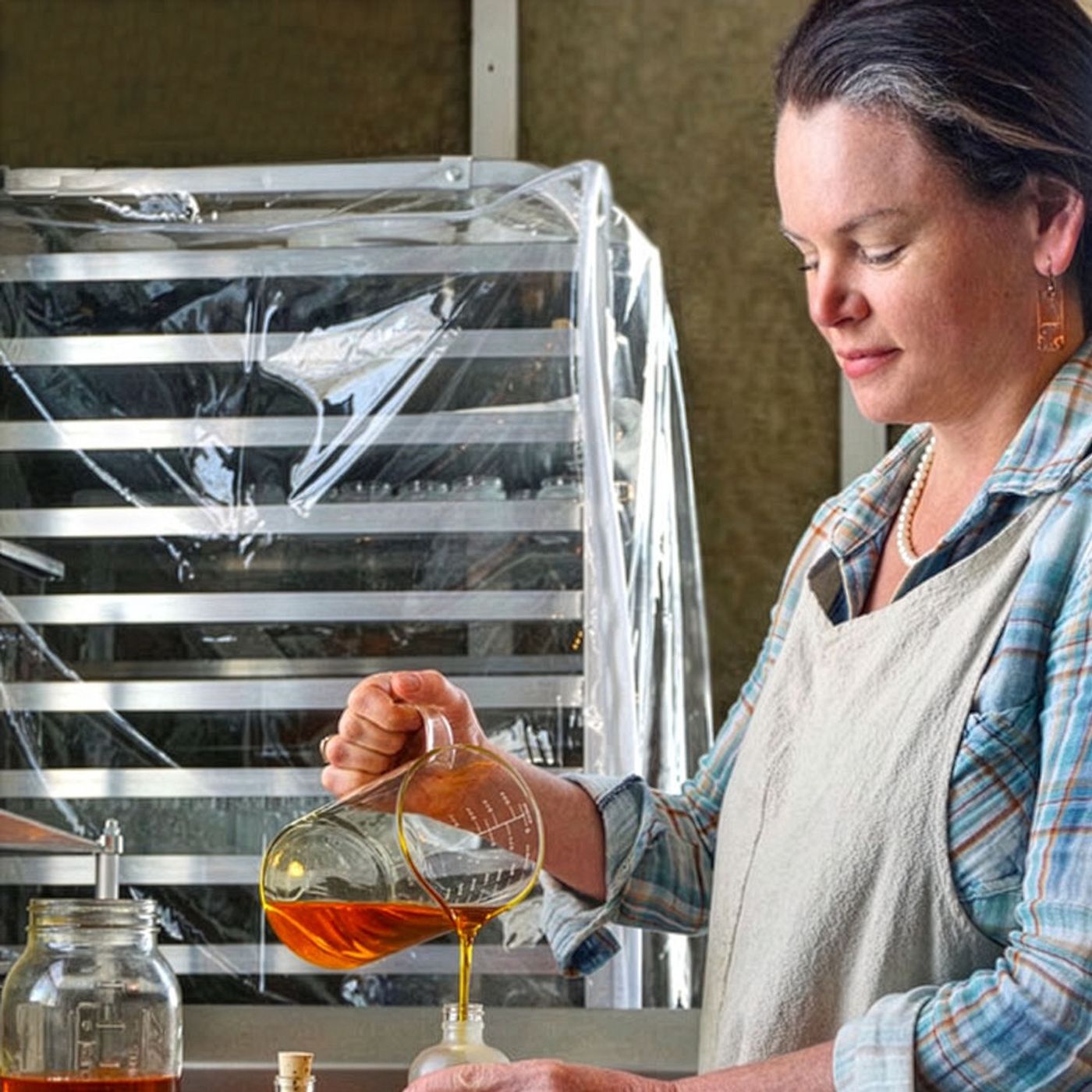
Boost farm revenue by adding dried herbs to your crop plan with Emily Springer of Meeting House Farm and Collaborative in Maine
About this episode
Most flower and vegetable growers can add herbs to their existing crop plans without changing what they’re already doing- and dried herbs can complement the fresh crops by providing a year-round income stream. On this week’s podcast we talk with Emily Springer of Meeting House Farm and Collaborative in Maine about how she grows herbs on the farm and sells them through the collaborative. Emily started the collaborative so growers can use the online sales platform to connect with buyers nationwide and ship herbs from their own farms.
She tells us how over 80% of the herbs sold in the United States are imported, and the $12 billion dollar market is expected to double over the next decade. We discuss which herbs are in demand, how to grow and dry them, how to join the collaborative, and the profitability of growing herbs. Though many overseas producers have a lower cost of production, domestic growers can compete on quality and transparency in the herb market. The conversation also covers harvesting, processing, pest management, and how much of the labor associated with drying and processing herbs can be done in the offseason when the farm is less busy.
Connect With Guest:
Instagram: @meetinghousefarm
Emily’s article from the March 2026 Growing for Market Magazine:
Add herbs to your crop plan to strengthen both land and profit
Podcast Sponsors:
Huge thanks to our podcast sponsors as they make this podcast FREE to everyone with their generous support:
Seven Springs Farm Supply is a farm-based supply company focused on serving market gardeners and has been in business for 35 years. Our catalog includes a comprehensive selection of approved-for-organic fertilizers, pest & disease controls, growing mixes, cover crop seed, and more. We offer custom fertilizer blending and seasonal cooperative purchasing opportunities, and our experienced team is ready to help guide you to the best solution for your farm's needs. Request a free paper catalog and learn more at sevenspringsfarmsupply.com or give us a call at (540) 651-3228.
If you grow for market, you know performance is everything. That’s why so many farmers are turning to Burpee’s Farmers Market. Dedicated to professional growers, Burpee is now offering non-GMO seeds in larger quantities – bred and selected for standout flavor, strong yields, and the kind of visual appeal your customers crave. Burpee’s been doing this for 150 years, and they’re still creating new varieties with growers like you in mind. You can check out the full lineup at Burpee.com/FarmersMarket.
Farmhandis the virtual assistant built for farmers—helping CSAs scale sales, run error-free fulfillment, and deliver 5-star service. Whether you’re at 100 members or 1,000, Farmhand helps you grow without burning out. You’ve heard us—and our farmers—right here on the Growing for Market Podcast. Explore more stories and learn more atfarmhand.partners/gfm.
BCS two-wheel tractors are designed and built in Italy where small-scale farming has been a way of life for generations. Discover the beauty of BCS on your farm with PTO-driven implements for soil-working, shredding cover crops, spreading compost, mowing under fences, clearing snow, and more – all powered by a single, gear-driven machine that’s tailored to the size and scale of your operation. To learn more, view sale pricing, or locate your nearest dealer, visit BCS America.
Nifty Hoops builds complete gothic high tunnels that are easy to install and built to last. Their bolt-together construction makes setup straightforward and efficient, whether it's a small backyard hoophouse, or a dozen large production-scale high tunnels- especially through their community build option, where professional builders work alongside your crew, family, or neighbors to build each structure -- usually in a single day.Visit niftyhoops.com to learn more.
Farming is hard. Running it shouldn’t be. Tend helps you plan your season, map your farm, and track every task from seed to sale. No spreadsheets, no guesswork, just seamless workflows. Tend is the all-in-one farm management platform that brings together planning, field mapping, fulfillment, real-time inventory, sales, labor, traceability, and accounting in one easy platform. Built for small market gardens, CSAs, and large diversified farms. Get started with a free account at Tend.com. No credit card required.
Subscribe to our magazine- all new subscriptions include a FREE 28-day trial!
Get every episode summarized
Each time Growing For Market Podcast publishes, we email you a written briefing from the transcript — the topics, who appeared, and any specific claims, with the ad reads skipped.
Email me new episodesFree for 3 shows. No card needed.
Hosts & guests
Transcript ready
1,225 searchable segments. Every word is indexed and playable.
Full transcript
Growing For Market Podcast — Boost farm revenue by adding dried herbs to your crop plan with Emily Springer of Meeting House Farm and Collaborative in Maine. Machine-transcribed; use the interactive transcript above to jump the player to any line.
It's the growing for market podcast. Herbs add a completely different revenue stream to your farm. They're dried, primarily, which means you don't have to sell them quickly. You have 24 months on average to sell your herbs. You can sell them in January when you're not as busy. And then it also herbs get a higher price per pound than, say, carrots. Now, there's some different work involved. You have to drive them. You have to do something called garbling, which is to break up the leaves into, like, tea-sized pieces. But if you're adding herbs in, and maybe just, like, two or three, to something you're already growing, it's a really nice additional revenue stream, particularly because you can grow a lot on just an acre or a quarter of an acre, even. Hello, and welcome to the Growing for Market Podcast, where we talk about growing, marketing,
and the business of growing flowers and vegetables for local markets. I'm Andrew Mefford, your host and the editor of Growing for Market magazine, proudly celebrating 35 years in 2026 as the magazine buy and for vegetable and flower market farmers. If you're enjoying the podcast, just wait till you see the magazine, go to growingformarket.com for more. Also, if you could give us a follow and a rating, it really helps other like-minded people find the podcast. And now let's take a minute to hear from our sponsors. It's with their generous support that we can bring you the podcast for free. This episode is sponsored by Nifty Hoops. Nifty Hoops designs and builds high tunnel systems for growers who want dependable results. What stands out is that Nifty Hoops tunnels are complete systems designed by experienced builders with the details worked out ahead of time. That means the core components are included from the start, like end walls, ventilation, doors, baseboards, and double layer poly, rather than being added later.
The tunnels are designed for real wind and snow loads, efficient assembly, and long service life. You can choose a self-build kit with guidance from written manuals and videos, or a community build where Nifty Hoops works alongside you and the project gets completed in one day. Nifty Hoops is built more than 1,500 hoop houses across the country, including many funded through the NRCS High Tunnel Initiative. They're known nationwide for predictable outcomes and ongoing support. If you're planning a high tunnel project and want to done right, you can learn more at niftyhoops.com. Most CSAs don't lose members on price. They lose them because their systems break. In a recent 70 minute panel, three veterans CSA operators serving hundreds to thousands of members break down production planning, fulfillment, retention, and what they'd change for 2026. They talk honestly about what fails when you scale, how they protect member trust, and what actually drives renewals.
Download the full conversation at farmhand.partners slash gfm and see how the fastest growing farms are building smarter businesses. That's farmhand.partners slash gfm. Today, we have the pleasure of welcoming Emily Springer to the growing for market podcast. Emily is the founder of Meeting House Farm and Meeting House Collaborative, a community of organic herb growers, and her farm is in Scarborough, Maine, just south of Portland on the coast, about two hours south of where my farm is in central Maine. Also Emily has an article in the current March 2026 growing for market magazine about how to add herbs to the vegetables or flowers that you may already be growing. So we're going to link that in the show notes so you can go check that out if you want more details. So without further ado, welcome to the growing for market podcast, Emily. Thank you for having me, Andrew. I'm excited to talk about this. Yeah, sure.
I really enjoyed the article and it sounds like there's some good opportunities in there for our audience. So I'm excited to talk about this too. Yeah. So first, could you just tell us how long Meeting House Farm has been around and what you grow there? Absolutely. So my husband and I actually took over a stewardship of the land in 2016 and we knew we wanted a farm. We've been looking and I was still at this point in my life. I was still working in corporate America financial services and we found this farm. It wasn't exactly where I wanted it to be. It was actually in Scarborough and it's more of a suburban farm. I wanted to live on a long dirt road where nobody could find me. But this farm just popped into our lives. It was two and a half acres surrounded by a neighborhood, super close to Portland, but it was this old farm from 1731. And we took a birth stewardship there and started growing. Although I was working in financial services at the time, I actually come from a long line
of farmers and homesteaders. So I did know how to grow. And within a year, I actually left my corporate job and started growing full time. So when we purchased the land, I knew I really wanted to grow herbs and I had been growing our own food for a while. I had been growing our own medicine for a while and actually, I'll just tell you a quick little story. What happened was my kids were little, I have twins, they're 19 now, but this was a long time ago. It was in the middle of the winter and I was using elder flour, they had upper respiratory congestion and I was using elder flour to kind of clear that up for them. And we ran out and I had been growing it and saved it and dried it. But we ran out and I thought, oh, this is no problem because we live in Maine. And elder is native to Maine. No problem. So I went searching for this elder flour and I couldn't find it, I looked online, I mean, I was searching everywhere, I ended up purchasing it from a company in Oregon.
It shipped to me here in Maine. And when I opened the package, it was wrapped in plastic and it was from Bulgaria. And I was just like, whoa, something is so wrong with this picture. So this happened prior to purchasing the farm. But I knew then that there was an opportunity. I knew that there was an opportunity to grow herbs here in the United States. So when fast forward again, once we purchased this farm, I knew I wanted to grow herbs. Well, in the first year, I could not grow enough herbs to meet demands. Now I was just starting so I didn't have a huge stock, but really quickly I could see that there was no way I could grow enough. So I had some farmer friends, one of them is patch farm, Brenna May, she has an organic farm in Denmark. And I said, hey, would you be willing to grow a little bit? And she said sure, absolutely. So she has a primarily vegetable and animal farm. And she started growing colinjola to see some basic herbs.
And that was by this time it was 2019 and this was the end of 2019. And I between Brenna May at patch and another friend who had power farm. We got our first collective group of herbs. And I said, well, this is good because I actually have a background in financial services in corporate and I'll sell this for us. So that's really when Meeting House Farm started. So we had Meeting House Farm itself, the physical farm. And then in 2019, we really started Meeting House Collaborative, the website is meetinghouse.farm. That was our online farmers market where you could go and purchase colinjola from any one of the farms that were a part of the collaborative. So that was 2018 and it's just been growing since then. On our farm specifically, that's what you asked me, we have 80 different herbs that we're growing. I'm kind of a plant geek, I'll just confess it now. You're in a good place here.
Okay, good. So we have 80 different herbs that we grow, we're certified organic, we're also biodynamic. And one of the very coolest things about herbs is that you don't need a lot of land to grow a significant crop. So we have about an acre and a half in production right now. And we do heirloom vegetables for like a market garden basically and our primary work though is herbs. That's really cool. First of all, I got to say, yeah, that's quite a supply chain to go from Bulgaria to Oregon and then back to Maine, a lot of herb miles on that elderberry. And my other thought is that that makes a lot of sense that you would start kind of an online farmers market for herbs because I worked for a number of different farms just trying to learn how to do it. And one of them was pretty serious about their sort of like herbal apothecary. They had all these products and they sold them at farmers market, but the volume was very
low. Yeah. So I can see how that would be something that would be difficult to move much volume if you're just selling to your local area like through a farmers market. So can you tell us a bit like about how the collaborative has developed over the years? Like where are you now with that? Yeah, actually, let me just say something about what you said about the farmers market too, because I did try the farmers market. And at first, I was convinced that this was going to, it was in my, it was very romantic and my mind, right? You can go to the farmers market and be this herb peddler and have all these people coming to your stand and it's not great. And what happened in reality is that you have to do so much education for the general populace about what herbs are that it really didn't, it was not worth it for me volume wise. If I was there selling my vegetables and also some herbs, that worked, but just herbs alone didn't really work. And that was part of what forced the collaborative online was the pandemic.
So it just ended up being a part of our story because if you notice, I said we started, we got our first herbs together in 2019 at the end of 2019. Well, everybody knows what happened in 2020. It was right away. And luckily, I already had a website and luckily I knew, I mean, I did a lot of fintech financial technology. So I knew what to do. So we just had everybody's herbs physically in our location in Scarborough and just took pictures and put them up online so that with one transaction, you could choose what farm you wanted to purchase from. One of the things I've always been really passionate about is high quality and transparency. You should know where your plants come from. And so when we were putting this farmer's market together, this online farmer's market together, that was just a founding tenant for me. We, I wasn't trying to hide where the plants came from. I want you to know that you're getting high quality, super fresh herbs.
So all that to say that the actual farmer's market is nowhere near as effective as the online farmer's market because then you have this national audience and our audience is national today. I diverted a little bit, but your question is, well, where is the collaborative today? So we have more than 50 farms today. We have branched out of Maine. We have farms in California and Arizona and Montana and Washington and we're all across the country. I still am super passionate about local herbs. So when someone is purchasing online, they can choose to purchase as local as possible. But at least if they're needing to order herbs from Washington, at least they're grown in Washington and not grown in Bulgaria. So we're an end. We are shipping direct from farm to your door. So while I hesitate to use this example, it is really powerful because you'll immediately know what I'm talking about. We are like the Amazon for herbs.
I'm not advocating Amazon, but immediately have this idea in your mind that, oh, I can go online. I can search for, let's say, Calendula, and I can see that I can purchase Calendula from five different sources. If I also want to buy Camameal, I can purchase Camameal from another three sources. It's just one transaction and then on our site, I'm meeting how to stop farm, you're going to get a package of Calendula from the farm in Maine and Camameal from the farm in Vermont. And they ship separately, but they come to your door. So we are doing farm to consumer directly. There's no middleman, it's the, and what we do, what our collaborative does, is allow all these farms to share in a resource, a marketing resource, a customer service resource, a logistics resource. That stuff is not stuff farmers like to do. So if we can share that cost across all of our farms, we all win.
And we're all better together. So yeah, we just keep growing. And I'll tell you something else, our biggest problem is the number of farms growing. We need more. Our demand, I mean, we sell out of everything every year. That is not our problem. Our problem is having enough people growing. Yeah. Well, that's great. The demand is so strong in a way that you can't keep up with it. So in case someone's in the audience is intrigued by this idea of the collective, what do growers have to do to join? Well, we're a little picky. I have to be honest. So part of what we do for our customers is ensure that the herbs are super high quality and that they're grown organically and regeneratively. But farms don't have to be certified because there's a lot of great growers out there that aren't certified organic. And that's, that's fine. But we hold responsibility, we've taken on the responsibility not just for the transparency but also to ensure we vet our growers to make sure that they are truly growing high quality
herbs. So we ask for some information upfront and then they have a conversation with our collaborative director, Sammy, who asks even more questions about how they grow and what plants they like and how things are going and how their dry room is. Most farms need to have some sort of licensing that's state specific. So in Maine, for example, you would need to have a dry room, so a room to dry your herbs and which is not that hard. And if you're interested, there's more information on our website. And then you need to have a license as a home producer or a home processor. That's $35 a year. It's really simple and most farms have it anyway. So if you're farming today, let's say you're growing vegetables today, maybe some fruit trees, maybe some animals, maybe just like Brenna May at patch. It's really not a big change to start growing herbs and herbs add a completely different
revenue stream to your farm. They're dried primarily, which means you don't have to sell them quickly. You have 24 months on average to sell your herbs. You can sell them in January when you're not as busy. And then it also herbs get a higher price per pound than say carrots. Now there's some different work involved. You have to dry them. You have to do something called garbling, which is to break up the leaves into like tea sized pieces, but if you're adding herbs in and maybe just like two or three to something you're already growing, it's a really nice additional revenue stream, particularly because you can grow a lot on just an acre or a quarter of an acre even. Yeah, absolutely. If you don't mind me quoting yourself back to you from your own article, and let me pause for a second. You touched on the dry room. So you do talk a little bit in the article. I just want to point out for our listeners. You talk a bit about the dry room. And I know you're working on an article for, I think it's the main magazine talking about dry rooms.
So there's, if people are intrigued here, there's going to be more resources coming. But in your current article, you say, quote, herbs don't require large acreage to generate meaningful income. And they offer something many fresh market crops can't flexibility. End quote. And so as an example in the article, you say that a quarter acre of land could produce between 1,000 and 1,300 pounds of dried herbs selling anywhere from 25 to $75 a pound working out to somewhere between 25 to $100,000 from a quarter acre of herbs. I mean, obviously that's a great, that's a great revenue. I think for anybody who's used to selling vegetables or flowers. And you do note that at the beginning growers might get more like half to three quarters of those yields, but that sounds pretty good to me. I like the approach you take in your article basically to say, Hey, vegetable and flower growers, you don't have to drop what you're already doing to add some herbs to your crop plan. So I think you're saying growers can add some herbs basically as a cash crop to complement what they're already doing.
And now let's take a minute to hear from our sponsors. It's with their generous support that we can bring you the podcast for free. Farming is hard. Running it shouldn't be. Tend helps you plan your season, map your farm, and track every task from seed to sale. No spreadsheets, no guesswork, just seamless workflows. Tend is the all-in-one farm management platform that brings together planning, field mapping, fulfillment, real-time inventory, sales, labor, traceability, and accounting in one easy platform, built for small market gardens, CSAs, and large diversified farms. Get started with a free account at tend.com, that's t-e-n-d.com, no credit card required. If you grow for market, you know performance is everything. That's why so many farmers are turning to Burpee's farmers market. Dedicated to professional growers, Burpee is now offering non-GMO seeds in larger quantities.
Bread and selected for standout flavor, strong yields, and the kind of visual appeal your customers crave. All farmers' market varieties are trialled at Burpee's research farm in Doyle's Town, Pennsylvania, where expert horticulturalists test for germination rate, vigor, disease resistance, high yield, and consistency, things that make a difference in the field and to your bottom line. The seed assortment includes USDA certified organic varieties, Burpee bread classics, heirlooms, and exciting new introductions. Burpee's been doing this for 150 years, and they're still creating new varieties with growers like you in mind. You can check out the full lineup at burpee.com slash farmers market. And now back to the show. Could you give us some examples of what some of the easiest herbs, the gateway herbs would be to get started with?
Absolutely. So, let's say you're growing, so there's a couple things. Most farms have weeds, so if you're farming today, you know, most farms have weeds. Some of those weeds are actually herbs that people will pay money for. As an example, yellow dock or nettle, nettle is a huge one. Checkerberry farm in sort of north central Maine actually had a ton of nettle, and they started harvesting. One of their farm workers knew about us, and she started harvesting this nettle and selling it. Nettle sells for $43 a pound. And this was something that they were mowing down just like trying to get rid of. And with many of these quote-unquote weeds, the more you harvest them, the less they're there, right? So you're actually kind of controlling it as well. So nettle, dandelion, yellow dock, burdock, these are herbs that you're probably trying to get rid of. Weeds you're trying to get rid of, but they actually could be sold. There's also some cover crops that work the same way.
Melky oats. Those are just cover cropped oats. And you harvest them at the Melky stage, red clovers, another one. So that's where you're getting a two-fer, right? So you are doing cover cropping, but you're able to sell parts of it to bring in some additional revenue. And then as far as just some easy ones to get started that sell really well, Tulsi, Calendula, and lemon balm, we can never have enough of those. Calendula is an annual, lemon balm is a perennial, Tulsi is an annual. So actually, Calendula and Tulsi were what I asked Brenna made a grow that first year and said, hey, could you just throw a couple of rows in? And particularly if you're crop rotating anyway. So let's say you had carrots one year in a row. You can throw Calendula in there the next year and go back to something else thereafter. So it's a really nice thing to throw into rotation. Yeah. Well, that's intriguing. We definitely have some nettle patches here on the farm.
My kids have definitely found them with their feet before so they're there. Okay. So that's a great idea about some starter herbs. I'm curious about the collaborative. Does the collaborative set the price or do individual growers have different prices for the same thing on the collaborative website? Great question. So the collaborative does market research every year. And we publish to everybody in our collaborative what the market price is. And to come up with this market price, we actually go and look at all like many different growers and many different suppliers from wholesale to, you know, some more of the boutique kind of sellers and come up with an average so that we get a market price. And that's where we set the price from meeting house farm. That's our physical farm. So when we're growing Calendula, that price comes from our market research. We share that information with everyone in the collaborative. However, our collaborative members set their own prices.
It's entirely up to them. Now what happens in reality is that most of the time they just set the same price we have, which is fine. That's great. But they can totally set it for $5 less if they want to. And one of the things it's the demand is a so abundant that in fact, I've had this conversation with a farm that had a slightly higher price on their Milky Oats. They were worried. They said, well, we dropped the price. I said, nope, don't worry about it. You will sell all of your Milky Oats within time. Just wait because everybody else is going to sell out. And it's just we never have extra Milky Oats. We always sell them. Okay. That's cool. To growers play a flat fee or percentage or something for selling through the website. Yeah. So we have two different models that have come. We've played around with stuff, you know, I mean, we're a startup. We're a small business. This is an idea that came on the back of a napkin for me. So we have two different models. One is geared towards larger farms, established farms where they pay a yearly fee as to be
part of and we try to set it up so that that fee actually comes out of their sales. So they never have to have anything come out of their pocket. It's great. Yeah. So yeah, it's nice. It's just you don't there's nothing you never feeling anything. And then every month when we pay you when you get a payout, we keep 6% and that 6% is sort of our collaborative. It's how we keep the website going. It's how we pay for shipping. It's how so there's always logistically shipping is really messy. So while we have our customers pay the shipping mostly, there's always these little back end fees that come in and just stuff that has to be taken care of plus that's credit card processing fees. These are three and a half to 4% all by themselves. So if you think about that, that margin, that's not going to us at all. It's really just literally kind of keeping things afloat. And then the yearly fee is what is helping us to do marketing and things like that.
That's option one. Then there's also an 80 20 split. So if you are a small farm, you don't know if you're going to sell every month, you're just getting started. The 80 20 split is better for you. So 20% of your sales are going to stay with us and 80% are going to go back to you. It's still a really fair model. But if you are established and you're going to sell a lot, the other model is better for you. The annual membership is a better and we can actually do a payment plan with that and do it every month too. Okay. Well, yeah, I get that. There's costs associated with running the website and the collaborative and I think a lot of people would be happy to pay a percentage to have somebody else do that because yeah, like you said, I mean, people are all over the place, but I know a lot of farmers who would prefer to keep their hands dirty and stay out in the field and have to do marketing and yeah, and all that kind of stuff. So I can see I see the value there. Not to mention, I mean, just having an e-commerce site yourself is a thousand dollars plus a year. So right away, it's cheaper to do it through us because you're not paying a thousand
dollars a year. Yeah. There's that too. Sales through the collaborative. Is it exclusively retail or are people able to buy wholesale quantities of herbs through the collaborative? We do. We have we have a lot of wholesale accounts actually. We give them a little bit of a discount. Our farms can choose to opt in or not and most wholesalers are buying like a pound of five pounds at a time or they're buying 12 one ounce packages to put on their retail shelves. Right. So one or the other, we also have requests for things like 800 pounds of catnip. Or 700 pounds of arnica or can you do, you know, 200 pounds of elderberry? The answer is always yes and what we do then is it's very manual. We just reach out to our farms and say, hey, would you like to be a part of this because we know who grows what? So for elderberry, hey, I know that there are these three farms in Maine that do elderberry. Can you guys come together? We'll collect it all and we'll fill that order. So those are those really huge orders are very manual and something that we kind of just
work through mostly as a service because I have a mission. We have a mission. Did you know? And here's what it is. Did you know that 80% of the herbs in the United States come from Asia and Europe? I mean, it's a crazy number. It's actually higher than 80% and did you know that it's a $12 billion a year industry? So here's what I keep thinking. We have farmers that are struggling. We have this huge industry. We have these plants that could be grown that we need and we're not taking advantage of it. We're importing everything. So that really drives me. People who grow our food should live abundantly and I want this to be a way to help them to do it. Yeah, absolutely. And I did not know any of that stuff until I read it in your article. But yeah, that really surprised me. I don't know. Maybe I shouldn't be surprised that so much of the herbs are imported. But yeah, just thinking that most of the things you're talking about can be grown here.
So also in the article, you talk about how that whole market is projected to a more less double by some more like $25 billion by 2033. So clearly, the market is worth a lot of money. But the places that you say that the herbs are coming from as far as China, Eastern Europe, India and such like that, I assume they have a production advantage. And being able to pay much less for labor than we can here in the USA are domestic growers able to compete on price because there's less shipping involved or quality or how do the economics of dry derb growing work for North American growers? How are North American growers able to make a profit when they're competing with growers in markets with much lower wages? So we are able to compete on quality. The quality is so vastly different. I mean, you can see it in like right in your hands. Nettle that came from Asia is brown and that's coming through some of those big suppliers. Nettle from that comes through Meaninghouse Farm is great green.
It is a different thing. And the reason is that they're processing at such high volume over there. They're almost cooking the herbs and they're old. I guarantee they're old. They're older than 24 months. You can tell by looking at them. So their medicinal quality is severely degraded. So as not everyone, there are wholesalers out there that really don't care. But for the people that we want to work with, the wholesalers that we want to work with and the consumers that we want to work with, they want that green nettle. They don't want the brown stuff and they're willing to pay a little bit more for it. The other really interesting thing is that we have set our prices to be competitive. If you're using the Meaninghouse Farm price, we've set our prices to be competitive even with what's getting imported. Now, I can't compete with the stuff that comes on Amazon that's like a ginormous bag of oregano, but it's not even the same product.
So if you're wanting to buy that then, well, go ahead. The other thing that's really super important for growers in the United States is how we package. So you don't actually want to sell 100% wholesale. You actually need to sell a portion wholesale to get the volume and then a portion retail. And because that, the reason for that is that when you package something in smaller amounts, people pay more for that. So right, I mean, if that's the case with anything. So really, the really important thing is to be able to package things appropriately. And that's something that we share with our collaborative members to help them make sure they're getting the high average highest price per pound by selling some retail and some wholesale. Yep. Okay. And can you work with growers in Canada too, or is that complicated by the border crossing? Are you as meeting House Farm Collaborative just USA? Right. Now we're just USA. And I don't see that changing right now because of the administration.
I would love to welcome farmers from Canada into our collaborative. And there's some really amazing or growers in Canada. So if we can figure out how to get around all of this craziness, yeah, but I don't see that happening, you know, in the next couple of years. Yeah, not the least complicated time to do cross-border stuff right now, unfortunately. Right. Okay. That makes a lot of sense. I just want to make sure and ask because we do have a lot of readers and listeners in Canada too. Well, hang tight readers and listeners in Canada because we'd love to have you. All right. Stay tuned Canada. All right. It's winter right now, farm planning time of the year for a lot of growers. If someone is thinking about giving herbs a shot, how do growers find out what crops are in demand in order to decide what to grow? Like, all right. So you said you said you're selling out of everything. So I like clearly demand is good. I guess I'm wondering are there any herb crops that are not on the easy list? Like because I've read your article, the ones, the ones you just mentioned were ones that
I think you were suggesting as easy, some of them like being annuals instead of perennials. Those are easier ones for growers to get into. Are there anything that you're just like constantly sold out of that is on the harder list to grow? Either because it's their perennials and you know, it may just take a few years to establish and that's always harder, right? The perennials are because you've got to go through a year or two without a lot of income to get there. So like, even though I don't know perennials, maybe easiest to establish financially, it's a little heavier of a list for growers to get involved with. So is there anything else that just occurs to you of like, oh, man, we can never have enough blank? Yeah, absolutely. And that is a really good point about the perennial versus annual. I like to, with new growers or experience farms, I always suggest put in a mix because perennials, it's an investment, right? You really can't harvest right away and while perennials are also, you know, you're giving you a bigger bang for your buck, right? You plant them and then you don't plant them again.
You're not planting them over and over and over again. You plant them one time and they give you more and more and more every year. So perennials are a great investment, but I always suggest to farms to plant some annuals, some perennials and some trees, some bushes that take a really long time so that you kind of have this tapestry that starts to come together and really support you over a three to five per period. Your question was, what herbs, I just like, oh, we just could not ever have enough. Arnica is one. It takes a few years to establish Solomon seal is another little bit difficult to establish, but Solomon seal sells, I think it's $84, $85 a pound. It's the root. And so it's at least a three year, you lose throws another one. That's Siberian ginseng, otherwise known. The other plants that are over harvested, things like golden seal, bloodroot, things like that. It's really important that we start to grow those so that we don't have to harvest from
the wild. And those always sell really, really well. But Arnica is not hard to grow. You just have to get it started. And that's $126 a pound, I think, right now. Okay. Cool. I appreciate this specifics because I imagine people out there listening just in it always helps to have some concrete examples. And it's so nice, yeah, if you can get perennials established and going, I have very fun memories for a while. I worked on a farm out in California that had these huge rosemary hedges. And they just had this standing order with, I think it was a bakery somewhere local and it was like one of our Friday or Saturday jobs to go out and just cut 10 pounds of rosemary and ship it off to the bakery. And you know, it was definitely in a Mediterranean climate there. So I think I'm sure they had to do some work to get it established. But it just kind of like grew, you know, it's just like this, this thing that kept giving that we kept kept going back to. And actually, that reminds me, I worked for a farm in upstate New York who did this
a serigrant about rosemary also where, and they found that they could get the cold hearty version of rosemary to overwinter in an unheated hoop house. Do you know if that works here in Maine? Actually, I do know that it works because there's one out here on, I'm actually talking to you from Monhegan today. There's one out here on Monhegan that lives in an unheated hoop house. And one of our farms has one living in a geodesic domes sort of thing unheated in New Hampshire. And it's only like 10 miles over the border. So yeah. So yes, it does work. Okay, cool. Well, that's good to know. People may be able to push the season a little bit on things if they have a little, if the crop is high enough value, and they have some protected space, right? Because my understanding is that usually rosemary won't overwinter outside up here in the north. No, and they're really hard to bring in too. I mean, they're sort of finicky, but yeah, I love.
And once they once they establish rosemary, they're so amazing. Uh-huh. Yeah, yeah. So it's a great plant. What about pest and diseases? I would think one advantage of producing herbs for drying is that they don't have to be as cosmetically perfect as flowers or vegetables since they're going to get garbled anyway. But am I wrong about that? You are 100% right about that. And they're naturally pest resistant. Herbs are actually really good in this age of climate change. They need less water than vegetables. They do still irrigate to be fully transparent, even plants that I feel like don't really need irrigation. We're irrigating just to keep things steady throughout the season on our firm. But I will say that they are much more drought tolerant once established than any vegetable you could ever grow. They just are. And they are also naturally pest resistant. There's very few pests. I don't have to use many. Well, we're biodynamic farms.
So we actually our pesticides are actually herbal preparations that we spray on our plants. But even that is a rarity. We have occasionally had some powdery mildew on some things. We've had some aphids and we use a tea made from other plants to spray on those plants that have the infection. But it's markedly different between the vegetables that we grow and the herbs that we grow. It's just they have essential oils and the bugs don't really like them. And the fungal, you know, fungus doesn't like it either. Ashwaganda is another really big crop for us and for many growers. It's a perennial from India. It's hugely hot on the market right now. And it is grown. It's a nightshade and it is grown kind of like a tomato, right? So think about like the way you grow tomato. It's a little bit similar. It's the same family. We harvest it in the fall and it's the root that we harvest. And that one is the pickiest of all of our herbs that we grow. It gets the potato beetle and it just absolutely will decimate that plant and we just hand
pick them off. Aside from that though, our pest pressure is really light. When I'm, you know, we're mofka certified organic and I'm filling out all the stuff, you have to fill out all the, anytime you do a pesticide application, it's minimal. I mean, it's like three or four lines of, hey, we had powdery mildew, so we sprayed a Yarot. Yeah. Yeah, yeah. Okay. That's good to know. Okay. Because that's what I kind of heard is that a lot of the plants that we consider herbs or medicinal herbs may have developed their like essential oils and that, you know, the things that give them that the smells and the medicinal properties and things may have been sometimes as a sort of like making their own pesticide, you know, like I don't know if it makes it more than the bug can handle or if it's like too strong of a flavor, so it's going to go each of vegetable plants anyway, but that was kind of the impression that I got. Yeah. They're also less modified, right? So herbs typically, especially if you're growing medicinal and I should say that at our collaborative, we love culinary and medicinal herbs.
You don't have to do one or the other. I will say though that the all of the herbs, whether they're culinary or medicinal, have been less modified as a rule than our vegetables have been and they have developed on their own over time with their essential oils that are naturally pest deterrent and pest resistant and yeah, they're just a lot easier to grow, particularly if you're growing perennials. Yeah. Well, that definitely recommends them for growers, got enough to deal with. They're also good pollinator plants. A lot of them have beautiful flowers and are very attractive to the bees. Well, that's another good reason to maybe throw a better two of them and if you have an established vegetable or flower farm, right? Because that's going to draw the pollinators and beneficials in and it should help out all your other crops if you're growing an herb that blooms as part of it's before it's harvest cycle. So if growers are thinking about this, is there any specialized harvesting equipment for herbs or is it just clippers, pruners, harvest knives and stuff that growers already probably
have? Obviously, I mean, that's one of the reasons it's such a nice lift is that there's very, it's a very low barrier to entry, particularly when you're working with the collaborative. So for the actual harvest, where typically we hand harvest, if you, we have a couple farms that use horses to harvest, but basically you can follow the same harvest pattern that you would for some of the other things you're harvesting. So if you're harvesting potatoes anyway, you could use that same sort of mech, if you're going to make it a mechanized harvest, you can typically use something very similar to harvest ashwondo roots. For example, we do all of ours by hand and most many herb farms do are horse-powered herb farm in New York. She has a whole set up so she can go in and chop the blossoms off of the red clover. It's pretty awesome and she's pretty fast. So I'm always jealous of that, but yeah, nothing more than a basket and some clippers and some manpower. And then you need to be able to dry.
And that really is where you make or break your harvest is in the dry room. You have to be able to dry correctly and a dry room does not have to be big. It does not have to be specialized. We are not talking the cannabis market here. We have a dehumidifier in our dry room. It's completely dark. We keep it around 80 degrees and 30% humidity. We don't allow any plants to cross contaminate and we keep that thing running all season long. It is in the upper story of our barn, which is naturally hot and dry. You can't put it in the basement in other words, you know, but it doesn't have to be huge either. ours is 8 by 10. Okay. And so it sounds like not a lot of air circulation. It sounds like you're mostly depending on the dehumidifier because one thing I was wondering when you were talking about like, yeah, in the article, you say proper drying is the most critical step in herb farming because I get how there's certain pinch points in agriculture. It's like, I'm imagining it's this way.
You tell me if I'm wrong, but I'm imagining you could grow the best herbs. But then, you know, if you dry them wrong, they're going to mold or go to, like you were saying, like with the four in herbs, they're dried at too high of a heat is like you can degrade them in that drying process. And so in my mind, I was picturing like a bunch of fans, but it sounds like you're just, you have a small room that you're really just pulling the moisture out of the air with a dehumidifier. Do I have a mental picture right? Yes, but the dehumidifier has a fan on it. So it's actually, there is air circulation. And when it's super humid, we actually turn and we have a stacked dry room. We turn the fan on. I think we put about 250 pounds wet every week in our dry room. It's that, I mean, that's significant. And so when we do that, we'll turn the fan on just it's not a special fan, just a fan. And then it's things that are good processing practices that everything sanitize. You don't cross contaminate. We can't sell herbs that are accidentally blended.
I mean, these are the things that gotcha, right? So when you're first starting out, we often get moldy herbs because they aren't dried well enough. It's not rocket science, but you do need to make sure it gets dried. We often get cross contaminated herbs. So colinjola, for those of you who have never seen colinjola, it's a really bright orange sunny flower. I mean, like, when it dries, it's still really bright and orange and very obvious. And if you mix that into lemon balm, which is green or metal, also green. If you have the colinjola drying on top of the nettle and little pieces of colinjola fall into the nettle, you're going to have little really obvious orange bits in your nettle. And yeah, you can't, I mean, I can't sell that as nettle. I have to sell it as a nettle colinjola blend, which it's not the thing. So cross contamination is a no-no. And we work with our farms really closely to make sure that it doesn't happen. Okay. So yeah, that's good to know. They gotta keep separated. And now let's take a minute to hear from our sponsors.
It's with their generous support that we can bring you the podcast for free. Seven Springs Farm Supply has been the market gardeners supply company for over 30 years. Their catalog includes a complete selection of organic fertilizers, pest and disease controls, growing mixes, and cover crop seed. Their experienced team is ready to help you problem solve and find the right solution for your farm and your goals. Seven Springs is committed to providing growers with superior products in service because they understand that their success depends on your success. Just a free paper catalog and learn more at sevenspringsfarmsupply.com. Seven Springs Farm Supply, the market gardeners supply company. Today's episode of the Growing for Market Podcast is brought to you by BCS America. On our farm, we've had our BCS two-wheel tractor for over a decade, and with no belts to slip, its all-gear-driven construction is still going strong. Though we originally got it for rototilling, we kept it even when we went mostly no-till
because it can do so many other things around the farm. From snow blowing, to making raised beds with a rotary plow, to chipping wood, it can do just about anything you might need on a farm with a right attachment. Need to shred a cover crop? A BCS flail mower will make quick work of even the most vigorous cover crop and chop it up so it breaks down quickly. Want to stir in compost or amendments without inverting soil layers? A power hero turns your BCS into a precise tilting machine with depth control so you don't mix deeper than you want to. With so many attachments to choose from, it truly is the Swiss Army knife of farm implements. It's why, instead of saying two-wheel tractor, so many people just say BCS. Tractors and attachments are on sale through the end of the year. Visit BCSAmerica.com to find sale pricing and your nearest dealer. And now, back to the show. So how much if you're drying 250 pounds of wet herbs go in at 250 pounds, how much did they weigh when they come out dry? Okay, so it depends on the herb.
People ask me this question all the time. But on average, which I like averages, on average, you can assume between a third and a quarter comes out. So you lose three quarters of weight, right? And a quarter is kind of conservative and a third is a little bit, I typically go with a quarter, but it totally depends on the plant and how much water is in there. And do you want to know a plant geek thing? That's really cool. Please. In a season that's very wet, plants have more moisture in their leaves that has to be pulled out than in a season that's dry. That doesn't make sense. But it's kind of wild to me that the plants actually hold more moisture in a wet season. And we know this because we keep track of the weight of the plants when they're wet versus the weighted plants with a dry. Oh, that is, yeah, that's cool. I've never heard that before.
And I can see how it must change like if you're growing something that's just a leaf versus a tell me if I'm wrong, but I'm imagining like, I'm thinking about calendula flowers. Like because when you're drying calendula, you're taking that whole, the whole flower head right or you are just the petals. No, the whole flower head because the medicine that the resin is actually what's medicinal and it's in the calyx at the bottom of the, in that green part of the flower. Yeah. Okay. So I tell me if I'm wrong, but I'm betting that calendula would be higher on the spectrum of keeping its weight because there's so much, I mean, it just seems like those flower heads would be heavier than something that's just a leaf. Exactly. Or fluff. So Arnica is another example. Arnica looks, you know, it has a calyx in everything, but it kind of turns to fluff when it dries. So it's lighter. That makes sense. So calendula is one of the things that you mentioned and it does strike me as it's something that's fairly accessible for people to grow. I'm wondering about the harvest on calendula because I feel like I've seen people using those like blueberry rakes.
You know what I mean because you live here in Maine, right? So for people who aren't familiar with these things, it's like a scoop, but instead of a solid bottom to the scoop, it has all these little little wires that are spaced out. And so the people may or may not know, there's a lot of wild blueberry harvesting up here in Maine. And the way that you do that manual is you run the scoop through the low bush blueberries in it. It grabs the berries with leaving as much of the plant matter behind. Whereas I feel like I've, have I seen people using those kind of rakes to harvest calendula? Are I am I making that up? No, you can. We harvest with our hands, but because it actually ends up being a little bit faster, but people do definitely use those rakes for chamomile for sure. And we even have one farm that's made all his own tools to do just that. So you absolutely can and depending on your volume, we have, we tend to have a good number of workers that that come in and pick and it's been, it's worked out for us.
One other thing I'll say with labor on an herb farm, everybody wants to work on an herb farm. It's never a problem. So people love to pick herbs. Okay. Well, that's good to know. This is like, I don't know. It does sound like it would be beautiful and probably also smell good to work on an herb farm. But that's good to know people want to do that. It's still hard work though, just so you know, hot, sweaty, hard work. Exactly. I saw so many people who haven't worked on farms do have an idealized version of what it's going to be like. So I'm glad you said the part about the hard work too, because yes, I think I don't think there's any jobs in farming that don't involve at least some hard work, but it's, it's good work. You know, if the, the kind of person who wants to do that and be outside can be really good. I worked on a farm that would over harvest for market grew or like they grew vegetables, but they had a pretty extensive little apothecary. And so they would, they were harvest way more herbs than they knew they were going to sell at the market, right?
The old market adage of pilot high and watch it fly, they knew they, so they would take these huge piles of herbs to the market and it looked really appealing. And I guess I think the big piles help them sell in the first place. That way if there was a big run or more demand than they anticipated on any of the herbs they were stocked. And what they would do is they would bring the herbs back from market, anything that came back, they would hang them up in a dry room and then garble it at the end of the season when they were less busy. Is that correct? Okay. Totally 100% I didn't, I didn't know if like, I don't know, having them out in the world or something. I mean, they handled them very carefully like anything else that you would be trying to sell to the public at farmers market. I just, I thought of that with all this, this herb talk, it reminded me of that. So so that okay, okay, I'm glad to know that is a very sound strategy and something about dry rooms because you're drying things, there's very little bacterial contamination possible. It's much easier to have sanitary herbs coming out of a dry room than when we're washing
our fresh carrots to take them to market, right? Because you've got water and all the stuff, right? But once the herbs are dry, you have to treat them like food, but also they're pretty safe. So yeah, even if somebody had picked up that bunch of time at the market and then you put it in the dry room, it would still be fine. Okay. Good to know. So in the article, you talk about how, I think you talk about how you plant perennials sort of like a no-till system with cardboard and wood chips. I think a lot of people know, I feel like the bane of perennials is that getting overtaken with weeds or grass. Like, do you have any tips for how to keep perennial herbs from getting overtaken with weeds? Yeah, well, I can tell you what we do. And I can tell you what we're experimenting with as I like to experiment. I think most farmers like to experiment. Okay, so my tried and true method is this, clean cardboard down. And I know big farms that do this way bigger than mine. You get refrigerator boxes, run cardboard down your row.
This is for a new row. And then six inches of compost, we try to make our own compost on our farms. Sometimes I bring in some cow manure. And then two to three inches of wood chips. And I treat wood chips like gold that, remember, this is a perennial bed. This is where we're going to plant perennials, not an annual bed. I treat wood chips like gold because they feed the mycorrhizal fungi in my soil. And they're sometimes hard to get. We've been really fortunate recently. We've had a lot of down trees on our land. So we've been using our own wood chips. And I should say, I think probably most of your audience knows this. But if you're using wood chips for perennials, you want them to be deciduous. And ideally the rameal from the rameal branches. So from the branches, rather than the trunk, I'll tell you the truth. I will use wood chips from the trunk if I have them. So just, but ideally in a perfect world, just perennial. Because there's more nutrients in the rame, the rameal from those like three, it's like, I was looking at this as like mostly it's like three to four inch branches
or maybe not like different people. Yeah. Okay. So basically branches. Okay. Yeah. I learned all of this from Michael Phillips who has since passed on, but he is just really an amazing rock in this world of mycorrhizal fungi. But he was, I was fortunate enough to be able to learn from him and. Yeah. He was a great guy. I was lucky enough to have met him. I forget like at a conference or two over the years because he had a farm just over in New Hampshire, right? In Vermont. Yeah. Or Vermont, I think is Vermont. New Hampshire. Okay. Maybe Vermont. Okay. But yeah, those would be good sources of information in addition to your article. If he has some great books out there if people want to know more. So anyway, this is my tried entry method is to, to layer this up and ideally that sits for six months before you plant in it. I'll tell you the truth. I'm almost always planting in it right away. So it still works that way. If you're building, I do the same thing for an annual bed, but instead of which it's I use straw. And here's why if which chips get mixed into the soil, they steal the nitrogen from the soil as they decompose.
So it's great for perennial because you're not, ideally, you plant your perennials and then you step back, right? And you're leaving them. If you are in an annual bed, you're always crop rotating and in there mixing things around. It's really, really difficult not to mix the wichips into the soil, in fact, nearly impossible. So I use straw instead of wichips. The depth helps to keep the weeds down. So that's really important. I don't really skimp on the depth. But here's the experiment of late, which has been working really well. So instead of, so I put the compost down. So cardboard, compost, just like normal, then I've been laying a burlap on top of that. And then wichips on top of that. And it's been an amazing difference. It keeps the wichips from getting into the soil and it's tamping down those weeds. That's not to say I don't weed. I do. I also do a really good job of edging my fields like so that I'm keeping, I have a barrier to keep the weeds out so they don't creep in.
I'm a pretty neat farmer. I think every farmer is different. I'm a pretty neat farmer. So herbs also work for me really well that way because I like things pretty neat. Things in rows, my team laughs at me, just, yeah, everything's neat. Yeah, yeah. I know what you mean. There's lots of different styles of farmer out there. And when you say you're edging the rows, you mean you're like going down each row of perennials with one of those like lawn edgers? Yes, I do use a lawn edger, but I use it on the outside. So not every single row, but like, not every row. I kind of make a barrier between what would be grass or whatever is growing their woods or whatever is next door, you know, outside of the row. I literally make it, it's a ditch really, like a little ditch. And even though we're a no-till farm, I've been to the rules with this and I make this like ditch around my, around where I'm growing so that it keeps the weeds on one side and my plants on the other. Yeah. So I'm thinking that's especially useful for those rice ominous grasses that like, to creep in from the side. That's exactly why I do it.
Yep. It's actually, it's incredibly helpful. And then when we're weeding, we just kind of keep that clear all season. And I do it every season. And it's worthwhile venture. Cool. All right. Well, that's really the questions that I've prepared for you. But I do, you know, I do have a question. So let's say someone's listening to this interview and they're intrigued by the possibility of sell it to the collaborative. I mean, sounds interesting to me. Honestly, like, our farm has changed a lot. It's been about a decade since I took over growing from market and over that time we've transitioned our business more from fresh produce to nursery. It's really my wife's business. We kind of have his and hers businesses now just because growing from market gets most of my time these days. But I'm always looking for interesting opportunities and it seems like an intriguing opportunity. And so if, whether it's me or somebody else, you know, I'm not having a background in growing and selling herbs, I wouldn't want to grow them on speculation. Just like, I'm going to grow stuff in, in like, hope I find a market for it. So like, it's a winter time right now. If someone's listening to this conversation and they're intrigued, I'm imagining the
first step would be to reach out to you and go through the process to get registered or become a member of the collaborative. Yeah, yeah, absolutely. Just have a conversation with us. You can go to meetinghouse.farm slash meetinghouse collaborative and find lots of really great information. Just kind of poke around with the website. You could also email us at farmers at meetinghouse.farm and we'll reach right back out to you and you can talk to Sammy and she can give you all the details. But really, if you just go to meetinghouse.farm, check us out, see what it's like from a consumer side and then if you look right under the collaborative, you can read about our story, read more about how to join, find out all sorts of great information. Okay, cool. And so if someone gets signed up with you, are they approved for like particular crops or can they sell anything that you sell? You can sell anything that we sell as long as it's high quality. So we are and we know where it's coming from.
So I mentioned this at the beginning. I'm all about transparency, all about quality. And so we're picky to make sure that the farms are regenerative, that they're organic, that they are committed to high quality herbs, that they have a dry room, that they have the right licenses. And then once you're in the collaborative, you can sell anything except cannabis. We don't do any cannabis. There's plenty of other people that sell cannabis. And we don't allow you to sell any alcohol based extracts on our site. That's because there's all sorts of other regulations and I'm not going into that. Like I'm just not going to deal. We do some extracts, our personal farm. But I also know that we're meeting all of our requirements and criteria and it would be a lot to check that for every single farm. You can sell, so you can sell value by products like sabs and teas and oils. You can sell straight up dried bulk herbs. You can sell any herbal product, whether it's a culinary or medicinal herb on the website,
no yet other than cannabis, nothing illegal or legal in the case of cannabis. Well that makes, yes, certainly here in Maine. But yes, I can see why there's a whole patchwork of regulations on that. So it's probably, and like you said, there's places that specialize in that. So I can see why I can see why you don't do that. I can also see why you're picky because of course, you know, that's really good. Like you said, you know, one of your selling points is that it's local ish depending on, you know, people have their choice. They can pick how close to their farm or their consumers can pick how close to them. They want to buy, and obviously if that's one of your selling points is quality, you got to make sure the quality is high or else people aren't going to keep buying it. Okay. Or buyers can also rate the farms so they can, you know, make a little review for every farm when they buy from them. And you'd be amazed at how many of our consumers actually buy from like five or six farms at a time.
They'll go on and go shopping and they'll have herbs from all over the place. Yeah. So we are hyper local and we really encourage you, you know, if there's colinjola from the farm down the road, please get it from that farm. But it's also really cool to have a farm and say Arizona because they grow herbs that we can't grow in Maine, but we're still sourcing them in the United States. If you get these cool herbs out of Arizona and it's better than having them shipped from from Asia. Yeah. And it's going directly to a farmer. That's the other really big thing is you're getting it from a farmer. You're not just getting it from a processor. I also would say that we only accept farmers, which sounds really self-evident. But we have a lot of people who are producers who want to be part of the collaborative. And we say no. We are here for farmers. You have to be growing the products. You have to be growing the herbs. You can't just be buying colinjola from Amazon and making a staff. We won't go with that.
Yeah. I can see how people would want to who are just like processing or whatever would want to sell through your site. But I can also see how that is not what your site's about. So that's not what I mean, we are here because farmers should be able to grow herbs and live abundantly through them. And that's what we're all about. Yeah. Well, that's so cool because farmers tend to be price takers in the world. If you know what I mean, you know, like unless you're, I mean, I think a lot of people in our audience are doing direct market farming. So you can set your own price at the farmers market or on your own farm stand or something like that. But in the greater world, you know, farmers tend to be price takers. And it occurs to me that you're, I think you're growing the market for farmers and helping them to be more price makers than just like you can wholesale this to somebody and you can take or leave the price, you know. So that's how that's like definitely see the value there. Well, I know that you know a lot of other stuff because I've already already liked the article. But also that was my whole idea was that you wouldn't have to repeat your whole article
and we could talk about other stuff in this interview. So once again I encourage people to look down on the show notes or they can go over to growingfirmarket.com will make your article free. So they can just they can just read it there. All the other good stuff that you're talking about in the article. But I did want to give you the chance to just say is there anything else that I should have asked you about or that you'd like to say before we let you go. I think you asked me so many great questions and I think you've probably heard how passionate I am about this and how much I want 80% of the herbs that are used here in the United States to come from the United States not to be imported. I want to flip this and I really want to change this for American farmers believe this is a huge opportunity for all of us. I think that the world will be a better place if we're all growing a few rows of herbs. Yeah, absolutely. Well, yeah. I think that that 80% of the herbs that are coming from outside of the country, it can seem daunting of like, oh, you know, like we're only growing 20% of our own herbs.
On the other hand, I want to encourage growers to think of that as market share that they can take. Yeah. Totally. Yeah. Take it. So that's really cool. I mean, it occurs to me that you are opening farmers who don't have the skills to make their own website up to a whole separate digital marketplace by providing them with that infrastructure. So that's really really exciting to me. I think that'll be interesting to our audience too. Okay. So you talked about some of the places people can find you online, but is there any anywhere else people should look you up online or social media or wherever you want people to find you? Yeah. Absolutely. You can follow us on the Graham. My kids tell me it's the Graham now, not Instagram, I don't know. You can find us there at Meeting House or Farm. You can find us on Facebook at Meeting House Farm Main. We're not on Twitter or TikTok right now. I don't know. I'm not a very good dancer. So I think you have to be dancing to get on to TikTok, but I have a couple young people
working for me and they insist that I get on there. So you never know. Maybe I'll start dancing on TikTok before you know it. So yeah, Instagram and Facebook are great places to find us online, Meeting House. Farm will give you all sorts of wonderful information too. Okay. Cool. Well, I think you're doing well. It seems to me like Instagram is where a lot of the farmers hang out, but you know, you could get them to do the dancing like where they are harvesting or, you know, drying or whatever they're doing. I think this is a good thing. Maybe we could kind of collaborate on a TikTok farmer dance. Oh, viral. Yeah. I'm sure it will. It'll be great. I'm going to have you lead the way. Oh, can I get my kids to help? I think they'd be better at the dancing part of it than I would. Farmers kids, even better. Yeah. Okay. All right. Well, stay tuned, folks. This is very exciting coming your way as soon as we can get us together. We'll see. But all right. Well, Emily, I really appreciate you taking the time to tell us about the collaborative
and writing the article for us too. So I enjoyed hearing about it. Hopefully people check that out there. And if people get the magazine, they can stay tuned for your article in May about focusing in on herb drying rooms. So maybe they'll have some more herb crops growing by then and they'll need to figure out what they need to be building this summer to get them all dried. So thanks again for sharing your experience and expertise. I really appreciate it. And I'm sure our audience will too. Thanks so much for having me, Andrew. This has been really fun. And I look forward to seeing lots more herb farmers out there. Yes, I'm sure you're about to start getting calls. All right. Thanks, Emily. Thanks, Andrew. Thank you for joining us for this episode of the Growing for Market Podcast. If you've been enjoying the show, please consider giving us a follow and a rating or a review. It really helps others find the podcast. For more tips and tricks from Farm at a farmer, check out our magazine at growingformarket.com. Whether you're a commercial grower or just want to grow like one, subscribe to growing
for market magazine for the nitty gritty of growing marketing and the business of market farming. We publish 10 issues per year with articles written by experienced farmers on topics ranging from tools and techniques to farm business operations and marketing. If you've been listening to the Growing for Market podcast and haven't yet checked out growing for market magazine, we've made a change so you can try the magazine for free. We've added a free month to the beginning of all first time subscriptions. Try out the digital or paper magazine for a month and if it's not for you, cancel within 28 days and you'll never even get built. All subscriptions get you a year of the magazine plus 150 downloadable back issues from the last 15 years and over 1700 archived articles. With digital subscriptions starting at just $39 a year, head on over to growingformarket.com and subscribe today to benefit from over three decades of writing by farmers, for farmers in growing for market magazine.
More episodes
More from Growing For Market Podcast

Customizing POS systems for farmers and farmstand tips with Lindsey Lusher Shute...
Growing For Market Podcast

Folks who help farmers: how to find and work with them with Sarah Geurkink from...
Growing For Market Podcast

Sweet corn- can you make money on it? And best practices with Dan Fillius from I...
Growing For Market Podcast

The future of market farming in the era of digital sales with Amelia Ihlo of Roo...
Growing For Market Podcast