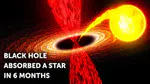
Black Hole Ate a Star Like Spaghetti, Watch What Astronomers Saw
About this episode
Get every episode summarized
Each time Bright Side Universe publishes, we email you a written briefing from the transcript — the topics, who appeared, and any specific claims, with the ad reads skipped.
Email me new episodesFree for 3 shows. No card needed.
Hosts & guests

Transcript ready
178 searchable segments. Every word is indexed and playable.
Full transcript
Bright Side Universe — Black Hole Ate a Star Like Spaghetti, Watch What Astronomers Saw. Machine-transcribed; use the interactive transcript above to jump the player to any line.
You've been there, settling in for an evening of TV only to waste half the night scrolling. Enter Fire TV, entertainment with zero effort required. Fire TV serves up personalized recommendations from across all your apps. Not sure what to watch? Just tell Alexa Plus what you're in the mood for and she'll pull up the perfect recommendation. Problem solved. Stop the scroll, start the show. Find what you're looking for with Fire TV. This may be required. To see one of the most significant astronomical events of all time, we go to South America.
In the Atacama Desert, Chile, we find the most advanced technology for space observation. Here, the Royal Astronomical Community Members watch for six months as a black hole simply absorbed a massive star. By the way, these are the same scientists who prove that in the center of our Milky Way Galaxy is a super massive black hole and even took a photo of it. For the first time in history, this incredible event happened very close to Earth. Well, the distance of 215 million light years is considered quite close in astronomy terms anyway. Light from this event reached our planet in September of 2019 and even the most experienced scientists dropped their jaws and surprised. Imagine a star the size of our sun, about 860,000 miles wide. Such stars have enough weight to create a strong gravitational field holding many planets in their orbit. And now, let's place a giant black hole next to it.
The hole is absolutely black, shaped like a disk and weighs a billion times more than this star. The force of its gravitational field is incredible. One can leave its gravity force. Objects that can move at the speed of light will still fall into this black abyss. Even light itself cannot escape its boundaries. As soon as a star enters the gravitational field of a black hole, it has no chance. At first, it tries to resist the pull of the black hole. Still, the star's outer layers begin to stretch toward the black hole, just like spaghetti. This is due to a powerful force of attraction. If you had the opportunity to extend your hand toward the black hole, you would see your fingers begin to stretch and elongate. This is because the force of attraction increases with every inch. Therefore, it acts strong. Exima is unpredictable, but you can flare less with eggless, a once-monthly treatment
for moderate to superior eczema. After an initial four-month or longer dosing phase, about four and ten people taking eggless, achieved itch relief and glare are almost glare skin at 16 weeks. And most of those people maintain skin that's still more glare at one year, with monthly dosing. Empless. Libri Kizumap, LBKZ, a 250mg per 2mL injection, is a prescription medicine used to treat adults and children 12 years of age and older who weigh at least 88 lbs or 40kg with moderate to severe eczema. Also called atopic dermatitis that is not well controlled with prescription therapies used on the skin, or topicals, or who cannot use topical therapies. Empless can be used with or without topical corticosteroids. If you use if you're allergic to ebgless, allergic reactions can occur that can be severe. Eye problems can occur. Tell your doctor if you have new or worsening eye problems. You should not receive a live vaccine when treated with ebgless. Before starting ebgless, tell your doctor if you have a parasitic infection. Ask a doctor about ebgless and visit ebglus.lily.com or call 1-800-LilyRX or 1-105-4-5-5-9-7-9. Kayak gets my flight, hotel, and rental car right. So I can tune out travel advice that's just plain wrong.
Pro sky coin, way better than points. Never fly during a Scorpio full moon. Just tell the manager you'll sew instant room upgrade. Stop taking bad travel advice. Start comparing hundreds of sites with Kayak and get your trip right. Bad advice. You talking to me? Kayak, got that right. Hunger on your fingers than on your arm. That's why this process of pulling objects into a black hole is called spaghettification. The first thing to be sucked into the black hole is the star's crown. This is the outer shell of the star, which consists of hot plasma. You may notice how the star begins to shrink inside. This is because that plasma makes up most of the visible side. When this hot plasma spaghetti reaches the black hole, it may appear to remain on the disk's edge and continue to orbit the black hole. But in fact, there is no turning back anymore.
The star's particles have already hit the event horizon of the dark abyss. The gravitational field of a black hole bends light around its edges. So the event horizon looks a bit like a quesant for the observer. Boy, lots of food metaphors here. I'm getting hungry. You may also notice a kind of chaos in this ring, as if some light particles are moving in one direction and others and another. This happens because of a mirror effect. But you can be sure that whatever reaches the event horizon will sooner or later be pulled into the singularity or the black pearl of the black hole. Another illusion you spot is the star particles in the event horizon moving slower. The truth is that supermassive objects, like a black hole, curve space time around them. And the more massive the object, the slower time flows near it. If you hang one watch beside a black hole and another on a wall in your bedroom, you
will see that the second hand in the first watch barely moves, while a whole day passes on Earth. As observers, it seems to us that the particles of light have slowed their movement. But in fact, they may have already been absorbed by the black hole ages ago. Now massive streams of red-hot plasma splash into space, just like spaghetti sauce. When a black hole has absorbed star material, it emits powerful rays of energy at a rate of about 6,200 miles per second. This release of energy is accompanied by an intense flash. As thanks to this flash, scientists can even detect this process in the first place. This phenomenon can be observed when a supernova explodes. When nothing remains of the star's body, we can still see star dust and other particles in the black holes of an horizon. Kind of like the Parmesan cheese sprinkled on the spaghetti. Hey, stop me if I'm taking this too far.
When the process of spaghettification is completed, about half of the star's weight has been thrown into outer space as dust and glowing particles. The other half was entirely absorbed by the black hole. The scientists observed this process for almost six months. But what would be more interesting is to dive into a black hole yourself. Well, we can't do that yet, but we can simulate this process. Here's a little drone, our metal friend. Kind of like a meatball. No, I haven't had lunch yet. Right now, let's head us. This episode is brought to you by Nespresso. Introducing Virtua Up, the latest and a long line of innovation from Nespresso. It's innovation you can touch, sense, and taste in every single cup. With a three-second start, easy open lever and dedicated brew over ice button, it's even easier to enjoy your coffee your way. For yourself, shop Virtua Up exclusively at Nespresso.com.
Safe distance from the black hole. The length of about three widths of the event horizon. Objects at this distance can orbit the black hole safely, a little closer, and it'll be swallowed up by a dark infinity. So our destroyed star could have safely existed at this distance. Moreover, planets can live at this distance. But if there is a suitable source of light and heat somewhere nearby, life can exist on these planets too. But our goal is the singularity, and we guide the meatball, I mean the drone, closer to the event horizon. After a few minutes, the force of attraction begins to strengthen, and the drone starts to stretch like spaghetti. When it begins spinning around the black disk, it means it has reached the event horizon and has started its descent into the black of this. Now let's look at everything from the drone's perspective. All the light from the stars that it sees becomes blue. This is called gravitational blue shift.
As it falls into the black hole, its gravitational field pulls the photons of light down, giving the energy. Their wavelengths grow shorter, so the red photons change into blue. The drone continues to fall and is already completely hidden from our eyes. And all that the robot sees is a bright, thin blue beam. Now it's in complete darkness. There's absolutely nothing here, not even time. Here time goes so slowly that our entire solar system could grow old and cease to exist during a minute spent in a black hole. But our drone will live until its battery is empty. Hey, the drone sees a small bundle of light again, and is getting closer and more prominent. Now the drone will experience the same fall only in reverse. Once the drone leaves the singularity, the heart of the black hole, it will be on the event horizon once again. The light from the stars gradually changes from blue to red.
Then the drone is thrown into outer space, perhaps in some far away galaxy. Well, returning from a black hole is just a theory. Some people think that black holes are a kind of wormhole that can lead us to distant places in space. But so far, these theories are considered fiction. Black holes are quite challenging to detect. The problem is they are, well, black, just like space. They don't emit light like stars, so they can only be detected by gravity anomalies. Despite this, scientists believe there are a vast numbers of black holes in our universe. They're born when a massive star collapses under its own weight, and given the infinite number of stars in the universe, black holes are probably a common phenomenon. Scientists believe black holes have their own lifetimes. This is because of hawking radiation. A black hole loses mass, and so, to continue existing, it has to absorb massive objects
like the star we just watched. But if the black hole lives in deep space, it has less to absorb, and will most likely begin to shrink until it just disappears, like this plate of spaghetti. ever seen a musical so good you didn't want it to end, like you could live inside it forever. Then you're going to love Schmigadun. Get your one-way ticket to Broadway musical paradise! If you ever felt trapped at a musical, like you literally couldn't escape, then you'll hate to miss Schmigadun, because you'll never want to leave, and you can't. But the important thing is, you'll never want to! Get tickets at SchmigadunBroadway.com
More episodes
More from Bright Side Universe

Solar Eclipses That Changed Human History Forever
Bright Side Universe
Our Solar System Is Doomed Because of This Star
Bright Side Universe
7 Ancient Sites Some People Believe Were Built by ALIENS
Bright Side Universe
What Changed the Moon Forever? The Incredible Event That Shaped It
Bright Side Universe