Loading...
About this Episode
Emeritus Professor Darryl Jones from Griffith University has spent decades researching our relationship with wild birds and joined Philip Clark with advice for listeners to Nightlife.
Hosts & Guests
Transcript
ABC Listen, podcasts, radio, news, music and more.
If you're someone who likes to feed the birds in your back yard,
new developments in Australia's bird flu outbreak might make you think twice about the habits.
Research led by Griffith University suggests up to half of Australians like to feed wild birds.
But experts are warning that bird feeders can bring large numbers of birds into close contact,
potentially creates ideal conditions for disease to spread.
The stakes might be getting higher.
H5 bird flu has now been detected in mammals in Australia that raises fresh concerns about how widely the virus could move between species.
So should we be rethinking the way we feed wild birds in our own backyards and could a well-intentioned habit be helping the virus spread?
These are things that we've put to emeritus professor Darryl Jones from Griffith University who has spent decades researching why people feed wild birds and the effects on birds.
He's also the author of feeding the birds at your table a guide.
He's with us now Darryl good evening to you and welcome to Nightlife.
Thanks Bill.
Based on your research, how many people do you think regularly feed wild birds in Australia?
Well, we've got data from all over the country now.
It's about between 38% to be absolutely accurate and 52%.
So let's say a third to a half of the people in Australia regularly feed birds.
About a third of them feed them every day.
There's a lot of birds and a lot of people involved.
Yeah, so I suppose I'm really surprised at hear those sort of figures.
I am surprised actually.
So say them again more than...
Well, about a third of households, a third to a half of households in Australia, all across the place, from one to birth, you know, Melbourne to everywhere else.
This is a really common thing for people to do.
Everybody seems to know that you shouldn't.
Yeah, I look, putting H5 bird flute to one side for the moment, is it intrinsically a bad thing that this is happening?
No, it's not.
I've gone from being an avid anti-feeder, you know, a rabid anti-feeder to somebody who's now promoting it as much as I can.
And because of the way we allows us to easily and simply and cheaply connect with nature, you know,
to have a wild bird just come in for no reason at all except that you put out a handful of food to come and visit people, visit you.
It can be a really profound experience and it's really important, I think.
So that's why there's such a sad moment at the moment for me to say, maybe we need to rethink this at the moment just while this bird's around.
It's important to stress this, isn't it, that as far as I understand it, that people...
I mean, if you put out seed for parrots, for example, it's not as though this is their primary source of food, is it?
No, or is it really important to know that?
No, a lot of people put out the food and I think the single-handedly keeping the whole ecosystem going.
That's right, they're keeping this bird alive.
That's right.
But what they need to know and everybody needs to know is that the food that they take from your place is nothing more than a snack.
I like to think of it a tim-cam and a cup of tea with a friend.
Within, grab a thing, how you going off the go.
Thankfully, less than 10% of their diet comes from these things.
This is the birds that visit feed it.
Most of the food they get is the natural way, which is really important.
What's concerned about the birds?
If I stop feeding tomorrow, are they just going to die of starvation?
Well, of course they're not that silly.
They're being from millennia.
But what we do is we do something really artificial.
We put the food in one place, replenish it every single day.
There's no equivalent of that nature anyway.
We've gone from this location.
They have to move on to the next one.
They're going to find something somewhere else.
Gee, where's Darryl?
You're saying they're not loyal.
Dear idea.
Yes, I know.
You're a lot of counselling to people saying, Mrs. Smith, look, I know that you're single-handedly keeping this family,
magpies alive.
But I probably hate to break it to you, but there's six other old ladies in New York Street doing exactly the same thing.
It's also what people are feeding birds.
There are good and bad things you should be putting out, aren't there?
Oh, yeah, absolutely.
No, that's the problem.
Should you put out mince for corkabarras, for example?
You shouldn't put out mince for anything we've now known.
Mince doesn't have enough calcium in it.
It's a really bad sort of food.
It's convenient, I don't know, convenient and cheap.
And magpies are the most fed bird in Australia.
And most people feed the meat.
But it's really bad stuff because it doesn't have enough calcium.
And if they eat too much of it, they can lead to all sorts of problems if you don't have enough calcium.
They start with drawing the calcium in their body.
What's the best thing to feed a magpies then?
Well, at the moment, until they come and they're working on it, I know they're a fact.
You're working on, you know, you'll be able to go to the pet store in a 10-year time and probably buy magpies food if you want.
Magpies mix.
Magpies mix or magpies meals or whatever.
Just at the moment, it's best to feed them dry food, dry pet food.
Because at least with the pet food, it's all balanced.
It's balanced.
It might not be specifically for birds, but it's a lot better than mince.
I was at right.
So I want to say dry pellets.
Dry dog pellets.
Dry dog pellets.
Dog or cat pellets.
Dog or cat food, yeah.
It's made for animals.
Right.
And it's much better than mince.
Okay.
Now tell me about H5 bird flu.
Now this is a concern, isn't it?
Because tell me why right now you probably should be thinking of not feeding birds.
And if you've got a bird feeder, we're getting rid of it.
Yeah, the good news is, the thing the magpies are probably the least likely bird to ever get catch this thing because they hate everybody else.
Right.
Or the magpies, they have nothing to do with them except when they're fighting.
So most of the time it's going to be a really big problem with colonial birds, you know, like sea birds and water birds again.
And water birds get together in big groups and that's there.
The place.
Well, by colonial birds, you mean birds are getting to colonies.
Exactly.
Absolutely.
Yeah.
They're the ones that most separate because in those densely dense areas with lots of the birds all together.
That's where they're going to be.
They'll be able to share that disease amongst themselves with magpies coming.
But this is just, you know, because it's not just the magpies that come.
If you've got a magpies, I've mentioned a few times now already.
That's common bird.
But you know, magpies often have cookware and butch birds and caroons and all those other things.
Meadage is coming.
But if you're putting out seed, you can have a dozen different species coming all together or mixing.
You know, if any of those birds are sick at all, they don't have to be just birds with any sort of sickness.
That's the obvious place for the spread at your feet.
So how does it spread between birds anyway?
Well, we're not entirely sure.
But it's a really it's the.
It seems to have just come in direct contact, you know, like fighting, fighting and eating.
Well, big, big to beakers of work.
It's big or saliva or in water.
Right.
We know that it lasts pretty well in water.
So that means we also have to think about our bird bars.
Yeah.
Yeah, gee, that's that a lot of people would not be taking that that world, they're because.
Not at all.
Because bird bars in gardens are commonplace, aren't they?
Birds, birds, like.
Yeah.
So what I'm doing now at the moment is trying to people, what are we going to do about this?
If you can't, you know, it's the best thing at the moment is to stop feeding altogether.
Right.
But don't stop putting out water for a start for a thing.
I mean, it's going to be a hot dry summer by all accounts.
We have to make sure that the water is there and just clean it out all every day, you know,
wash it out thoroughly, scrub it down and make sure it's clean.
Oh, as long as you're doing that every day, it'll be fine.
So if you're going to feed the birds, take the responsibility of feeding them.
You've got to make sure that you clean that spot where they're coming every single day and never put out too much food.
So two things, don't put out too much because it's not all the food they need.
It's just, it's where the beneficiary is, not the birds, to come and visit us.
And that's a wonderful thing.
But if we're going to, you know, if it encourages lots of foods to mix and the wood wouldn't normally be mixing,
then that's what we're really worried about.
So if you're going to do it, limit the how much food and then also clean it, clean it down really thoroughly.
Right.
You say, Meg Pies, I'm not very susceptible to getting birds.
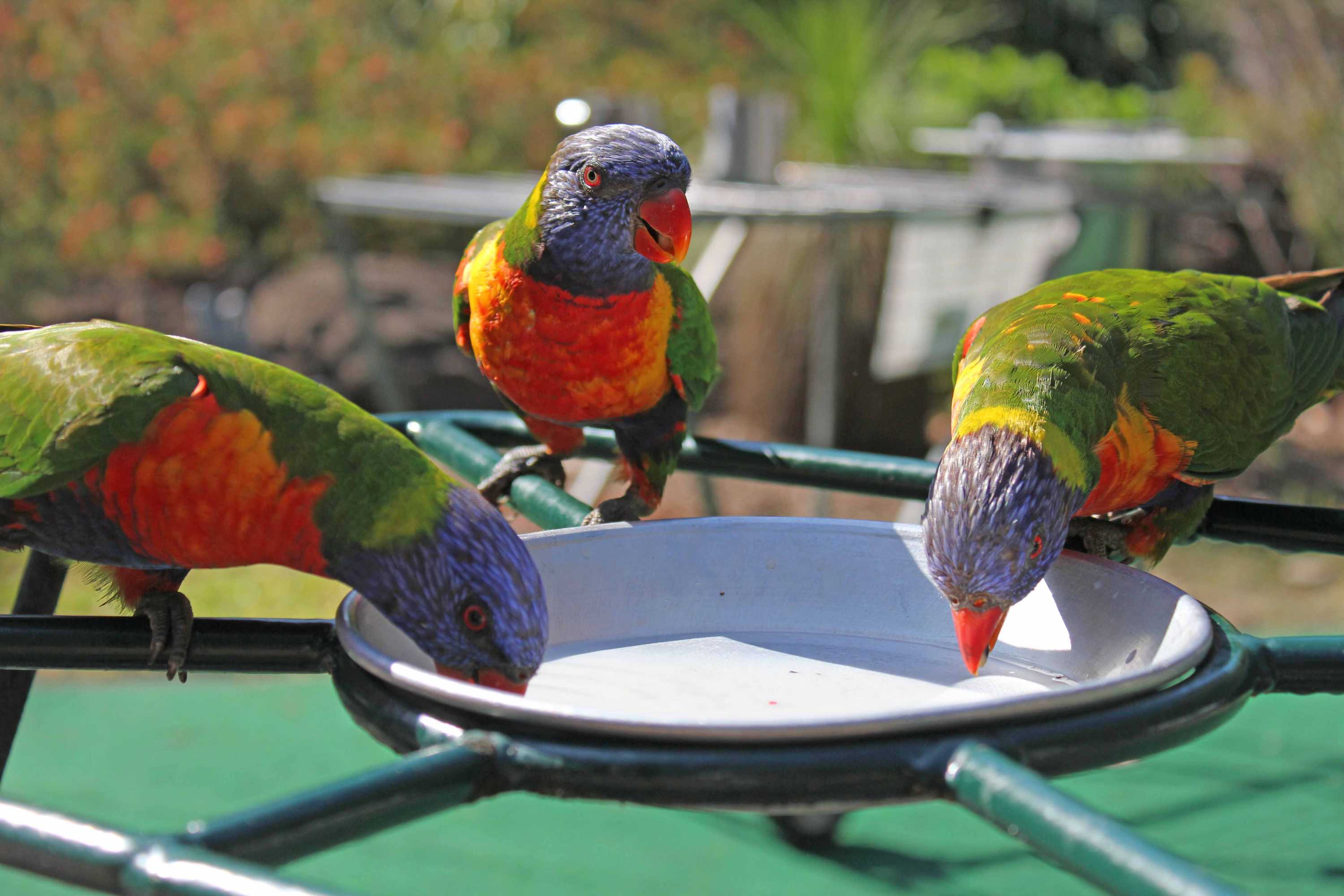
So what about our glorious parrots?
Yeah, well, rainbow orchids get around in big groups.
I suppose they do.
Yeah, they do.
Yeah, they're, they're worried.
Well, we simply don't know.
It's all happening so fast and so rapidly.
And it was real concern.
And especially this mixing with getting into the mammal population with its seals and adulthood now.
Why are they, why are they catching it?
Are they eating the birds or is it just contact with the bird?
I think it's, we don't exactly know.
But it's probably just the contact.
But anytime when birds die, you don't even see a dead bird because they're so flimsy,
you know, their skeletons are really light and they're made of feathers and they just vanish really fast.
They just speak a perfectly quickly.
But when you see a whole lot of dead birds, that's one of the things you need to do.
If anybody sees a whole lot of dead birds, just to make sure it's not dead birds,
certainly don't touch them.
But report that to a vet and the vet so now I've got a big network to talk to each other
and get all the information I can.
I mean, for people who genuinely feed birds because they genuinely care about them
and they enjoy the connection with nature, you're saying,
well, I mean, can they continue enjoying this without feeding them?
Yes, I hope so. I hope they can.
I mean, this has been my mission now.
Everything I write and write lots of books and things.
It's all about connecting with nature and here I am telling people not to.
In such an easy and well, so it's a tough, tough time for it to be around at a moment.
But you can do it. I mean, you can still enjoy them.
And that's why I'm saying you can still put out.
If you put out a handful of seed and you just have a half a dozen birds coming,
and not mixing very much, that's okay.
You know, and the types of things that we get mostly coming to our neighboring neighborhood,
suburban setups with her feeder,
not sort of the ones that are most likely to have this bird flu.
But if you had, you know, when it gets into the pigeon population,
and here I'm only being Melbourne now, these things are like, you know,
now that it's in the Silvergill population,
to see girls there everywhere,
kind of the MCG unit, thousands of them, fly, flying around.
You just think how many of these have got the bird flu?
Got the bird flu.
Yeah, she was.
Because what do you think is going to happen, Darryl?
The Australia is one of the last places in the world to get this thing.
And we can't stop it. We know that.
And trouble what you get it.
It's almost 100% mortality rate, which is terrible.
I'll give you, you will die almost certainly if you're a bird.
So it's pretty bad.
Now, I think it's going to be a, we're in for a catastrophic time.
Maybe just next couple of years.
How long has it got to last, do you think?
I have no idea. We really don't know anything about this.
But so we're scrambling.
And the, I have to say, the government is not doing a very good job
getting ready for this.
Because we know what they actually do, though, Darryl?
Well, what they're doing at the moment is down here in Melbourne, they're starting to vaccinate
their little penguins because they're one of those from around here.
You know, little penguins are a classic seabird that colonizes, gets around in groups.
And so they're going to be really susceptible. We don't want them lost.
The little, little bushbirds are mostly going to be fine because they don't get rid of it.
You can't vaccinate wild birds, can you?
Because there's no practical means of doing something.
No, no, no. But you can, you can, like the colony's colony's a penguin.
You can think, you can imagine doing that.
But yeah, for the others, I don't know. There's nothing I can do about those.
Yeah, we just, you see, we got it. Do you think some species are just not going to survive?
Yep. I think I'm afraid that's the case.
We've got too many birds close to the edge of the extinction already.
And if they get nailed, you know, they can't cope with, with a whole lot of mortality.
Are there any birds that don't get it?
Oh, we don't know yet.
I mean, I can say pretty much the majority of birds won't have a chance.
One get it. One, one, one, be killing everything.
We can already predict which one is as hurtable.
Some reason I don't understand. Black swarms are a real concern.
They seem to be incredibly susceptible to this thing.
And other bird flu type diseases.
What about coca-barrots? Do they get it?
They could get it. But how would they get it?
You know, they're not going to be, I guess they could be, yeah, I don't know.
If they don't hang around with other birds today.
Well, they don't. But one, one way they could get it is if there was an infectionist bird came and ate some meal, you know, at a feeder.
And then the magpies came down and took what it was left, not the magpies, the coca-barrots.
That's when they could get, it could be caught there.
Hmm.
Most of those, most of them are familiar with bushbirds, they're not going to be served.
What about really endangered birds like the swift parrot and things like that?
Well, yeah. I mean, the good thing for those, the only good thing about it is that they're so few of them that they have much chance of catching this thing.
But they don't like each other, so they keep away from one another.
But flocking birds like self-acrested coca-toos, for example.
Oh, yeah, absolutely. Waiting for it.
Covages and gullars and corral as all those birds with gang, gang, gang, gangs and all those beautiful birds.
So why isn't it, might there be some side benefit in the sense that it might clobber the Indian minor population, which is a new species bird?
Probably if it got into the minor population name, we see everybody.
So I think you've been spreading it white and it's only problem.
I'm trying to, I'm desperately trying to look for, as you are, you know, something positive to come from this.
And I'm not sure there's going to be many, many problems.
So in short, we're done a hellongers going to last, but it's going to last for some years, you think?
It's going to be last some years, there's going to be a lot of bidet, some of right?
Yeah.
Darrell, I'd like to say, I'd like to say great to talk with you, but I know it's not a big, big, populate but good conversation.
But in the meantime, in the meantime, probably don't, probably stop feeding birds.
And if you do, if you do, yeah, that's right.
If you can, stop it. They don't need it.
They might, they'll probably complain and start knocking on the window and say, where's my tuck for the day?
Could you switch the years, probably?
Not too much food.
Make, if you're going to clean, if you're going to feed and lots of people will anyway, make sure you just keep it really clean.
And space, and maybe space it out on the, on the, on the bridge.
Space it out, absolutely. Yeah, space it out.
Because what you're trying to do is minimise the contact with, with the birds.
Yeah.
You know, with the birds.
And of course, this immediately makes me think, worst thing we can do is to hand feed a wonderful experience when you do it.
Yeah, because it's such an intimate thing to do with a wild bird.
But that's, that's asking for trouble, everyone.
Yeah.
All right.
Darrell, let's, let's hope for the best, but as you say, outlook is not good.
Appreciate your time. Thank you.
Thank you, home.
See you.
I'm Eritas Professor Darrell Jones from Griffith University.
You've been listening to a Nightlife podcast for more great conversations about the issues that impact you,
as well as features on travel and food, head to the Nightlife webpage.
You'll find it at abc.net.au slash nightlife.
You don't need to be a night owl to enjoy the nightlife.
You'll find it at abc.net.au slash nightlife.


