About this episode
An iconic cartoon character liberated from copyright, journalism from the world of competitive spreadsheeting, a controversial piece of US currency. Each year the Planet Money team dedicates an episode to the things we simply love and think you, our audience, will also love.
In this year’s Valentine’s Day episode:
- The Public Domain Day list from Jennifer Jenkins’ of Duke’s Center for the Study of the Public Domain and her colleagues.
- Jesse Dougherty’s article “Between the sheets at the college Excel Championship” which is behind a paywall. Here is Jesse’s substack.
- 404 Media’s excellent journalism on the tech that ICE is using
- An ode to the language of the penny, including songs like Pennies from Heaven.
- The only self-check out that doesn’t waste your time.
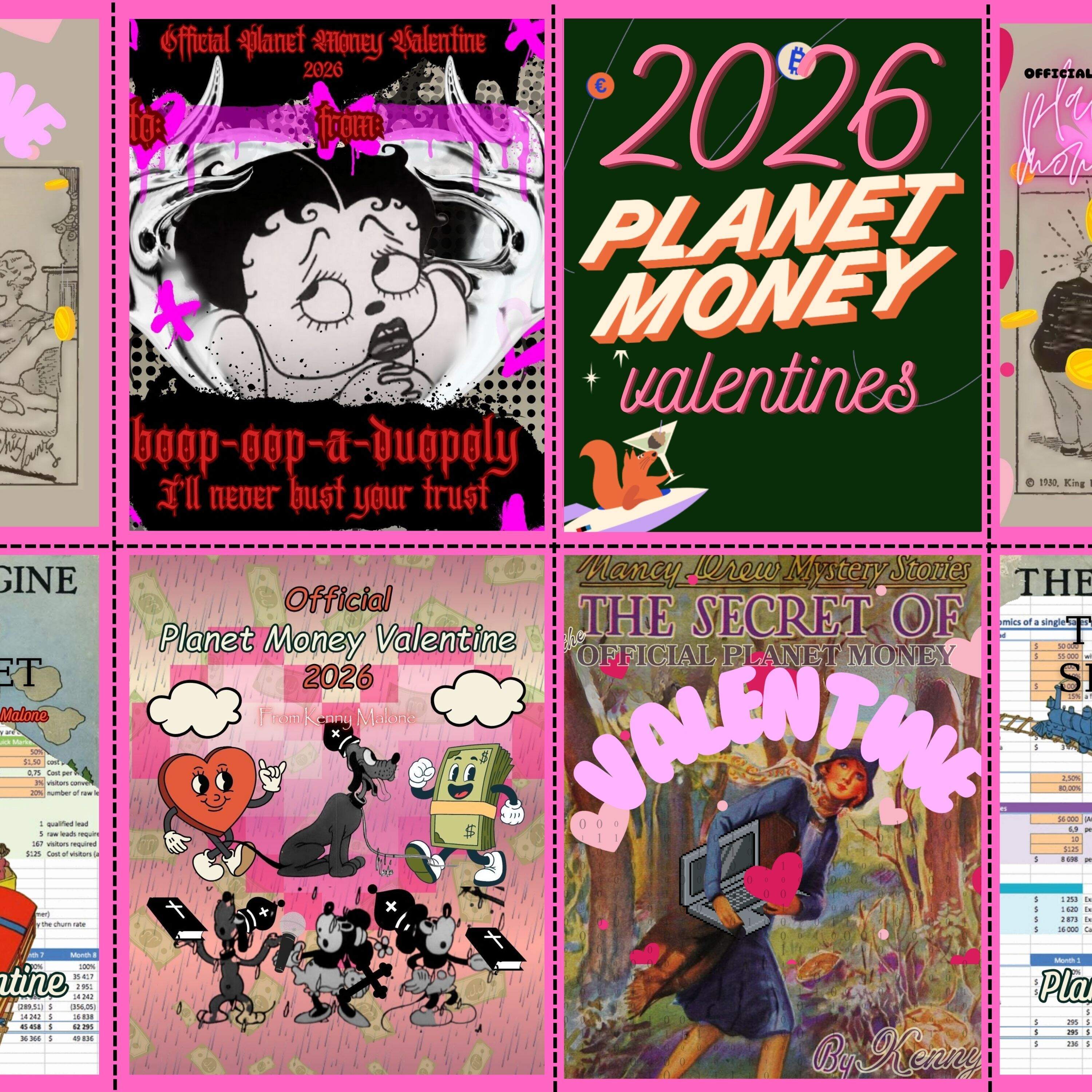
- And we made public domain Valentine’s cards.
Download THE OFFICIAL Planet Money valentine here.
Pre-order the Planet Money book and get a free gift. / Subscribe to Planet Money+
Listen free: Apple Podcasts, Spotify, the NPR app or anywhere you get podcasts.
Facebook / Instagram / TikTok / Our weekly Newsletter.
This episode of Planet Money was hosted by Kenny Malone. It was produced by James Sneed with help from Sam Yellowhorse Kesler, fact-checked by Sierra Juarez, engineered by Cena Loffredo & Kwesi Lee, and edited by our executive producer Alex Goldmark.
See pcm.adswizz.com for information about our collection and use of personal data for sponsorship and to manage your podcast sponsorship preferences.
NPR Privacy Policy
Get every episode summarized
Each time Planet Money publishes, we email you a written briefing from the transcript — the topics, who appeared, and any specific claims, with the ad reads skipped.
Email me new episodesFree for 3 shows. No card needed.
Hosts & guests

Transcript ready
784 searchable segments. Every word is indexed and playable.
Full transcript
Planet Money — Betty Boop, Excel Olympics, Penny-isms: Our 2026 Valentines. Machine-transcribed; use the interactive transcript above to jump the player to any line.
This is Planet Money, from NPR. So Jennifer, you got what I sent you, yes? I did, it's the greatest mystery of the year so far. This is Jennifer Jenkins, lawyer, professor. You may have heard her before. She's become sort of an official trademark and copyright attorney here at Planet Money. And what I sent her is inside a large yellow envelope. You want me to guess? You want me just to open? No, just go ahead and open. I love surprises, Penny, so just this is like, oh, this is loud. Every year, we at Planet Money send valentines to the things we love this year to innovative reporting on ice, to the sport of competitive spreadsheet, to perhaps the only beloved self-checkout system and more. And typically these are not physical valentines, they're shout-outs in a valentines episode, such as this, chock full of big ideas and recommendations that we want to share with you all.
But, for my first valentine, two Jennifer Jenkins, we had in fact made a bespoke physical valentine. What? Oh my God! Yay! Do you want to describe it? I need a moment. Oh my God. Okay, fine, I'll describe it. Red and black font. That's a little tattoo motorcycle style. It says official planet money valentine. And then a famous cartoon character that, for reasons, we are not going to get sued for using. And that character also happens to be one of Jennifer's favorites, Betty Boop. Happy valentine set. Oh my God. Okay, so, okay. No, I know you love Betty Boop in particular. Oh my God, so much. Explain why you have an affinity for Betty Boop because she is one of the first comic book characters who was not defined by her relationship to a male character. So many mouths says Mickey Mouse's girl. All of well is Papa's girl. Betty Boop's just her own woman. She's fiercely independent.
She's unapologetically sexy. She dances around. She sings. Boop, boop, boop, boop. I have to have boop, boop, boop, boop, boop, boop, boop, boop, boop, boop, boop, boop. Betty Boop debuted in this cartoon in 1930, 95 years ago, which means, as of January 1st, the copyright has expired. Anyone is allowed to use this version of Betty Boop for anything. This version, by the way, literally a dog person hybrid, which is very weird and would not always be this way. But yes, this version from 1930 is now in the public domain. And the reason I knew this is because every year, Jennifer Jenkins helps put out a list of all the famous books and songs and cartoons entering the public domain. And that, that is my first Valentine. To Jennifer's annual list of newly liberated intellectual property, the public domain day list, where you will learn that the copyright has now expired on the book, The Maltese Falcon.
The song, Georgia on my mind, the Academy Award-winning film, All Quiet on the Western Front. And yes, Betty Boop. Enter iconic catchphrase, although Jennifer has noted something odd about what we've written on her Valentine. Is Boop Boop a question mark? Yes, we're going to get to that in a second. Because first, the reason I wanted to give a Valentine to this list is because it feels like all of these works are now flooding into the public domain in a somewhat novel way. And that is because for 20 years, leading up to 2019, basically nothing entered the public domain, legislators with lobbying from Disney, kept extending the length of copyright. Right, literally the public domain was frozen for two decades. And so all of the material that was set to go into the public domain from 1923, we had to wait 20 years for it to finally start entering the public domain in 2019. And that's why you're hearing about it so much, because now the gold poster where they
are in every single year, you can expect a trove of material to enter the public domain. And I mean, and you can find out about it from my Valentine, the public domain day list from Jennifer Jenkins. I can't tell you how tickled I'm trying to find the right word. That's what my grandma's way said. I'm like, just tickled about this Valentine. Oh my God. So are you going to, you haven't explained the question mark yet? Ah, yes, the Boop Boop a question mark. Happy Valentine's Day and welcome to Planet Money. I'm Kenny Malone. Today on the show, the things that we love and that we think you will love. Nick Fountain brings us investigative reporting that you can do at home as well. Eric Amaris makes a case for the love of her life, the one that got away, the US penny. And along the way, together, we will all design the first ever official Planet Money Valentine's Day card that you can print out and give to the nerd love of your life.
We're going to finish our Betty Boop Boop a question mark Valentine by coming up with a pun to make the economist in your life swoon, although it turns out it will be a bit of one. Boop Boop. But do we, I don't actually know how to say it, but as a French economist who is like, no, let's not do that one, right? Okay, no. This message comes from Capital One. Capital One offers checking accounts with no fees or minimums. What's in your wallet? Capital One's Applied. See Capital One dot com slash bank for details. Capital One NA member FDIC. This message comes from Odoo. How many streaming subscriptions do you have? Is it the same for your business? Avoid it by having all of your business on one platform. Try Odoo for free at odoo.com. That's odoo.com. Welcome back to a very special Valentine's Day episode at Planet Money. Lots to do here. Jennifer Jenkins and I, we're kicking around ideas for how to take the newly public domain
Betty Boop, tweak her catchphrase, and make the official Planet Money economics-themed Valentine. Boop Boop, but dumping. Dumping is something that's an international trade thing, right? Yeah, it's an international trade thing. It's when you sell a whole bunch of stuff cheaper, right? Yes. Yeah. I do feel like dumping is maybe the wrong, it's like not the right, okay, okay. Meanwhile, my colleagues have their own traditional Planet Money Valentine's to hand out to the things that they love and want to share with you all at home. Hey Kenny. Hi Jess. Jess Zhang, senior supervising editor at Planet Money, and if you love an episode of our show, it's probably because of the notes that Jess gave. If you hate an episode, it's probably because we ignored notes that Jess gave. And Jess has brought a Valentine very near and dear to my heart. I think you and I have a special love for spreadsheets. Love spreadsheets. And it's so particular to us that I feel like sometimes I don't even want to talk about
in a meeting because I'm like, everyone else is going to be bored by whatever love for spreadsheets we have. Yeah. Jess, I couldn't be more excited. Yes. Okay. So this Valentine is actually to a Washington Post article that I saw recently, and it's all about Microsoft Excel. That article was written by reporter Jesse Dockerty. The headline made me blush a little bit between the sheets at the College of Excel Championships. A little too naughty for my taste, but very, but very clever. I thought we were going to skip over that. No. I had to talk about that. People need to find it so they could search for it. Sure. Okay. So I saw this article and it's all about Microsoft Excel. In particular, something called the Microsoft Excel collegiate competition. And so it's an annual competition that happens around Christmas time. This year it took place in Las Vegas. And basically there's two parts of the competition. Yes. It has semi-finals, finals. It has the whole rigmarole. And looking at the photos and pictures and videos of it, it looks like what I imagine
eSports video game competitions to be like. So like by the time it's won't want eSports competitions to be like quite honestly, sells, this is lots of, yeah, it's amazing. Yeah. So by the time you get to the semi-finals and finals, there are people on a stage and their screens are projected in the background so everyone will watch. And it's basically a series of puzzles that people have to go through. Yeah. And so I saw one puzzle was like planning a group trip with 500 of your closest friends. That's very good. So I think there are all sorts of things where it's sort of like how do you use Excel to do these things. And I think for me what I loved about it so much was like, oh Excel is like a language. It's a really powerful tool if you can understand the language. And this is maybe the most extreme kind of highest form of this language is watching these
people use it. And I think this article got that to a large degree. I did do a little background research and anticipation of this. Now, a lot of these competitors are finance majors, it says, make sense. Those are like often very complex formulas you need to learn and so it would attract that kind of person. But do you want to guess in what industry Excel is reportedly used the most? Oh, and it's not finance. Nope. Oh my God. It's not something mundane like accounting. It is manufacturing. Manufacturing. I can see that. I can see that. And it makes sense. It's a very intuitive program. It's very user friendly. So you don't have to have a master's degree to use this, which is like it's the best. One of the great things about reading this piece in particular is it treats these Excel experts with the sort of elevated regard that you and I are just all in for. It's not a joke. It's like truly in awe of these people's skills, which I am as well.
And it's so good. Yeah. I looked into the reporter who went his coverage is mostly of college sports. And so I really liked that he took the same like excitement, vigor, all of the things, the rigor that you would take to college sports and applied it to this scene and took it as seriously as everything else. And so I think that really comes through in the article that he wrote. Yep. Sports coverage is useful in many, many disciplines. I think. That's true. That's true. And I guess we should say that that kind of excellent sports coverage is the kind of thing that the Washington Post has just decided to eliminate almost entirely. But yes, our first Valentine to Jesse Dockerty, his story, between the sheets, the college of self-championships, his extraordinary work by Jesse, check out the article, check out his sub-stack, which we will link to in the show notes. And thank you, Jesse. Thank you, Kenny. Thank you, Jesse. We begin this next Valentine with a quote from Forbes Magazine.
Quote, I can't wait to use that self-checkout machine, said no one ever. Retail stores have increasingly scaled down on hiring and paying human beings to scan our purchases, and instead are forcing us to do it as customers, slowly with constant machine problems that require an overworked human to come over and scan some card. Anyway, Forbes describes an exception to this, though. The clothing store Uniclo, Uniclo has developed a cult following for its self-checkout. Quote, you just toss all the apparel you're buying into the self-checkout machines container bin and miraculously, all of your items are automatically scanned. Apparently, this is because each item has a little radio transponder. Anyway, that is the background you need to know. For this next Valentine, our own Alexi Horowitz-Gazzy was walking through New York with a friend, remembered how much he loved Uniclo's self-checkout and hated other self-checkouts and recorded this audio Valentine on his phone. It's a rainy January day at the Broadway Uniclo store looking for that heat deck.
It's cold outside. I found a turtle neck. It's a full turtle neck. There is driving techno. Where are the self-checkouts here? Right in the back of the self-checkout. What's your name? Mel Ray. Oh, wait, sorry. Mel Ray, say your full name. Oh, my full name is Melissa Ray Bailey-Gale. How do you feel about these machines? How do I feel about the machines? Do you like them or are they going to know it? I like them, but people are annoying about them. They ask questions all the time. They're like, where are the bags? Really? Oh, okay. And it tells you that right here. I see. They're okay, I guess. I mean, I like that a bit fast. So I work for an economics radio show, and we have to give our valentines to things in the world. Give your valentines to them. So this is one that I've kind of thought about giving my valentines to for a long time. Do you need a little self-checkout? Is what you're giving your valentines to too? To technology no way. Is there something a little sad about that? Yes. Very much so. To technology, that's crazy. This one I see every day. This one that gives me problems. Do you want to give it to me?
Hey, okay. You just try to elevate that daily things in life. What would your valentine go out to? It would go out to me getting a promotion. If you all hear this unique, I'm promoting the technology. Give me a promotion. Excellent. It's true. You're going to move a lot of these products on this. Exactly. Thank you so much. Oh, self-checkout. There it is. All right. We're in line with the self-checkout. Wonderful. Oh, look at this. It's just silent. You just see rows, maybe like two dozen people in a silent row, communing with these plastic tubs that immediately extract their money from them. Okay, so we've got a sort of monolithic plastic bin thing. It's just like a big tub. Press start. Okay. Heat tech, ultra-warm. So it's just kind of like intuited magically just by standing next to this machine, what we have. It's just so confident. There's just zero hesitation.
Do you need any shopping bags? Sure. I hate to admit it. Something about it just screams love, you know? There's nothing more romantic than parting with your hard-earned cash. Unicle yourself, check out. Will you be my Valentine? Please, select the items in the scanning area. On your right hand side and press and start. I'm not gonna take that as a yes. Bye, Uniqlo. Happy Valentine's Day. Alexi Horowitz-Gazi there, who did ask me to clarify that he is, quote, not some sociopath who wants all humans replaced by machines. It's more like if there has to be self-checkout, you know? Here's one that doesn't create more of a mess at the checkout, that's his point. And I will add that Alexi's Valentine did prompt a whole lot of frantic research for some of us at Planet Money, wondering, why isn't every self-checkout this good? And why isn't my grocery store this good? And is Alexi paying extra for his Uniqlo
turtleneck because of this? And the answer seems to be that each item at Uniqlo, you know, it has this little RFID chip, a tiny little radio transponder. And those have become cheaper and cheaper. One McKinsey report says that RFID tags have come down from 20 cents about a decade ago to four cents a tag in recent years. And yeah, I mean, if you sell clothes like Uniqlo, like, what's an extra four cents to make your fancy self-checkout work? Especially if Uniqlo doesn't have to pay a cashier and customers move through it faster. But if you're a grocery store and you sell, you know, green peppers, an extra four cents on each pepper really cuts into the margin. So I wouldn't count on seeing this Valentine's worthy technology at the grocery store anytime soon. Meanwhile, back with my Valentine's Day co-pilot today and Betty Boop Stan, Jennifer Jenkins. We hungry, let me go back to my list. All right, those are top one. We are building the official planet money, Valentine's Day card, our task at the moment,
find a nerdy twist on Betty Boop's iconic catchphrase, something economic that isn't also, how do you say, horribly unromantic? Boop, boop, boop, boop, doom loop. Which is, do you know what a doom loop is? No, no. Doom loop is a self-fulfilling disaster tornado cyclone. Like how Greece had its credit rating downgraded, which scared investors, which caused all kinds of new problems for Greek finances, which made Greece an even riskier investment, et cetera, et cetera. So, you know, boop, boop, boop, doom loop, I guess. That's brilliant. And it also really captures the spirit of Valentine's Day. Well, yeah, no. Okay, okay. This one is, it doesn't rhyme as well. I'm gonna warn you, ready? I can do it. I think when you start to think about it, it's actually quite beautiful, ready? Okay. Boop, boop, boop, but doom loop. Oh, that's nice. Oh, you got it. You got it. That's the one. A doom loop is where two companies control a market,
a monopoly for two, if you will. And I think that's kind of like, I don't know, something lovely. Well, I mean, maybe not as a consumer, but like, metaphorically, because it's two together. It's not a monopoly, it's a doom loop. Yes. Honey, will you be mine and we'll own everything? Okay. Yes. Okay. Well. That's hot. After the break, we finish off our boop boop, but do happily, Valentine, so you can give it to the market dominator in your life. Plus, a Valentine to serious data journalism that you can do at home right now. This message comes from disparity. Excellence takes drive, work, perseverance. Tiger Woods brings it to the course. Inspirity brings it to your business. Want to be the best? Work with the best. Inspirity, how you HR matters. Learn more at inspirity.com slash tiger. For our next Valentine, I was simply sent a Zoom link
and told show up here. And so, I did. Trenton for a package. Hello. Oh, hey Kenny. Sorry, I was just jamming out to my favorite song. Music's playing. I forgot you were coming in. Happy Valentine's Day, Ken. This is just the music you were playing when it showed up. This is incredible. Yeah. Great. If the pan is from heaven for you and me, I come over here by. Well, it's very loud in my ears. It's wonderful. Turned it down for you. Well, it's funny that you mentioned pennies from heaven, Erica, because this is a phrase I only recently learned. Oh, really? Do you want to explain what it means? It's just kind of like your good fortune is going to come raining down from the sky. And it can only come in what is quite possibly one of the greatest currencies that we've ever all had the fortune of knowing. Clearly, we are now here with plenty of many co-host, Erica Baris, who is about to present her Valentine. I feel like we've walked right up to it.
Just go ahead and say it. Okay. My Valentine is for the one that got away. My one true love, the penny. You're one true love. Why, why, Erica? We are living in this like increasingly digital, bubbly, cloudy world. And the penny is one of the few things we have that is a link to the past that we can hold. And it makes noise. And it is just like, it's just a small, tiny little thing. It's just so nice. You get a hundred of them. You have a whole dollar. Who doesn't love a dollar? I mean. All right, you love the penny. Last year, it was announced that the Federal Reserve will, well, it's the treasure, right? Last year. It's going to stop minting pennies. So no new pennies. Okay, so it's not like they're going away permanently. They're not gathering pennies and burning them in a bonfire. No, no, no, no, no, they're good. They're good. If you have pennies, they're still tender. Yeah, yeah, they're forever indefinitely.
But it's not just that you love the penny. My understanding is, I think you love the culture around the penny, perhaps more than the penny. Yeah, I mean, you know, the penny is just a coin. Like, let's be real. But I love language, right? And there's all these like words and like phrases and expressions in our language that are built around the penny. Like, you know, penny for your thoughts. Then there's a, find a penny, pick it up. All day long, you'll have good luck. Yeah, good luck. I do like the luck part of the penny. Yes. Lucky penny, you have a penny, it's a lucky penny. I like the lucky penny. A penny saved is a penny earned. Have you ever heard the cost of pretty penny? Yeah. Yeah, that cost of pretty penny. Yeah. In for a penny, in for a pound. And then this one is, I love this one. Penny wise and pound foolish. That is my favorite one. I love that one. I think that's my favorite too. It's really beautiful. Yeah. It's true. So we spent, I guess, 250 years with the pennies
are smallest denomination. So the entire vernacular about- Actually, that's actually true. Because we used to have a half penny. We used to have a half cents. But we've had pennies for a very long time as our smallest denomination. As our smallest denomination, and therefore, whenever we reached for or created some kind of saying that needed to emphasize the smallest denomination, it's true. It's all built around the penny. And so I guess you're sad we're losing that. We're not losing that. You can still say your old sayings if you want. I guess, but who's going to appreciate them? We stop making the penny for two main reasons. One is, apparently, they cost a little bit more to make than they're actually worth. The US Mint is saying that this is going to be a savings of $56 million a year. So they cost more than $3 cents to make $1. So they are literally penny-pinching, I guess, is what's happening. And then our other reason. She want to hear the other reason? Please. The reason we got rid of the penny
is because people pay for everything with credit cards and phone payments and whatever now. Here's my question. Yeah. Will we run out of pennies before the sun extinguishes? Probably not. And I'll tell you why. You think we'll still have pennies? Yes, it's a medal. It's not going anywhere. Okay, yes, I mean, yes, so metaphysically, they will start. But I'm just saying they'll be lost in the proverbial couch cushions for eternity. That's what I'm saying. When will they fully be down sewer grates and buried in people's backyards in a way that they're unusual? I can guarantee that I will actually become an 85-year-old woman and pennies will still be in circulation. Will still be there? Yeah. Yeah. Hopefully I make it that way. Oh, yeah. Thank you. The pen is going over and over for you and me. All right, for our final Valentine. I had a little bit of spare time on my hands. I will say I'd been spending a lot of that time
on the list of public domain things newly available to mess around with. And I decided to make another special little Valentine to tee up this final segment. Nick Fountain. Hi. Planet Money Co-host. I need to give you something. Are you ready? Yes. Never been more ready. My Valentine for you, Nick, is ta-da. Nancy drew mystery stories. The secret of Planet Money Valentine, ba. The very first Nancy drew novel is in the public domain this year. So that's very exciting. And so as you can see, Nancy, this is actually a book about some sort of clock. But I've replaced the clock with a laptop computer. She's carrying a laptop computer. There's a lot of ones and zeros in the background. There's data because I know that your Valentine has to do with our love for the kind of reporting that is about following the data, following the money. It's the kind of stuff that we really, really get into. And so with that, Nick, I'll throw it to you.
Amazing segment for Valentine. Yes. Amazing segue. My Valentine goes out to the journalists at 404 Media, for their coverage of immigration and customs enforcement. And in particular, the technology that ICE has been using in this past year. Yeah, 404 Media is the name of the outlet. And I feel like they're probably, they should be, but they're not yet a household name, perhaps. And so it's probably useful. You want to talk a little bit more about them. Yeah, there are this new-ish outlet. Pretty small. They are owned by their reporters, which I think is pretty cool. Have sort of a retro internet vibe. Kind of not unlike Nancy Drew. So your new super retro internet vibe. Yes, yes, proto-internet. Yeah. Their design choices are not what I want to shine out though. It just seems like these folks have been training for this. Their entire lives. And because of that, they're firing on all cylinders. Like tech reporters, largely. They're tech reporters. And so what I want to shout out are their scoops, which are many and I am very jealous of. I find them, it's been really incredible.
And do you want to shout out a specific scoop? Yeah, I mean, it's probably they're reporting on Palantir, the data mining software company. And this app Palantir develop, which seems like it's sort of the Google Maps for ICE. According to their reporting, it compiles federal data and shows ICE neighborhoods that might be hot spots where lots of non-citizens are suspected to live. It shows potential targets on maps. And like if an agent clicks on one, it'll show a dossier about that target. By the way, we reached out to Palantir. They disputed this description of the software. They said it's a tool used to reconcile address data, data that's not theirs they wanted to be clear, but their customers. And while 404 is really secretive about their sourcing, they are very open about their techniques. So like a year ago, they had this little online training for their subscribers of which I am one. Hello there. Can you let us know if you can see us. About how they use public records to generate scoops. So this is a very old school system
for searching government, a federal government procurement records. Nick, do you want to describe what's happening in this video here? Yeah. So this is reporter Joseph Cox directing people to the federal procurement website, which is just a public site, basically listening, all the contracts, the federal government enters into. Just go to that search bar and just type in immigration and customs enforcement. And so Joseph is showing how an enterprising reporter can learn a lot about how a federal entity like ICE operates just by looking at the contracts its sciences from, you know, its janitorial services to its technological perpetrator. There you go. So click on that. Yeah, click on that. Then these are all the contracts for ICE. In other words, they are peering into this government database and then following where that leads them. It is, I guess one of the most basic things that journalists do, which is just a kind of accountability. Like where's our tax money going and why?
Exactly. And I watched that training and I was like, that's amazing. We need to do that. I need to do that. And then like many things in life, I did not do it. And they did it and they did a great job and I am jealous and I am grateful. You don't need to be hard on yourself, Nick, because now we've heard video of them doing it. So perhaps someone listening will also just be a part of this because look, we're all the public and the public has a right to lots of information and you should take advantage of that, Nick, or anybody listening, if necessary. Let this be an inspiration to us all. And check out their work. Where can you find that? For reformedia.co. Thank you, Nick. Thanks, man. We will make sure to post a picture of the Nancy Drew Valentine I made for Nick and a few others. You can find those on our Instagram. All right, that leaves us with one final task before we're done today. To finish up the official Betty Boop, Planet Money Economics Valentine's Day card so that you listener can print it out
and give it to the most important person in your life. So remember, picture. We've got a kind of tattoo style red on black font that says the official Planet Money Valentine, which we feel okay writing, because we're not going to get sued because we are using the picture of Betty Boop from 1930, which is now in the public domain. And it says, boop boop, a duopoly. We just needed one last touch, a little tagline to pull it all together and make this Valentine about love and market dominance. I brought our Betty Boop loving friend, Jennifer Jenkins, a few options to choose from. Is this the taglines or the actual? So it's just going to be the tagline for boop boop, a duopoly. Yeah, that's clearly winner. Okay, so here we go. Boop boop, a duopoly subline. You dominate the market for my heart. It doesn't quite work because it's like you dominate, that's one player, it's not quite there. Okay, I anti-trust you. That's clever. And who doesn't love a double negative, right? Okay, exactly.
All right, ready? Together, we are everything. Oh, that's much better. Okay, all right, ready? Boop boop, a duopoly. I'll never bust your trust. Ooh, this is good. Okay, and then here's the last one. Boop boop, a duopoly. You plus me equals hopefully not so much potential consumer harm to warrant regulatory intervention. That one's a little worried. It won't fit on a candy heart, but I think the sentiment is right. Yeah, fine, I got a little carried away there. The clear winner was Boop boop a duopoly. I'll never bust your trust. I'm in love with this idea, it's amazing. On behalf of the public domain, we thank you. Happy Valentine's Day. Happy Valentine's Day. We will post the official Planet Money Valentine as a downloadable file at PlanetMoney.com and on our Instagram. If you give this to someone, please let me know
how this goes over. I am very curious. Email us that story, PlanetMoney at npr.org. That's PlanetMoney at npr.org. And if I may sneak one final Valentine, it is to you all, to our listeners. And I would like to say that I'd love to deliver personally one of our official Planet Money Boop Valentine's when I see you in person as part of the Planet Money Book Tour, which is not your typical book tour. We are staging live, never before seen Planet Money Stories. We've got Q&A, we've got a bonkers lineup of guests for live on stage interviews. And I will personally be at the stops in Seattle, Portland, and San Francisco. And at least one of us co-hosts will be at every single stop putting on a show, taking your questions. There's 12 cities in total, each stop a little different and you can find out the details, who's coming where and to what city, at a link in the show notes, or you can go to PlanetMoneyBook.com, where you will have to scroll down a little bit
to find that information fair warning. At the live events only, you will get a specially designed tote bag with your ticket purchase while supplies last. That is, again, PlanetMoneyBook.com for more details, scroll down to find those details. Today's episode of Planet Money was produced by James Sneed with help from Sam Yellowhorse Kessler. It was fact-checked by Sierra Juarez, engineered by Cinalofredo and Quasilee, and edited by our executive producer, Alex Goldmark. I'm Kenny Malone. This is NPR. Thanks for listening.
More episodes
More from Planet Money

The loan at the heart of a new foreclosure crisis
Planet Money

Cost-cutting, quiet guilt and the inflation generation
Planet Money

Trump drinks Venezuela’s milkshake
Planet Money

Love in the time of Palantir
Planet Money