About this episode
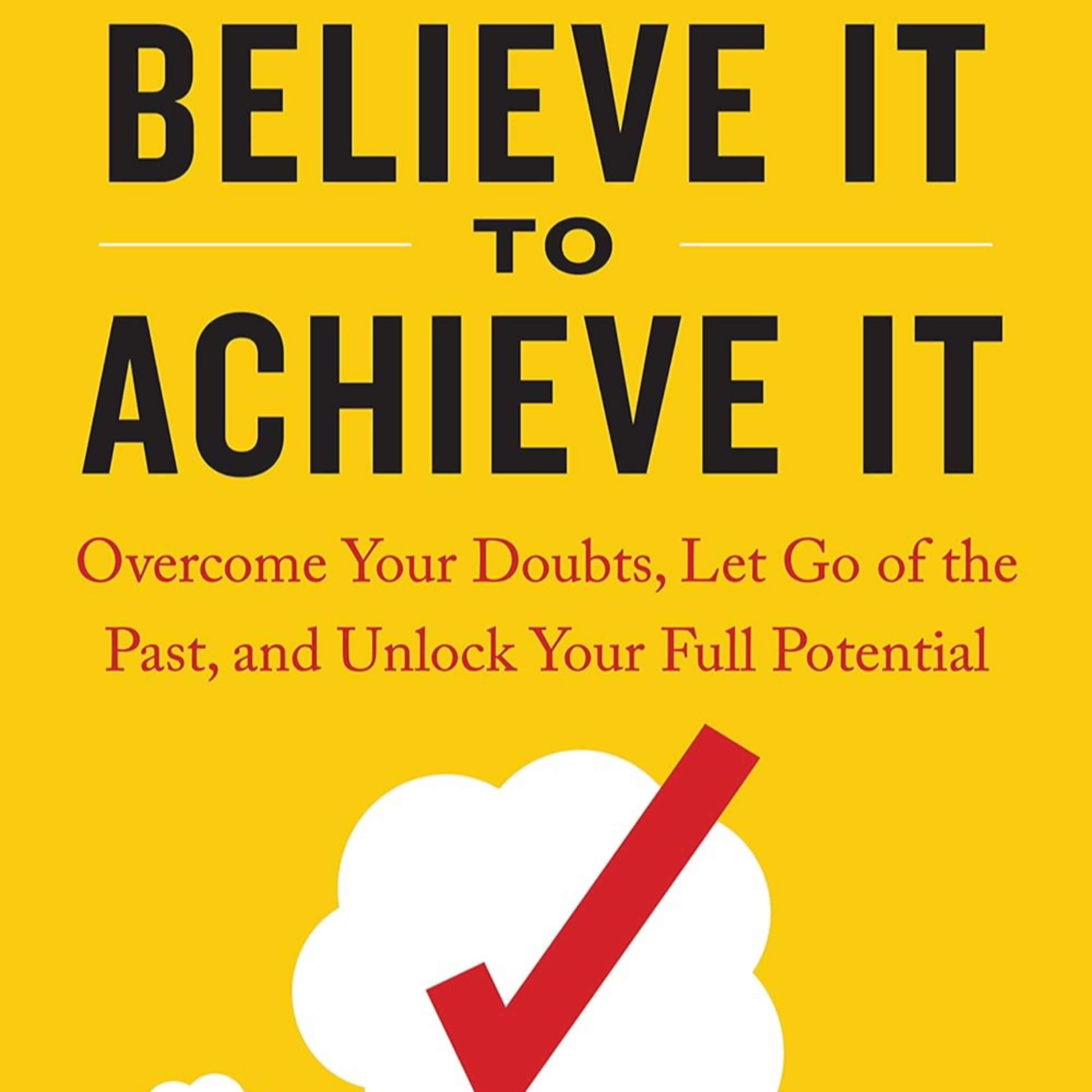
In this episode of Book Bites, we dive into Believe It to Achieve It by Brian Tracy. Stop letting self-doubt hold you back. Tracy reveals how to identify and eliminate the negative beliefs that act as "mental brakes" on your success. Learn how to reprogram your subconscious mind, build unshakable self-confidence, and align your thoughts with the future you desire. It’s time to transform your thinking and unlock a life of unlimited possibilities.
Get every episode summarized
Each time Book Bites by Juli publishes, we email you a written briefing from the transcript — the topics, who appeared, and any specific claims, with the ad reads skipped.
Email me new episodesFree for 3 shows. No card needed.
Hosts & guests
Transcript ready
570 searchable segments. Every word is indexed and playable.
Full transcript
Book Bites by Juli — Believe It to Achieve It by Brian Tracy. Machine-transcribed; use the interactive transcript above to jump the player to any line.
Welcome to today's deep dive. We are really thrilled you're here. Yeah, absolutely thrilled. Because today we have a very specific and honestly a really exciting mission. We are going to unpack the psychology of high achievement and personal transformation. Which is a huge topic. It is. And to do this, we're pulling our insights directly from the audiobook believe it to achieve it by Brian Tracy and Christina Stein. Such a fantastic resource. It really is. And look, we know you. You are the kind of person who is always eager to learn. You're always looking to optimize your life and constantly searching for that next mental edge. Right, the people listening are driven. Exactly. So today we're giving you a fast, thorough shortcut to understanding how your own mindset might actually be the single biggest thing holding you back. Think of this deep dive as, well, basically the ultimate instruction manual for your mind. I love that. That's a great way to frame it. Because the human brain is this marvel of biological engineering. But it famously doesn't come with a user guide.
Yeah, no manual in the box. Right. So today, our scope of analysis covers a lot of fascinating ground. We're going to explore the deeply ingrained psychological blocks that usually form in our early childhood. They're early stuff. Exactly. And we'll examine the specific mental laws that govern success. You know, these invisible rules dictating how we interact with the world. And most importantly, we will outline the actionable steps you can take today to actually rewire your brain for a happier, more resilient, and ultimately more successful life. Okay, let's unpack this right from the start with a brilliant analogy from the source material. You've probably seen or at least, you know, heard of Michelangelo's famous statue, the David. Oh, yeah. The masterpiece. A legendary masterpiece. But when Michelangelo was asked how he managed to sculpt something so perfectly beautiful, he said something incredible. What did he say? He said he actually saw the David in the block of marble at the very beginning. His only job was to meticulously remove everything that was not the David until only perfection
was left. Wow. It's such a profound metaphor for human potential, especially when you apply it psychology. It really is because the argument here is that you listening to this right now, you are already the masterpiece. You're the David inside the marble. Yes. The goal of your personal development isn't necessarily to add a bunch of new shiny things to yourself. It's actually to chip away the negative emotions, the self-doubt, and the false beliefs that have kind of crested over your potential. Chipping away the excess. Right. And the author's pair of this classical metaphor with a very modern story. Brian Tracy talks about a time he bought his absolute dream car. It was a silver gray Mercedes-Denz. Oh, nice. Beautifully engineered car. Exactly. And for a year, he drove it and it drove fine. He was perfectly happy with it. But eventually, he took it to a specialist mechanic for a tune-up. The mechanic looked under the hood and found one tiny valve in the carburetor that a previous mechanic had accidentally installed backward. Just one tiny valve. One backward valve. So he fixed it.
And when Brian got back into drive the car, he barely touched the gas pedal. And the Mercedes just exploded forward like a rocket. He actually had to slam on the brakes just to avoid crashing into a wall. That is wild. Right. Fixing that one tiny backward valve completely transformed the car's performance. What's fascinating here is how directly that mechanical issue relates to what psychologists call your self-concept. The self-concept. Right. Yeah, your mind is exactly like that beautifully engineered Mercedes. You, as the driver of your life, might feel like things are moving along at a perfectly satisfactory pace. You're doing fine. Just cruising along. But even so, a single unconscious block, perhaps a negative memory from years ago or a deep-seated self-limiting belief, can act like a locked brake on one of your wheels or a backward valve in your engine. Which means you're working harder for less result. Exactly. You might be working incredibly hard, stepping on the gas with all your might, but you're just spinning in circles or burning out.
Once you identify and remove that one backward valve, your progress accelerates immensely without any extra effort. And when I was reviewing the notes on this self-concept, it struck me that it isn't just one single monolithic idea. It's more like a three-part engine that drives our behavior. That's a perfect way to look at it. Think of yourself concept as having three main components. First, there's your self-ideal. The ideal version of you. Right. These are your values, your virtues, the ultimate aspirations of the person you deeply want to become. Second, is your self-image. How you see yourself. Yeah, your inner mirror. It's how you picture yourself performing in any given situation before you even do it. And third, the most crucial part is your self-esteem. Which is the core of it all. It is the reactor core of your personality. It simply comes down to how much you genuinely like yourself. Everything we are going to talk about today revolves around optimizing that reactor core. Because when your self-esteem is high, your self-image improves, and you move naturally closer to your self-ideal.
And to optimize that reactor core, we really have to figure out where the glitches came from in the first place. Which brings us all the way back to childhood. The early programming. Yes. The sources note something amazing. Children are born completely fearless and uninhibited. Babies actually only have two innate fears programmed into their biology. Just two. The fear of loud noises and the fear of falling. That is it. Everything out every other fear, anxiety, or hesitation you have right now was learned. Yeah, and unfortunately a lot of that learning comes in the form of what the authors call negative habit patterns. These are essentially invasive weeds that get planted in your mental garden very early on. Often entirely unintentionally by a well-meaning parent. Authority figures, yeah. And the authors highlight two massive weeds that choke out our potential. The first is the fear of failure. Which creates what they call the, I can't habit. I can't reflex. Right. This usually comes from destructive criticism during those early exploratory years. When a parent constantly yells stop or physically punishes a curious toddler
for simply trying new things, the child internalizes a deep fear of failure. It becomes hardwired. Exactly. And as an adult, whenever you face a new opportunity, a promotion, a new relationship, a creative project that I can't reflex kicks in automatically. The authors point out that you can actually feel this physically. In your body. Yes. It usually hits right in your solar plexus. That pit of the stomach dread. The second major weed is the fear of rejection. Which creates the, I have to have it. I have to. Yeah. This usually stems from conditional love. This happens when parents withdraw their affection if the child doesn't behave perfectly or meet their expectations. The child learns a very dangerous lesson. Which is what? I'm only safe and I'm only loved if I do exactly what they want. Wow. That is heavy. It is. In adulthood, this manifest is a compulsive need for approval. You become hypersensitive to what your boss thinks, what your neighbors think, what everyone else wants from you.
And physically, this tension is very different from the fear of failure. Where do you feel this one? It is usually felt as a tight stiffness all the way down the spine or across the shoulders. Like carrying a weight. I love how Christina Stein, the co-author who is a practicing psychotherapist, handles these learned habits in her actual practice. She shared an incredibly vivid anecdote about a woman who was absolutely terrified of a specific coworker. Oh, the kitten and the tiger. Yes. She was just paralyzed by anxiety every time she went to the office. Christina had her visualize her insecure, intimidated self as a timid little kitten. Then she asked her to picture her confident, grounded, capable self as a powerful tiger. Such a great visualization. And she had this woman literally practice being her tiger self before she walked into work. And the physical transformation was astounding. By consciously shifting from the kitten mindset to the tiger mindset, sitting up straight or breathing differently, the anxiety completely vanished. The coworker didn't change at all.
Not one bit, but the woman's internal representation of her self-hat. It's a brilliant externalization technique. Yeah. Because if we pull back and look at the macro level of our lives, those I can't and I have to, thoughts are just those invasive weeds. They aren't reality. They are learned in responses. Just weeds in the garden. Exactly. The fundamental reason people get stuck in life, whether they are languishing in a bad job or trapped in a toxic relationship, is essentially a fear of losing the love, approval, or security, provided by an important person or institution. And that fear paralyzes them. Right. But recognizing it as just a learned habit, a weed, means you can finally realize that you have the power to pluck it out. And once we've cleared out those weeds, we need to understand the actual rules of the game we're playing. The sources dive into what they call the iron laws of the mind. And the granddaddy of them all is the law of cause and effect. The big one. The premise is simple but profound. Nothing is random.
Your thoughts are the actual causes and the conditions of your life are the effects. I have to admit, this is where I get really excited, particularly regarding the empirical research they cite to back this up. The UPEN study, right? Yes. There was a massive 22-year longitudinal study conducted the University of Pennsylvania. Researchers interviewed 350,000 people to find out what they thought about on a daily basis. The results were incredibly clear. What did they find? The top 10%. The happiest, most successful, and most fulfilled people in this study thought about two specific things most of the time. What they wanted and how to get it. That is so telling. They weren't ruminating on what they were afraid of or who wronged them yesterday or how bad the economy was. No, not at all. They focused their cognitive energy on what they wanted and the practical steps of how to get it. Exactly. It creates a neurological upward spiral. When you constantly think about what you want, your brain's particular activating system starts filtering the world for opportunities to achieve it.
It's like turning on a radar. That's a perfect analogy. And this ties directly into another critical rule. The law of correspondence. It states that your outer world is always a mere image reflection of your inner world. So if you're a mess inside your life is a mess outside. Right. If you walk around with a poverty consciousness, you are going to struggle. And a poverty consciousness isn't just about worrying over grocery bills. It's a defensive mindset. Like playing not to lose instead of playing to win. Precisely. It's the mindset where you won't invest $100 in a new certification that could double your salary because you are so fixated on protecting that $100. You actually repel wealth and opportunity because your internal state is entirely focused on scarcity. But if you shift that. If you deliberately cultivate a prosperity consciousness, your external reality will eventually alter to match it because you'll start taking actions aligned with abundance. Because we literally manufacture our own expectations. And that brings us to the law of substitution,
which is an absolute game changer. This is a huge concept. It is. Your conscious mind can only hold one thought at a time. It's either a positive thought or a negative thought. You have a default failure mechanism in your brain, an evolutionary leftover that automatically kicks in when you stop actively thinking about your goals. The defaults to looking for threats. Right. Left to its own devices, the brain defaults to worry and threat detection. But you also have a success mechanism by deliberately substituting a positive goal-oriented thought for a negative one. You completely override that failure setting. You get to choose the thought that occupies the space. Which brings us to the most critical and honestly, perhaps the most challenging part of this entire deep dive. Oh, the heavy stuff. Yeah. If we are manufacturing our own reality through our thoughts, we have to deal with the heavy negative emotions that we are still holding on to from the past. You can't just positive think your way out of deep-seated resentment.
No, you definitely can't. We've talked about substituting thoughts, but when we get to the physical reality of letting go of negative emotions, here's where it gets really interesting. The author share a concept adapted from the Sedona method called the pencil test. I love this exercise. It's so visceral. I want you to imagine this. Imagine you are holding a standard wooden pencil in your hand. You squeeze it tightly, making a fist as hard as you can. Imagine holding it like that for an hour. Your knuckles would be totally white. White knuckles, exactly. Imagine holding it for a day, a week, a year. What happens? Your hand cramps an agony. Your arm muscles eventually atrophy. The pain is blinding. So how do you get rid of the pain? You simply open your hand and let it go. Yes, you just open your fingers and drop it. Gravity does the work. And they apply this directly to emotional pain. Holding on to a grudge or past trauma is exactly like squeezing that pencil. You are the one expending the energy to hold on to it. Exactly. To be free, you must choose to open your heart,
open your mind, and let it go. This raises an important question, though. Why do we hold on so tightly in the first place? Why do we squeeze the pencil until our arm atrophies? That's the million dollar question. The sources argue that the core of all anger and negative emotion is blame. It is psychologically impossible to hold on to a negative motion. If you cannot blame someone or something else for it. To blame is the glue. Blame is the glue. So the ultimate antidote, the psychological circuit breaker, is incredibly simple to say but incredibly hard to do. It's repeating the phrase, I am responsible. I am responsible. Precisely. The moment you say I am responsible, the negative emotion stops in its tracks because you've removed the blame. No, we have to be very clear here, right? This does not mean you are to blame for everything bad that has ever happened to you. Oh, absolutely not. If someone runs a red light and hits your parked car, it is not your fault. Right. But you are absolutely 100% responsible for your response to it. You control your reaction.
Will you let it ruin your month? Or will you handle the insurance and move on? Taking responsibility for your response cancels out the lingering negativity. And taking that radical responsibility leads directly to the ultimate freedom, which is forgiveness. The sources lay out a very specific list of four people you absolutely must forgive if you want to drive your life like that two-knit Mercedes. Number one on the list, your parents. This is a tough one for a lot of people. It is. But they did the best they could with the tools they had. They were imperfect people, raising an imperfect person. There's this wild, almost comedic anecdote in the book about a 35-year-old man who attended one of Tracy's seminars. Oh, the guy with the 20-year grudge? Yes. He had been holding a bitter, consuming grudge against his father for something that happened when he was 15 years old. It was so toxic. It was ruining his current relationships. So right after the seminar, he feels empowered. He goes to his dad's house, confronts his gruff, tough father, and says, Dad, I forgive you for what you did when I was 15.
And what happens? His dad looks at him, totally confused, and says, I have no idea what you're talking about. That is such a profound realization. He carried that heavy pencil, squeezing it tightly for 20 years, and his father didn't even remember the event. He didn't even cross his mind. It perfectly proves that forgiveness is a purely selfish act. It's not about letting the other person off the hook. They might not even know they're on the hook. Yeah. It's about setting yourself free. Exactly. Okay. Person number two to forgive. Past relationships. The author suggests a very tactical approach here. Write a letter. A physical letter. Yes. In this letter, you accept your share of the blame, because it always takes two people to create relationship dynamics. You forgive them for everything they did, and you genuinely wish them well, then you mail it. Or if that's too much or inappropriate, you rip it up or burn it. The physical act of writing it down and destroying it cements the emotional release in your brain. Number three, everyone else, every boss who fired you unfairly,
every friend who betrayed you, the person who cut you off in traffic, just let them go. And finally, number four, yourself. Forgiving yourself is often the absolute hardest part of this process. But you have to recognize a fundamental truth. The person you are today, listening to this right now, is not the same person who made those mistakes five, ten, or twenty years ago. You're just not that person anymore. You're wiser now. You have more context. If we connect this to the bigger picture, the authors make a brilliant, clarifying distinction between a fact and a problem. Oh, this distinction is crucial. It really is. Something that happened in the past is a fact. It is completely unchangeable. Becoming angry over an unchangeable fact is a massive waste of your finite mental energy. A problem, on the other hand, is something in the present or the future that you can actually solve. We need to focus our energy entirely on the problems and let go of the facts, which perfectly sets up our final section, mastering change and architecting your future.
Because once you've let go of the past and dropped the pencil, you have to face the future, and the future is full of constant change. Constant accelerating change. Right. The sources cite a fascinating Harvard University prediction from way back in 1952. Even back then, they predicted that change, competition, and new opportunities would only increase at an accelerating rate year after year, and they were dead right. Change is inevitable. How you navigate it is entirely up to you. One of the best mental frameworks the authors offer for navigating this constant change is called zero-based thinking. Zero-based thinking, how does that work? It requires immense courage to actually implement. You ask yourself this question, is there anything I'm doing today that, knowing what I now know, I wouldn't get into again. Wow, that is a heavy question. Think about that. If the answer is yes, whether it's a job you hate and investment that's draining you or a relationship that is toxic, your only question should be how to get out and how fast. Just cut the cord. It's incredibly stressful to face that reality
in the short term, but taking action massively reduces your long-term anxiety and frees you up for better opportunities. Right, so you've cleaned house mentally, you've reated the garden in faced reality. How do you actually build the future you want? The source is outlined a seven-step process to goal achievement, and it's not just a bulleted list, it's a workflow. I'll practical workflow. Imagine you want to totally pivot your career. Step one is deciding exactly what you want. Not just more money, but the specific role in industry. Step two is setting a hard deadline, because a goal without a deadline is just a wish. A wish, exactly. But step three is where the real work begins. Identifying the specific obstacles in your way. It's easy to blame the economy, but your actual obstacle might be a lack of a specific technical skill, which leads right into step four. Identifying the exact knowledge or skills you need to acquire to overcome that obstacle. And then you move to step five, which is crucial. Identifying the people who's help you need. No one succeeds in a vacuum.
You always need people. Always. Yeah. Once you know who you need, step six is making a sequenced plan based on priority. And finally, step seven, the most important of all. Take action immediately. Do something no matter how small. Every single day that moves you toward that goal. Daily momentum. Right. But going back to step five, the people, the best way to build your own self-esteem and achieve your goals is actually to build the self-esteem of the people around you. The authors break this down into the five A's. The five A's. Let's hear them. Acceptance, which you show simply by smiling at people. Appreciation, which is saying thank you constantly, admiration, complimenting specific traits or possessions, approval, which is praising good behavior immediately. And finally, attention, which means active listening. I have to admit the active listening part hit me hard. We all like to think we're good listeners, but taking the time to actually deploy it as a tool is practically a superpower. It really is. The physiology behind active listening is fascinating.
When you practice it, meaning you pause before you reply, you ask for clarification instead of just waiting for your turn to speak. And you paraphrase what they said, it actually physically lowers the speaker's heart rate. It changes their biology. Yes, it triggers the release of endorphins in their brain. You're literally making them feel physically better, safer and more important just by truly listening to them. It's an incredible tool for genuine human connection and people will move mountains for someone who makes them feel that way. So what does this all mean for you, the listener? It means you are the architect of your own mind. You do not have to be a victim of your past, your childhood programming, or your current circumstances. You're in the driver's seat. Exactly. By plucking out those I can't weeds planted long ago, they taking absolute radical responsibility for your responses to the world. By actively opening your hand and dropping the pencil of past grievances, and by focusing purely on what you want and how to get it, you can drive your life like that fine-tuned Mercedes. The backward valve is gone. The power is entirely in your hands.
I want to thank you for joining us on this deep dive. In a world full of noise, endless distractions, and constant doom scrolling, critical thinking, and a willingness to examine and reshape your own self-concept are your ultimate defenses. They are the best tools you have against information overload and personal stagnation. Before you go, I want to leave you with one final provocative thought from the source material. It's a bit of a perspective shift. The authors note that people who technically die on the operating table, people who have near-death experiences and are resuscitated, often report a very similar phenomenon. It's a really profound observation. They say that while they were on the other side, they were asked two specific questions, two questions that seemed to strip away all the noise and sum up the entire point of human existence. As you go about your day-to-day, I want you to mull over these two questions for yourself. Imagine being asked, what have you learned in this lifetime and how have you increased your capacity to love? Think about it. We'll catch you next time.
More episodes
More from Book Bites by Juli

How to Politely Tell People to F*ck Off by Alba Cardalda
Book Bites by Juli

Cómo mandar a la mierd* de forma educada de Alba Cardalda
Book Bites by Juli

Women Who Run with the Wolves" by Clarissa Pinkola Estés
Book Bites by Juli

Mujeres que corren con los lobos" de Clarissa Pinkola Estés.
Book Bites by Juli