newsJul 10, 20261:17:12pending
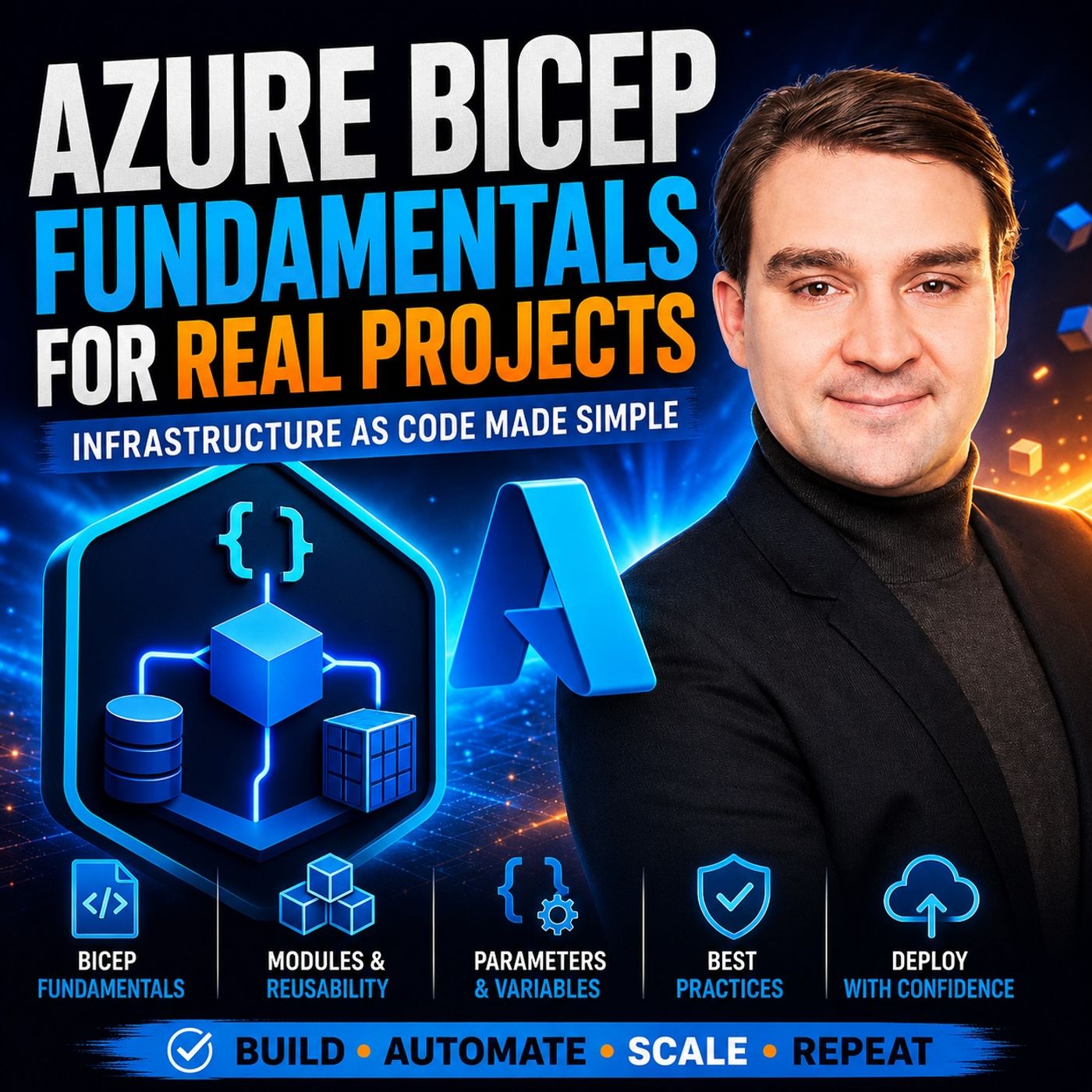
Azure Bicep Fundamentals for Real Projects
About this episode
Learning Azure Bicep is easy. Building infrastructure that survives real-world enterprise environments is something entirely different. In this episode of the M365 FM Podcast, host Mirko Peters explores what separates hobbyist Infrastructure as Code from production-ready cloud architecture. Rather than focusing on syntax alone, this episode dives into the architectural thinking behind Azure Bicep, showing how modern organizations design scalable, secure, and governable Azure environments using Infrastructure as Code, Azure Policy, Deployment Stacks, Azure Verified Modules, Management Groups, and enterprise governance. You'll learn why Bicep is far more than a replacement for ARM Templates. It has become Microsoft's strategic language for defining Azure infrastructure, enforcing governance, automating deployments, and enabling cloud platforms that remain maintainable as organizations grow. Whether you're deploying your first storage account or designing enterprise landing zones across hundreds of Azure subscriptions, this episode provides the principles needed to build infrastructure that lasts.
WHY BICEP IS MORE THAN BETTER SYNTAX
Many developers view Bicep simply as an easier way to write ARM Templates. While the cleaner syntax, reusable modules, and improved readability are significant improvements, Microsoft's long-term vision goes much further. Bicep has evolved into the language that defines Azure governance, policy, security baselines, and infrastructure lifecycle management. Modern Infrastructure as Code is no longer about automating deployments—it's about codifying architectural decisions that remain consistent across teams, subscriptions, and cloud environments.
THINKING LIKE A CLOUD ARCHITECT
One of the central themes throughout the episode is the difference between automation and architecture. Real-world Bicep projects are built around organizational standards rather than individual deployments. Topics include:
BUILDING REUSABLE BICEP MODULES
As Azure environments become larger, reusable modules become the foundation of maintainable infrastructure. The episode explains how well-designed modules encapsulate organizational decisions including security baselines, naming conventions, monitoring requirements, compliance standards, and networking patterns. Rather than copying infrastructure between projects, organizations build internal module libraries that allow development teams to deploy secure infrastructure while automatically following corporate standards. The discussion covers:
One of Microsoft's biggest Infrastructure as Code innovations is Deployment Stacks. Unlike traditional ARM deployments, Deployment Stacks introduce state awareness, allowing Azure to understand which resources belong together throughout their lifecycle. The episode explores how Deployment Stacks simplify environment management, resource cleanup, brownfield migrations, and governance while reducing orphaned resources and configuration drift. You'll also learn how Deployment Stacks compare with Terraform's state management model and why this represents a major architectural shift for Azure-native deployments.
MANAGEMENT GROUPS, POLICY, AND GOVERNANCE
Enterprise Azure environments cannot be managed one subscription at a time. This episode explains why Management Groups form the true control plane for Azure governance. Topics include:
BUILDING ENTERPRISE LANDING ZONES
Azure Landing Zones are much more than preconfigured subscriptions. They provide complete enterprise-ready cloud environments including networking, monitoring, identity integration, governance, security controls, and operational best practices. The discussion explores how organizations compose Landing Zones using reusable Bicep modules, allowing application teams to deploy workloads into standardized cloud environments without sacrificing flexibility.
BICEP VS TERRAFORM
One of the most common questions facing cloud architects is whether to standardize on Azure Bicep or Terraform. Rather than declaring a winner, this episode explains the strengths of both platforms. Bicep provides immediate support for new Azure services, seamless Azure integration, and simplified Azure-native deployments. Terraform remains an excellent choice for organizations operating across Azure, AWS, Google Cloud, and hybrid environments. The right decision depends on business requirements, governance strategy, and long-term platform goals—not simply personal preference.
WHO SHOULD LISTEN?
This episode is perfect for:
Become a supporter of this podcast: https://www.spreaker.com/podcast/m365-fm-a-microsoft-mvp-podcast-by-mirko-peters--6704921/support.
WHY BICEP IS MORE THAN BETTER SYNTAX
Many developers view Bicep simply as an easier way to write ARM Templates. While the cleaner syntax, reusable modules, and improved readability are significant improvements, Microsoft's long-term vision goes much further. Bicep has evolved into the language that defines Azure governance, policy, security baselines, and infrastructure lifecycle management. Modern Infrastructure as Code is no longer about automating deployments—it's about codifying architectural decisions that remain consistent across teams, subscriptions, and cloud environments.
THINKING LIKE A CLOUD ARCHITECT
One of the central themes throughout the episode is the difference between automation and architecture. Real-world Bicep projects are built around organizational standards rather than individual deployments. Topics include:
- Infrastructure as Code
- Enterprise architecture
- Governance as Code
- Management Groups
- Azure Landing Zones
- Resource ownership
- Organizational standards
- Platform engineering
- Cloud operating models
- Infrastructure lifecycle
BUILDING REUSABLE BICEP MODULES
As Azure environments become larger, reusable modules become the foundation of maintainable infrastructure. The episode explains how well-designed modules encapsulate organizational decisions including security baselines, naming conventions, monitoring requirements, compliance standards, and networking patterns. Rather than copying infrastructure between projects, organizations build internal module libraries that allow development teams to deploy secure infrastructure while automatically following corporate standards. The discussion covers:
- Azure Verified Modules (AVM)
- Resource modules
- Pattern modules
- Platform modules
- Module registries
- Versioning
- Parameter validation
- Variables
- Outputs
- Semantic versioning
One of Microsoft's biggest Infrastructure as Code innovations is Deployment Stacks. Unlike traditional ARM deployments, Deployment Stacks introduce state awareness, allowing Azure to understand which resources belong together throughout their lifecycle. The episode explores how Deployment Stacks simplify environment management, resource cleanup, brownfield migrations, and governance while reducing orphaned resources and configuration drift. You'll also learn how Deployment Stacks compare with Terraform's state management model and why this represents a major architectural shift for Azure-native deployments.
MANAGEMENT GROUPS, POLICY, AND GOVERNANCE
Enterprise Azure environments cannot be managed one subscription at a time. This episode explains why Management Groups form the true control plane for Azure governance. Topics include:
- Azure Policy
- Policy Initiatives
- RBAC
- Least Privilege
- Management Group hierarchy
- Subscription governance
- Compliance
- Security baselines
- Governance as Code
- Platform engineering
BUILDING ENTERPRISE LANDING ZONES
Azure Landing Zones are much more than preconfigured subscriptions. They provide complete enterprise-ready cloud environments including networking, monitoring, identity integration, governance, security controls, and operational best practices. The discussion explores how organizations compose Landing Zones using reusable Bicep modules, allowing application teams to deploy workloads into standardized cloud environments without sacrificing flexibility.
BICEP VS TERRAFORM
One of the most common questions facing cloud architects is whether to standardize on Azure Bicep or Terraform. Rather than declaring a winner, this episode explains the strengths of both platforms. Bicep provides immediate support for new Azure services, seamless Azure integration, and simplified Azure-native deployments. Terraform remains an excellent choice for organizations operating across Azure, AWS, Google Cloud, and hybrid environments. The right decision depends on business requirements, governance strategy, and long-term platform goals—not simply personal preference.
WHO SHOULD LISTEN?
This episode is perfect for:
- Azure Architects
- Cloud Engineers
- DevOps Engineers
- Platform Engineers
- Infrastructure Engineers
- Azure Administrators
- Enterprise Architects
- Cloud Consultants
- IT Decision Makers
- Microsoft MVPs
- Anyone learning Azure Bicep
Become a supporter of this podcast: https://www.spreaker.com/podcast/m365-fm-a-microsoft-mvp-podcast-by-mirko-peters--6704921/support.
Get every episode summarized
Each time M365.FM - Modern work, security, and productivity with Microsoft 365 publishes, we email you a written briefing from the transcript — the topics, who appeared, and any specific claims, with the ad reads skipped.
Email me new episodesFree for 3 shows. No card needed.
Hosts & guests
No transcript yet
This episode has not been transcribed. Request it and it moves to the front of the queue.
More episodes
More from M365.FM - Modern work, security, and productivity with Microsoft 365

Constraint-Based Scheduling: The Architecture That Makes Production Plans Real
M365.FM - Modern work, security, and productivity with Microsoft 365
Sep 15, 20261:51:40pending

A Machine Goes Down. How Should Your Production Plan React?
M365.FM - Modern work, security, and productivity with Microsoft 365
Sep 15, 20261:41:43pending

Can Value Stream Mapping Become a Live Data Model?
M365.FM - Modern work, security, and productivity with Microsoft 365
Sep 15, 20261:48:32pending

How Finite Capacity Scheduling Actually Works in Manufacturing
M365.FM - Modern work, security, and productivity with Microsoft 365
Sep 14, 20261:54:54completed