newsJul 14, 20261:00:09pending
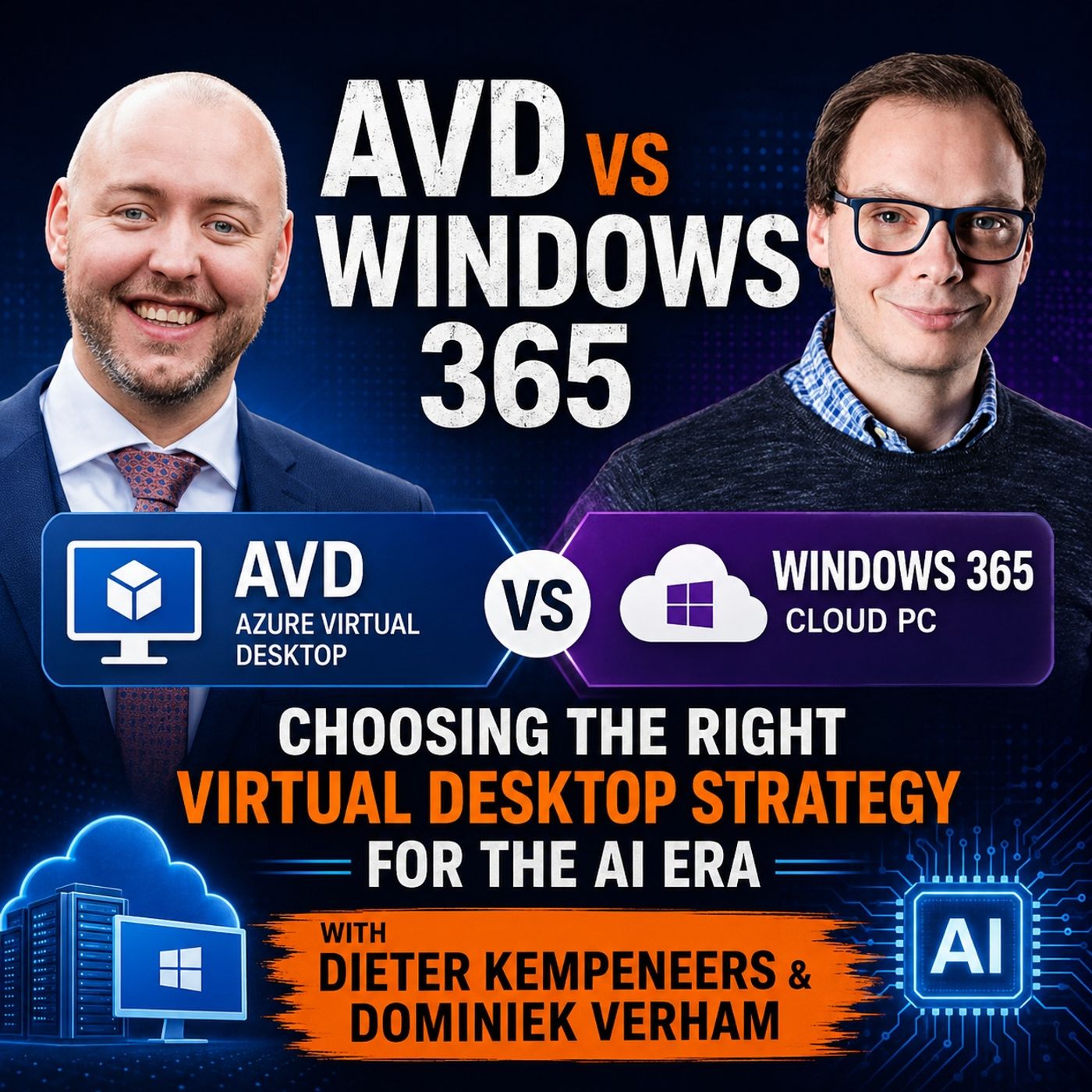
AVD vs Windows 365: Choosing the Right Virtual Desktop Strategy for the AI Era with Dieter Kempeneers [MVP] & Dominiek Verham [MVP]
About this episode
Virtual desktops are entering a new era. Remote work has become standard, AI-powered PCs are reshaping endpoint computing, and organizations are looking for secure, scalable, and cost-effective ways to deliver modern workspaces. But one question keeps coming up: Should you choose Azure Virtual Desktop or Windows 365? In this episode, Mirko Peters is joined by Microsoft MVP Dieter Kempeneers and Cloud Solution Architect Dominiek Verham to break down the architecture, business use cases, security, automation, and future of Microsoft's virtual desktop ecosystem.
UNDERSTANDING THE DIFFERENCE BETWEEN AVD AND WINDOWS 365
The discussion begins by explaining the fundamental differences between Azure Virtual Desktop (AVD) and Windows 365 Cloud PCs. While both deliver Windows desktops from the cloud, they solve different business problems. Azure Virtual Desktop provides maximum flexibility, customization, and infrastructure control for organizations with complex requirements. Windows 365 focuses on simplicity, predictable licensing, and rapid deployment, making Cloud PCs accessible without requiring deep Azure expertise.
BREAKING DOWN THE CORE BUILDING BLOCKS
Dieter and Dominiek walk through every major AVD component, including Host Pools, Session Hosts, Workspaces, Application Groups, FSLogix profile management, Azure Files, Azure NetApp Files, Microsoft Entra ID, and Microsoft Intune. They explain how these services fit together to create scalable, secure virtual desktop environments while highlighting Microsoft's shift away from complex golden images toward modern cloud-native deployment models.
WINDOWS 365 MAKES VIRTUAL DESKTOPS SIMPLE
One of the biggest advantages of Windows 365 is its simplicity. Organizations no longer need to build an Azure landing zone or manage backend infrastructure before deploying Cloud PCs. With Microsoft handling storage, networking, compute resources, and platform management, IT teams can provision secure desktops in minutes while benefiting from predictable monthly licensing, simplified operations, and reduced maintenance overhead.
SECURITY, IDENTITY, AND MODERN MANAGEMENT
Security remains a central theme throughout the conversation. The guests explain how Microsoft Entra ID, Intune, Conditional Access, Microsoft Defender, compliance policies, device management, context-aware redirection, and security baselines work together to protect both Azure Virtual Desktop and Windows 365 environments. They also discuss how organizations can secure remote work without relying on traditional VPN solutions while improving user experience and reducing operational complexity.
AUTOMATION, AI, AND THE FUTURE OF CLOUD PCS
Infrastructure as Code, Bicep, Terraform, Microsoft Graph, Azure DevOps, GitHub Actions, Copilot+ PCs, AI acceleration, GPU-enabled Cloud PCs, monitoring, cost optimization, and automation all play an increasingly important role in virtual desktop strategies. The discussion explores how AI-powered hardware and cloud services will reshape endpoint computing over the next few years while helping organizations simplify management and improve productivity.
WHICH PLATFORM SHOULD YOU CHOOSE?
Rather than positioning Azure Virtual Desktop and Windows 365 as competitors, Dieter and Dominiek explain why many organizations benefit from using both. Azure Virtual Desktop delivers maximum flexibility and infrastructure control, while Windows 365 offers operational simplicity and predictable costs. The right choice depends entirely on business requirements, workloads, user profiles, and long-term IT strategy—not marketing comparisons.
KEY TAKEAWAYS
Choosing between Azure Virtual Desktop and Windows 365 isn't about finding a universal winner—it's about selecting the right solution for each business scenario. From architecture and automation to security, AI, licensing, and operational efficiency, this episode provides practical guidance for IT architects, consultants, administrators, and decision-makers building the next generation of digital workplaces. Whether you're modernizing remote work, planning Cloud PC deployments, or designing enterprise-scale virtual desktop environments, this conversation delivers valuable real-world insights
Become a supporter of this podcast: https://www.spreaker.com/podcast/m365-fm-a-microsoft-mvp-podcast-by-mirko-peters--6704921/support.
UNDERSTANDING THE DIFFERENCE BETWEEN AVD AND WINDOWS 365
The discussion begins by explaining the fundamental differences between Azure Virtual Desktop (AVD) and Windows 365 Cloud PCs. While both deliver Windows desktops from the cloud, they solve different business problems. Azure Virtual Desktop provides maximum flexibility, customization, and infrastructure control for organizations with complex requirements. Windows 365 focuses on simplicity, predictable licensing, and rapid deployment, making Cloud PCs accessible without requiring deep Azure expertise.
BREAKING DOWN THE CORE BUILDING BLOCKS
Dieter and Dominiek walk through every major AVD component, including Host Pools, Session Hosts, Workspaces, Application Groups, FSLogix profile management, Azure Files, Azure NetApp Files, Microsoft Entra ID, and Microsoft Intune. They explain how these services fit together to create scalable, secure virtual desktop environments while highlighting Microsoft's shift away from complex golden images toward modern cloud-native deployment models.
WINDOWS 365 MAKES VIRTUAL DESKTOPS SIMPLE
One of the biggest advantages of Windows 365 is its simplicity. Organizations no longer need to build an Azure landing zone or manage backend infrastructure before deploying Cloud PCs. With Microsoft handling storage, networking, compute resources, and platform management, IT teams can provision secure desktops in minutes while benefiting from predictable monthly licensing, simplified operations, and reduced maintenance overhead.
SECURITY, IDENTITY, AND MODERN MANAGEMENT
Security remains a central theme throughout the conversation. The guests explain how Microsoft Entra ID, Intune, Conditional Access, Microsoft Defender, compliance policies, device management, context-aware redirection, and security baselines work together to protect both Azure Virtual Desktop and Windows 365 environments. They also discuss how organizations can secure remote work without relying on traditional VPN solutions while improving user experience and reducing operational complexity.
AUTOMATION, AI, AND THE FUTURE OF CLOUD PCS
Infrastructure as Code, Bicep, Terraform, Microsoft Graph, Azure DevOps, GitHub Actions, Copilot+ PCs, AI acceleration, GPU-enabled Cloud PCs, monitoring, cost optimization, and automation all play an increasingly important role in virtual desktop strategies. The discussion explores how AI-powered hardware and cloud services will reshape endpoint computing over the next few years while helping organizations simplify management and improve productivity.
WHICH PLATFORM SHOULD YOU CHOOSE?
Rather than positioning Azure Virtual Desktop and Windows 365 as competitors, Dieter and Dominiek explain why many organizations benefit from using both. Azure Virtual Desktop delivers maximum flexibility and infrastructure control, while Windows 365 offers operational simplicity and predictable costs. The right choice depends entirely on business requirements, workloads, user profiles, and long-term IT strategy—not marketing comparisons.
KEY TAKEAWAYS
Choosing between Azure Virtual Desktop and Windows 365 isn't about finding a universal winner—it's about selecting the right solution for each business scenario. From architecture and automation to security, AI, licensing, and operational efficiency, this episode provides practical guidance for IT architects, consultants, administrators, and decision-makers building the next generation of digital workplaces. Whether you're modernizing remote work, planning Cloud PC deployments, or designing enterprise-scale virtual desktop environments, this conversation delivers valuable real-world insights
Become a supporter of this podcast: https://www.spreaker.com/podcast/m365-fm-a-microsoft-mvp-podcast-by-mirko-peters--6704921/support.
Get every episode summarized
Each time M365.FM - Modern work, security, and productivity with Microsoft 365 publishes, we email you a written briefing from the transcript — the topics, who appeared, and any specific claims, with the ad reads skipped.
Email me new episodesFree for 3 shows. No card needed.
Hosts & guests
No transcript yet
This episode has not been transcribed. Request it and it moves to the front of the queue.
More episodes
More from M365.FM - Modern work, security, and productivity with Microsoft 365

Constraint-Based Scheduling: The Architecture That Makes Production Plans Real
M365.FM - Modern work, security, and productivity with Microsoft 365
Sep 15, 20261:51:40pending

A Machine Goes Down. How Should Your Production Plan React?
M365.FM - Modern work, security, and productivity with Microsoft 365
Sep 15, 20261:41:43pending

Can Value Stream Mapping Become a Live Data Model?
M365.FM - Modern work, security, and productivity with Microsoft 365
Sep 15, 20261:48:32pending

How Finite Capacity Scheduling Actually Works in Manufacturing
M365.FM - Modern work, security, and productivity with Microsoft 365
Sep 14, 20261:54:54completed