Loading...
About this Episode
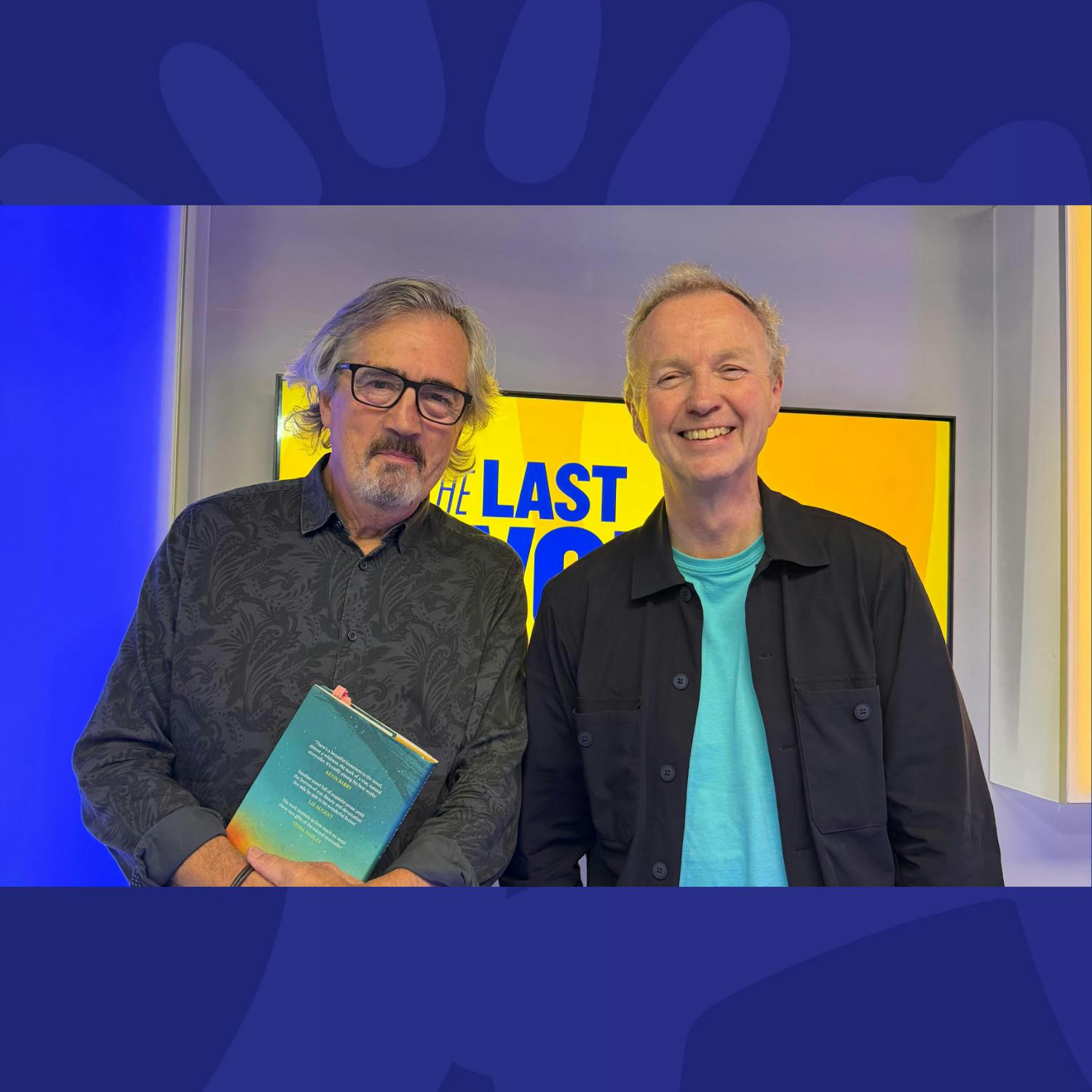
Sebastian Barry talks to Matt about his latest novel, The Newer World, which tells the story of Tennyson Bouguereau, a freed slave trying to find meaning in post-Civil War America.
To catch the full conversation, press the 'play' button on this page.
Hosts & Guests

Transcript
With Cricket Wireless, you can count on reliable nationwide 5G.
Because Cricket Wireless is on the AT&T network,
which means you can start listening to that new album that just dropped at home
while running errands and at the gym without any hiccups.
Find plans with unlimited data for every lifestyle and price point.
Switch to Cricket today.
The last word.
With Life Pharmacy.
Over 100 local pharmacies nationwide that are always here to help.
Life Pharmacy.
Live better together.
We're delighted to have Sebastian Barry back with us today.
It's been a few years since his last novel.
He is of course one of our most successful, most loved novelists.
His new book, The New World, returns to a subject that he has become fascinated with.
19th century America.
Sebastian, great to see you.
Thank you for being with us and to see you, man.
Tell us the new world.
So what's the story in this?
Yeah, well, as you say mid 19th century.
Is very interesting period to read in.
Because a lot of the things you read.
I have a reminder strongly of things you're reading at the moment about modern America.
For instance, America's full up.
We don't want these Catholic Irish.
We don't want such and such.
We want and then it's pretty civil war.
When the states are trying to decide what to do about that.
Sorry, just excuse me.
So is it has it always been ironically almost when you consider that the United States of America,
the melting pot of immigrants from all over the world.
Yeah.
That despite that, there's always been a large degree of anti-immigration in there that those who settle do not want anyone else coming in after them.
And even the Irish perhaps have been guilty of wanting to sort of pull up the ladder after they've climbed up.
Exactly.
But the other thing was that there was all that land west of the Mississippi that people thought would never be settled.
So a lot of these ideas were Eastern, midwestern ideas at best that there were enough people.
It was also an enormous fear actually of Catholicism diluting the beautiful Protestantism of how they had things.
All those things, all those forces that may seem historical, but seem to have very vivid echoes still.
And of course, if you forget your history, your condemn to relive it as they say.
And just as a human being noticing, I mean, Irish people are by, I don't know, by nature.
I mean, maybe we're born Democrats.
That's one thing.
And of course, in those days, Democrats were the Republicans.
There was this strange switch.
But we do in a way, we are invested in America in a very strange way.
We think, Cucolan and these were our mythologies, but actually it's really the Marx brothers and all that.
And the Ford's cowboy films, you know, that.
So America is, although we're separated from it by a sea allegedly, there's something deeply familiar about American history and American art.
And I think that's where I, like I was told it when I was a little boy by my grandfather who had been all over the world as a sailor and a soldier.
That he had a great uncle who had been at the Indian warts.
So I'm nine years old in bed with him.
He's telling me this. I think I know what he's talking about because at the stop, top of the street in Donnery, there was a cinema.
And we'd see all the cowboys.
But I didn't really know what he was saying.
So that's what drew me to America in the first place.
A putative great, great uncle.
I didn't even know his name. I still wouldn't know his name. He was obviously in Alhara.
And so landing there and spending decades trying to write days without end, which was the first of these books within the ten books.
Finally writing that book.
It was an effort to find him and in among his associates, his friends, his, his beloveds in that book is tennis and bourgeois.
Who is when Thomas meets some fairly young freedman on large makeings estate down in Paris, Tennessee, that wonderfully named place.
A thousand moons. It was the next book which was written more or less by Winona.
There adopted daughter who is Lakota Sue, young woman.
And I just felt, I felt honor bound in a way that intention should have his own book. And that's what this.
What did your publishers say to you about this white Irish guy wanting to write a book right about a black freed slave?
So what would you know about that? And are you entitled to write about that?
Well, I don't think anyone's entitled to write anything. I don't think I think writers are essentially sort of outlaw figures.
I shouldn't expect too much of them in the way of ethics and maybe even morals.
But the only thing you have is writer and I've been writing full time for 49 years is the instinct and the compulsion towards a new book.
It will be completely in co-hate. You won't even know what it is. Obviously before you start, it would be very tiresome if you did.
But the event I did pause in my intentions towards asking Tennyson to tell me his story for about four or five years.
After I published a thousand moons because I don't after after all is a book by a young Lakota Sue woman of 17, which I pay to him now either.
So I'm sorry fiction writing is what the imagination anyway.
I mean, sometimes know that they would start with the critics for saying you can't do this. You can't do that because you don't know about it.
But all fiction is rooted in imagination.
Yeah, and you should be very careful telling people not to do things because the child in us will always go and do that very thing.
But yeah, I mean, to my mind were all all modern humans, which I think is true, are descended from the same mitochondrial eat.
So all modern humans as Mr. Dillon just says and on the can inside the good news is we're all the same family and the bad news is we're all the same family.
The fact is we've had vastly different experiences of the earth in the intervening 200,000 years.
I think it's part of the duty of the writer if so drawn to try and enter into the state of a family member from whom you have been separated by maybe 150 years of living and try and imagine what that is.
It is actually an active empathy, interest and love and actually a certain level reverence.
I think there's also a kind of innocence in writing that's very important to preserve.
As soon as you tell the writers not to do certain things, you are removing that innocence. You're making them hyper aware.
And I will confess every day of writing this book and every year of thinking about writing this book.
This was on my mind, which is not huge, helpful in your work room, but I worked through it out of a sheer need for Tennyson, Buzra.
Also, could it be that your publishers would worry given the current state of the United States of America?
That a book like this wouldn't sell. It's just like, I mean, this might be the type of story that would make for a very good movie.
Except I'm wondering who in America at the moment would finance a movie about a freed black slave.
There might have been a decade or two decades ago, but now given the current environment.
Well, I mean, your books don't have to be movies, but there has been a very brilliant producer has worked for nine years trying to make a film of days without end.
The barrier you come up against for that film was it deals with Native American things.
And if you're not Native American and Hollywood, they're very worried about making such a film.
Cultural appropriation.
And just to sheer concern and nervousness around these things.
I mean, maybe our job is also to kind of blunder on and just follow our own lights.
Because that is the one freedom I think you should give to writers to follow their own instincts and assume that they will meet their instincts responsibly.
Okay. How much research and study have you done about mid 19th century America?
Have you become sort of an expert on it to then imagine the stories of your carry Tristan?
I've had it.
I've become a kind of lover of it or like cockroach, you know, in a food cupboard just delighting in the source of food.
I found some amazing books along the way.
A man called Thomas Wentworth, Hickinson, for instance, who is the first, the colonel of white man, of course, the first colonel of one of the first black regiment in the Civil War.
And he wrote an amazing book, which I think is a sort of masterpiece.
And Emerson agreed with me.
He said, this is a masterpiece written by a man who's not given to masterpiece.
So along the way, there have been these incredible books.
And maybe there's 150 or 200 books that you have to read and forget most of it.
Because when you come to your own book, you want these tiny things rising up in you going onto the pages, if it's from lived experience.
My responsibility, you know, towards Tennyson, is that my feeling about it was over the years, was that I was the only Egypt he could find to write his book.
Sorry.
So I was on about to do it.
Has he become sort of a real person to you, even though he's an imagines person who never lived?
Matt, I live in the hills in southeast Wakelow.
There are many people up there. I've got seven dogs. There's more dogs in our house than people.
And of course, your characters, I mean, there is a sense that our own reality is provably false in the sense that everything I said, slight microsecond delay.
So this is all a film we're creating for ourselves.
So something created by words, I think, has as forceful a reality as reality.
And maybe more so.
But Tennyson is intensely real to me.
You know, when I go home this evening, I'll tell him about how I got on signing his book.
The other thing I saw is that it's spread across your books.
I know you've got this sort of the last three books.
Could be read loosely as a trilogy, but they're not really.
And they can be read out of sequence.
But something that is very much there as well is violence.
Because that's something wasn't that that made 19th century America was extraordinarily violent.
Yeah, the symbolic and actual power and positioning of the rifle, the Spencer rifle or whatever gun you had.
And continues to be, of course, the case in America.
You know, one of the most graceful thing we did as a new nation, I think, was not have a non-police force.
That's very rare in the world.
You know, I'm not in any way interested in guns. I wouldn't be able to shoot a gun.
But it is as a technical matter, as a writer drawn to fascinating things.
The existence of the gun in American history, you know, is beyond fascinating.
It almost has its own wild and dangerous poetry.
Would it ever be removed, you think, or is it just so deeply ingrained that no matter every time we hear of appalling gun murders in the United States.
And you hear about restricting access to guns or to bullets or whatever and it never happens.
Would it ever happen? Is it just so deeply ingrained in our culture?
When the year 71, the word ever takes on a new meaning.
I could easily say not in my lifetime. And it probably wouldn't be too disruptive.
But I see it's not that I wanted to be removed or to remain.
The fact is it's such a powerful presence in the culture that it's staring back at you.
And all reading all through the 1840s, 1850s, 1860s, 70s, 80s.
Now, I mean, Tennyson is sent down to New Mexico to discipline, you know, in the army, to discipline Native American leaders who don't want to be on reservations, who want to be back to their old life and the hills.
As a connoisseur of freedom himself, he's being obliged as a soldier to take away the freedom of another group of people.
So it's all those ironies as well. I mean, one can mourn them, one can be deep saddened by them.
But also, you know, it is, it is in itself just very interesting.
Just thinking Sebastian Barry, if you had been grown born in that period, and required to live in mid-19th century America, would you have survived it?
Well, you know, lots of people didn't, as you know, there's a lot of Irish people.
I was just, I'm going down to Oxford, Mississippi in a few weeks to do a bookshop there.
And I just noticed, you know, it's everywhere, like, a Faulkner's house, which he took over, was actually the plantation of an Irish immigrant called Robert Shioge, I think his name was.
And he had just come over, made some money in Tennessee and gone down and established a plantation with slaves in Oxford, Mississippi.
You know, our presence is everywhere, both as peculiar victims, but also as perpetrators. And I think, oh, pressers.
That is our part in the history. And that's why in a way, it's an Irish subject for me, because I'm looking at what we did as people and what we need to say about that.
The purest form of remembrance is accuracy and authenticity.
If you can say, yes, these things happened in this, in this following sequence.
Then I think you've done something at least a little bit graceful and merciful in history.
The newer world is the new novel from Sebastian Barry. It's been great having you with us on the last word.
Thank you very much.
Next word.


