scienceJun 30, 202126:27pending
Are Supermassive Black Holes Collapsed Dark Matter Halos?
About this episode
The Astronomy, Technology and Space Science News Podcast.
SpaceTime Series 24 Episode 74
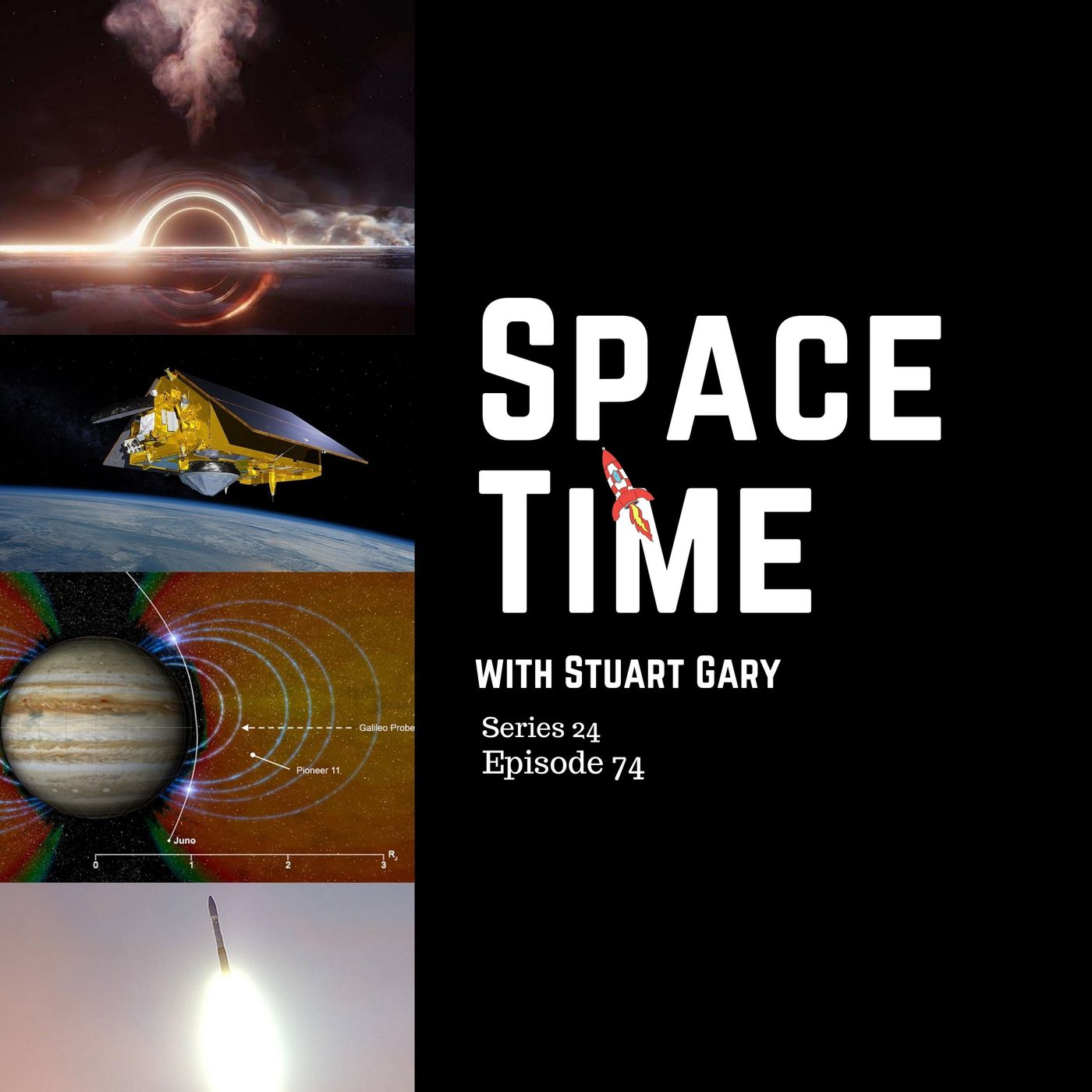
*Are supermassive black holes collapsed dark matter halos
A new study suggests that supermassive black holes could be formed out of the collapse of dark matter halos.
*Sentinel’s ocean data starts flowing
After six months of check-out and calibration in orbit, the Sentinel-6A spacecraft has started providing its first data streams of the world’s oceans and how they’re being affected by global warming.
*Juno detects a new Jovian high energy radiation source
NASA’s Juno spacecraft has discovered a new heavy high energy radiation source in Jupiter’s radiation belts – which are already considered the most intense in the solar system.
*America launches three new spy satellites on a converted nuclear missile
NASA's Wallops Island Flight Facility on the Virginian mid Atlantic Coast has been a busy place of late with back to back rocket launches taking place.
*The Science Report
Study warns climate change is killing wildlife because when wild animals are hot, they eat less.
Researchers say drinking coffee may be good for your liver.
The world’s growing problem of microplastic pollution.
Study shows medium-sized dinosaur predators are wiped out from areas where T-Rex’s dominate.
Alex on Tech on the new TCL Wearable Display.
For more SpaceTime and show links: https://linktr.ee/biteszHQ
Become a supporter of this podcast: https://www.spreaker.com/podcast/spacetime-with-stuart-gary--2458531/support.
SpaceTime Series 24 Episode 74
*Are supermassive black holes collapsed dark matter halos
A new study suggests that supermassive black holes could be formed out of the collapse of dark matter halos.
*Sentinel’s ocean data starts flowing
After six months of check-out and calibration in orbit, the Sentinel-6A spacecraft has started providing its first data streams of the world’s oceans and how they’re being affected by global warming.
*Juno detects a new Jovian high energy radiation source
NASA’s Juno spacecraft has discovered a new heavy high energy radiation source in Jupiter’s radiation belts – which are already considered the most intense in the solar system.
*America launches three new spy satellites on a converted nuclear missile
NASA's Wallops Island Flight Facility on the Virginian mid Atlantic Coast has been a busy place of late with back to back rocket launches taking place.
*The Science Report
Study warns climate change is killing wildlife because when wild animals are hot, they eat less.
Researchers say drinking coffee may be good for your liver.
The world’s growing problem of microplastic pollution.
Study shows medium-sized dinosaur predators are wiped out from areas where T-Rex’s dominate.
Alex on Tech on the new TCL Wearable Display.
For more SpaceTime and show links: https://linktr.ee/biteszHQ
Become a supporter of this podcast: https://www.spreaker.com/podcast/spacetime-with-stuart-gary--2458531/support.
Get every episode summarized
Each time SpaceTime with Stuart Gary publishes, we email you a written briefing from the transcript — the topics, who appeared, and any specific claims, with the ad reads skipped.
Email me new episodesFree for 3 shows. No card needed.
Hosts & guests
No transcript yet
This episode has not been transcribed. Request it and it moves to the front of the queue.
More episodes
More from SpaceTime with Stuart Gary

Comet Births and Neptune's Secrets
SpaceTime with Stuart Gary
Sep 11, 202622:27completed
Molten Planets and Solar Storms: Unveiling Cosmic Wonders
SpaceTime with Stuart Gary
Sep 9, 202634:16completed

Dark Matter Signals and Lunar Origins: Exploring the Universe's Mysteries
SpaceTime with Stuart Gary
Sep 8, 202625:39pending

Discovering Blazars and SpaceX's New Spaceport
SpaceTime with Stuart Gary
Sep 4, 202618:54pending