About this episode
1.Lord Rama’s Chapel was found in UR, Iraq.*
2.A burial ground called as Nagar is fond in Syria. It is called Tel Brak now.
3.Idols of Rama,Sita and Lakshmana are found.*
4.Ancestors of the Syrians were the Halaf and Ubaid.
They date back to 6100 BC.
They had connection with the Tamils and this is reflected in the ruins of Nagar.*
These people traded with the Tamils.
”Naram-Sin traded with Meluhha (almost certainly corresponding to the Indus Valley civilization), and controlled a large portion of land along the Persian Gulf. He expanded his empire by defeating the King of Magan at the southern end of the Persian Gulf, and conquering the hill tribes to the north in the Taurus Mountains.
5.Akkadian’s( Forefathers of the Sumerians) Moon God was Naram Sin, Narasimha.*
6.There are repeated references in the Sumerian/Akkadian language to Meluuha.
7.Ancient Tamil Brahmi Scripts were found in Oman and Egypt.
These facts establish that,
The Tamils were an advanced civilisation by 2200 BC(Akkadian Empire)
The Hindu Gods and Goddesses were worshiped in Sumeria,
Names of Lord Rama and Bharata were found in the Kings List of Sumeria.’
‘A Tamil-Brahmi script inscribed on a potsherd, which was found at the Khor Rori area in Oman, has come to light now. The script reads “nantai kiran” and it can be dated to first century CE, that is, 1900 years before the present. The discovery in the ancient city of Sumhuram has opened a new chapter in understanding the maritime trade of the Indian Ocean countries, according to specialists in history.
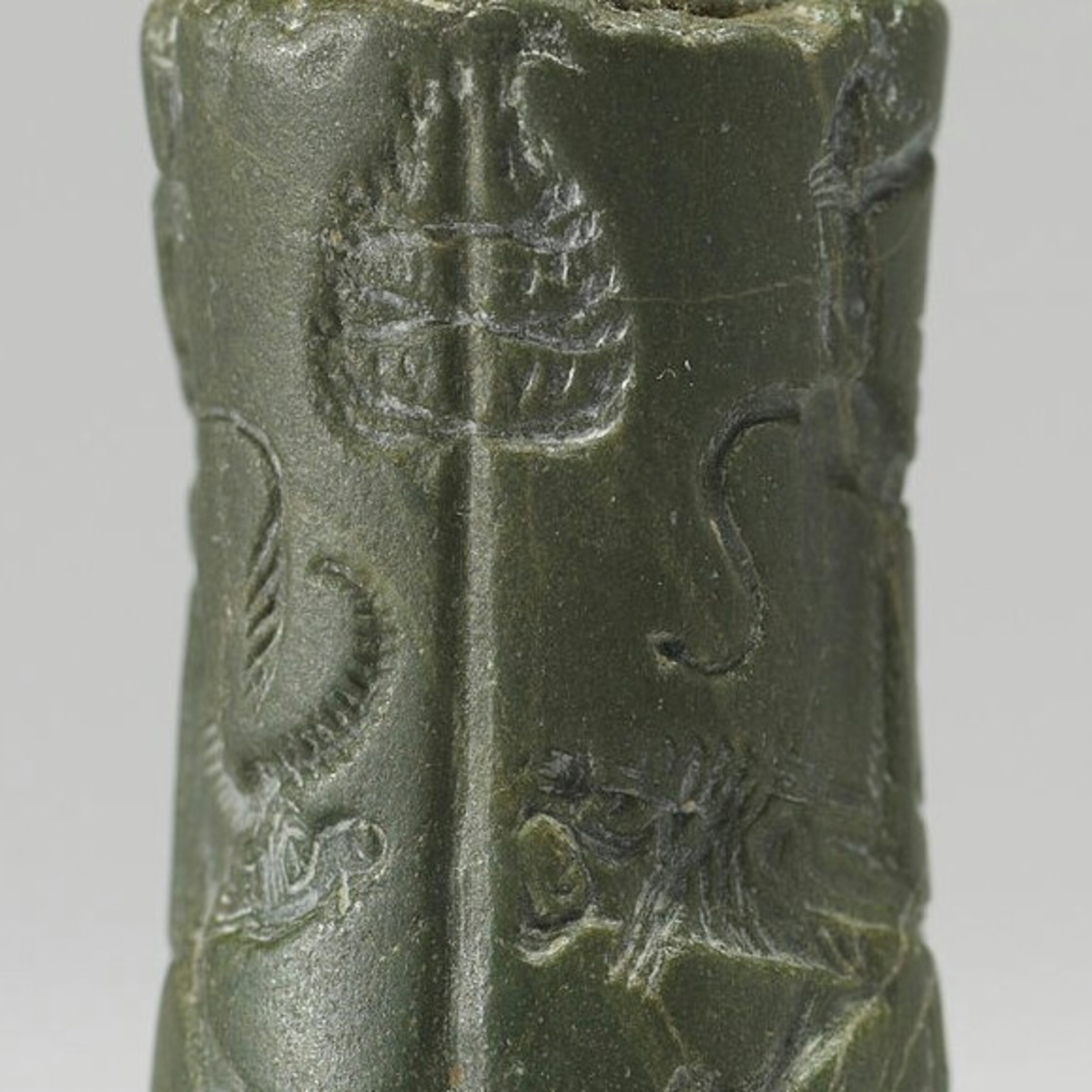
Tamil city in Sumeria 2200 BC
OM in Sumerian Prayer 2600 BC
Haran Shiva In Turkey
Please read the related posts of the above as well.
Who are Akkadians?
‘
The Akkadian Empire /əˈkeɪdiən/ was the first ancient Semitic-speaking empire of Mesopotamia, centered in the city of Akkad/ˈækæd/ and its surrounding region, also called Akkad in ancient Mesopotamia. The empire united all the Akkadian and Sumerian speakers for the first time under one rule. The Akkadian Empire controlled Mesopotamia (modern Iraq, Kuwait, northeast Syria and southeast Turkey), the Levant (modern Syria and Lebanon), and eastern and southern parts of Anatolia(modern Turkey) and Iran, sending military expeditions as far south as Dilmun and Meluhha (modern Bahrain and Oman) in the Arabian Peninsula.
During the 3rd millennium BC, there developed a very intimate cultural symbiosis between the Sumerians and the Akkadians, which included widespread bilingualism. Akkadian gradually replaced Sumerian as a spoken language somewhere between the 3rd and the 2nd millennia BC (the exact dating being a matter of debate).
The Akkadian Empire reached its political peak between the 24th and 22nd centuries BC, following the conquests by its founder Sargon of Akkad (2334–2279 BC).
Now there is a theory that Rishi Angirasa was worshiped/funded the Akkadian Empire
There seven Seers of Hinduism, who, at the beginning of every time cycle formulate the code of conduct, texts to follow.
These are called Saptha(7) Rishis.
They are.,
Atri,
Bhrigu,
Kutsa,
Vasishta,
Gautama,
Kasyapa and
Angirasa.
Now. the theory states that.
‘The supreme deity of the Sumerian pantheon is AN, or Anu. In the first two letters of the Sanskrit word An-gir-as, AN could refer to Anu. GIR might relate to the Akkadian fire-god— fire a..https://ramanisblog.in/2016/11/04/angirasa-founder-pre-sumerian-civilization-akkadian-empire/#:~:text=The%20Akkadian%20Empire%20reached%20its,(2334%E2%80%932279%20BC).
Get every episode summarized
Each time Hinduism History Practices Mantras publishes, we email you a written briefing from the transcript — the topics, who appeared, and any specific claims, with the ad reads skipped.
Email me new episodesFree for 3 shows. No card needed.
No transcript yet
This episode has not been transcribed. Request it and it moves to the front of the queue.
More episodes
More from Hinduism History Practices Mantras

Mrutunjaya Stotram by Markandeya
Hinduism History Practices Mantras
Jan 12, 20263:22pending
Surya Upanishad
Hinduism History Practices Mantras
Oct 2, 20255:22pending

Dhoomralochana Vadha Chapter 6 Durga Daptashati
Hinduism History Practices Mantras
Feb 5, 20253:56pending

Sri Vidya Explained,Texts Sources
Hinduism History Practices Mantras
Feb 5, 20259:19pending