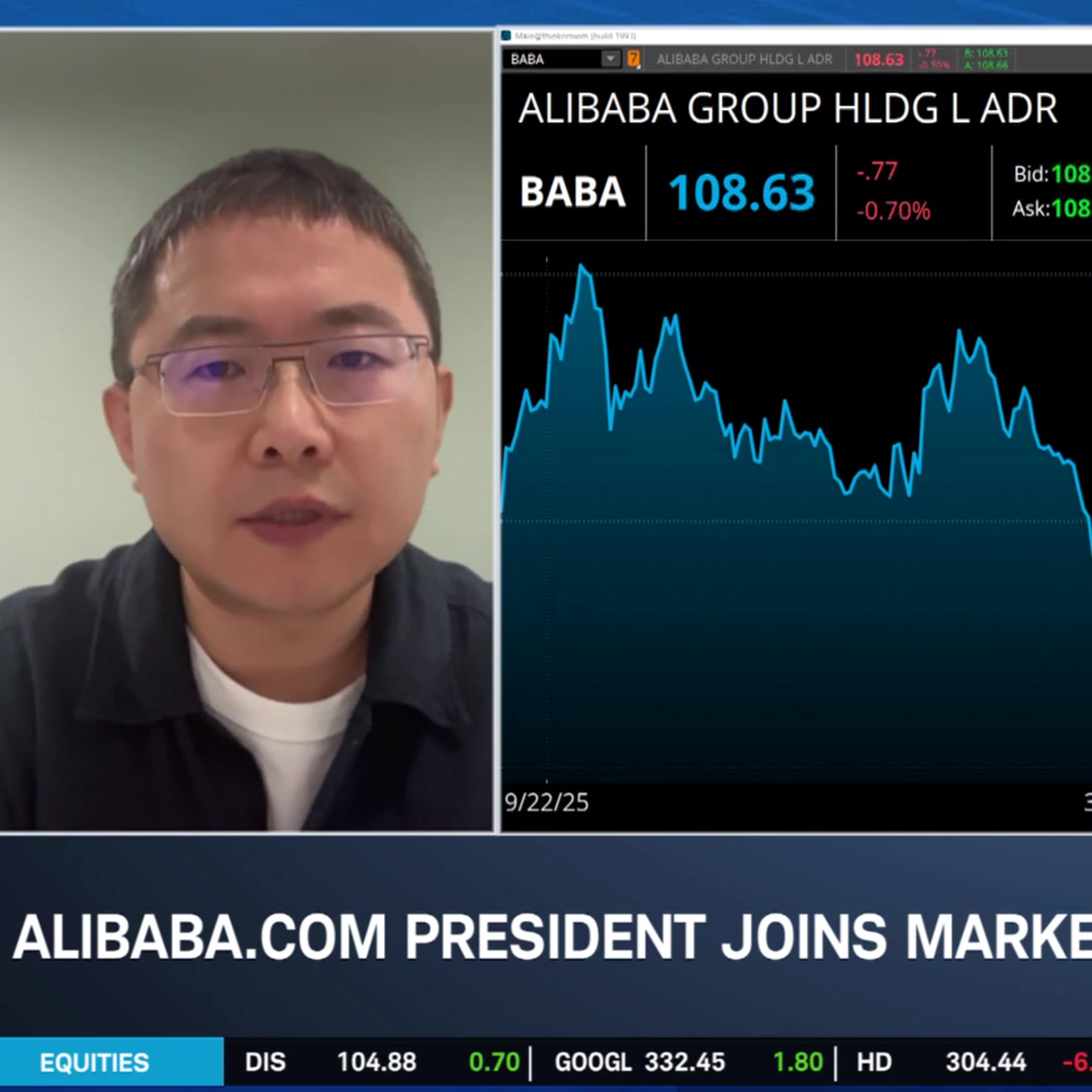
Alibaba.com President on Accio AI, Global Ecommerce & "A2A" Business
About this episode
Kuo Zhang, president of Alibaba.com, joins Market on Close to explain how the AI buildout is impacting the global commerce space, especially for smaller businesses. He also offers insight into Alibaba's Accio AI agent and ways the company balances tech costs with efficiency. Kuo makes the case that B2B is evolving into A2A (agent-to-agent).
======== Schwab Network ========
Empowering every investor and trader, every market day.
Subscribe to the Market Minute newsletter - https://schwabnetwork.com/subscribe
Download the iOS app - https://apps.apple.com/us/app/schwab-network/id1460719185
Download the Amazon Fire Tv App - https://www.amazon.com/TD-Ameritrade-Network/dp/B07KRD76C7
Watch on Sling - https://watch.sling.com/1/asset/191928615bd8d47686f94682aefaa007/watch
Watch on Vizio - https://www.vizio.com/en/watchfreeplus-explore
Watch on DistroTV - https://www.distro.tv/live/schwab-network/
Follow us on X – https://twitter.com/schwabnetwork
Follow us on Facebook – https://www.facebook.com/schwabnetwork
Follow us on LinkedIn - https://www.linkedin.com/company/schwab-network/
About Schwab Network - https://schwabnetwork.com/about
Get every episode summarized
Each time Schwab Network publishes, we email you a written briefing from the transcript — the topics, who appeared, and any specific claims, with the ad reads skipped.
Email me new episodesFree for 3 shows. No card needed.
Transcript ready
150 searchable segments. Every word is indexed and playable.
Full transcript
Schwab Network — Alibaba.com President on Accio AI, Global Ecommerce & "A2A" Business. Machine-transcribed; use the interactive transcript above to jump the player to any line.
Joining me now to discuss the role of AI in the future of e-commerce is Quo Zheng, the president of Alibaba.com. Quo, thank you so much for being with us today. Let's start broadly here. I mean, AI is rapidly changing the way that businesses operate. As we look more specifically at small businesses, how is it affecting how they're actually getting launched and how they're operating, particularly for entrepreneurs who don't have large teams or large amounts of resources when they start? You said a very good point that what we think AI today is a kind of a gendered team that you can delegate to your work to. And what it most can help for SMBs who would like to access the capability, the supply chain that normally only the big companies can help. And XU actually is a tool to help SMBs from sourcing from globally and also manage their work front, their storefront, manage their business.
And XU actually is the first AI workspace for e-commerce. That is how we design it. And so XU was designed to help with pretty much everything. I mean, from market research to product development, I watched your videos about it and it looks incredibly capable of sourcing logistics. How much of the traditional work of starting a business can AI now realistically take off of an entrepreneur's plate? It's a good question. So what we are focusing on more of the repetitive works. The repetitive works, for example, you talk about sourcing. So they need to kind of start from an idea and generate these impacts. Talk to thousands of suppliers and then select what. So in general, it takes for months, now is the help of AI. It can happen in hours or days. And the seller need to kind of sell the product in multiple platforms and they need to manage
the listings in different platforms and manage the customer support and also manage the data. So did they make money or not? And these repetitive works can be handled by AI as well. So those are the things that we think AI can help the most. And you just released a benchmark at Co.Creat showing that Axio actually completed 107 commerce tasks at more than 50% lower the estimated cost of open AI's codex and of anthropics quad code. What is allowing you to deliver comparable performance at a fraction of the cost? Okay. This is a great question. So we have a formula. The agent equals to model, multiply harness and multiply context. And for models actually, we are defining or we are routing different tasks, different jobs to different models to make sure that we use the best model and the most cost efficient
model to solve the red questions. And also we did a lot of tools, a lot of context and management to make sure that we can deliver the reliable result with the most meaningful cost. We think that a affordable AI is a useful AI. That SMPs don't have too much budget on that and they rely on the agent to do the daily work. And that's why we spend a huge of efforts to do that. And one of the things I noticed in your Co.Creat presentation about using Axio and some of the capabilities here is that it can actually take work off your plate like negotiating with the suppliers at the end. The human steps in and make sure to make the agreement. But as we move more into AI, doing processes like that, giving, from giving recommendations to actually doing the negotiation with suppliers, calculating, landed, cost, booking shipments, if there's a mistake, that would become much costlier. So how do you make sure that businesses can trust the AI agent to take these actions?
So the most important part we think is that boundaries. So the example you gave is that in the final step, you select weak partners you work with. So that part that we cannot let AI to decide for you, you need to make decisions. When you make the payment actually, is the human that need to make sure these are the terms, the contracts, the price, you're a great on. And then you can make decisions whether you take it or not. And these critical decisions that need to be happened to human is not that the AI can take everything from your plate. That is how we deal with it. And how does a small business go about measuring the ROI on an AI agent when they're looking at the overall efficiency? Is it time saved? Is it at lower sourcing costs, higher margins, increased sales? Or is it just ultimately that your business can operate with fewer employees? So first of all, how to define a business successful?
Actually, that is highly rely on the owner himself. So they may optimize on the margin part or they optimize on how much product I can sell to scale part. And we actually did when the business is running that is this owner to set up the goals whether it's achievable or not. I think current what we can help the business owners, first of all, to help them to access more of the supply chain network, help them access more of the tools that are expertise they do not have. And also we improve the efficiency of their daily job. And also we can tell them that the mistakes they may find before. Ultimately, it's going to be the revenue per person. So for the SMEs, if they can increase the revenue per person because of AI, that is a great help for them today. And so then how close are we to a world in which case a solo entrepreneur can effectively
operate a global e-commerce business with an AI team? We already see a few examples if you like to hear that last year we had two champions, one in we call it co-cred pitch, it's just like a shark tanks. So the one in US is recon tools so that the owner is Christian Reid. Actually, he has a small team and he has a great idea to improve the tools for construction to to mirroring. And this help of AI and of course, visit help of aliboe.com reached the global supply chain. So now he already built a big business and this customer, the customer list on his on his currently current business is including SpaceX, including the Schneiders. The small team can make business, big business, not only this big team, big company.
So that is the way that how we evaluate the agent can help the customers. And we think is already happening. And in the future we think B2B is evolving to A2A, is agent to agent. So agent can represent a buyer and agent can represent suppliers. So that way you can do things much faster and much efficient than before. So if we get A2A, agent to agent where the agents can actually negotiate and transact with one another, what would that fundamentally change about global B2B trade? I mean, could it ultimately make it possible for these smaller companies like Christians that you just highlighted there to compete with businesses that traditionally have had much greater resources? How can the SMBs have the level of kind of the big companies can have today actually the ultimate goal for all this technology, including the internet, including the agent, the AIs
we are providing today? And I think what we can see in the future, the first is more and more SMBs can participate in the global trade or participate in the global competition. So we don't limit the resources. They have a great idea and we can have tools, have some collections to help them to build that idea to a product and help them to promote to more people to the global market. And that is what we are doing today. But again, as in the most important part is first entrepreneur to define what problem they're going to solve. The idea needs to be solid and entrepreneur needs to define what the success needs. The reason of their business, these are the things that still need from the entrepreneurship of that leader and AI are the tools help them to accelerate. So that is our design of our tools. So quote, if these AI agents eventually handle much of the discovery, the negotiation
and the transaction itself, obviously under the control of the entrepreneur, what becomes the most valuable asset in global commerce then? Is it the marketplace, the data, the AI model itself or the trust between the businesses? If you talk about what define kind of entrepreneur, a great entrepreneur, great leadership, I think we mentioned some of that. So still, you need to have a great idea to solve a problem. We believe that the competition of AI is globally. That value that created need to be local is that a person who found a problem in his neighborhood and he wants to solve that problem. Then he comes up with the idea build up a business and it leveraged the AI leverages supply chain to fulfill his dream. And what we can help them is to using all the tools, all the supply chains and all the tools help them to sell to more people.
And the core part is still what problem you're going to solve. Is that problem a real problem? Is that problem can scale to more people? And how you control your business at the starting point, as a scale point and also as a mature point, how to control the rhythm of your business. Those entrepreneurship is still very rare currently to make sure that business is a success business. And what we all provided, I think in the end is the tools, supply chains and automations. And how to define the success business to you based on human. A lot more dreams coming to fruition thanks to the help of AI for sure. Quo, really appreciate you taking the time to be with us to highlight allebaba.com's Axiom platform and what it's doing. Quo Zheng, the president of allebaba.com. Thanks again for joining us.
More episodes
More from Schwab Network

Stock Market Today: ORCL & ADBE Earnings, AEO Plunges Near 52-Week Low
Schwab Network

Thursday's Final Takeaways: Crude Taps $103 & PPI Hotter than Expected
Schwab Network

Balancing High-Conviction AI With High-Dividend Diversification
Schwab Network

EARNINGS PANEL: ORCL, ADBE
Schwab Network