Airline "Demand Destruction" Risk & Options Trade Amid Iran Volatility
About this episode
United (UAL), American (AAL), and Southwest Airlines (LUV) among related travel stocks all experienced price turbulence as tensions flare between the U.S. and Iran. David Nelson explains how "demand destruction" present short and long-term headwinds for the travel industry. That said, David sees Delta Airlines (DAL) as the best positioned. Tom White offers an example options trade for United.
======== Schwab Network ========
Empowering every investor and trader, every market day.
Subscribe to the Market Minute newsletter - https://schwabnetwork.com/subscribe
Download the iOS app - https://apps.apple.com/us/app/schwab-network/id1460719185
Download the Amazon Fire Tv App - https://www.amazon.com/TD-Ameritrade-Network/dp/B07KRD76C7
Watch on Sling - https://watch.sling.com/1/asset/191928615bd8d47686f94682aefaa007/watch
Watch on Vizio - https://www.vizio.com/en/watchfreeplus-explore
Watch on DistroTV - https://www.distro.tv/live/schwab-network/
Follow us on X – https://twitter.com/schwabnetwork
Follow us on Facebook – https://www.facebook.com/schwabnetwork
Follow us on LinkedIn - https://www.linkedin.com/company/schwab-network/
About Schwab Network - https://schwabnetwork.com/about
Get every episode summarized
Each time Schwab Network publishes, we email you a written briefing from the transcript — the topics, who appeared, and any specific claims, with the ad reads skipped.
Email me new episodesFree for 3 shows. No card needed.
Transcript ready
99 searchable segments. Every word is indexed and playable.
Full transcript
Schwab Network — Airline "Demand Destruction" Risk & Options Trade Amid Iran Volatility. Machine-transcribed; use the interactive transcript above to jump the player to any line.
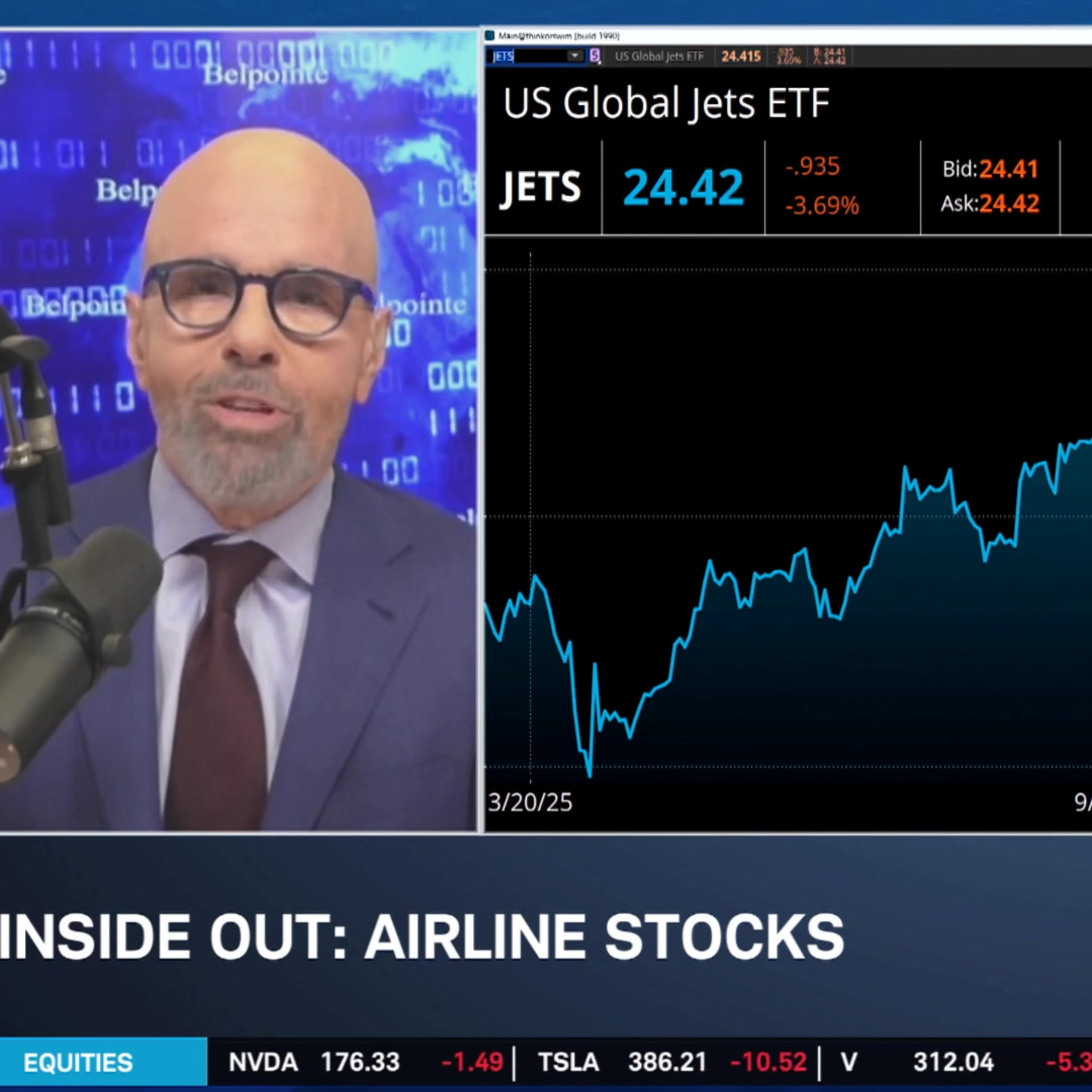
We're back on Morning Trade Live, here's where the major airlines are trading currently to start the week. These have been obviously the pressure points where we've seen the heavy losses over the course of the last week or so. American Airlines down almost 5% delta down 4.5. Southwest Airlines not bearing as bad down 4% but United is copying the brunt of it right now down 6.3% as we stand. So some heavy heavy selling pressure across it. Some of our consumer facing stocks are particularly for the airlines on oil that's now in triple digits. So let's go inside out on these airline stocks. Stocks joining us now is David Nelson, Chief Strategist of Bellpoint Asset Management. David, thanks so much for joining us. You say the airlines walked into this crisis naked. That doesn't sound good. Just talk us through your thoughts here. Yeah, they are completely naked. USC Airlines walked into this crisis completely unhedged. You know, they abandoned their hedges really at the bottom when oil was cheap. I think there's some airlines in Europe that have hedged. Maybe the best situated is Delta. They actually
owner refinery. That isn't kind of a structural advantage. Maybe above any US carrier right now. The dead man walking is American Airlines. They are really the most exposed in the group. 36 billion in dead. No hedges. You know, to me, this is an airline you really want to avoid even in the best of times. And the problem right now is that oil stays above $100 through summer. You're looking at, you know, real potential demand destruction. We started the show talking about the potential for the degree of short-term demand destruction and obviously showing up in the airlines is where we first look. Some of the consumer facing parts of this market, the cruise lines are getting punished as well. I'm just wondering, I mean, what does this mean for that travel bull market that everybody had been talking about? Because I mean, the airlines have been holding up quite well. I mean, they kick off these earnings season, really just smashing it out of the park with filling the front of the plane. Things are better than we anticipated. I mean, is it just oil that's going to
weigh on these boats? It's not. It's, you know, this is the Achilles heel of the travel industry. It's geopolitical conflict, you know, somewhere on the planet. It always comes from out of the blue. You wake up on a Saturday morning or Monday morning or Tuesday morning. I've lived through three or four of these at this point. You know, I was fully invested in airlines on 9.11. So I know what it's like. It's less, it's been blunted over the years because investors understand that these are, you know, temporary hits in the earnings stream. Airlines and cruise are probably the most volatile and so subject to oil. You've seen jet age jump from 250 to over $4 a gallon, just in, you know, in maybe in the last week. Get very tough, very difficult to do the math when you see something like that. Okay. So you're looking at those who are a little bit better positioned as far as being hedged, obviously, some exposure to that supply chain helps. As you mentioned, you've named a couple that maybe won't perform as well. What about overseas, then, David?
I mean, you know, some of the European airlines are also out in the Asia Pacific because they saw that, you know, airlines like Qantas and Singapore had been down, even though not a lot of their roots have actually been disrupted by this conflict. It's contagion, you know, when investors start to sell a group, they just sell everything in hand and they get frightened. And for good reason, I think from what I understand and I don't really cover the European markets all that much, but I believe some of the European airlines are hedged. But geopolitical conflict like this, there's whole, you know, there's a whole area of the planet that you can't go to right now. All eyes are focused on the straight of her moves. Maybe the, the most important 21 miles of waterway anywhere on the planet. And until that opens up and right now, de-escalation seems very, very difficult. And it looks like the only way we're going to get ships through that is either with a US Navy escort and even that's going to need an insurance backstop. How is this different, do you think, David, from other conflicts and energy shocks that
we've seen? Because obviously we are dealing with an issue in the Middle East where you do typically also have not just the higher oil prices, but some of these airlines having to actually re-root around a difficult and dangerous part of the world as well. It's, well, maybe it's different in the sense that, you know, Iran, their military is probably pretty well degraded at this point. The question is, is there an off ramp? And right now, there doesn't seem to be. They've appointed the son of Kamini, who's now the head of Iran, so any chance of an off ramp seems out of reach. Trump is already set on acceptable. Israel may even be in motion right now to take him out. However, their missile stockpiles are depleting, and it's going to be very, very interesting to see if any of the ships get through, if they've somehow let China somehow go through. So until this is resolved in some fashion,
I don't think you're going to see the travel industry, you know, find its feet. Yeah, and it came at a time when we were just almost seeing the travel industry somewhat finding its feet off the initial tariff impact as well. And, you know, obviously, people saying that it was a lot better than they had anticipated this time last year, but David, really fascinating chat. Thanks so much for getting us across your thoughts this morning on the airlines. David Nelson, you're welcome. Chief strategist, Bell Pointe, to asset management. All right, let's trade it now with Tom White, host of Fast Market. We're looking at United Airlines this morning. So, very much worse than the rest of them. One of the other performers, actually, on the S&P 500, just talk us through an example trade and an approach for this one, Tom. Yeah, it's been a following night for a lot of the airlines, and that's surprising, right? You know, fuel oil, fuel jet fuel prices are going to go right to margins for a lot of these airlines. And then also the fact that maybe the disruptions in air travel in the Middle East. Now, a lot of the airlines have, don't have a lot of exposure. You look at Delta United,
I think United's got about one and a half, two percent of their potential flights go in and around the Middle East. So, not a huge impact, but it's all going to be about jet fuel prices moving forward, which is cutting into those margins. That's why you're seeing stock down about 24 percent this year off over 6 percent today. So, I looked at a strategy. It's kind of twofold where, hey, I'm willing to buy the shares if the stock continues to fall. But if it doesn't continue to fall, I can still profit from this type of strategy. So, I looked at a neutral to bullish cash secured put here in United Airlines where I'm going to sell and out of the money put to the downside. Now, it's a really short term type of position. I just went out to the March 27th weekly option. So, just 18 days to expiration. And we're going to sell one of the 80 strike puts. You're going to collect a credit of roughly about three and a half bucks for this short short cash secured put. That takes your break even down to $76.50 to the downside over the next
two and a half weeks. That's about 11 percent below the current share price in United Airlines. The probability that that short strike, the 80 strike will be out of the money at expiration is about 60 percent. So, you've got that higher probability of success. But look at it this way. If you put a bid in for the stock at $76.50 for 100 shares or a thousand shares, you might not ever get filled on that. So, if you sell a cash secured put at the 80 strike that you collect 350 yet. That's what you can make. You're in a $50 per put. And it, but it takes your break even down to $76.50. So, if the stock does fall below 80, you can buy the shares. You get assigned. You can buy the shares at $76.50. So, that's an 11 percent discount to the current share price. And if you don't, if the stock doesn't go below 80, you just get to keep the credit that you collected, which is elevated because implied volatility levels are pretty high at this point. They certainly are, as we see this pullback across some of these names. And as we mentioned, UAL being one of the hardest skit to this morning,
down 6 percent, one of the worst performers on the SPX. Tom really appreciated, thanks for giving us some of the context of the example trade on this particular name. And we are pairing losses here, suffice to say, for these markets. But we continue to see a risk off tone in equities today.
More episodes
More from Schwab Network

Stock Market Today: ORCL & ADBE Earnings, AEO Plunges Near 52-Week Low
Schwab Network

Thursday's Final Takeaways: Crude Taps $103 & PPI Hotter than Expected
Schwab Network

Balancing High-Conviction AI With High-Dividend Diversification
Schwab Network

EARNINGS PANEL: ORCL, ADBE
Schwab Network