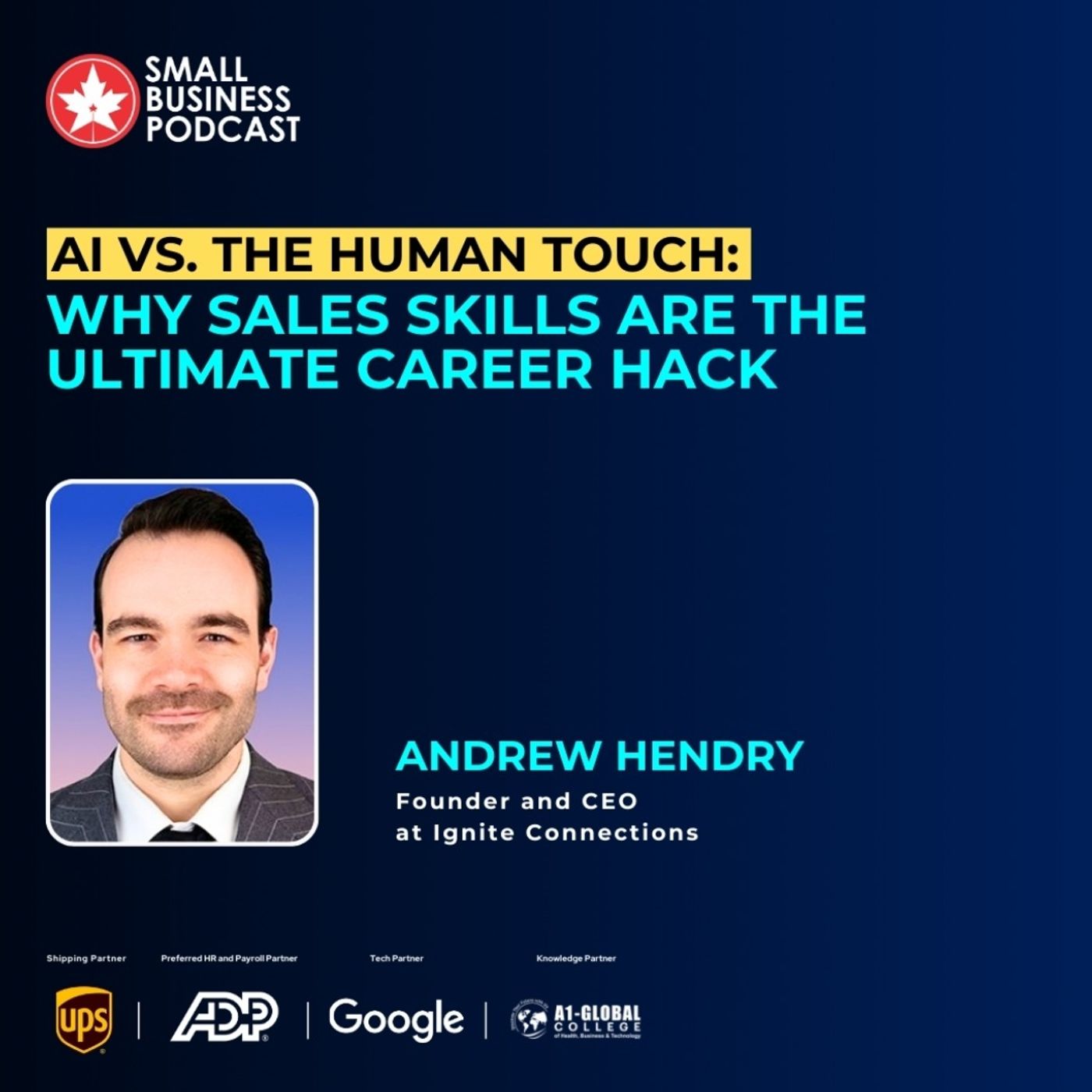
AI vs. The Human Touch: Why Sales Skills are the Ultimate Career Hack
About this episode
Welcome to the CanadianSME Small Business Podcast, hosted by Maheen Bari. In this episode, the focus is on why sales remains the foundation of entrepreneurship, especially in a 2026 landscape shaped by AI and automation.
Our guest is Andrew Hendry, Co-founder and CEO of Ignite Connections and author of Be First: Outsell Everyone. With over a decade of high volume sales experience and a client base of more than 1,000 real estate agents across the USA, Andrew shares practical insights on authentic connection, disciplined outreach, and scaling across borders.
Key Highlights
- Sales as the Core Skill: Why mastering sales is the most critical advantage for entrepreneurs in 2026.
- Be First Principle: One actionable tactic founders can use immediately to stand out and win attention.
- AI and Authenticity: Why technology enhances but never replaces genuine human connection.
- Scaling Internationally: Key lessons learned expanding from Canada into the US market.
- Power of Mentorship: How coaching accelerates growth and prevents costly early stage mistakes.
Special Thanks to Our Partners:
- UPS: https://solutions.ups.com/ca-beunstoppable.html?WT.mc_id=BUSMEWA
- Google: https://www.google.ca/
- A1 Global College: https://a1globalcollege.ca/
- ADP Canada: https://www.adp.ca/en.aspx
For more expert insights, visit www.canadiansme.ca and subscribe to the CanadianSME Small Business Magazine. Stay innovative, stay informed, and thrive in the digital age!
Disclaimer: The information shared in this podcast is for general informational purposes only and should not be considered as direct financial or business advice. Always consult with a qualified professional for advice specific to your situation.
Get every episode summarized
Each time CanadianSME Small Business Podcast publishes, we email you a written briefing from the transcript — the topics, who appeared, and any specific claims, with the ad reads skipped.
Email me new episodesFree for 3 shows. No card needed.
Hosts & guests
Transcript ready
200 searchable segments. Every word is indexed and playable.
Full transcript
CanadianSME Small Business Podcast — AI vs. The Human Touch: Why Sales Skills are the Ultimate Career Hack. Machine-transcribed; use the interactive transcript above to jump the player to any line.
Welcome to the Canadian SME Small Business Podcast, a podcast for Canadian Small Businesses. We interview Canadian experts and entrepreneurs to provide expert insight into marketing, innovation, business leadership, technology, and trends that impact small businesses. Whether you're just getting started or already established, UPS is here to help you make the most of your time. Their services, tools, expertise, and team of UPS Small Business Ambassadors can help businesses with all sizes, simplify processes, improve customer experience, and guide you on the path to growth. My name's Elaine Tank-Komo, founder of Easy Dazies, the official schedule for kids, and I want to invite you to visit UPS.com to learn more and save up to 52% or more on shipping. This is a paid advertisement. Hi everyone, this is Mahina. Welcome to the Canadian SME Small Business Podcast. Today we're going to explore why the ability to sell
isn't just a business skill, it is a very foundation of entrepreneurship itself. Because in the 2026 world, which is saturated with AI and automated outreach, the leaders will win are those who can cut through the noise with authentic human connection and the discipline to be first in every market they enter. Joining us to discuss this very important topic is Andrew Hendry, the founder and CEO of Ignite Connections. Andrew is a seasoned sales veteran with over a decade of experience and hundreds of thousands of personal sales calls under his belt. Since founding Ignite Connections in 2020, he has scaled the company to support over 1,000 real estate agents across the USA, helping them stop chasing leads and start closing appointments. He's also the author of the Powerhouse sales book, Be First, outsell everyone, and we'd love to delve deeper into what Andrew has to offer. So without further ado, let's dive in and welcome Andrew. Andrew, are you pleased to have you on the show today? Welcome to the podcast. How are you? Thank you very much. I'm doing great
thanks for having me. I got to say the intro. I'm going to start using that for internal communications. That was, please do. It was, it was quite a mouthful, but honestly, not much to unpack for listeners and we're very excited to do that. Now Andrew, you often say that selling ideas is an absolute cornerstone of being a successful entrepreneur, regardless of the industry. So let's really begin our conversation by understanding the sales foundation of entrepreneurship. Please tell us why is sales most critical scale for a new entrepreneur is in 2026? Yeah, that's, that's a really good question. It's, I think the two words are almost the same word entrepreneurship is selling. You know, from day one, and it doesn't really matter what kind of business that you're in, like it or not, you're, you're going to be selling to someone along the way. Maybe you need capital, right? Maybe right out of the gate, you need capital. You're going to need to sell your idea to a VC, your venture capital is firm. If you don't need money because you're going to bootstrap it, no problem. And you're going to need to get on the phones and sell your product to people yourself.
You know, you want to, you do want to scale a team? Sure, you're going to need to sell your idea to your team and not just once, but every day, right? At each stage of your business, you are selling at a bit of a different angle, but, but make no mistake about it, that that you're always selling. And if you ask me, this might not be the case in my company, but I think sometimes I think it is, sometimes I think it isn't. But I think the founder needs to be the best salesperson in the company for a lot of reasons. And I think it's because again, you need to constantly resell your ideas and resell the dream and the vision to everyone with whom you come in contact. Well, that is a great reminder that if you can sell why behind your business, then the what and the how they simply won't matter or to the market. So I love that. Now, Andrew, let's explore how you're a leaf first, mindset and the real world sales tactics set the pace for performance. We said, what is that one actionable insight from your book entrepreneurs can use today? The book. Oh, yeah. Yeah. I guess we can talk about that too as well. Yeah. Thanks for
bringing that up. That's a really exciting thing for me and for our team in a lot of ways. I think as any entrepreneur will probably relate red way to many books to the point where there's just a lot of information in there that maybe some of it's great. A lot of it maybe not as good. But what I found is that in all of these books about psychology and persuasion, I've always found it very theory based. And so every morning for the last six years, I've stood up in front of my sales team, whether that's been two people or 52 people. And then we train, we train on sales, or train on tactics. We train every morning on specific things that can actually help them sell better, right? And so I just kind of realized after a couple years that we ended up talking about the same sort of core components every single day over and over again, that really were the critical pieces that separated some of our top performers for maybe the ones that weren't at the top. So after a while, I figured, hey, we're doing all this training every day. Why not write it all down? So at first, it was going to be just sort of a playbook for like the training manual for for our team internally and for new hires that ignite. But I wanted to bring that, you know,
outside of the company and bring it to the marketplace in general, because I know there's a lot of people who, again, whether you're an entrepreneur, whether you're in sales or maybe even just in general, you communicate with people. Sales is a big key. So the book, I think, has 180 or so actual practical tips. So to pick one might be a challenge, but I think something that comes comes to mind quickly, probably would be about about thinking creatively. I think that you mentioned in your intro very, very well. The endless sea of noise and just there's just everyone's trying to sell something to somebody. There's so much out there that's being offered and especially nowadays where it's so available to us visually. I'm sure if you're on Instagram today, you're going to get hit with a hundred ads inside an hour, right? And so it's just there's so much noise and to cut through that noise, I think it's really important to be able to stand out. And I think sometimes people feel boxed in maybe by their company or by their own limitations mentally and what they can or can't do or what they think they can or can't do. But I think the more freely a salesperson or an entrepreneur can think about how to communicate with people and how to convert prospects,
the more differentiation you can have just by doing something that most people may not think to do. It's I'll tell a quick story about this. I trained under someone who used to work with very closely with quite a big name in the sales training space. And he was one of my early mentors. And he was telling me that he had been trying to convert this business on sales training for like eight months. They'd been going back and forth with this prospect. And the prospect has had gone a little boast as I'm sure we've all experienced a couple of times. And so what he did is he sent he sent a pizza to the person's office attention to the prospect. And he instructed the pizza place to remove a slice from the pizza before they delivered it. And to write on the inside lid of the box, our training is the missing piece to your business. Which I thought was such a it was such a creative way to get someone's attention like a pizza shows up that you're not expecting. Then you open it up and there's a piece missing and there's a message saying we're the missing piece. And so I think to be able to be creative like that in every aspect of business
just helps to differentiate at any time you need to be different. Right. So that is that is great in terms of telling us that hey, there's no excuses or approved being that first voice a customer here is. And that is clearly the difference between a lead and a signed contract. Next sets examine why human connection is a competitive edge in an AI driven sales landscape, Andrew. Is AI replacing sales or perhaps enhancing authentic relationships? Yeah, that's I guess that's the hot topic isn't it? Just the AI and all of that. I think honestly the answer to your question I think is in the question AI, but you know, break it down by definition is artificial intelligence. It's artificial. And when we think about the word artificial, I mean, if we even think about maybe like artificial sweetener, for example, by definition, artificial in the context of being made by people is not natural. It's not to real. That's that's the definition of it. And so I'd put the put the question to your listeners, how can
something not real serve as an adequate replacement for something authentic and real like human connection? And don't get me wrong. I'd be ignorant to think that AI is not replacing some things. I think it certainly is. And again, you said it beautifully in your intro. There's a lot of automation and a lot of tasks that people can replace with AI. But there are things that I definitely shouldn't and I frankly can't replace. And people ask me in other interviews as well if I think AI is going to replace salespeople as you have. And the answer is just simply no. That's I think is a salesperson. You need to maybe audit how you source your business and where you spend your time generating opportunity because of the majority of your days spend sending messages and it's sending LinkedIn DMs and finding the perfect prospect through research. And all of your communication is digital. You might want to try and see how you can spend more time at you communicating with people because that's the thing that won't be replaced. But if you close business and bring on new customers by speaking the way you and I are now, then AI ought to serve as
a tool to enhance your world by replacing some of that busy behind the computer work that you can spend more time at you in front of people. And as you put, you know, regaining that human advantage. That is a great insight, Andrea, really. And it tells us I'm using AI to handle the noise. So humans can focus on connection as how we turn a digital tool into a high performance partner. So thank you so much for highlighting that. Now let's look at how ignite connection scaled beyond borders to really serve 1000 US clients. That must have taken a lot of, you know, back and forth because Galea Canadian company nationally is no small feat. Andrew, what lessons did you learn scaling from Canada to the US? I think one of the big things is that especially in the modern age, we don't need to be limited by by physical borders or by geography in any way. You know, obviously, you know, you think back maybe to our parents or even our grandparents generation, if if they were going to start a business in Canada, very, very likely it was a
Canadian company that served Canadian people. And there's nothing wrong with that. But the marketplace outside of Canada is massive. I mean, we're a big land mass physically. We're very large. But the US, I think they have a population that's 10 times the size of ours. And they're right there. They're right next door. And so obviously, if we ever wanted to do a business meeting in the 1940s of the 1950s, stuff to hop on a plane, go down there, spend a few days like it's a whole thing. But you and I right now are speaking hundreds of miles apart and we're on Zoom, just like all of the technology enables us to be doing. And you know, I talked to a lot entrepreneurs who started a business who are thinking about starting. If I may spend just a lot of time planning every little detail before they think, okay, I'm ready to go to market. I can execute or take a step. And the reality is that I think just nothing's ever going to be perfectly ready or prepared. And that includes, you know, a target market. And so again, Canada is a big place. But depending on your business, Canada could be maybe, you know, a bad market for you to start in for whatever reason.
So my advice on the on the borderlessness of a business today is to go where your market is. If your market is in the US, but you live in Canada, we don't need to move to the US. You can you can be housed in Canada and work in the US. There's nothing there's nothing preventing you from doing that especially again by the marvels of communication technology. Why wouldn't you consider your options as immediately global? Mm-hmm. Now overcoming those water barriers through consistent performance and specialized expertise, it's what turns a local startup into a global player. So this was great. A view of a do share that experience with us, Andrew. Finally, let's highlight how mentorship and coaching feel long-term growth and leadership excellence. Please tell us why is coaching vital and what common mistakes could a mentor prevent? Yeah. You know, it's one of the reasons I was motivated to bring the book outside of our company. And it's because I find that especially in sales for whatever reason. I mean, you join a sports
team or a basketball. Everyone has a coach in sports. I think in sales and business is one of those things where I find people are kind of constantly and almost desperately looking around for help. And there's unfortunately so many places they can look that I think we have decision fatigue and where to go. So I think having a coach is really important for anybody right off the bat. And when you look at anyone who's incredible at anything, they all have a coach. And I think what I've always seen really interesting is that even when they become elite in their thing, they continue to have a coach. I mean, the Toronto Maple Leafs, the hockey team, they don't not have a coach on the bench. You know, these are the best hockey players in the world and they have a coach who's guiding them. Someone to keep an eye on your most microscopic efforts to help you adjust along the way. And so, being someone who has performed at a very high level in sales for the better part of the decade, I always make sure that I have someone to talk through my data with and really analyze where I'm doing well and where I can make adjustments to improve. And even now in my business, I have a mentor who is way further along than I am in the business
world who I can go to for that kind of guidance. And again, I mean, if coaches weren't important at a high level, then hockey teams and teams wouldn't have them at all. And I think it's like, coaching is so huge to make sure that you're accountable to your own standard of performance and the standard of performance that your team acquires up. You know, as far as mistakes, I can definitely speak to some mistakes that I've made along the way. And I think I think one of my biggest ones is something that I would give to listeners is to try not to assume that people know what your expectations are and try not to assume that people know how to meet your expectations. You hear a lot of mentors and coaches talk about, you know, you can't hit a target, you can't see, but it's the same thing when you're coaching a team. They need to understand with crystal clarity what you expect from them. And most importantly, and this ties back to an entrepreneur knowing how to sell, especially in a role like sales, it's your job to teach them continuously how to achieve the thing you expect them to achieve. And so as an entrepreneur,
as a founder, if you don't know how to sell and you're expecting your team to go to market and sell your product, you might have a hard time teaching people how to do that if you've never done it yourself. If you've never been the person who's actually gone to market and sold the product yourself. And so, you know, there's so many things that can get in the way if people's performance in sales that are outside their control. So I think as a mentor, you need to be there to push them through the hard times and give them the glory during the wins, right? You don't see a lot of coaches getting the praise and the glory for the wins. It's obviously always the players who get the glory, but make them a mistake that the coaches are there behind them. And that's how it should be, right? Being a coach isn't about that external glory. It's about helping people achieve what they want to achieve and the internal fulfillment of, you know, knowing you help them make it happen. This was a great response to really understand that value of mentorship and coaching. Andrew really tells us that investing in a coach is like buying a short card to lessons that typically takes years of failure, failure to learn. And they just don't help us solve problems.
They actually help us avoid them, accelerate our growth and really boost our confidence along the way. This was a great conversation, by the way. Thank you so much for all the expertise and the insights that you were able to share. Instead of a short amount of time with our listeners, as you wrap up, Andrew, if there is one piece of advice for Canadian entrepreneurs scaling today, what would it be? You know, this is business is one of those things where it's, it is a hundred times harder than you think it's going to be. It's a hundred times scarier, it's a hundred times more challenging and it's a hundred times worse than you think it's going to be at times. And so what brings people through that, I think, is if you're going to be an entrepreneur, my recommendation is that you align your beliefs, your internal beliefs at a basic level with what you are going to do as a business. You need to align your internal compass with what you're going to do because when, inevitably, the days, the weeks, the months, the years bring an onslaught of challenge, just seemingly endless flow of difficulty your way. If you're aligned with your beliefs
and what you believe about the world and your internal values are aligned with what you have to offer to the world, that in itself will pull you through the other side of all the challenge. Right. Well, that is a great reminder that everything in business, it starts with a successful sale. Thank you so much, Andrew, for joining us and for sharing such great insights and your expertise. Thank you. Thank you. Thank you. Thank you. And this says I was Andrew Hendry from Ignite Connections, a vital look at why the future works belongs to the people who master the art of being first and the science of human influence. Thank you so much for tuning into the podcast. Please be sure to subscribe and visit CanadianSemitadsia for more resources. Before we leave a special shout out to our partners, UPS, Avon Global College, Google and ADP, for their ongoing commitment to empowering small businesses across Canada. Please keep thriving and we'll see you in the next one.
More episodes
More from CanadianSME Small Business Podcast

The Health-Tech Giant: How VitalHub Built a $100M Global Software Empire
CanadianSME Small Business Podcast

How I Scaled 22 Stores in Canada’s Most Regulated Industry
CanadianSME Small Business Podcast

How Calgary Became One of North America’s Fastest Growing Innovation Economies
CanadianSME Small Business Podcast

The $100M Talent Secret: Why Wellness Beats Salary
CanadianSME Small Business Podcast