About this episode
In recent months, AI music has moved from novelty act into the realm of listenable music. For the first time, AI-generated songs from AI-generated artists are on the Billboard top 100 charts, and more musicians are coming out saying they use AI in their songwriting process.
Is this just another tech upgrade to the music-making process or does it signal something bigger in the industry? To investigate, SciFri producer and musician Dee Peterschmidt talks to journalist Kristin Robinson, who covers AI in the music industry, and Laurie Spiegel, an electronic and algorithmic music pioneer.
Guests:
Kristin Robinson is a senior writer for Billboard, based in Los Angeles, CA.
Laurie Spiegel is a composer and programmer based in New York, NY
Transcripts for each episode are available within 1-3 days at sciencefriday.com.
Subscribe to this podcast. Follow our show on Instagram, TikTok, Facebook, and Bluesky @scifri and sign up for our newsletters. Got a science question that’s keeping you up at night? Call us: 877-472-4374
Hosted by Simplecast, an AdsWizz company. See pcm.adswizz.com for information about our collection and use of personal data for advertising.
Get every episode summarized
Each time Science Friday publishes, we email you a written briefing from the transcript — the topics, who appeared, and any specific claims, with the ad reads skipped.
Email me new episodesFree for 3 shows. No card needed.
Hosts & guests

Transcript ready
254 searchable segments. Every word is indexed and playable.
Full transcript
Science Friday — AI Music Is On The Charts. Where Does It Go From Here?. Machine-transcribed; use the interactive transcript above to jump the player to any line.
Science Friday is supported by MathWorks, creator of MATLAB and Simulink software for technical computing and model-based design, MathWorks, accelerating the pace of discovery in engineering and science. Learn more at mathworks.com. Science Friday is brought to you by progressive insurance. You chose to hit play on this podcast today. Smart Choice. Make another smart choice with auto-quote explorer to compare rates from multiple car insurance companies all at once. Try it at progressive.com. Progressive casualty insurance company and affiliates, not available in all states or situations. Price is very based on how you buy. Life's busy. Don't let banking slow you down. Whether you're paying bills, setting savings goals, or just splitting the check. Atlantic Union Bank makes managing your money, easier. With helpful people and user-friendly tools, we make sure banking with us fits you.
Call, visit us online, or drop into an Atlantic Union Bank branch today. Atlantic Union Bank. Anyway, you bank. I'm Flora Lichtman and you're listening to Science Friday. In recent months, AI Music seems to have exited the realm of novelty act and moved into the world of having living, breathing fans. But what's the impact going to be? Science Friday producer and musician D. Peter Schmidt is here to investigate. Hey D. Hey Flora, AI Music got on my radar last year because I kept getting these videos on my algorithm. Venter of the road roller was a genius. He made a 20-ton machine, created 60 tons of force. The secret is that the roller drum isn't a solid piece of metal. AI generated songs, describing how various pieces of heavy machinery work. Pretty mainstream stuff. But for the first time, last year, some AI generated songs actually got onto the charts, like this one from Zenai Mone.
And some pretty big names in the music industry have gotten pretty vocal about using it too, like Timberland. It's like an assistant when I do a beat and I'm like, how would you take these drums and rearrange it this way? And I'm like, oh, I would have never heard it that way. So what's going on right now at AI Music companies like Suno? And is this just another tech upgrade to the music making process or is it something else? I wanted to call up one of the journalists I follow on this topic, Kristen Robinson, senior writer at Billboard, who covers AI in the music industry. Hey, Kristen. Hey, Dee. I was wondering if you also had a moment last year where you were like, oh, this stuff has kind of gotten to another level now. You know, I think it was around Zenai Mone, who you mentioned in the intro. I think Zenai Mone was a real turning point, but you could point to a few different turning points. It just kind of felt like a lot of stuff started happening really fast. So to back up a little bit before Zenai Mone, you know, June hits. And I find that there's this song on TikTok called A Million Colors by Vini Pre.
I was seeing it in TikTok clips with like Kylie Jenner doing her makeup to the song. And I realized that the song sounded kind of weird. And it turned out it was an AI song. And it was towards the top of the viral chart on TikTok. And then that just kind of felt like the first domino. And then things just totally got out of hand. Later that summer, this band called The Velvet Sundown, which was fully AI-generated music, and also AI-generated images to correspond with it, really caught fire online. And then Zenai Mone was in September. She became a big headline for us at Billboard because she signed a reportedly multi-million-dollar record deal with a traditional music company called Hallwood Media, who's known for just working with a regular artist previous to this point. And I think that a lot of people in the music industry considered Zenai Mone's signing and the fact that her songs were starting to climb on our gospel charts as a really big turning point when AI music has suddenly arrived.
When we say she signed with this label, who is the person getting the money here? Okay, that's a great question. So Zenai Mone is the AI-generated avatar and character created by a woman named Talisha Nikki Jones. Talisha lives in Mississippi. She considers herself to be a poet, but isn't someone who knows really how to get to a finished product of a final song. And so what they say, Zenai Mone is, is like a character for her to express her poetry through song. And so the person signing that deal would be Talisha Nikki Jones. And so the royalties would go back to her, and she has a manager as well. And what they would probably say is that these AI-generated characters or personas are no different from how Damon Alburn created the guerrillas with their little cartoon characters that kind of represented the band.
They think that this is a way for artists to maybe express themselves in genres that don't typically follow what they're known for. So they would probably say that this leads to more experimentation. And yeah, it's very interesting. There is a woman behind Zenai Mone. Yeah, I mean, can you talk a little bit more about what kind of genres we're seeing AI music kind of glum onto? We got we got gospel. We've got these like kind of weird heavy machinery videos. What what other genres are coming up? I am seeing a lot in the gospel Christian realm. I'm seeing country music that a million color song that I mentioned is more of like kind of a duop throwback, you know, 50s rock song. I think what I'm really seeing is that it's going for niche genres that tend to be fairly formulaic. Country music is not a super complex genre. Of course,
it has so much heart to it. And that's why we all love it. But the chord structure is usually pretty simple. It's usually a verse chorus, verse chorus, bridge chorus kind of structure. There's not a ton of experimentation going on in that genre in the lyrics tend to follow specific tropes. And I think that makes it a little bit easier to make a realistic sounding AI song in those genres. These are the French streaming service has done a lot of research in this field. And they've they've said publicly that their research shows that 97% of listeners cannot tell the difference between an AI generated song and a human made song. So I think it's very possible that some of these AI songs are being listened to and consumed by people who are not fully aware that they're listening to AI music. Well, I mean, do you think AI music has gotten like quote unquote good now? Can you are you one of those 97% people who has trouble telling the difference? Sometimes it is hard to tell. I think the big tell still is that the audio quality isn't fully like I don't even know how to describe it. It's a little bit of a scratchyness or
it's a little digitally sounding. Yeah. Yeah. Yeah. It's like pixelated. I don't even know how to describe that. Yeah, the audio version of pixelated. I mean, yeah. And I think that that's the big tell. And if you're in an environment where you don't have good headphones, if you're listening on your iPhone speaker, I think it's actually pretty easy to get fooled now. I mean, I guess I would consider myself part of the 97% although I think I can discern a lot better than your average person just based on the nature of my job. Yes. You've talked to musicians like Imagine Heap Charlie Puth about their use of AI. What sense do you get from musicians about how they feel about AI music? And maybe we can start with those examples first. Well, Imagine Heap has always been on the cutting edge. If anyone who's listening here is familiar with her work, she's always been both a musician and a technologist. She really feels that technology can make her art more impactful and take her to new places creatively. So she's leaning in pretty hard, but she is still very concerned about
models that train AI music models on works like hers without any compensation for those who they're training on. So she still tries to stay away from companies like Suno which currently have models that are being trained on copyrighted material without licensing or compensation for rights holders. But yeah, I'm seeing musicians really divide it. I don't really think you can say like, you know, everyone's doing this or everyone's doing that. I would say that a shocking number of professional songwriters and producers have been telling me mostly off the record that they are using Suno as part of professional songwriting sessions now. And so a lot of them have posited to me that there are probably songs on the hot 100 right now that have bits and pieces of AI generated material that is not disclosed. So a little crazy to think about that. I want to go to Suno and can you give us an idea of who the main AI music companies are?
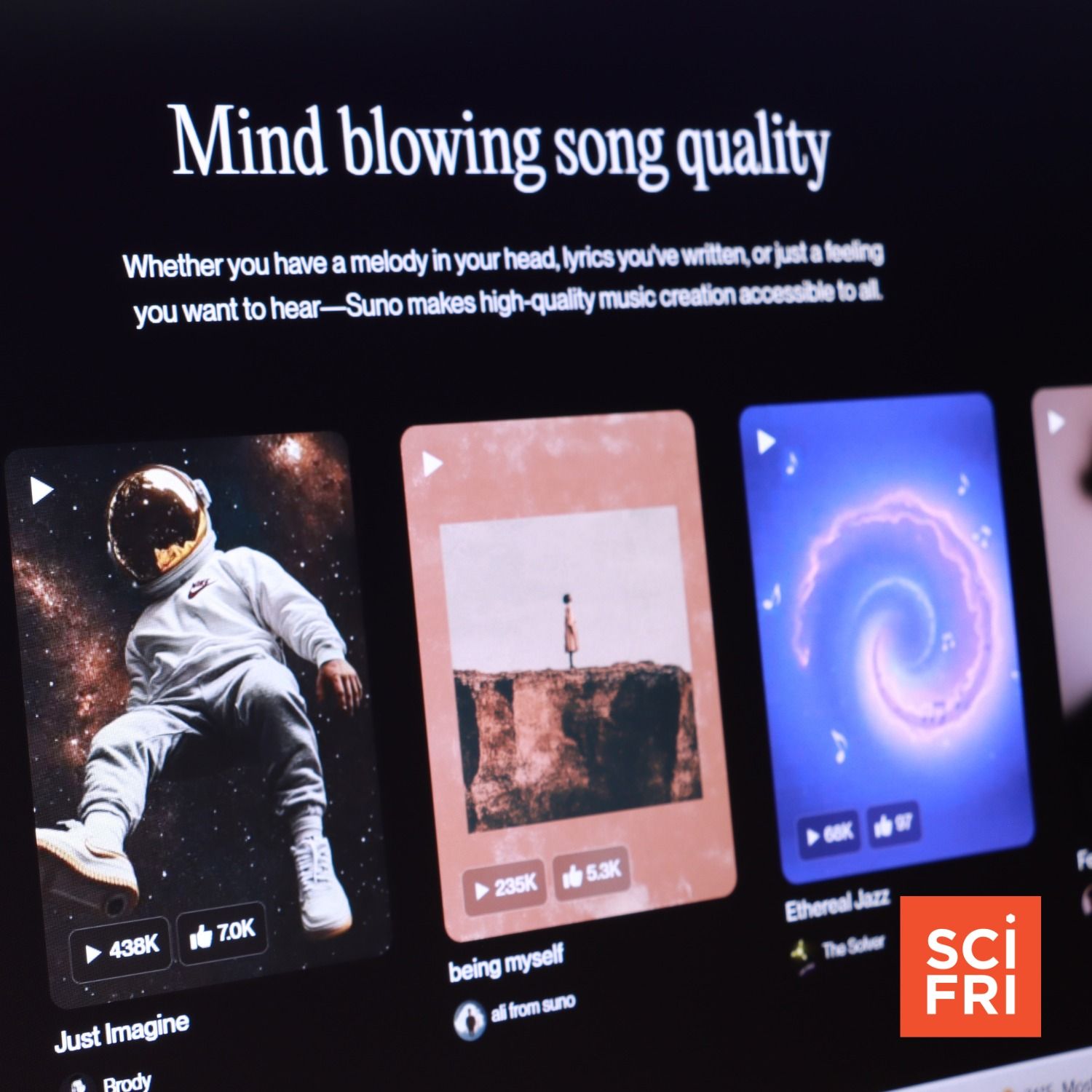
And you know, we've talked about these meme songs. We've talked about it helping with the production process. What exactly are they selling to people? Yeah. So when we think of like, you know, generating songs at the click of a button, that is really dominated at this point by Suno. It's an AI music startup. Suno is quite controversial in the music industry because people feel very threatened by them. I obtained an investor pitch check of theirs back in November and reported that 7 million songs are being generated on Suno every day. That kind of scale scares musicians quite a bit just in terms of although those 7 million aren't necessarily making it on streaming services. A lot of them are like some of them are. And that crowd potentially crowds out works made by human musicians. So Suno is a big one. UDO is another big one. They did kind of the same thing. You can type something into a text box and then out pops a song. UDO is now pivoting to do AI powered remixing of already made songs. This is a very popular category in AI music right
now. Spotify is even getting into this realm soon. And basically what this means is that with licenses in place, you would be able to take two of your favorite songs and create mashups, maybe remove the vocals so you can do a karaoke version. You can speed it up. You can slow it down all these kinds of things. So you can play with music that already exists. Well, it's funny because last year, the main, the major music labels were trying to sue the heck out of these AI music companies. Now they're partnering with them. What happened there? Yeah. So I think the music companies are really realizing that they can't make this go away. And so they need to find a way to extract value from it. I think another thing to keep in mind is that very recently, like within the last decade, two of the three major music companies became publicly traded companies. So they're probably getting a lot of shareholder or pressure to innovate, to integrate AI and to capture value there. They don't want to be seen as weak. They don't want to be
seen like they're behind the ball. So I think that that's also, you know, one of the reasons why they have been so willing to try to find reconciliation. Right. The music industry has gotten left behind a lot in the past in regards to tech and seems like they're changing their tune. So with all these recent deals, do you have a sense of where this is all heading? What do you have your eye on this year? Interestingly, the music AI game has mostly been dominated by startups. My take on that situation is that I think that music is a very hard thing to generate. And it's also not something that's a huge money maker. So I think it's been largely ignored by your open AI's and Googles of the world until now. But Google has launched Learia 3. It's latest AI music model on Gemini. Still not as good as sooner or a UDO. But who knows in the next year how it will develop? And they also acquired an AI music company called producer AI. So I have my eye on Google for sure.
And I also have my eye on these new models from Sino and UDO. Okay, we'll keep an eye on them too. Kristen Robinson is the senior writer at Billboard who covers AI in the music industry. Thanks, Kristen. Thank you. Okay, stay with us. Because after the break, we have one of the first musicians who experimented with algorithmically generated music back in the 70s. And we'll hear her take on AI music. Science Friday supported by Audible presenting Project Hail Mary. One of the most beloved adventure stories by Andy Weir, Project Hail Mary is now a major motion picture. So there's never been a better time to immerse yourself in the best-selling audiobook as the Soul Survivor on a desperate last-chance mission. Ryland Grace must save the Earth from disaster. Except they're right now, he doesn't know that. He can't even remember his own name, let alone the nature of his assignment or how to complete it. Part scientific mystery, part dazzling interstellar
journey, Project Hail Mary is a tale of discovery, speculation, and survival to rival the Martian. While taking us to places, it never dreamed of going. Narrated by fan favorite Ray Porter who brings every moment to life with humor, heart, and pulse-pounding tension, listen to the audiobook available on Audible and watch the Blockbuster movie starring Ryan Gosling in theaters now, Project Hail Mary. Listen, watch, save the world. Listen now at audible.com slash Hail Mary. Life's busy. Don't let banking slow you down, whether you're paying bills, setting savings goals, or just splitting the check. Atlantic Union Bank makes managing your money easier. With helpful people and user-friendly tools, we make sure banking with us fits you. Call, visit us online, or drop into an Atlantic Union bank branch today.
Atlantic Union Bank. Anyway, you bank. NASA and Paradise Island is home to the world's clearest turquoise waters and wide-sand beaches, where couples find secluded escapes, savor local flavors, and unwind to rhythms of behavior nights. All this and more is just a short flight away. This holiday season plan your escape at nasaupireticeilent.com. There's nothing like your first Mac. Here's what people online are sharing. At Dr. Rain says, everything is just so smooth and fast I still can't get over it. Sinking stuff between my phone and this is just chef's kiss. At Mr. Incredible488 says, Apple Silicon basically cures low-battery trauma. That's how they felt with their first Mac. How will you? Introducing the all-new MacBook Neo, an amazing Mac at a surprising price. Find out more on Apple.com slash Mac.
And now a person with a one-of-a-kind perspective on AI music, musician Laurie Speagle. A pioneer of electronic music and also of algorithmically generated music. And like today, it raised some eyebrows at the time. She wrote code for some of the first computer music technologies and her 1980 album The Expanding Universe is considered one of the greatest ambient music albums of all time. Another song from that album is even on the Voyager Spacecraft's Golden Record. Laurie, it's so great to have you here. Hi. Glad to be here. Did people think what you were making in the 70s and 80s was music, kind of like this AI conversation right now? Did you get shade when you got into this? There was a lot of heavy anti-computer sentiment back then because computers belonged to the most oppressive of organizations only. They weren't personal computers yet and it was the government,
the banks, the insurance companies, the military who had computers and the computers innocent things that they were inherited. The image of the oppressiveness of their controllers in the public because computers, you know, it was, they were called, they were inhuman, they were hustles in the arts. They were not the warm cuddly little laptops that we aren't used to at this point. So that I was often accused of dehumanizing music. But of course, technology is the most human thing around. I mean, we are by far the animal that does the most technology. You know, I think in the in the late 70s you worked on an algorithm to kind of replicate box harmonic style. Yeah, the, you know, box is just a superlative ideal for me and inspiration. And so I studied the harmonic progressions of the box corrals extensively and wrote a, you know,
way simplified compared to the mind of Bach algorithm that basically generated harmonic progressions that, that I felt were meaningful. Yeah, and obviously he's a super-mathematic kind of composer and it makes some sense to be like, how can I translate this into an algorithm? I mean, the other, the other side of the, the modern AI music site is, you know, there have been, there have been new studies of people who use these large language models experiencing something called de-skilling where, you know, you end up starting to rely so much on these models that you kind of end up outsourcing a lot of your own skill to them and then that skill attributes over time. And yet different skills are evolved during that process because the, the writing of the props for an AI system is in itself
at the very first stage of becoming an art form, I think. But it's quite different from the moment to moment generating of sound in response to your momentary emotions that the, the self-expressiveness of playing, playing music. And that is something that, that the way AI is being doing by giving a prompt and then waiting for a fabricated result is quite different from, I mean, the, the expressive nature of playing an instrument is, it's visceral, it's tactile. I mean, I've heard some music producers, you know, have talked about using Suno, one of these products and AI music because they, they don't want to be left behind and I've seen that language being used with other AI tools. What do you make of that in terms of, I mean, did you, did you feel like you were going to get left behind, you know, back in the 70s if you didn't engage with, you know, computer programming and
making fresh music? Just the opposite. I was kind of way out ahead to the point where it was impossible to explain to people what I was doing. I was not, I don't left behind. I was like on the lunatic fringe. I couldn't explain to people. People say, oh, you did music. What kind of music do you do? And I would say, well, I'm using computers and they would immediately, like, their expression would change and they'd want to change the subject too. In the arts, it's not a matter of keeping up, it's a matter of something honest and authentic coming from inside of you that you can embody in an experience external to you that you can share with other people. Everybody's trying to, like, give up what is new. That's not what makes high quality artistic expression. It has to be from inside of you. The music itself is what's important and that's not something which is reliant on any individual technology. It's gone through many centuries of
evolution of different technologies at it. It's still obvious to us what's really good music from the Renaissance that moves us and grabs us, or the early 20th century or whatever. It's what it does for us, you know, what music does for us. It's important. So I don't think it's really worth worrying about keeping up with that. It's just how you use it. Yeah. Well, it seems like so many things with AI is forcing us to ask, like, these really basic questions about the things that we like and why exactly we like them. I know you were just talking around that, but I mean, what does music mean to you? I don't know. I mean, the question of that I posted at the beginning, the question of what the purpose of music is for people and what parts of what music does to us are these
AI is able to satisfy. They obviously can generate music like material on demand, but it's not necessarily the expression of emotion or feeling. I really do want to play with them a bit more. I know that the writing of prompts is a very indirect way of making music, much like writing all those little dots on staff paper with a pencil. And then you get back a result, which is not what you had anticipated, because they're not really interactive. Emotions are kind of, you know, we don't understand them very well yet, but they are rock bottom and essential component of music. And this is where the AI's kind of fall down. They don't have them. And while they will probably figure out how to trigger them and evoke them, eventually,
and really good prompt writers might be able to do that, it still is very much in its inventory. These non-interactive, generative parrots, I guess you could call them. They speak the language that they have read all over the net or throughout the repertoire, and they parried it back, but they don't understand it on the gut levels that we humans experience it. Laurie Spiegel, a pioneer of electronic music and algorithmically generated music. Thanks for being with me, Laurie. Thank you for having me. By the way, one of Laurie's best known pieces of software, Music Mouse, which she made in 1986, recently got re-released on modern computers. It's like an interactive instrument you play with your mouse, where you basically drag your mouse around a musical grid, and it makes these fun chords and melodies. If you want to try it out, you can find a link to it on our website, sciencefrieday.com slash music. Thank you, Dee. This fantastic episode was produced by Dee
Peter Schmidt. And listeners, if you have thoughts or feelings on this or anything else that we cover, you were always here for it. 877 for Sci-Fi. Thank you for listening. We'll see you tomorrow. Bringing your business dreams to life takes hard, and about a thousand decisions a day. That's why Atlantic Union Bank's knowledgeable bankers are here for you. With the right guidance and customized solutions to help you reach your business goals. So whether you're planning your next move, upgrading your space, or scaling to meet demand, we make sure your business is ready for what's ahead, because we're big enough to support you, yet small enough to know you. Atlantic Union Bank. Anyway, you bank. The sun is out, the birds are chirping, and the open road is calling. Bring on the spring, at the Honda Spring Event, and take that road trip you've been dreaming of.
Now's the time to check out the Honda Civic and HRV. From Hunt, the 2025 Kelly Blue Books KVB.com Best Value Brand.
More episodes
More from Science Friday

Did scientists just find a dark matter particle? Maybe
Science Friday

Why physics and philosophy need each other
Science Friday

Recall rodeo: A food safety update + Why cars are catching fire
Science Friday

Is there science behind the ‘nervous system reset’?
Science Friday