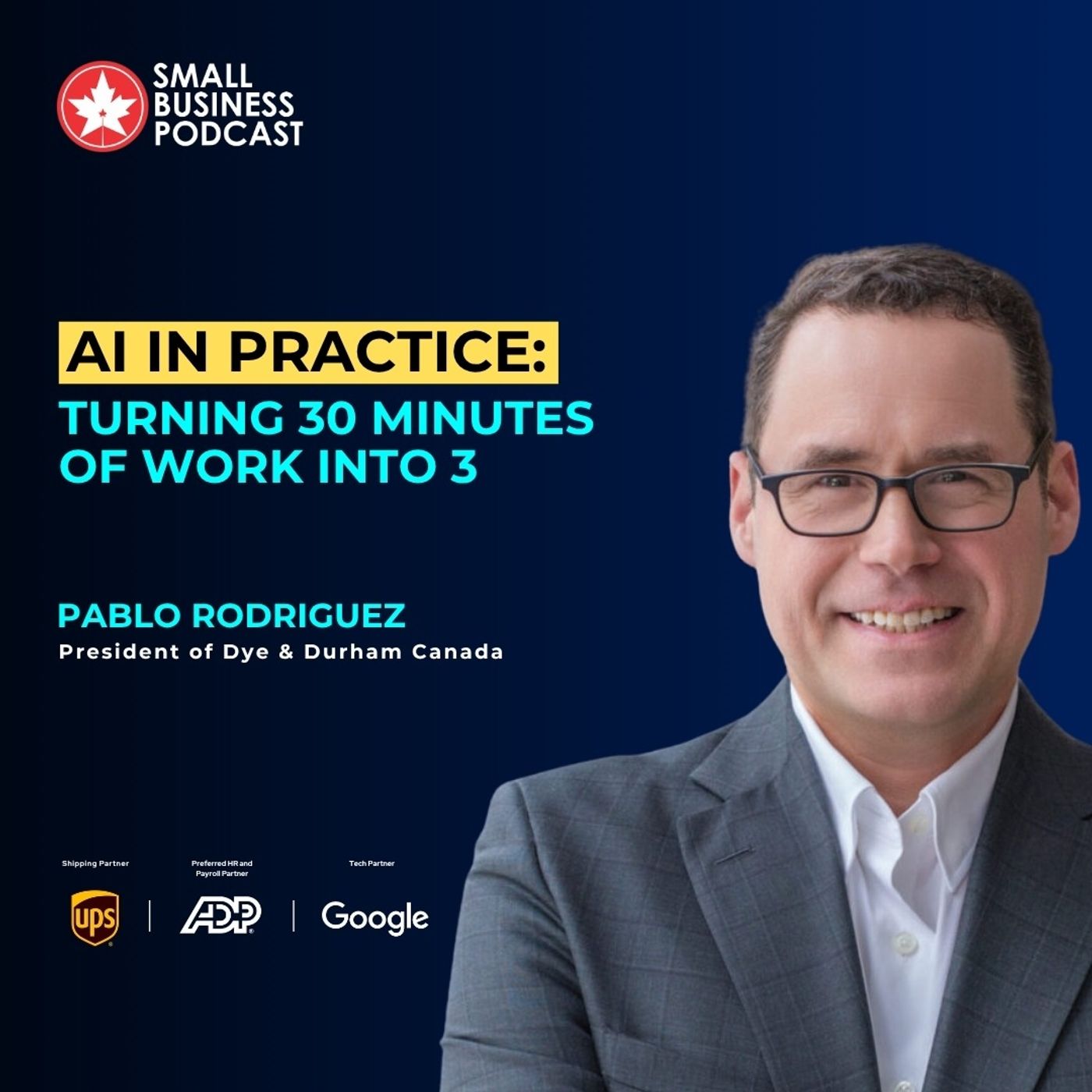
AI in Practice: Turning 30 Minutes of Work into 3
About this episode
Welcome to the CanadianSME Small Business Podcast, hosted by Kripa Anand. Today, we explore how businesses can bridge legacy operations with modern AI driven systems to eliminate inefficiencies and unlock growth.
Joining us is Pablo Rodriguez, President of Dye and Durham Canada. With deep expertise in scaling technology across regulated industries, Pablo shares how firms can streamline workflows and build confidence through smarter systems.
Key Highlights
- The Workflow Audit: Pablo explains how businesses can identify operational gaps and what high performing firms do differently.
- Choosing the Right Partner: Pablo shares the key indicators that help avoid ineffective or unused technology investments.
- AI and Risk Management: Pablo discusses how professional firms can adopt AI while maintaining strong risk controls.
- Scaling with Relevance: Pablo highlights how to expand nationally while staying locally effective.
- The Future of Technology Use: Pablo outlines what it truly means to leverage technology for growth in 2026.
Special Thanks to Our Partners:
- UPS: https://solutions.ups.com/ca-beunstoppable.html?WT.mc_id=BUSMEWA
- Google: https://www.google.ca/
- ADP Canada: https://www.adp.ca/en.aspx
For more expert insights, visit www.canadiansme.ca and subscribe to the CanadianSME Small Business Magazine. Stay innovative, stay informed, and thrive in the digital age!
Disclaimer: The information shared in this podcast is for general informational purposes only and should not be considered as direct financial or business advice. Always consult with a qualified professional for advice specific to your situation.
Get every episode summarized
Each time CanadianSME Small Business Podcast publishes, we email you a written briefing from the transcript — the topics, who appeared, and any specific claims, with the ad reads skipped.
Email me new episodesFree for 3 shows. No card needed.
Hosts & guests
Transcript ready
201 searchable segments. Every word is indexed and playable.
Full transcript
CanadianSME Small Business Podcast — AI in Practice: Turning 30 Minutes of Work into 3. Machine-transcribed; use the interactive transcript above to jump the player to any line.
Welcome to the Canadian SME Small Business Podcast, a podcast for Canadian Small Businesses. We interview Canadian experts and entrepreneurs to provide expert insight into marketing, innovation, business leadership, technology, and trends that impact small businesses. Whether you're just getting started or already established, UPS is here to help you make the most of your time. Their services, tools, expertise, and team of UPS Small Business Ambassadors can help businesses with all sizes, simplify processes, improve customer experience, and guide you on the path to growth. My name's Elaine Tank-Komo, founder of Easy Dazies, the official schedule for kids, and I want to invite you to visit UPS.com to learn more and save up to 52% or more on shipping. This is a paid advertisement. Hello everyone, this is Kripa Anand, and welcome to the Canadian SME Small Business Podcast. Today, we are discussing the bridge between
a 150-year-old legacy and the future of AI-driven efficiency. In 2026, the difference between a struggling firm and a thriving one often comes down to how they manage high-stake workflows and identify the hidden leaks in their daily operations. Joining us today is Pa Blu-Rodriguez, President of Die and Durham, Canada. With a deep background in scaling technology, within high-eregulated sectors, Pa Blu leads the Canadian strategy for a global leader in legal and financial software. He is here to show us how professional service firms can reclaim their time and confidence through strategic technology. So, before further ado, let's welcome the special guest. Pa Blu, it's such a pleasure to have you here. Welcome to the podcast. Thanks very much, Kripa. I look forward to this conversation. So, Pa Blu, now many SMEs operate with hidden inefficiencies that often act as a leak in their profitability without them even realizing it in the first go. From your extensive experience,
please go ahead and explain how can a business owner conduct a proper workflow audit to find these gaps and what would you suggest that they do differently than the others are not doing? Certainly. I think that broadly, law firms are really looking to build great businesses in Canada and in order to build that strong great company, they need to build strong legal work products and provide superior services and to do that really profitable. And technology is almost always part of that mix. So, I think as we explore how we go about building great companies and using technology, one way to look at that opportunity is really looking at it from more of a workflow perspective. Great products or services are really processes and you can break those processes down into chunks and really scrutinize what parts of that process
is broken, hard, or what parts of the process are really critical for your success. And as you identify those elements of the process, you can start to look at improving that process using technology. And so, I'll give you just a bit of a background in the area that I work in. We provide legal workflow solutions for real estate and that process is called convincing in Canada. About two decades ago, I live in Midtown Toronto, but two decades ago, I bought my home and back then, the way lawyers operated was you had to go into the law firm office, you signed an agreement, the gaps who'd go into the law office, the land registry office, in search, who owned that product or owned that property over the last 10, 15 years, to make sure that the title properly transferred, then they went back and they had to compile it all and they had to do a bunch of searches and then you had to go back into the office and
sign the agreement. That's how it was in the past. Very fragmented process, very analog, very risk process. And today, with our software and other technologies, you can really reduce those friction points, you can reduce the risk, you can ensure that the title gets properly transferred with the least amount of risk. So thinking about workflow and breaking it down under the steps in the processes is one way to look at how you can drive advantage in your business using technology. That's very well explained. Thank you so much for that Pablo. I completely agree with you. Identifying where your time is getting wasted is the first step towards building a truly scalable business model. Now moving ahead, let's explore why businesses should choose a true technology partner rather than just another software vendor out there in the market. Pablo, when evaluating a technology partner, are there any specific green flags as they
call it that a business owner should look forward to avoid the shelfware trap that is going on? Absolutely. So Crippa, first thing to tell you how not to buy a software. Or early in my career when I was a finance and operations manager, I worked for a midsize business, which is part of a conglomerate. And it was November and the year end was December and I worked very closely with the IT manager. And I love technology and that's why I worked closely with them. And they said, look, we haven't spent all of our budget. And we know this the software vendor and they've introduced us to this new class of software. And so we took a very quick look at that software. We purchased it. And I'm sure it's no surprise to the listeners that 10 years later it remained shelfware. And that's how not to do it. And there was a personal lesson for me that really to effectively purchase software. The first green flag as you raise is understanding
your business, understanding your workflow, your industry. What makes you unique? What is that process flow and where the processes start and stop? Which of your technologies are interoperable? Understanding that technology is more than just buying the service. It's making sure that you have internal champions that you properly onboard it, that you train it, that your users after the services purchased need ongoing support, that it really is a journey to purchase and apply technology. And so increasingly, you really need to have that broad mindset around technology. But again, I would suggest it really starts with a deep understanding of your business and your industry. There's no shortcuts. Yeah, that's a great reminder of there being no shortcuts because finding a genuine partner truly understands your specific industry nuances. It ensures that
the software actually gets used instead of sitting on a digital shelf as we mentioned before. Great. Now let's discuss how AI is helping reduce risk and automate complex legal workflows. I know we touched on how AI can be used to automate the workflows. But if you could just explain in a little more detail, that how can other professional services learn from how law firms use technology to manage high risks while adopting AI for efficiency? What's your take on that? So I'll give another story about early in my career. So again, early in my career, I supported a company that sold legal research. And basically, it was content that helped lawyers find the right precedent to support the argument of their client in a court case. And back then, and this was really only just a couple of decades ago, the way it was done was you would go to a law library. You would pull down from a shelf the most monstrous volume that you could imagine. You spread it
on the desk and you start to search that particular topic and trace it back to cases to find the right relevant cases that are appropriate for the scenario that your client is in. So you can bring forward the strongest argument to the court. That's how it was a couple of decades ago. And I'm sure your listeners are rolling their eyes a little bit. That sounds ludicrous. In today's environment, you go into your search, you put in the case parameters and and up pops using AI, a very relevant list of cases for you to research further. And where we are today with AI is very much that that turning point, if you will, we have in front of us a bunch of tools with an incredibly superior set of capabilities than the old analog ways of doing of doing business. And I would challenge the listeners to ask themselves, you know, if I want to treat my business
like that law associate in my earlier story of walking down to the library, or do you want to test and try and learn that AI enabled tools? There's an expression in a legal community that's often quoted that AI will not replace lawyers. But lawyers using AI will replace lawyers and do not. And I think that's a very true statement, and it's also quite applicable to to other industries. Kripa, you asked a little bit about how AI is being used in the industry, and I can give you a little bit more perspective on that. And I think legal really is a great case study for responsible use of AI adoption. The legal professional is it operates in a highly risk-averse regulated environment, and they're naturally very careful about the use of applying new technologies, and they're particularly careful around the accuracy and auditability human oversight in terms of the building out their legal work process through the adoption
of AI. And so from my vantage point, legal professionals are currently doing a few things really quite well that other segments could imitate or mimic, if you will. The first one is really protecting sensitive information. And so law firms need to protect their clients' interests and their clients' information very religiously. And so they're very mindful of reading the fine print around how AI systems ingest the content and the use of data privacy. And often it may result in the need to change the settings or upgrade to a paid version to protect the client's interests. So that's one advice I would give to the listeners is be very cognizant of protecting sensitive information. A second area that legal professionals do really well is reviewing AI output carefully. There's been a number of very well-documented cases of lawyers citing cases that were fabricated with AI to courts. Oh, and they've been
reprimanded and it's been broadly communicated in the media. And as a result of those few examples, lawyers are extra careful to make sure that they check all of the citations, that they understand that AI is not perfect. It's a tool and human judgment needs to be applied on top of that. And speaking of human judgment, I think lawyers do a pretty good job at maintaining their professional judgment when using AI. So the best use of AI right now is not replacing expertise, but really removing administrative friction points around that expertise. So AI is great at pattern detecting dealing with high volume of data processing and extracting and summarizing information, but it's not so good in terms of the use of professional judgment or accountability. Yeah, no, very interesting. That was a very well-detailing articulated pick on that. Before we go any further, here's a special message for all of our listeners,
especially to all the professionals watching. In 2026, AI is not here to replace your expertise. It is here to replace your data entry. If you were still spending 30 minutes on manual tasks that a machine could do in three, you are failing your clients and your bottom line. We have moved past the experimental phase of AI and it is now about embedding these tools into your actual daily workflow. Stop working for your technology and start making your technology work for you. Coming back to you, Pablo, I completely agree with what you said using AI as a partner for administrative and heavy lifting allows experts to just free their mind for the actual thinking and to focus back on the high value work that they were trained for ideally. Now moving ahead, let's look at how businesses can scale nationally while still respecting their regional nuances. Pablo, how do you approach business strategy when scaling a platform nationally
while ensuring it still feels relevant at a local level? Go ahead. Certainly. I'm sure a lot of your listeners are business owners that are looking to expand their business and often they're operating once and they want to expand to the province or across across the country. As you reflect a little bit around how you go about scaling markets, there's a couple of areas that I recommend you focus on. The first one is really where do you obtain the leverage by addressing multiple markets? What's the advantage? What can be standardized or what are those capabilities that can be spread across multiple markets to drive efficiencies and economies of scale? That's one area that the business owner really should focus on. The second one is what is unique or different about the new market that you're entering that you really need to uniquely service to be successful in that market?
Just stay relevant to be competitive to win in that new market. And frankly, you can't sit in your ivory tower and imagine you need to go see you need to meet the market to meet those people in the market to understand what's unique in terms of that new market. I'll give you a little bit of an example this past year. We extended our convincing software called Unity into British Columbia, which is the second largest convincing market in Canada. We didn't just plug it in. We didn't just start selling it in British Columbia. We took a lot of time and effort. We expanded our BC team. We drilled into that workflow that we talked about earlier to understand the nuances and differences of that local market to really create a version that is appropriate for that particular market. And so what did we discover when we went through that process? In Ontario, for instance, one of the key deliverables from the convincing processes, this statement of adjustment, it really
is the sort of document that illustrates that defines the financial consideration, the change in financial consideration between the buyer and the seller. And what we found was that in Ontario, this document was generally prepared by the seller while in BC, it was generally prepared by the buyer, fundamentally opposite approaches to the workflow. In fact, as we drilled into the workflow differences, we found about a thousand different decision points or workflows that needed to be altered to reflect the BC market. And that's why it's critical as you think about scaling your business that you truly both understand the unique market needs of where you're going, but also what the advantages are in terms of scale and platform across multiple markets. I love that answer. That was very interesting to think for a second and realize that the small differences in the workflows make a huge lot of a difference and definitely balancing national
scale with local relevance is the goal standard for any SME looking to expand across Canada. Now let's do a little time travel Pablo. Let's imagine I would give you a time machine and let's say we were to go five or ten years into the future. When you get out of the time machine, how exactly do you envision technology changing the Canadian ecosystem specifically? It's interesting. I'm a techno optimist. Crepa, I think that technology has a real advantage to make the world a better place. And in the professional services, I see it playing a tremendous role in terms of reducing risk for the law firm clients, improving the quality of work, and frankly, quality of life of legal professionals. I'll riff a little bit on that. I think one of the big challenges in the legal community today is staff retention, staff burnout, and a feeling that they don't fully enjoy their job. And I think technology has the opportunity to address all
of these needs squarely. So what does technology do and what will the future look like? I think the amount of tedious low value work will reduce very significantly with technology. And legal professionals will work up that value curve and do much more interesting, challenging impactful work. And the copying and pasting, the summarization, and all of those tedious tasks or a lot will be eliminated. I think the technology will also allow workers and professionals to work how they want where they want when they want real flexibility in terms of how they approach work. So these are some of the advantages. And I think that legal profession is really driven by talent. And so taking care of talent is really key to the future of the professional service. You've painted quite a picture there, Pablo. The future definitely looks very promising.
And I'm loving this conversation and definitely we'd love for you to be back. But before we let you go, if there's one final piece of advice that you have for our listeners, specifically for those who might feel overwhelmed by the pace technology is changing, what is that one thing you'd like to tell them and why? I would say that to many law firms like many small businesses, yeah, you'll both a sense of excitement and also being overwhelmed as they think about building a great company with technology. And my recommendation to them would be to pause, to breathe, and frankly then to get started. And as we talked about, you can start with a deeper understanding of your workflow and your pain points, not technology. And then once you understand your workflow and pain points, you can start to engage with and work with partners. I would suggest
to the listeners to be open to learning new things and new approaches. And to seat technology is really an enabler for growth tool that can really drive differentiation, not something that's going to replace you or challenge you personally. And last, I would suggest that you need to understand and consider taking controlled risks to build your advantage as a business. So that would be my advice to your listeners. That's a golden advice that technology should always be a tool for simplicity, right? Not another source for complexity in your life. That was Pablo Rodriguez, you guys. Thank you so much for joining us. It was such a pleasure having you on the show. All right, that was Pablo Rodriguez from Die and Durham, Canada. A master class in how to audit your workflow and use technology to turn manual burdens into competitive advantages. To all the listeners, thank you so much for tuning in to the Canadian SME Small Business
Podcast. Be sure to subscribe and visit CanadianSME.ca for more such resources. And lastly, a very special thank you to our podcast partners, UPS, Google, and ADP, for their own going commitment to empowering small businesses across Canada. I'll see you guys in the next episode prepare on and signing off. Thank you for listening to the Canadian SME podcast. Please visit CanadianSME.ca to subscribe and join us next again as we share more expert advice from Canadian business leaders.
More episodes
More from CanadianSME Small Business Podcast

The Health-Tech Giant: How VitalHub Built a $100M Global Software Empire
CanadianSME Small Business Podcast

How I Scaled 22 Stores in Canada’s Most Regulated Industry
CanadianSME Small Business Podcast

How Calgary Became One of North America’s Fastest Growing Innovation Economies
CanadianSME Small Business Podcast

The $100M Talent Secret: Why Wellness Beats Salary
CanadianSME Small Business Podcast