About this episode
Get every episode summarized
Each time Reuters World News publishes, we email you a written briefing from the transcript — the topics, who appeared, and any specific claims, with the ad reads skipped.
Email me new episodesFree for 3 shows. No card needed.
Hosts & guests

Transcript ready
105 searchable segments. Every word is indexed and playable.
Full transcript
Reuters World News — AfD win, Ukraine, glacier blankets and horse smuggling. Machine-transcribed; use the interactive transcript above to jump the player to any line.
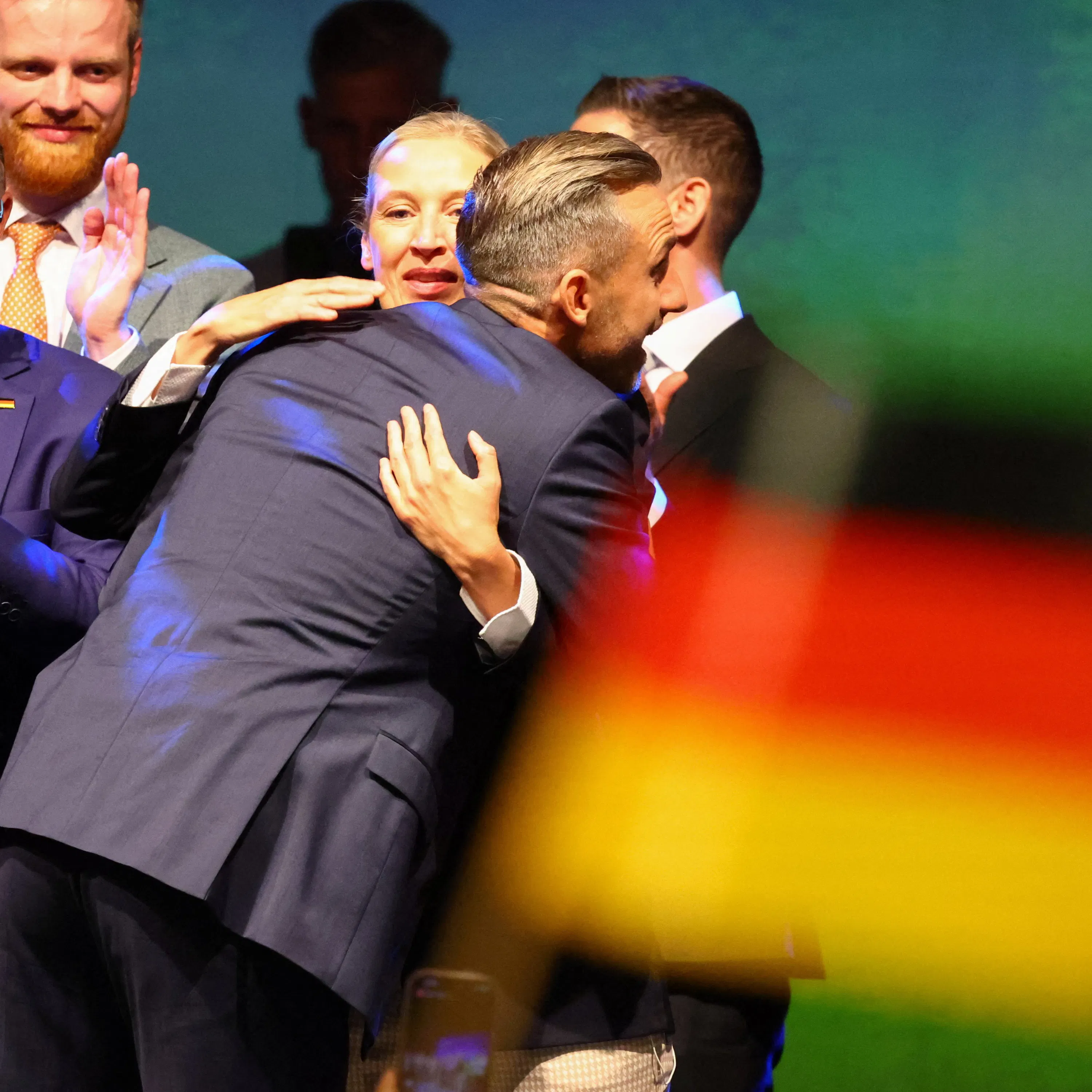
Hi, I'm Kim Vannell in London. It's Monday, September 7th. Today. In Germany, the far right AFD wins a key state election. US envoys Whitcaw and Kushner push for peace and cue. And scientists look at whether sheep wool can help slow glacia melt. This is Reuters World News bringing you everything you need to know from the front lines in 10 minutes, seven days a week. We start with a shake up in Germany's political landscape. The far right alternative for Germany party has won a historic victory in the state of Saxony and Holt, taking 44% of the vote. The one puts it within reach of governing at the state level for the first time since World War II. Europe editor Rachel Armstrong has more.
This election result will likely ricochet through Europe, not because Saxony and Holt is a particularly large state or because it will give the AFD enormous policy power, but because it will galvanise as a far right of populist parties, particularly the National Rally in France and show them how this type of election result can be achieved. It will also mean German Chancellor Frederick Mertz will have to be even more focused in the coming months and years on domestic politics to try and win back support of his party which will really collapse than this election. So with him likely more focused on internal matters and French President Emmanuel Macron leaving the Elysée early next year ahead of an election that the far right National Rally might win, there may well be a vacuum in the year where leadership from Berlin and Paris traditionally comes from. And any potential vacuum in European leadership could have consequences felt beyond Germany's borders. Ukraine really needs European support right now. It is coming under relentless Russian
air strikes and is much more reliant on Europe than the US now for a lot of its financial and military needs. Now Berlin's support is unlikely to waver significantly overnight, but it may become harder for Mertz to be the leader to push for tougher sanctions on Russia or greater support packages for Kiev just as they head into what will be a brutal winter. As that brutal winter approaches, the reality on the ground in Ukraine is stark. US peace envoys Jared Kushner and Steve Whitkoff are talking up new momentum after meeting President Vladimir Zelensky in Kiev over the weekend. They flew there from Moscow where they held talks with Russia's president Vladimir Putin. No breakthrough was announced at the Moscow talks, but Whitkoff says they heard, quote, new ideas and hopes a new round of talks will be announced soon. Since the last piece talks in February, each side has intensified long range air attacks deep inside the other's territory.
Kiev resident Julia describes the sense of total powerlessness as air alerts continue to ring out in the city. She says if it's going to kill me, it will. What is producer Andrei Premiachenko describes a typical day in Kiev. The hardest thing about daily air attacks is you can't really sleep. During night you hear explosions even though you can get used to hear an explosion, but you still afraid. What if the next explosion is your house or replace you sleep? Then you go to work. And still you hear every radio alerts, you hear explosions. The traffic is really bad. If you don't have a car, you struggle to get where you need to get because transport doesn't operate quite in the same manner as it operates without aerial alerts, you get to the office like me. And you still hear explosions. You smell the smoke.
As the war rages on for almost five years now, a potentially harsh winter is fueling even more The last winter was very hard. It was very cold. But people thought that okay, we leave through this winter, we get by and maybe the world will be over when winter is over. But now it feels like people don't think so. People don't believe the world will be over after the winter. So it's like hope evaporated. To Iran, where the parliament speaker is warning that any further attacks will draw a heavier, faster, and more painful response. Meanwhile, according to state media, Tehran will announce a new restricted zone outside the straightforward modes in the coming days, one that would extend
into parts of the Gulf. Details are thin, but the Secretary of Iran's Supreme National Security Council says, any ship entering that new zone will be added to a sanctions list. Now that move will be watched closely by traders for a look at what oil markets are doing. And for the week ahead, here's Mike Dolan from our sister podcast MorningBid. So the weekend developments have crude prices rising again, first thing on Monday. And this is very significant because it's adding to pressure at the pump and at the retail cost of fuel, particularly in the United States. Diesel prices hit their all-time high on Friday. And that's going to be both a political and an economic issue as we head into the midterms. But as regards this week, there was a lot of politics all weekend, both in the Ukraine Russia war and on the Gulf situation and there has been no breakthrough in either. Thanks Mike. You can catch MorningBid wherever you get your podcasts. At least five people are dead after an Amazon Prime air cargo
plane overran a runway and crashed at Miami International Airport on Sunday. The Boeing 767, which had just flown in from Puerto Rico, hit multiple vehicles on landing. Five others were hospitalized. Three are in critical condition. The National Transportation Safety Board is investigating. Now to Nepal, where 10 days after the devastating glacier collapsed, a 64-year-old woman is pulled from her collapsed home by rescuers. Chandigarh Kumar Shrista had survived an ennaro pocket of air surrounded by water and mud. Tens of thousands of people are still missing after the massive mudslide on the Himalayan border between Nepal and China's Tibet. Would the Giron border crossing now a grizzly emblem of the devastation? It's where that incredible footage showed a wave of mud
and debris enveloping buildings. Royces went to that spot to view rescue efforts and a trip organized by China's foreign ministry. Our reporter Niko Kocchan sent us this from the ground. There's only one road that leads to this location. So first responders were first flown in via helicopter while other emergency personnel worked day and night using excavators to clear a path forward inch by inch. The path officially reopened Wednesday, allowing more emergency personnel it applies to Risa's critical location. As glaciers across the Alps keep shrinking, researchers in Switzerland are turning to an unlikely material to help protect them, sheep's wool. The Keepet Wall project has spent the summer testing where the wall blankets can slow melting as effectively as the synthetic tarps often used on glaciers. We can really constate that the front had been very limited to the base. Project manager Timothy Steiner says the team is pleased with the results. After taking measurements throughout the summer, he says
melting under the wall covers was just as limited as under conventional synthetic coverings. The project is also aimed at finding a use for Swiss wool, much of which is currently discarded. But Steiner says protective coverings are only a temporary fix and at tackling climate change remains the only long-term way to slow the retreat of glaciers. In Redford, Texas, the Rio Grande is shallow enough in places to walk across. And according to local deputies, that's exactly what horse smugglers are doing. Reporter Cassandra Garrison spent days along remote stretches of the Texas-Mexico border investigating the illegal trade that authorities fear could complicate the fight against new world scruel. When you see the low water levels of the river that separates Mexico from the United States, it's easier to understand how animals could be smuggled across, basically undetected. Here in this area, there's no fences, there's no surveillance, there's nobody patrolling, and that's the case for many areas of the US border still in
Texas. Deputy say smugglers simply walk across the river from Mexico to trail its waiting on the other side. Drives pay about $1,000 to haul them to major cities like Houston or Dallas. Any animal moving from Mexico to the United States under normal circumstances would undergo government health inspections, checking for any tiny wounds where a scruelorim infection may have taken hold. But obviously, any animal smuggled from Mexico to the United States would be operating outside the balance of those typical protocols, making it a greater risk for the scruelorim outbreak. Authorities haven't connected any US scruelworm cases to these crossings. Experts warn that an outbreak of the flesh eating parasite could cost the economy up to $1.8 billion. For more on any of the stories from today, as well as more analysis and news shaping our world, check out Reuters.com or the Reuters app. There is a link in the description to download it and start getting pure news straight from the source. Don't forget to follow us on your favorite
podcast player. If you're listening on a smart speaker, just ask for the latest news from Reuters seven days a week. We'll be back tomorrow with our daily headline show.
More episodes
More from Reuters World News

Pricey oil, GOP convention and a folding iPhone (Update)
Reuters World News

Houthi attacks, Canada tariffs and foldable phones (Updated)
Reuters World News

Ukraine talks, Huckabee, space wars and French butter
Reuters World News

Kharg Island, OpenAI agents, Germany's election and the return of CDs
Reuters World News