About this episode
Hey there! It’s Michael here — and welcome back to Speak Naturally in a Minute from Happy English. I’m here every Sunday with a quick one-point lesson to help you improve your pronunciation, rhythm, and intonation.
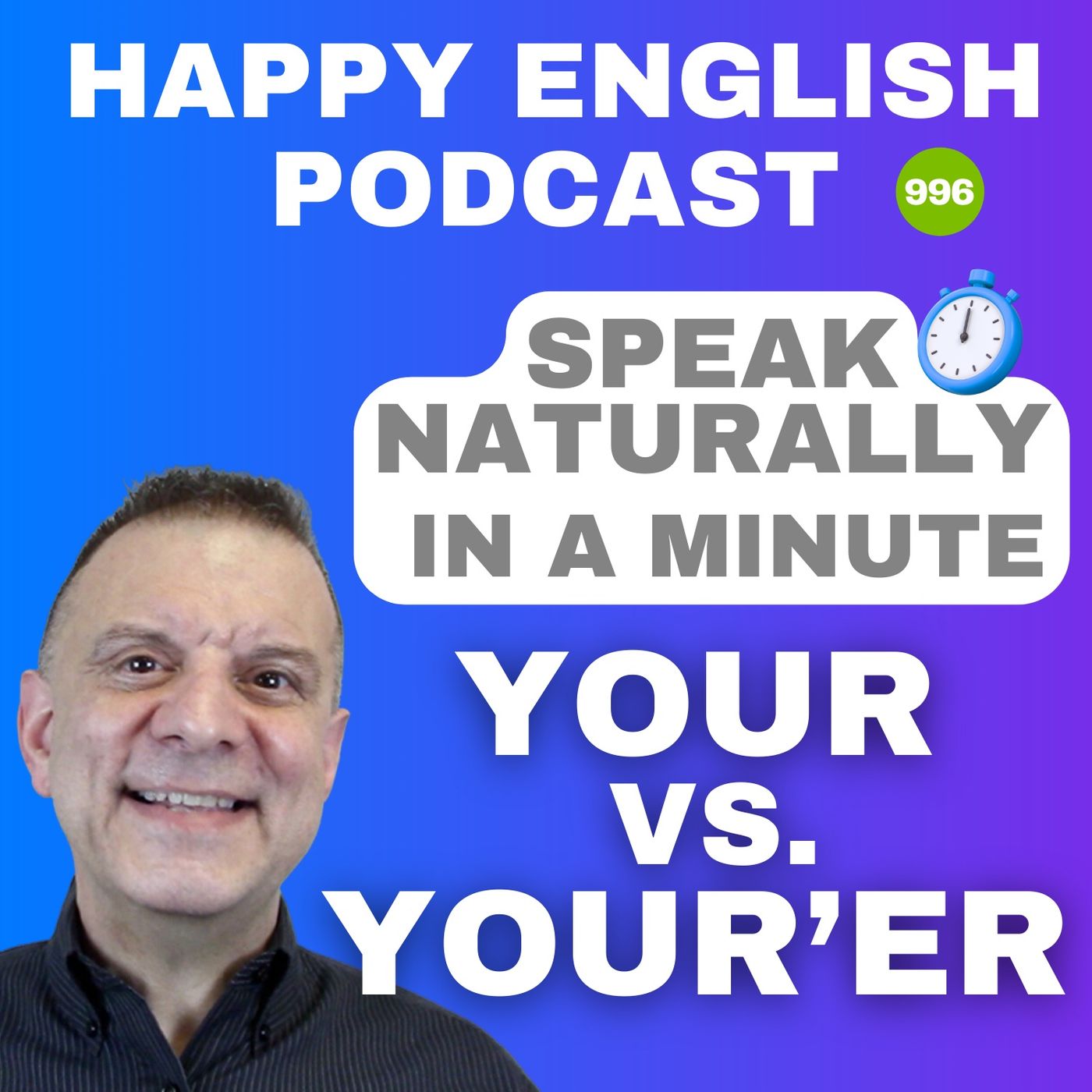
Today, let’s talk about something that confuses a lot of learners. Why do “your” like, your pen and “you’re” like you are nice sound exactly the same in American English? The reason is, in natural speech, both words usually reduce to “yer.”
So instead of saying: “your phone” Americans say: “yer phone.” And instead of: “you’re late” We say: “yer late.”
Listen to these examples:
This is part of American rhythm — small words often get weaker, and the important words get the stress.
Try using this pronunciation in your English conversations this week. Let me know in the comments how that goes. And remember to follow and subscribe so you won’t miss the next Happy English Podcast and next week’s Speak Naturally in a Minute.
Hey, thanks for listening! Until next time, keep learning and keep it cool.
The Happy English Podcast
Helping people speak English better since 2014
Over 1,000 episodes • 8 million downloads
📘 Build your vocabulary with my free Vocabulary Workshop
https://learn.myhappyenglish.com/vocabulary-workshop-signup
🎥 Watch video versions of the Happy English Podcast on YouTube
https://www.youtube.com/@HappyEnglishNY/podcasts
🌐 Learn more about my English lessons and courses
https://www.myhappyenglish.com
Today, let’s talk about something that confuses a lot of learners. Why do “your” like, your pen and “you’re” like you are nice sound exactly the same in American English? The reason is, in natural speech, both words usually reduce to “yer.”
So instead of saying: “your phone” Americans say: “yer phone.” And instead of: “you’re late” We say: “yer late.”
Listen to these examples:
- “Is that your car?” → “Is that yer car?”
- “You’re early today.” → “Yer early today.”
- “Your idea is great.” → “Yer idea is great.”
This is part of American rhythm — small words often get weaker, and the important words get the stress.
Try using this pronunciation in your English conversations this week. Let me know in the comments how that goes. And remember to follow and subscribe so you won’t miss the next Happy English Podcast and next week’s Speak Naturally in a Minute.
Hey, thanks for listening! Until next time, keep learning and keep it cool.
The Happy English Podcast
Helping people speak English better since 2014
Over 1,000 episodes • 8 million downloads
📘 Build your vocabulary with my free Vocabulary Workshop
https://learn.myhappyenglish.com/vocabulary-workshop-signup
🎥 Watch video versions of the Happy English Podcast on YouTube
https://www.youtube.com/@HappyEnglishNY/podcasts
🌐 Learn more about my English lessons and courses
https://www.myhappyenglish.com
Get every episode summarized
Each time Happy English Podcast publishes, we email you a written briefing from the transcript — the topics, who appeared, and any specific claims, with the ad reads skipped.
Email me new episodesFree for 3 shows. No card needed.
Hosts & guests
No transcript yet
This episode has not been transcribed. Request it and it moves to the front of the queue.
More episodes
More from Happy English Podcast

1032 - AT vs. IN - What’s the Difference?
Happy English Podcast
Apr 15, 20269:10failed

1031 - Good At vs. Good In - What’s the Difference?
Happy English Podcast
Apr 13, 20268:37failed

1030 - Have to → Hafta Speak Naturally in a Minute | Happy English
Happy English Podcast
Apr 12, 20261:53failed

1029 - Hit Means Go TO - English Tips in a Minute | Happy English
Happy English Podcast
Apr 11, 20261:26failed