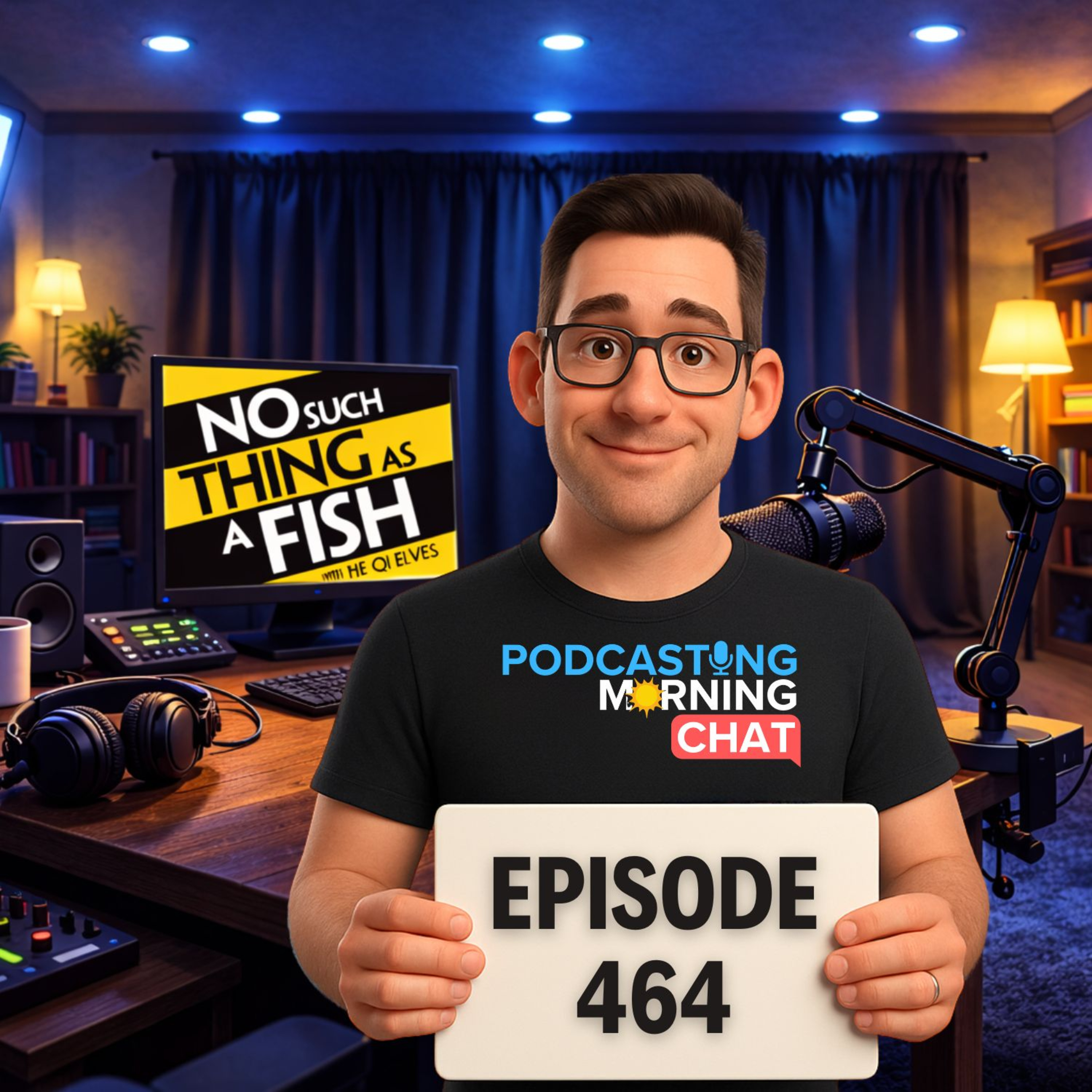
464. Why This “Weird Facts” Show Is Impossible to Stop Listening To
About this episode
The most addictive podcasts don’t just inform you, they make you feel like you’re sitting at the table. In this Obsession Worthy episode, while Marc is out, cohosts Ralph Estep Jr and Jonathan Howard take the reins to lead a discussion on No Such Thing As a Fish and what you can take away for your own show. We break down why the banter works and how inside jokes keep people listening. We also talk about how the cast builds momentum with quick turns, clear roles, and a format that lets them cover a lot without feeling scattered. You’ll hear why that “talking back to your phone” feeling matters, and how to create it without trying to be funny on command. The big takeaway is simple: you can experiment with topics, but your structure has to carry the weight. Then we try a fun “bring a fact” segment to test the method in real time.
Episode Highlights:
[01:18] Meet the panel
[02:58] Universal doorways and why absurdity hooks listeners
[07:07] Why controlled chaos creates energy
[19:37] Listener talk-back moments and knowing your audience
[21:18] How creators actually find their audience
[24:03] Entertainment first as a guiding principle
[32:50] Testing formats before committing
[38:24] The fact challenge game begins
[39:14] The origin of the word “podcast.”
[44:05] The silence podcast debate
Links & Resources:
The Podcasting Morning Chat:
Join The Empowered Podcasting Facebook Group:
www.facebook.com/groups/empoweredpodcasting
Book A Free Call With Me:
https://calendly.com/ironickmedia/freestrategycall
Join The Empowered Podcasting Facebook Group:
www.facebook.com/groups/empoweredpodcasting
Application To Submit Your Show For Evaluation:
No Such Thing As a Fish:
https://www.youtube.com/watch?v=ZB6NvXuWk4k
Remember to rate, follow, share, and review our podcast. Your support helps us grow and bring valuable content to the podcasting community.
Join us LIVE every weekday morning at 7 am ET (US) on Clubhouse: https://www.clubhouse.com/house/empowered-podcasting-e6nlrk0w
Live on YouTube: http://podcastingmorningchat.com/joinus
Brought to you by iRonickMedia.com
Please note that some links may be affiliate links, which support the hosts of the PMC. Thank you!
--- Send in your mailbag question at: https://www.podpage.com/pmc/contact/ or [email protected]
Want to be a guest on The Podcasting Morning Chat? Send me a message on PodMatch, here:
https://www.podmatch.com/hostdetailpreview/1729879899384520035bad21b
Get every episode summarized
Each time Podcasting Morning Chat publishes, we email you a written briefing from the transcript — the topics, who appeared, and any specific claims, with the ad reads skipped.
Email me new episodesFree for 3 shows. No card needed.
Hosts & guests
Transcript ready
843 searchable segments. Every word is indexed and playable.
Full transcript
Podcasting Morning Chat — 464. Why This “Weird Facts” Show Is Impossible to Stop Listening To. Machine-transcribed; use the interactive transcript above to jump the player to any line.
Good morning podcasting morning chat today is Monday March 2nd, 2026 and today is our obsession worthy podcast show. We're going to be listening to no such thing as fish that's episode 621 and Jonathan Howard is going to lead us in a great discussion about what makes this obsession worthy and what we can learn from it. So if you listen live on Clubhouse hit the share button, bottom left hand side of the screen and share however Clubhouse let you, if you want to join us live on the video, you can go to podcastmorningchat.com slash join us and we're catching us via podcast, YouTube, LinkedIn, etc. Please share this episode with a fellow podcaster. Now give me about 30 seconds and we'll get things going. I just want to thank you for being here today. Well good morning everybody again.
Welcome to the podcasting morning chat. Thank you so much for being here. I'm your host for today, we're off east step junior, filling in for Mark Aaronic and crew on stage of me, our producer Ashley Feller. We've got Jonathan Howard BC Babbles, D.R.F.A. Matthew Bliss, Nick Norback and Tide Tutoring AKA Nikki. So we're going to get started today on an obsession worthy podcast. This is no, excuse me, no such thing as fish, thank you Jonathan. It's a great title. The Jonathan, I'm going to go ahead and turn over the reins to you, my friend and you can take us down the road of no such thing as fish. Just kind of as a quick reminder, we do this as a way to look at other podcasts and see what we can take from them and use in our own podcasts to make them a little bit better, a little bit more obsession worthy. That's what we're doing today. We are taking a look at no such thing as a fish. I believe it was episode 621 and it is no such thing as space or a space egg.
I believe is what we're talking about here episode 621, but the concept of the show is that for smart and I'd lightly say weirdos bring one really interesting fact to the conversation and it becomes a really entertaining kind of variety show of a conversation. The pace never flat lines. It's always one fact per person gives it a clear lane and there's no confusion as to what's going to happen during the episode. And then every fact that's brought gets kind of poked, teased, upgraded or there's like debate around it so that creates some momentum. Before we dive into the conversation that this podcast, I want to highlight some of the universal doorways that are used throughout the podcast and these are things that everybody cares about, which is humans are absurd. Number one, all our systems are broken so bureaucracy, history, science and language. You were confidently wrong, which is another one of those fun universal doorways, or this detailed changes the entire picture.
So those are kind of the four topic, you know, main ideas that they use throughout the podcast that we can all relate with. And Jonathan, I just want to interject something, you know, every week I try to listen to the whole obsession worthy podcast, I mean, this one had me hooked from the beginning. It was just a really cool concept. I was trying to multitask and I had to stop multitasking because I want to hear what they're going to say. It was really engaging and that was the thing about this one and I hope everybody gets a chance to listen to, if they haven't listened to it already because it is super engaging. And you're right about that doorway. That was the coolest thing. Anyway, I didn't want to interrupt you right there in mid thought, Jonathan, but it was a really cool episode. Quite right. I'm going to have to stop giving obsession worthy podcasts because you keep having to stop doing your multitask. So this episode, there's a guest slot. He adds some novelty and some dynamic to it to the episode. There's a few topic lanes. One is super computers, cranes, silica gel, which I personally enjoyed the silica gel one I found hilarious, but it really signals a curated fact menu, not random things happening.
And the pacing is built in because the format cycles and it goes from banter to fact drop to a bunch of people rifting and then they pivot and repeat. So the whole structure of this podcast really forces them momentum and keeps people going and listening. So we're going to do a quick three clip rundown today of what makes the podcast episode of session where they all go through some of the obsession where the things towards the end. But then we're going to do a slightly different thing inspired by this podcast. Let's start with the setup and the first insane fact for this podcast. We've got phones with our four favorite facts from the last seven days and in a particular order, here we go. Starting with fact number one, that is James. Okay. My fact this week is that when the father of supercomputing, Seymour Cray got stuck on a problem. He would go into tunnels. He built under his house and speak to elves. My kind of guy. Yeah. So this is a guy called Seymour Cray.
He built some of the first supercomputers and according to one of his colleagues, who's John Rollwagon, Cray said that when he got stuck on a problem, he'd go under there and the elves come with the solutions to his problems. Yeah. Why is certainly true is that he was brilliant at sort of getting a computer problem, going away, just thinking about it and then getting the answer. Yeah. So it's an interesting story because it's sort of he had such a weird myth about him. Did he really talk to elves? Was he messing with his friend? There was a story that he built his own boat and at the end of every year, he would burn the boat and then he would build a new boat the next year because he loved building things and he loved creating a new thing on the blank page. I heard that he burned a boat just because he'd built a new one. It starts out with saying he would build supercomputers and talk to elves in the tunnels underneath his house. And the fact is that he was building the supercomputers and that creates the structure of this podcast and the elves in the tunnels is contributes to the chaos of what's happening
during this clip. They didn't hook you with like supercomputer computing history because that would be boring. They really hooked you with this weird visual of a genius crawling into his tunnels under his house, talking to elves. And your brain is picturing this entire thing as we kind of highlight it. And that's what creates the obsession in this podcast is that unique visual that you're getting of a mad scientist kind of crawling into tunnels under his house, speaking with random little elves. And I pictured the elves in the tunnels speaking with him. So that creates a little bit of the obsession there. But definitely if anybody else has anything they want to share on this one, I got some other stuff, but I don't see the clubhouse room. Go ahead, Matt. Do you have a comment to make? I've always enjoyed listening to these episodes for all the reasons you talk about Jonathan. And the key thing I think to note from the clip, kind of practicalizing what you manage to academically, putting a really good sentence at the start, Jonathan, is that this is just the beginning of how their conversations progress.
It's a little bit chaotic, but they like to tie amusing trivia facts to each other in a chain. So it almost makes sense in terms of the progression. But the thing that you didn't mention is that the people who are their usual hosts for this, they're connected to a lot of other creators and comedians in the space who know lots of stuff. But these guys were the comedians who did the research for the TV show QI in the UK for a long time. It was first hosted by Stephen Frye, and I can't remember the name of the host now. But that was a show where you had two competing sets of three panelists who were famous people who would just kind of go back and forth discussing facts in trivia. And no such thing as a fish was a place for the researchers who were comedians to kind of unpack even more facts that they get. And God, some of the facts that they talk about are really weird and interesting.
As you listen to further facts along, I'm sure you've got clips of it, Jonathan. You'll hear them start to back reference old facts as jokes and connecting the ideas together. Like you'll even hear the mention Seymour Cray here. And then they talk about cranes and you start to think, oh, maybe they're prompt who is just like a single word and they're like wrapping facts around it. It's a really well done show and I find it incredibly hilarious. In five minutes, a lot happens. Like how is this super computer defined? How in the US we built a super computer made of 100 plus PlayStation 3s because it was cheaper, how the international space station cools itself, and that the hometown of Jack Dawson is the same as the office of the super computer king was there. So it's kind of controlled chaos. In five minutes, you get a whole lot of facts and it's really well done because it doesn't feel like complete chaos. It feels like it's flowing and you're getting interesting things and you feel a little
bit, just a little bit smarter having listened to do it. And you're learning the whole time, which I think is one of the coolest things because like I said, it took me away from what I was doing and I had to listen to this because I was like, oh, this stuff I didn't even know. And to learn stuff, you don't know, especially at 53 years old is a really cool thing, dude. You know, I thought that was really cool and the way they engaged it, you know, the way they just had this sort of banter between each other, sometimes it was hard to pick up the dialect was a little bit complicated at times, catching the accents were a little strong, but I managed to hang in there. So they lead with, you know, father super computing, which signals that it's a real topic, but they add in the L's which signals fun. And that's the exact combo that makes this podcast super bingeable because it's smart, but it's never too serious. It's never self, you know, like, oh, we're better than all of you because we know more than you kind of a podcast. You actually makes it relatable, bingeable, and still smart. And then they're made conversation about supercomputers and how they, and, you know, how the
International Space Station cools itself when Andy alerts out space sausage. So that's our next clip. Could we cook something with radiation in space and then that comes back to earth? I guess so. Yeah. I just had an idea that's all I'm just going to write a piece of this. The guy Andrew Space sausage. I'm thinking space sausage. What when space, space X is straight there? Space X. Oh my God. I don't want to deal with mask space sausage. You send the satellite up surrounded by a thick layer of meat, right? Yeah. It's like a Scotch egg. Like a giant Scotch egg in space. And as it cooks, it drops off and comes back to us. When it's cooked, how does it not burn on reentry? Oh, we can't double salt this down the line. I'm asking for $100 million. That's all right. Just bad news. Just quickly on Seymour Cray, he was born and eventually set up his offices in a place
called Chippewa Falls in Wisconsin. And that is Chippewa Falls is where Jack from Titanic was actually born. Although when it happened, the lake wasn't actually there. So Jack Titanic was born in Chippewa Falls. That's completely random fact that came out of that. This is like smart friends kind of derailing into the absurdity. And that gives you an instant understanding of the entire vibe of the show. If you listen to just this clip, you know exactly what the show is going to be like. There's going to be smart people talking about stuff. And there's going to be moments of absolute absurdity, which allows the listener to learn and laugh, but your brain remembers it because it's attached to this whole scene of, you know, a satellite going up, you know, wrapped in meat. It's an absurd visual, but you're going to remember it now. In the current era, especially on social media, you need to entertain to capture attention. And fish is a perfect example of this. The way that they're entertaining, but providing value and information that's useful
is the perfect example of what we need to be doing on social media when we're trying to reach people. And Jonathan, that's part of everything. Matt has a comment he wanted me to go ahead, Matt. This is going to jump on top of the point you're making Jonathan, but the other thing that I had in my mind that keeps engaging is that I think that the listener can think of other facts that connect to the other facts that they're talking about. And it helps with the learning, not just the entertainment, they're incredibly funny to listen to, but remembering things that you know about the things they're talking about allows you to add your own kind of internal dialogue with them as you think about stuff. Like when they talked about using radiation to rapidly cool in the satellite stuff, it reminded me of a book I read a little while ago from Neil Stevenson called Seven Eaves where a portion of this book was about building an entire ring around planet Earth in a future where Earth was uninhabitable. And they do that as a way to super cool what is otherwise environments and stuff.
But yeah, just connecting your own facts to what they talk about while you're listening is a part of it too, I think. This is creating like this inside joke, the space sausage joke, which Matt mentioned earlier is one of those things that it will come back a couple times during the podcast and possibly in future episodes. So it's creating this inside joke that makes the listeners feel like they're part of a club. And when you're part of a club, that creates binge behavior. So obsession where the podcast don't just deliver content, they actually deliver moments, moments that people can resonate with and connect with. I think that's an important part. Now, Celica Jell, the little packets that are in your shoes, can actually become a gemstone. A gemstone that Taylor Swift sings about in her most current album. And yes, I can actually bring everything back to Taylor Swift. So there we go, but Celica Jell can make open light. So we can play that third clip. And before you go there, I just want to say something about space sausage, man. It was like, that is a really cool thing.
And they're talking about how they're going to get it from space and back and forth. And I'm thinking, that is, at that point, I decided I'm going to go walk the dog because I'm going to get out of my office for a little bit. And I'm out there walking, I'm talking about space sausage. And I'm looking up to the sky and saying, are we going to get to a point where we're cooking sausages in the sky and we're dropping it down to people on planet Earth? But all right, Jimmy, go ahead and hit number three, man. Go ahead. You just never know what'll happen. But yeah, go ahead. You could make opals out of it. Ooh. So the cars are just stones. The stones, all the fruits. Yeah. So the stones, basically, opal is made of silica, but it's dehydrated and it's compressed by nature. But you can make opals in the lab by getting a load of silica gel, putting it in water, leaving it for weeks and weeks and months and months until it all sinks down and stacks itself perfectly. And then you remove all of the water and it's in a perfect lattice. And that's how you make lab made opals. Wow. That's very cool. This is the same material, basically.
And in a different crystal structure. Precisely, yeah. When you start zooming in enough like this, everything gets a bit weird. I find, like this stuff, silica gel was first created in the early 20th century by a researcher at Johns Hopkins University called Walter Patrick. And he created it out of a material called water glass, which as far as I can tell is water soluble glass. OK. That's not very useful in what it's construction, quite hard to have a glass. Silica gel. Now, how many, like silica jelly, those little packets, those tiny little packets that come in your shoes, they actually have a purpose, by the way. And that purpose is to keep the moisture out of your shoes. And they, Silica, apparently, is incredibly good at doing this. We learned in this podcast because it has a ton of, it's not absorption. It's adsorption because it's holding the water on the outside of the molecule. So there we go. I've learned that also a new word and Jonathan.
Like instantly, I'm thinking, how many of these packets have I thrown away? And I need to start keeping these things because I'm thinking, I could have one of those basement bins that we all have full of these silica packets. And I'm thinking, because it's funny the other night, my wife just had surgery. I mentioned it to everybody. So I was cooking dinner. I am not domesticated. So I put the dinner on table. I had made ravioles and all of a sudden, I take my eye for them, I'm trying to take it on my pocket and it slings across the room, lands in the ravioli and I'm thinking, what am I going to do now? This iPhone is covered with red sauce. And of course, initially, I thought, I'm going to throw out and sink and wash it down. I'm like, no, Ralph, it's an electronic. But then when I was listening to this episode, I'm like, that's what silica gel will be perfect for. Again, I learned something new, Jonathan. And that was the coolest thing about this. And then the whole idea of this lattice spreading out, this little packet of silica gel, I say, the theater of the mind just went off during that part. It's definitely interesting. You know, it's, okay, so you're like silica gel, which says do not eat. So it's like the biggest villain in your shoe, it's toxic, it's going to kill you, which
it isn't. You could actually eat it, although they said, don't, you probably don't want to, it's going to dry you up a little bit. But it is not going to kill you just by eating it, although there might be other chemicals in there that might follow the label on the packet, as they said. But then they heat you with this, like it can become a gemstone. And I don't know if you've seen opals or opalite because opalite is the lab made version of opals, you know, that's a pretty, okay, wait a minute, this is this little packet that looks like a scrap piece of paper in your shoe can actually become a gemstone. So that's like an obsession move there with an ordinary thing, having an unexpected transformation, which will instantly give the listener a dopamine hit, like, oh, okay, wait a minute, this is kind of cool. Jonathan, I just want to say, as they're talking about the opals, I'm thinking, man, are you saying they're like, I can manufacture opals if I save these silica packets? You know, I'm thinking about the people who are like living in their parents' basements
and it's like, you know, this would be a really cool way to make some extra cash. Now, they get into it. I think it sounds like it's going to take a while for that to happen because they're talking about months and years and all that sort of thing. But I thought that was really kind of a cool thing. And I see Matt, did you want to comment? I see you put something in a chat. This is the fear where you talk about being a fan of a podcast like this and why it's a obsession worthy and then it starts to slowly become the podcast that we're so obsessed with. I was musing in the chat that Australia is actually known for opal mining. That the western part of Australia, I think, is predominantly where a lot of opal mines have been created and it's where a lot of it is sourced. So I was wondering if it was possible that there's secret silica stores that have been compressed over the large number of years that it's existed that just haven't been founded to now, but that's another fact. Something else to get you thinking. And that's the thing that I think this particular show does so well is it makes you, and I'll
use a term that Ralph uses, it made me talk back to them. And I think that we all can learn from that in our own content work. If we can get our audience and our listeners to talk back to us, that's huge because that means you've really engaged with them when you when you find yourself wanting to talk back and say, yeah, but you forgot about this or all that's really cool to know. I think that's a thing. Jonathan, I'm sure you're going to talk about that here when we get closer to the end, but like, that was a key takeaway for me, man, is what the point where we can get people to actually talk back to us. That's enormous. The way that you get people to talk back to you is by understanding who you're creating your content for. And I think that's one thing that this podcast is really, really good at. They know who they're creating for. They understand that the people that are listening are going to kind of be weird nerds just like they are. And they're highlighting those things that are going to connect with those people so that it pulls them in. And that's a lesson that we can all learn. We all need to know who our audience is so that we can speak and create content that they're going to say, oh my God, that's so me.
Because when you get them to create that content that says, oh my God, that's so me, that actually helps your content go much further because people see themselves in your content. They're going to share it with their friends. It's going to become relatable for them. So understanding who your audience is, which this podcast does very, very well, helps you really connect with those people that you want to connect with and not have the podcast, it just kind of falls flat on, oh, okay, great. That makes a obsession where these, when you're speaking to your ideal audience. Hey Jonathan, let me interrupt you for a second because I think about if we've got new content creators out there watching or listening to this right now and you just made a statement that I 100% agree with. Speak to your audience. Well, if I'm new to this, how do I know what my audience is? How do I determine who my audience is? Because I think sometimes us veterans who've been doing this for a little while, we make an assumption that we know who our audience is and I think most of us probably do because we've met the people, we've been out there, we've been engaged with those people.
But Jonathan, and I don't mean to put you on the spot, but this is a thing we can talk about the whole group and it looks like BC's got to comment too, it's like, how do you determine who that is? I mean, you can have an ideal in your mind like, here's who my audience is and Nick, I see you on a comment as well, I'm going to go to BC and Nick, but how do you determine who your audience is? Go ahead BC. I would say depends a little bit on whether or not the show you want to create is something that is going to help you establish thought leadership or if it's simply a conversation that you think needs to be had. If you're in a similar boat like yourself and myself or you're establishing your thought leadership and you're establishing an opportunity for you to showcase what you know in a particular field, then you need to ask yourself, where would I find this kind of content? Where have I seen this content before? And that's likely going to be the good place where you'll find that audience to receive that thought leadership. But if it's more of like a, you know, where you got your, what's it called? Not cold cases, but the mystery like murder, all that stuff, you know, it's more lifestyle,
more family oriented kind of things, so be Facebook, Instagram. I think it depends on what the function of the show is going to be and that'll help determine what area you want to look for your audience in. Go ahead, Nick. I really struggle with this when I created my show because I tried so hard to get hyperspecific with my audience right out of the gate. And to your point, you don't really know your audience until you know your audience. So I think a big piece of this is you come up with what you think your audience is and you really hammer that audience with content and really speak to that audience and through that is where I think you're going to start seeing people start poking out. You're kind of creating content on a little bit more broader scale and then you look for different signals that say, hey, okay, that's my person, okay, that's my person, okay, that's my person. And then you can really start narrowing down based on those little signals that you receive to say, okay, this is my target audience.
This is the person that I need to be talking to, not the slightly broader view of what I thought my audience was. Now, I think that's a brilliant point, Nick. And let's go to Matt. No such thing as a fish. These guys, it's easy for us to make statements like make sure that you're delivering for the audience and that these guys do such a good job of it. What you have to remember is that they've been doing it for over 10 years at this point. They also entered the podcast game in what I think is sometimes colloquially known as phase two of podcasting, which is kind of immediately post serial blowing up and podcasting becoming like a bit of a thing. And the other thing to remember about this is that it's largely for entertainment as well as factual stuff. And I think entertainment podcasts, they hold a special space where if you are not entertained, you're not going to stay in the same way that a kind of a comedian delivers something at a comedy club, they don't ask the audience what they'd like to hear most of the time.
There's a brand of comedy that does that. That's a bit more audience, bantery stuff. But you kind of have to bend and sway with what is entertaining for the audience that you have. And if you're asking being different, people don't need to stay if they're not entertained. And I find it really interesting that there's a group of people here who didn't get hooked into it so much. And I'd very much like to find out why. But I think these guys have a pre-established audience if only because they are unapologetically who they are in terms of an entertainment product. And the requirement isn't that they stay. You were talking about thought leadership. If the thought leadership that they're trying to establish here is about finding ways to use radiation and lobbing sausages into space, it's not really quite in the same frame. Entertainment and stuff that makes people laugh has its own little separate category to the regressive mean of advice that we usually give to podcasts.
And I think sometimes the audience just gets attracted to that kind of thing. It's not really an answer or really, it's just an alternative perspective on the way to think about these kinds of podcasts. Let's not forget there are two sides to orient X, right? There's the part of us where we ourselves try to pre-establish where we think the audience is and therefore where to start investing our time and promotion. But then there's the part of it where we try to establish the digital footprint of our platform to where we draw people in, where we establish ourselves as solution oriented or as hitting certain keywords or discussing certain phrases that people are going to be looking for when they hop onto a search engine and trying to gauge from there, okay, where are they coming from? Am I seeing any numbers? If so, are they on mobile, web, are they coming from a social media post, are they coming from the search engine, where, and then I think from there, optimizing is a really big part of that. Go ahead, Nicky. I know you had a comment and Jonathan, I want to go back to you for the takeaways because
I know you've got something cool here for the middle end of the show today. Go ahead, Nicky. For me, the question isn't about who the audience is, it's about who's engaging with the content and that's how I figure out who the audience is because if I try to figure it out beforehand, I'm going to get lost in the sauce. But if I start posting, I start sharing my podcast out, I start putting holes out there, you know, all different kinds of things and I see that certain people are engaging. Maybe it's more women, maybe it's more men, maybe it's people of a certain demographic or generation than then I know who my audience is. But as far as engaging the audience, I'm still playing around with that too. And I really like to use the markers, the chapter markers in Buzzsprout. So if a guest has a particularly, I don't know, controversial opinion, I can post a link to a poll to ask the listeners, you know, what they thought of the opinion and then, you know, ask some to choose between different answer choices and whatnot. And then I also like to do lots and lots of teasers in my Facebook group before the
episode airs to get that audience engagement up. And so there's, I'm thinking in terms of like beginning, middle and how can I engage them throughout the entire process before the podcast comes out during the podcast when they might click on the markers and then at the very end as well. Nikki, I think that was a brilliant observation, just shared because I think that is so much one point. And Nikki, I'm actually one of your Facebook friends. So I see this stuff you put out and it definitely engages me. And I think it's really wise what you said about see who reacts, see what the feedback you get. So thank you for sharing that, Nikki. I think that was a very, very good point, Jonathan. I want to go back to you because I want you to give us your takeaways. And then I want to get into our special treat for today. I'm going to get to the takeaways. I quickly want to mention when it comes to finding your audience, well, one, you're going to join my unforgettable impact collective and we're going to walk you through that. But if you don't want to do that, one of the things that I really highlight and we do is you make a guess, your best guess based on what engagement you're getting.
And you find three of the people that you think you're going to be really actually going to be appealing to. You're going to find those three people and then you're going to actually find in your audience who those three people are and you're going to sit down and interview them and find out what they're looking for. Because that's going to give you real insight into who is listening, who do you want to talk to? A quick tip that I picked up at podcast movement last year is put once a month, put a half hour on your schedule where you're going to talk to a listener, any listener and let your listeners show up for that and actually, you know, let you know what they like, what they don't like, what they're doing. And I know Sid did something like this as he was redoing his podcast this past few months. It's definitely something that can actually work. That is a great idea. And I think it's something a lot of people don't think about is build that into your calendar, build that as part of your system to go and engage with people in your audience and ask them about what you're talking about. So thank you, Jonathan. That's a great point.
And I'm going to push back on Matt a little bit because I think right now when it comes to entertainment, even though this is an entertainment podcast, we all need to take a little bit away from it because all of our content needs to entertain our audience in some way. Because that's what people are looking for. They come home from work. They're looking for something to listen to, looking for something on social media. They're looking for something that's going to entertain them, make them laugh, make them forget about their day. They're not necessarily looking for lessons. They're not necessarily looking for what, you know, what they can learn. They're looking for something that they can be entertained by. So I think all of us need to take a little bit of that away from these entertainment podcasts and figure out ways that we can entertain our audience, even if we are running businesses. We don't have to be 100% super. This is who I am. This is my business. I run. You can actually be entertaining. Matt wants to comment on that just to say that there was a little back and forth with me and Nick in the chat in the clubhouse where to that point, Nick mentioned that they're
coming from the entertainment, but they get the bonus of learning something at the same time. And I remarked that while it is entertaining to stay, if people aren't entertained, they're not going to stay for just the facts. So to what you're saying there, the entertainment is a big part of like any podcast, but I think in this one, primarily if you don't find their back and forth funny or intelligible at times, then you're probably not going to stay for to just hear what the facts are and just get the information. It's always a great line. It's never one way or the other, but that's the great thing about podcasting. And I agree. That's what works for you and what your audience actually likes, what they're entertained by, what they're not entertained by, so in order to get them to stick around for you. So I guess let's hit the takeaways and then we'll get to our fun little end part here. So the first takeaway is the show is a format. It's not a topic. So they can talk about super computers, cranes, silica gel and women in science in the
same hour because the glue isn't the subject. The glue is the format of the show. So if your podcast feels random, you don't need a tighter niche. You need a tighter format, something that's going to help you actually keep it and make it feel like one piece of content, not multiple random things going on. I agree with you. So if you find that it's random, how do you make that determination of what format would work? Because I think what you just said is brilliant, but how do we say to the new person or the person's been around for a little while, how do you find that format that works? Do you go copy someone else's format? Do you ask your audience, what do you think Jonathan, the best way to get to that format that works? So there's a few things I would do. I would try a few different formats, take inspiration from other podcasts and see what is going to work for you. So if there's something that you want to do, something you kind of feel like, or something that you have that's a completely different idea, but it sort of fits into something you've
seen, heard, or otherwise, then take that and see if you can make it work for you. And then try a few different things. As we're doing, and I believe that all content, whether it's a podcast or a piece of post you're putting out there, is experimental. So try it and see if it works and judge based on what your audience gives you feedback on. What did they love it? Did they listen to a whole bunch? Did they not listen to a whole bunch? I have one of my episodes of my podcast got 500 downloads. One, I have most of the other things around it, and I have a couple that have 100, a couple that have, so I go back to that one that has 500 downloads and I see what's the format of this? What did I do differently? How can I repeat that because it's my best performing piece of content? So test some different things, see what works, ask your audience, listen to other podcasts and get inspiration from those. One thing, Jonathan, I just want to interject though, if you're going to test, do a test that's not one episode because I think so many people go out there and they try, oh,
let me try this format this week, let me try this, you're going to drive your audience crazy doing that. I think you've got to think about, for example, I do one of my shows as a daily show. When I want to test a format change in a daily show, I'm doing it for 30 days because I want to see what does it do in 30 days. If you've got a weekly show, you might need to test it longer than that because you need time for this thing to sort of to cook and, you know, to play it, like we talked about the Silgato over time. I think I do the same thing because I think so many content creators, they change formats and they don't get instant feedback and they're like, oh, something's not working. You got to let it simmer a little bit, Jonathan, do you tend to agree with me on that? I tend to agree. And it's one of those things, if somebody's posting for me, if somebody's posting five days a week, then yes, they're going to have to post for 30 to 60 days before we know if it's working or not. If you're posting three days a week, you got to post up to 90 days to know if it's working. So you've got to give yourself time. The more times you test something, the more data points you get, the better guess you can make.
And it's still going to be a guess because we're just looking and we're putting out content, our audiences are fickle, we're fickle, you know, it is a lot. When you're dealing with people, it's a lot of testing and a lot of figuring out what might be the best. Let's hit the next one, which is the obsession worthiness of a podcast. It lives in a lot of the aha moments. Every winning segment has like a moment your brain goes, okay, wait, what? And then, oh, I get it. And that's what you're looking for. Don't just share the interesting info, but build up to that aha moment, that moment that's, oh, oh, wow, I get that or that's cool, you know, that's what you're looking to get with from people. And that comes from understanding your audience, but also being able to tell a story that gets people and brings them along on the ride with you. So that's my second takeaway, I think I have four, I think. Specific numbers beat vague amazement and I didn't have any good clips of this actually
and I realized this after I made this obsession worthy thing, but they use a lot of specific numbers and that's because it makes you kind of envision what's happening. So you know, whether it's 800 man, 140 horses, 204 cranes, the coin flip analogy that they used in the supercomputers, all of that was very specific. People remember when you give them a number, they can picture. So whether it's 112 or a million, they still remember when they give them that number that can be pictured. So specifics are really important when you want to create something that people remember and come back to. And then finally, the real secret sauce on this podcast, it's not the facts, it's not the craziness, it's the social chemistry. It's that they're all kind of the same people, they get along, they're interrupting each other, they're escalating the jokes that they're telling and there's like a reward for listeners who are paying attention. So your podcast becomes bingeable when it feels like a hangout, not a lecture.
Now I have a quick question about this, but does anybody remember which obsession where they podcast, I first said that about, it's very different from this one. So it might have to do with the Kelsey brothers, I was going to say we were going up in a Taylor Swift in there or what, I wasn't even trying to, it was the Kelsey brothers, it was their podcast where they create this hangout for their audience. It's not a lecture, it's just a place to hang out and listen and talk to talk about sports. And that is where this podcast also works out because it's a place where you can hang out and listen to interesting facts and not feel like you're being lectured. Two very different ones, same takeaway from both of them though. Great takeaways by the way Jonathan and I think we all can learn for those things because as we look to refine our craft or look ways to do things better, those are all excellent takeaways. I like to, oh wait a minute moment. Again, I go back to you, you're talking to the screen, you're talking to your phone, you're talking to where you listen into that. So great observation is Jonathan.
So do we want to get into our, no such thing as a podcast? I think we got to do that Jonathan, I think, I think it's time to do that my friend. All right. So I asked people to bring facts. Now I have kind of a set up for the facts and then we can talk about it just like happens in the podcast. So the fact you get two sentences kind of give your fact, the receipt which is the supporting detail, a number, a name, a real example, and then the flip, which is why it matters or what it changes. So that's kind of how they framed their facts as they built them in. You get about 90 seconds to share that for those of you that have facts and then the group will get two minutes to challenge it, clarify it, add a related example, find a funny angle or brand it because we need a, you know, space sausage moment here or space egg moment here. We name it. So I believe Ralph, you and Matt, at least have facts. I've got one if we want to go first, I'm happy to do that. So here's a fascinating fact, the word podcast almost wasn't the word.
Early names like audio, blogging, webcasting and even blog casting were floating around until, but journalists Ben Hammersley casually blended iPod and broadcast in 2004 article for the Guardian, basically is a throwaway suggestion and here's the thing it's ironic about it. Never needed an iPad to listen or iPod to listen and the device faded, but the medium exploded. So that was my, my fun fact for today, same by want to comment on my podcasting fact. This is why it's hard and I think that no such thing as a fish make it look easy that they probably do a bit of pre prep with what the facts are so that they can do some research and stuff. It's kind of hard to think of where your brain would go as a response to kind of keep the conversation moving and the other thing is they record in person, which makes it super easy to check themselves in their body language and all that kind of thing. But if I was going to respond to that, I'd say, well, the iPod's pretty much dead, isn't it? In terms of a pod product, but podcast might be carrying the colloquial reality of what
might be a misattributed to Steve Jobs as someone who invented the podcast. That tends to be what I think about when people are trying to define what podcast is or where it came from. It's just funny. If you think about it, like if the original device was called something besides an iPod, we could have some kind of crazy name for it. But I think Apple, you know, brilliant in that beginning that people just kind of stuck to it. Like, you know, people call the refrigerator the frigid air in the, in the copiers is a Xerox machine. I think it just kind of stuck to it. But, but Matt, I want to say something about what you just said. And as I was listening to the episode we, we highlighted today, I was thinking the same thing. They've got to do some prep work on this because the things they brought to that were brilliant. And it was things that they had to have planned out ahead of time. Jonathan, I don't know if you have any background information on that, but it would seem like that is part of what makes that work. It is definitely something that works, makes it work. And I did a little bit of background on some of your things, but the immediate thing that popped into my head when you said podcast was Coca-Cola and you said frigid air.
But to me, it was Coca-Cola because that's what I grew up calling soda is Coca-Cola. And that was the immediate connection to podcasts that it became something that it really isn't because I mean, Coca-Cola is just Coca-Cola, not actually all soda pop as some people call it. I don't know who calls it pop, but you know, some people in weird places do, which would be another random tangent that we could go down on that one. But they definitely do a little research ahead of time. And I think it's valuable to do a little bit of research when you're talking about it. I'm going to take your tangent because I grew up on the East Coast here in Delaware. I went to University in Nebraska, my freshman year in college. And I walked into a grocery store and I'm checking out and I had a case of soda zone there. Of course, I call them sodas from the East Coast. And she says, you want me to put your pop in the car? I'm like, are you going to strike me or something? I thought she was going to come across again, hit me. The word pop was just this colloquial thing when in the Midwest, it's a thing, Jonathan.
But you're right. I think Coke is a great example of that. I think that's a very important point. So I guess the takeaway for all of us is, let's figure out that word so we can always be branded with it. I think that'd be a very cool thing. I'm going to raise your pop and go to Jimmy's because I went to school in Boston and they called sprinkles, Jimmy's up there. And I was real confused, real, real confused when they asked her, I wanted Jimmy's on my ice cream. What? No, I don't want to, Jimmy, on my ice cream. Thank you very much. I think specificity with naming the drinks is very important, culturally. My parents had the experience being Australian. They visited London at some point and they went to a pub and they didn't want to be or anything. They'd just come off the flight. They asked for a lemonade. And what they got instead was what the English call a bitter lemon, which is essentially what you'd probably call a hard lemonade in America. It's more of a, the bitter, lemony kind of lemonade, whereas in Australia you asked for a lemonade and it's just like a, you know, a sprite or a, a seven up as they call it over
here. Yeah, drinks and branding, I think, cross culturally, we're never going to entirely figure that out. So there we go. In the conversation. Are we doing the thing? You're doing the thing. You're doing the thing. We got a little help there, but we're doing the thing. And I think that, you know, that's how it works and that you can figure out a way that to make it work, even as a segment in your podcast as something you end with or entertain in some way like we're doing here, you never know what will come of it. Matt, I think you had a fact you wanted to share also Matt, do you want to go ahead and share your fact now? My fact is that at the end of 2020, someone created a podcast about silence. Now where this kind of fits in, it's called five minutes of silence, the author of it, who I believe is an audio engineer to some degree, Oliver Seuss, who lives in Zurich in Switzerland. He only created three episodes, but each episode was designed to record five minutes of silence
in different spaces. He records it in his washing machine. He goes out in the snow on a Friday night and records five minutes of silence there, but he also has an episode where he records the silence in an anicoic chamber. I think that's the most interesting fact that I can find actual facts and figures about. Now if you don't know, an anicoic chamber is built to be the most silent a room can be. And there are varying levels of success that companies have when they create these chambers. But to give you an idea, the typical anicoic chamber has a noise floor of negative 12 decibels, negative 12 decibels, whereas if you go to noiseawareness.org, they provide what common noise levels are for what we consider normally quiet spaces. And a quiet office or a library is generally 40 decibels of ambient noise.
So the anicoic chamber being as quiet as it is and the funniest thing that I imagine as part of this is that it's so quiet that if you sit in there and listen, you can hear your body doing its digestive bodily things because it's the only noise that's created inside this room. But I thought it was interesting as podcasts is that generally hate silence that this bloke had a crack at creating a podcast where he records silence. I got to challenge this dude, how do you record silence? To me, that's that very nature doesn't make sense to me. So this is the interesting part, right? I was thinking about it as I was trying to listen to it. And silence these days is so anti-podcast, anti-listening experience that it may even be difficult for you to tell when you listen to this podcast if you're actually getting the silence because any platform, any device and any headphones you listen through,
it may just be gating and not letting any of the sound through at all. It may be adjusting the file for the silence. So really, I think there's an element of trust here that we believe that he's going into the snow on a Friday evening with his recording equipment and recording five minutes of silence in that space. But that's why this podcast is interesting. And Jonathan, you step in at any point with this because I know it wrangled you a little bit. It's called five minutes of silence, but every episode is about 10 to 12 minutes. 19 minutes for one thing you just described, 19 minutes. But it provides a bit of context, right? And that's why the silence isn't about the silence. It's probably about the trust. So Oliver needs to set up a bit of the space for you to believe that he's there. And in the snow episode, while he's describing the experience of a quiet field of snow in late year Zurich, he records himself stepping through the snow as he describes
moving to the space so that you know that he's there. There's an element of trust in the silence. And of course, it shows us that not all silences are created equal. Yeah, I'm going to say that he would have built more trust with me if it was actually five minutes long. And if he recorded more than three episodes, I'm just saying. I'd appreciate it more. If he did that, I mean, you got to build that trust up over time. There is also another podcast called Five Minutes of Silence that is distributed on Apple podcasts. And that is actually five minutes of silence. There's nothing else going on in those. All right, come on guys. No, seriously, five minutes of silence. There's nothing going on. That's not an episode. That's silence. You can't put a frame around silence. What in the world are we talking about here? Hey, I'd like to step in for a second. If that's okay. No, go ahead. Jump right there. Good morning. Good morning. Good morning. After just experiencing 43 inches of snow here in Rhode Island, I will tell you, I was just thinking
about the fact that when we get snow like that and the plows can't come down the road, there is something to be said about the silence when it snows. You can't really explain it unless you experience it. And then I thought of on YouTube that fake, you know, kind of fireplace that people watch. And that's got millions and millions of views. So who knows, you know, but I have to say capturing that silence during and after a snow storm, it's really hard to explain. If you've never experienced it, but it's pretty cool. We had the same thing here. I live on a farm. And after that last snow storm, we have cows here on the farm. And it was perfectly silent. Then one of the cows decided to let out one of these mues. It just echoed across the pastures. And you're absolutely right. Meg is, I hope I'm saying, Meg, it's an amazing thing. I mean, until somebody explores that, it's really hard. But did anybody else have a quick fact they
wanted to share before we close out for today? Well, I can close out with that won't lead to a discussion, but that I think is super interesting. Well, go ahead, Matt, lay us on the super interesting fact. So my original fact that I was going to bring here before the silence one, which I thought was a bit more accessible, is that when we hear our ear canals are filled with tiny little hairs grown through specific kind of cells. And the presence of those hairs is important for us to be able to hear in the first place. So it's not just the rata tat against our ear canal and our ear drum that's creating the noise, but these hairs need to be present as well. And when you're in very loud environments, like concerts and stuff like that, the cells that generate these hairs get damaged. But there are some avenues of supplementing with magnesium in specific ways. Disclaimer, I am not a doctor. And if you were looking for medical advice, you should definitely seek advice from your doctor on this one. But that supplementing magnesium creates a
neuroprotective layer to preserve those cells. So you can preserve your hearing for later use. Matt, thank you for sharing that today, listen, I'm going to close it out for today. I just want to remind everybody that tomorrow we're going to be talking about content editing. So make sure you join us again tomorrow on podcasting morning chat and whatever you do today, have a great day and enjoy some silence. Jonathan, thank you so much for bringing this obsession worthy and everybody have a great day today.
More episodes
More from Podcasting Morning Chat

513. Why Independent Podcasters Are Losing Control
Podcasting Morning Chat

512. The One Question That Keeps Listeners Hooked
Podcasting Morning Chat

511. The Video Race Reshaping Podcast Hosting | Podcast News
Podcasting Morning Chat

510. Stop Telling People to Check Out Your Podcast
Podcasting Morning Chat