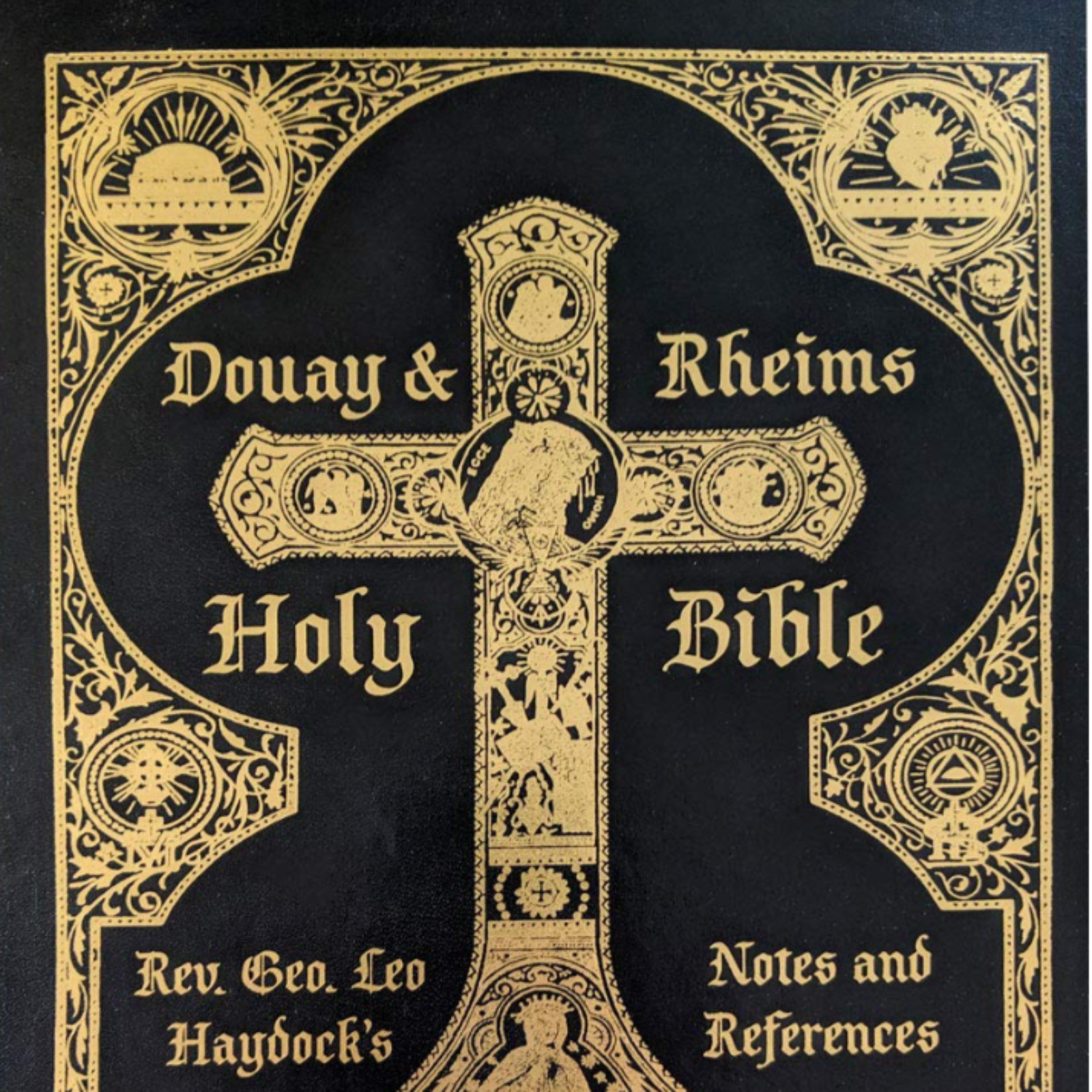
1962 Missal - Commentary on the Mass Readings: Tue, Mar 24
About this episode
Daniel 14: 27-42;
John 7: 1-13;
Haydock Commentary
Please consider donating to help keep this podcast going by going to buymeacoffee.com/catholicdailybrief Also, if you enjoy these episodes, please give a five star rating and share the podcast with your friends and family
Get every episode summarized
Each time Catholic Daily Brief publishes, we email you a written briefing from the transcript — the topics, who appeared, and any specific claims, with the ad reads skipped.
Email me new episodesFree for 3 shows. No card needed.
Hosts & guests


Transcript ready
90 searchable segments. Every word is indexed and playable.
Full transcript
Catholic Daily Brief — 1962 Missal - Commentary on the Mass Readings: Tue, Mar 24. Machine-transcribed; use the interactive transcript above to jump the player to any line.
2. Tuesday, March 24. The lesson from Daniel, chapter 14, verses 27-42. In those days, the Babylonians went to the king and demanded, hand over to us Daniel, who has destroyed Bell and killed the dragon, or we will kill you and your family. When he saw himself threatened with violence, the king was forced to hand Daniel over to them. They threw Daniel into a lion's den, where he remained six days. In the den were seven lions, and two carcasses, and two sheep had been given to them daily. But now they were given nothing so that they would devour Daniel. In Judea, there was a prophet, Habakkuk. He mixed some bread and a bowl with the stew he had boiled, and was going to bring it to the reapers in the field, when an angel of the Lord told him, take the lunch you have to Daniel in the lion's den at Babylon. But Habakkuk answered, Babylon, sir, I have never seen, and I do not know the den.
The angel of the Lord seized him by the crown of his head, and carried him by the hair, with the speed of the wind. He set him down in Babylon above the den. Daniel, servant of God, cried Habakkuk, take the lunch God has sent you. Thou hast remembered me, oh God, said Daniel, Thou hast not forsaken those who love thee. While Daniel began to eat, the angel of the Lord at once brought Habakkuk back to his own place. On the seventh day the king came to mourn for Daniel. As he came to the den and looked in, there was Daniel sitting in the midst of the lions. The king cried aloud, thou art great O Lord, the God of Daniel. Daniel he took out of the lions den, but those who had tried to destroy him he threw into the den, and they were devoured in a moment before his eyes. Then the king said, but all the inhabitants of the whole earth feared the God of Daniel, for he is the savior, working signs and wonders in the earth, who has delivered Daniel out of the lions den. Hey, that commentary.
Daniel was twice cast into a den of lions, once under derriest the mead because he had transgressed the king's edict by praying three times a day, and another time under evil merodac by a sedition of the people. This time he remained six days in the lions den, the other time only one night. Something that this Habakkuk is the one whose prophecy is found among the lesser prophets, but others believe him to be a different man. Habakkuk, the eighth of the minor prophets, lived before the Babylonian monarchy was formed, yet he might still survive. If this had not been a true history, such an extraordinary mode of conveyance would not have been mentioned. One author imagines it was an illusion to fill up the deacon, and it was fabricated by some Christian, but the adotion founded in Hebrew versions, and he was no friend to Christianity when he wrote. The Gospel from John chapter 7 verses 1 through 13. At that time, Jesus went about in Galilee, for he did not wish to go about in Judea because the Jews were seeking to put him to death.
Now the Jewish feast of Tabernacles was at hand. His brethren therefore said to him, leave here and go into Judea that thy disciples also may see the works that thou do, for no one does a thing in secret if he wants to be publicly known. If thou do these things, manifest thyself to the world, for not even his brethren believed in him. Jesus therefore said to them, my time has not yet come, but your time is always at hand. The world cannot hate you, but it hates me because I bear witness concerning it that its works are evil. As for you, go up to the feast, but I do not go up to this feast, for my time is not yet fulfilled. When he had said these things, he stayed on in Galilee, but as soon as his brethren had gone up to the feast, then he also went up, not publicly, but as it were privately. The Jews therefore were looking for him at the feast and were saying, where is he? And there was much whispered comment among the crowd concerning him. For some were saying, he is a good man, but others were saying, no, rather he seduces the crowd.
Yet for fear of the Jews, no one spoke openly of him. Hey Doc, commentary. This was the festival of tabernacles on which the Jews made tents, in imitation of those which were their habitations during their so-journing in the wilderness for 40 years. See the Bidicus 2334. The Jews called it a festival day, though it consisted not of one, but of many days successively. These brethren of Christ were the relatives of the Blessed Virgin, not her children, for as in the sepulchre where the body of our Savior was deposited, no other mortal lay either before or since, so neither did the womb of Mary ever either before or after bear any other body but that of her divine son. So succinct to Guston. Christ says, I go not with you, nor to be there at the first day, nor in that public manner as you desire, but when the feast was half over, about the fourth day, Jesus went through there in a private manner. But why does he ascend to the festival day when he said he would not?
He did not say, I will not ascend, but only I do not ascend, that is, in your company. So says in John Chrysostom. Or I do not go up to this festival, namely the first or second day of the feast, which lasted eight days, and to which you wish me to ascend. But I go afterwards when the first part of the festival was over. So says to Guston. It was the people that held the favorable opinion of Christ, whilst on the contrary, the scribes and Pharisees speak ill of him, saying not that he seduceth us, but he seduceth the multitude. So says in John Chrysostom. No one publicly took the part of Jesus however favorable were their private sentiments, for the Jews hated and persecuted such as sided with him.
More episodes
More from Catholic Daily Brief

1962 Missal - Commentary on the Mass Readings: Sat, Aug 22 (Immaculate Heart of...
Catholic Daily Brief

Commentary on the Mass Readings: Sat, Aug 22 (Queenship of the Blessed Virgin Ma...
Catholic Daily Brief

Commentary on the Mass Readings: Fri, Aug 21 (Pope St. Pius X)
Catholic Daily Brief

1962 Missal - Commentary on the Mass Readings: Fri, Aug 21 (St. Jane Frances de...
Catholic Daily Brief