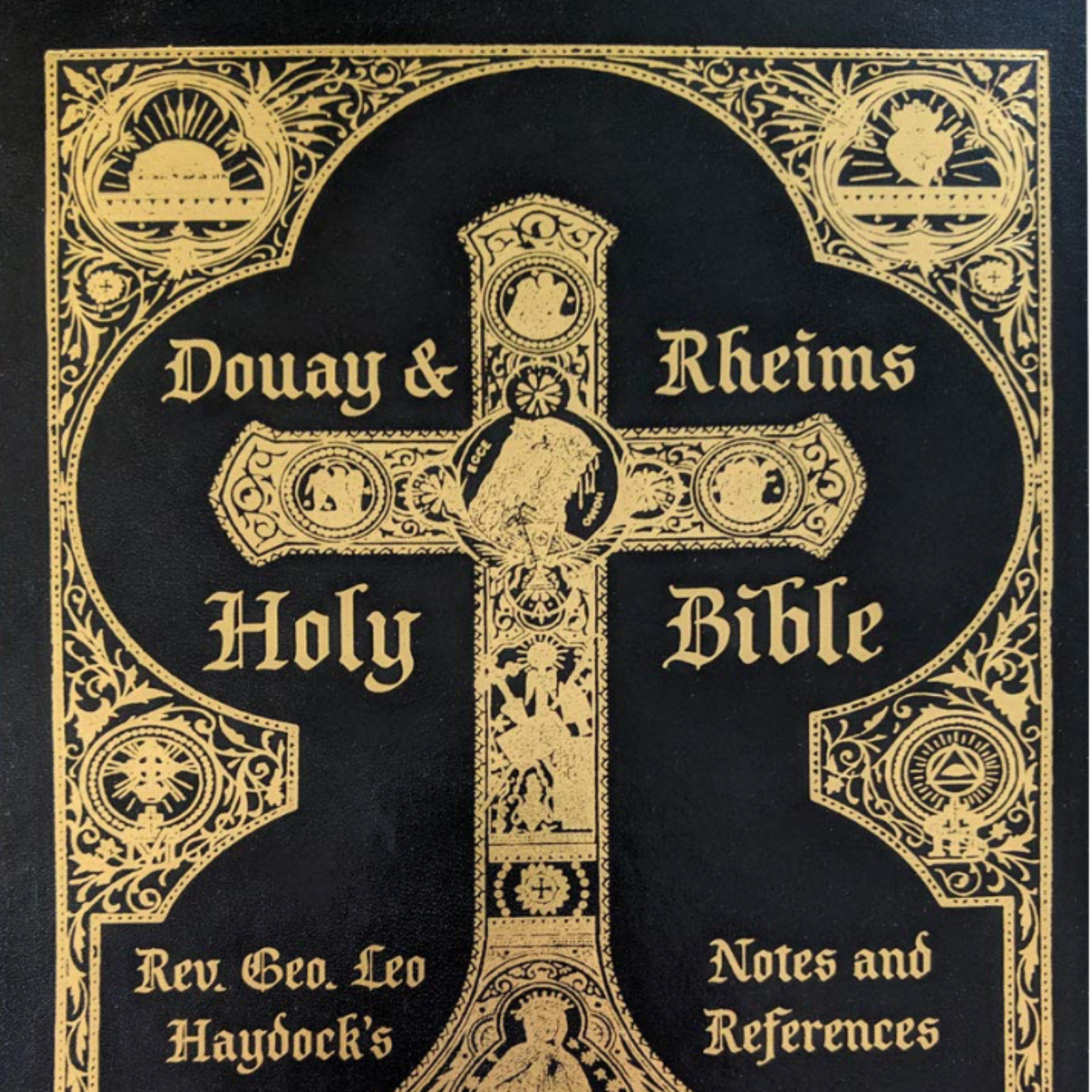
1962 Missal - Commentary on the Mass Readings: Mon, Mar 16
About this episode
1 Kings 3: 16-28;
John 2: 13-25;
Haydock Commentary
Please consider donating to help keep this podcast going by going to buymeacoffee.com/catholicdailybrief Also, if you enjoy these episodes, please give a five star rating and share the podcast with your friends and family
Get every episode summarized
Each time Catholic Daily Brief publishes, we email you a written briefing from the transcript — the topics, who appeared, and any specific claims, with the ad reads skipped.
Email me new episodesFree for 3 shows. No card needed.
Hosts & guests


Transcript ready
92 searchable segments. Every word is indexed and playable.
Full transcript
Catholic Daily Brief — 1962 Missal - Commentary on the Mass Readings: Mon, Mar 16. Machine-transcribed; use the interactive transcript above to jump the player to any line.
16. The lesson from 1 Kings chapter 3 verses 16 through 28. In those days there came two women who were Harlitz to King Solomon and stood before him, and one of them said, I besiege you my lord, I in this woman dwelt in one house, and I was delivered of a child with her in the chamber. In the third day after that I was delivered, she also was delivered, and we were together, and no other person with us in the house, only we too. And this woman's child died in the night, for in her sleep she overlaid him. And rising in the dead time of the night, she took my child from my side, while I your hand made was asleep, and laid it in her bosom, and laid her dead child in my bosom. And when I rose in the morning to give my child suck, behold it was dead. While considering him more diligently when it was clear day, I found it was not mine which I bore.
And the other woman answered, it is not so as you say, but your child is dead and mine is alive. On the contrary she said, you lie for my child lives and your child is dead. And in this manner they strove before the king. Then said the king, the one says my child is alive and your child is dead, and the other answers no but your child is dead and mine lives. The king therefore said, bring me a sword. And when they had brought a sword before the king, divide, said he, the living child in two, and give half to the one and half to the other. But the woman whose child was alive said to the king, for her heart was moved for her child. I beseech you my lord, give her the child alive and do not kill it. But the other said, let it neither remind nor yours but divide it. The king answered and said, give the living child to this woman and let it not be killed, or she is the mother thereof. And all Israel heard the judgment which the king had judged, and they feared the king, seeing that the wisdom of God was in him to do judgment.
Hey dot commentary. This sentence manifested the wisdom of Solomon, who knew that the real mother would feel the emotions of parental tenderness. By similar experiments the truth has sometimes been discovered. Claudius obliged a mother to own her son by ordering her to take him for a husband. Licking of threes told three who pretended to be the sons of the deceased king of the Samarians to shoot an arrow at the corpse, which the real son would not do. The gospel from John chapter 2 verses 13 through 25. At that time the Passover of the Jews was at hand, and Jesus went up to Jerusalem. And he found in the temple men selling oxen sheep and doves, and money changers at their tables. In making a kind of whip of cords, he drove them all out of the temple, also the sheep and oxen, and he poured out the money of the changers and overturned the tables. And to them who were selling doves, he said, take these things away and do not make the house of my father a house of business. And his disciples remembered that it is written, the zeal of your house has eaten me up.
The Jews therefore answered and said to him, what sign do you show us seeing that you do these things? In answer, Jesus said to them, destroy this temple, and in three days I will raise it up. The Jews therefore said, 46 years has this temple been in building, and will you raise it up in three days? But he was speaking of the temple of his body. When accordingly he had risen from the dead, his disciples remembered that he had said this, and they believed the scripture and the word that Jesus had spoken. Now when he was at Jerusalem for the feast of the Passover, many believed in his name, seeing the signs that he was working. But Jesus did not trust himself to them, in that he knew all men, and because he had no need that anyone should bear witness concerning man, for he himself knew what was in man. 8. How could the son of the carpenter, Joseph, whose divinity was yet unknown to the people, succeed in expelling so great a multitude from the temple? There was undoubtedly something divine in his whole conduct and appearance, which deterred
all from making resistance. The evangelist seems to insinuate this by putting these words, the house of my father into our Savior's mouth, which was making himself immediately the son of God. This made origin consider this miracle in overcoming the unruly dispositions of so many as a superior manifestation of power to what he had shown in changing the nature of water at Cana. Jesus Christ here shows the respect he requires should be shown to the temple of God, and Saint Paul speaking of the profaners of God's church, Seyath, if any man defiled the temple of God, him will God destroy, 1 Corinthians 317, which in a spiritual sense may be understood of the soul of man, which is the living temple of the living God. The 46 years may refer to the time the second temple was being built, from the edict of Cyrus to the 6 year of Darius. Others think that it includes the enlarging and beautifying of the temple, which was begun by Herod the Great 46 years before the Jews spoke this to our Savior. Jesus did not trust himself to them. His fathers generally understand these words to them to refer to those who believed in
him mentioned in the preceding verse, though they believed in him he did not trust himself to them because he knew them. He knew their weakness, their inconstancy, their unsteadiness. He knew they would abandon him on the first occasion, and that his passion, his cross, his doctrines would be a subject of scandal. Saint Augustine compares these first believers to Catacumans. They believe in Christ, confess his name, and sign their foreheads with his cross, but Jesus Christ does not trust himself to them. He does not trust to them the knowledge of his mysteries. He does not reveal to them the secrets of his religion. The Catacumans were not allowed to be present at the Holy Mysteries of the Sacrifice of the Mass, but went out after the instruction of the Gospel, whence the first part of the Mass was frequently called the Mass of the Catacumans.
More episodes
More from Catholic Daily Brief

1962 Missal - Commentary on the Mass Readings: Sat, Aug 22 (Immaculate Heart of...
Catholic Daily Brief

Commentary on the Mass Readings: Sat, Aug 22 (Queenship of the Blessed Virgin Ma...
Catholic Daily Brief

Commentary on the Mass Readings: Fri, Aug 21 (Pope St. Pius X)
Catholic Daily Brief

1962 Missal - Commentary on the Mass Readings: Fri, Aug 21 (St. Jane Frances de...
Catholic Daily Brief