About this episode
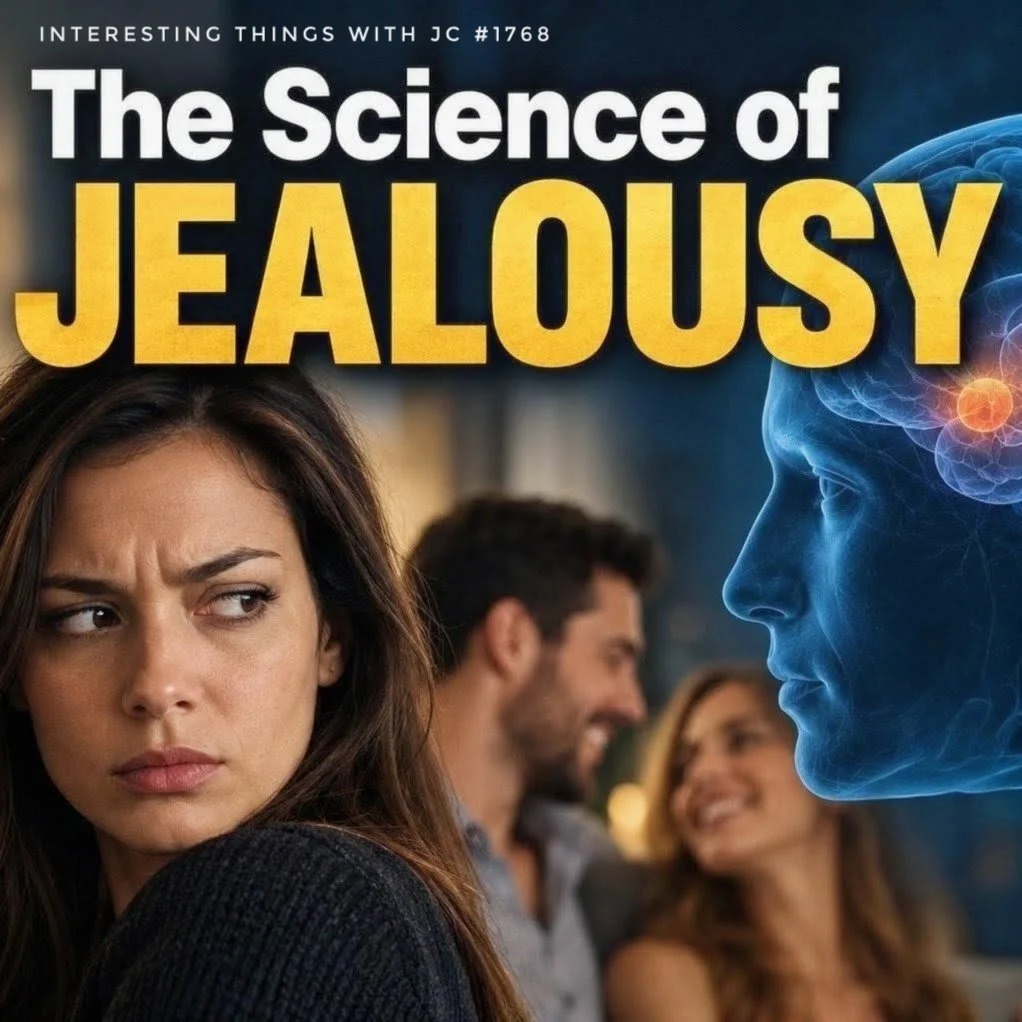
Interesting Things with JC #1768: "The Science of Jealousy" – Jealousy can fire before there is proof: attention shifts, suspicion locks in, and the brain starts tracking details and possible rivals. The threat may not be real, but the alarm already is.
Get every episode summarized
Each time Interesting Things with JC publishes, we email you a written briefing from the transcript — the topics, who appeared, and any specific claims, with the ad reads skipped.
Email me new episodesFree for 3 shows. No card needed.
Hosts & guests
Transcript ready
29 searchable segments. Every word is indexed and playable.
Full transcript
Interesting Things with JC — 1768: "The Science of Jealousy". Machine-transcribed; use the interactive transcript above to jump the player to any line.
Jealousy. He can start before anything has actually happened. A look that lasts a little too long. A message comes in at a strange hour. Someone's attention shifts across the room, and your mind starts filling in the blanks. The threat might be real, it might be imagined, but the reaction, it comes fast, it takes over. It mixes fear, anger, stress, and the possibility of losing someone very important to you. Brain scans show that some of the areas involved in jealousy are also involved in emotional distress and pain, including the insula and parts of the singular cortex. Your stress response, it can kick into. That helps explain why jealousy isn't just something that you think about, but you can feel it physically. And once suspicion takes hold, not knowing, it can keep it going. Your brain doesn't need proof before it starts paying close attention. Remembering those little details, noticing changes in behavior, and watching anyone who might be a threat.
There may be a very old reason for that. For most of humanity, losing a partner could mean losing much more than a relationship. It could affect children, food, protection, shared work, social standing, even survival. A Volutionary Psychologist think jealousy may have developed partly as a early warning system to protect relationships and watch for rivals. One part of that theory says men may be more sensitive to sexual cheating because historically, a man could never be completely certain a child was his. Women may be more sensitive to emotional cheating because a partner could shift his attention and all of his resources, some or some. Research has found evidence for those differences, but not consistently, other results can change depending on how the questions are asked. There are different kinds of jealousy to reactive jealousy follows something that actually happened. Suspicious jealousy can grow without
much evidence leading to worry, checking, mistrust, and constantly being on guard. Your past experiences, trust, attachment, and the relationship itself, it can all affect how strongly you react. And it's not only romantic, it can show up between friends, siblings, co-workers, or anywhere that someone feels that they could lose a relationship, attention, or their place in a group. That's where understanding the brain chemistry and evolutionary psychology comes in handy. Jealousy may be an alarm meant to get your attention, but hearing the alarm doesn't prove that there's a fire. Knowing that gives you a chance to look at what's actually happening before deciding how to respond. These are interesting things with J.C.
More episodes
More from Interesting Things with JC

1769: "Football Brain Injury Cover Up"
Interesting Things with JC

1767: "The Spider-Man of Paris"
Interesting Things with JC

1766: "Autistici/Inventati - The Network Behind the Network"
Interesting Things with JC

1765: "The FBI Surveillance of Martin Luther King Jr."
Interesting Things with JC