About this episode
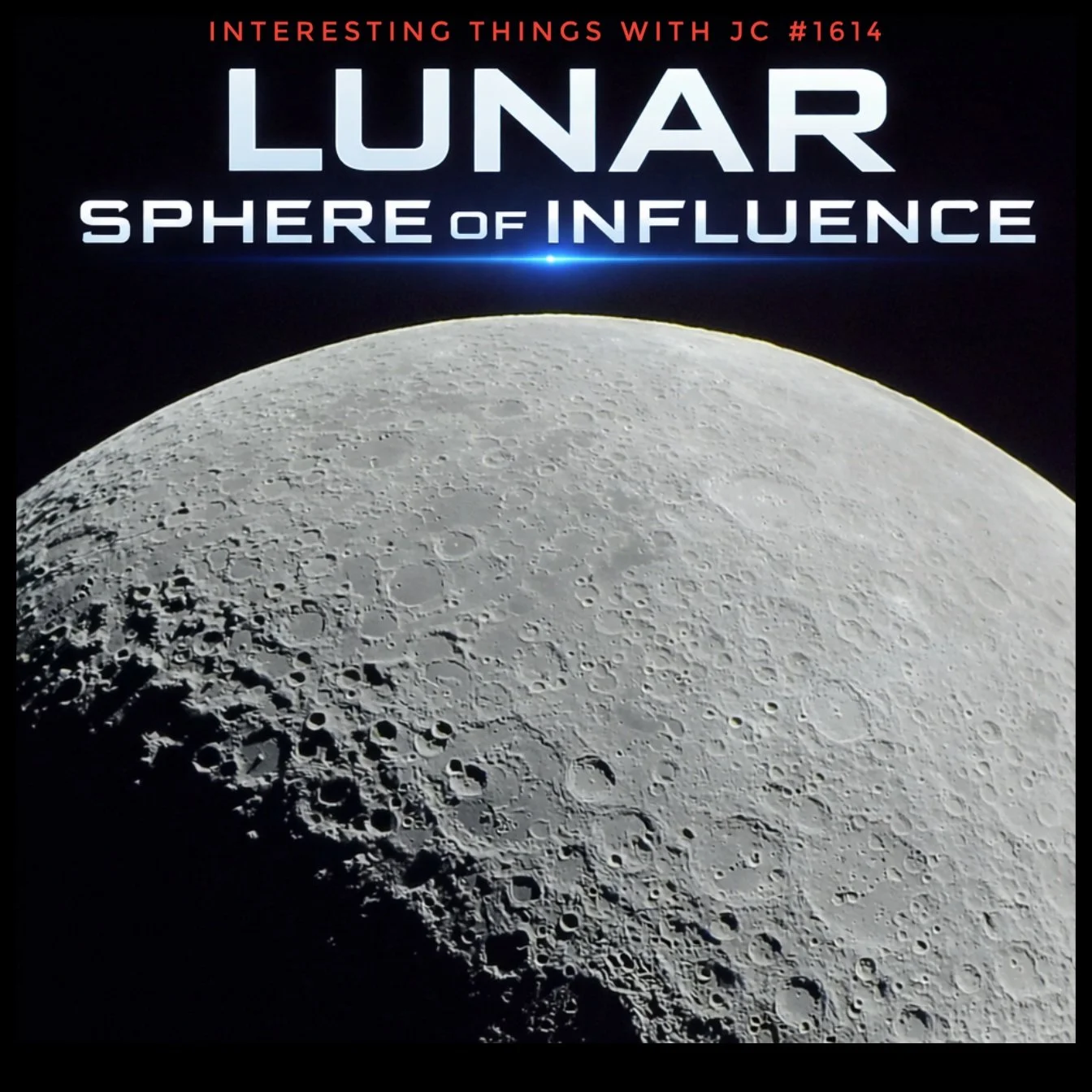
Interesting Things with JC #1614: "Lunar Sphere of Influence" – This is the invisible point where the Moon’s gravity overtakes Earth’s on Artemis II. The spacecraft is already inside this boundary, where it stops losing speed and begins accelerating again without firing engines. The path has not changed, but the force controlling it already has.
Get every episode summarized
Each time Interesting Things with JC publishes, we email you a written briefing from the transcript — the topics, who appeared, and any specific claims, with the ad reads skipped.
Email me new episodesFree for 3 shows. No card needed.
Hosts & guests
Transcript ready
40 searchable segments. Every word is indexed and playable.
Full transcript
Interesting Things with JC — 1614: "Lunar Sphere of Influence". Machine-transcribed; use the interactive transcript above to jump the player to any line.
At less than 60,000 miles, about 96,500 kilometers from the moon, Artemis, too, already passed the point where Earth is the stronger pole. Nothing Mark said, there's no signal, but the physics, it flips. This is the lunar sphere of influence. The region where the moon's gravity overtakes Earth's honest spacecraft. That boundary sits about 41,000 miles, or 66,000 kilometers from the moon. And Artemis, too, it's well inside that. Up to that point, it's been slowing down. It left Earth at roughly 25,000 miles an hour, about 40,000 kilometers an hour, fast enough to escape. But as it climbs away, Earth's gravity pulls against it the entire time, steadily reducing the speed. But that doesn't last. Gravity, it doesn't shut off. It just simply shifts. And that control goes to the moon.
So as Artemis, too, crosses into the moon's sphere of influence, Earth's pole has weakened enough that the moon's pole becomes stronger. And once that happens, the direction of the dominant force changes. It begins to accelerate, not from engines, but because it's now falling towards the moon. Gravity, it follows an inverse-square relationship. Distance drives everything, so Earth is far more massive, but much farther away at that point. So its pole drops off very quickly. The moon is smaller, but now close enough that its influence begins to build rapidly. And at that crossover distance, the moon becomes the primary gravitational system. And from there on, the path is governed by the moon. Same trajectory, same velocity, but a different center. This is how lunar missions are built. Earth provides the initial energy and sends you out. You slow, as you climb away, then you accelerate again,
as you fall into the moon's gravitational well. If you need to enter orbit, you fire engines and reduce that speed. If not, you keep it. You swing around the moon and you head on back. And by the time Artemis, too, was reported to under 60,000 miles, about 96,500 kilometers from the moon, that transition was already complete. No visible boundary, but once you pass it, you are no longer leaving Earth. You're already under the moon's control. These are interesting things with J.C.
More episodes
More from Interesting Things with JC

1770: "When a Parasite Rewires Behavior to Spread Itself"
Interesting Things with JC

1769: "Football Brain Injury Cover Up"
Interesting Things with JC

1768: "The Science of Jealousy"
Interesting Things with JC

1767: "The Spider-Man of Paris"
Interesting Things with JC